Biology Education Professional Website Template
Synapse is a warm, botanically styled biology exam prep landing page template built for AP Bio students, pre-med freshmen, and nursing students. It features a four-step modular study path card grid, an inline 12-question adaptive diagnostic quiz, a personalized topic map result, and a study plan capture form, all wrapped in a field-journal aesthetic that feels as comfortable as your favorite library corner.
by Rocket studio
Quick summary
Synapse is a single-page biology exam prep template designed to guide students from confusion to confidence. It combines a modular card grid study path, an inline adaptive diagnostic quiz, and a personalized topic map into one warm, botanical landing page. The design speaks directly to biology majors, pre-med students, and anyone facing a high-stakes science exam.
Who this template is for
This template is built for educators and EdTech founders who serve students in the biological sciences. If your audience is preparing for a demanding science exam, this template matches their mindset and study habits.
- Pre-med freshmen working through dense introductory biology content and needing a clear path through cell biology, organ systems, and physiological processes
- High school students targeting a top score on the Advanced Placement Biology exam, covering everything from cell structure and gene expression to animal behavior and evolutionary ecology
- Nursing students who need clinical-ready knowledge of the human body, major organ systems, human anatomy, and human physiology before entering practice
What problem this template solves
Biology students often waste study time reviewing topics they already understand while neglecting real gaps. The result is a student who feels busy but is not actually moving forward. This template solves that by putting a diagnostic first, then building a structured study path around what the student actually needs.
- Students spend hours rereading textbooks without knowing which molecular biology or cell biology concepts still need work, leading to exam-day surprises
- Biology majors preparing for competitive programs lack a structured framework that moves them from broad introductory biology topics to high-detail mastery of developmental biology, molecular genetics, and experimental design
- Instructors and prep services have no visual, engaging way to show students exactly what a structured study journey looks like, making it hard to convert visitors into committed learners
What you get with this template
This template delivers a complete, ready-to-customize landing page built specifically for biology exam prep services. Every section is intentional, grounded in conversion logic and genuine educational value. Biology courses often include both lecture and laboratory components to provide hands-on experience, and this template reflects that dual emphasis by pairing a knowledge-check quiz with a structured study path.
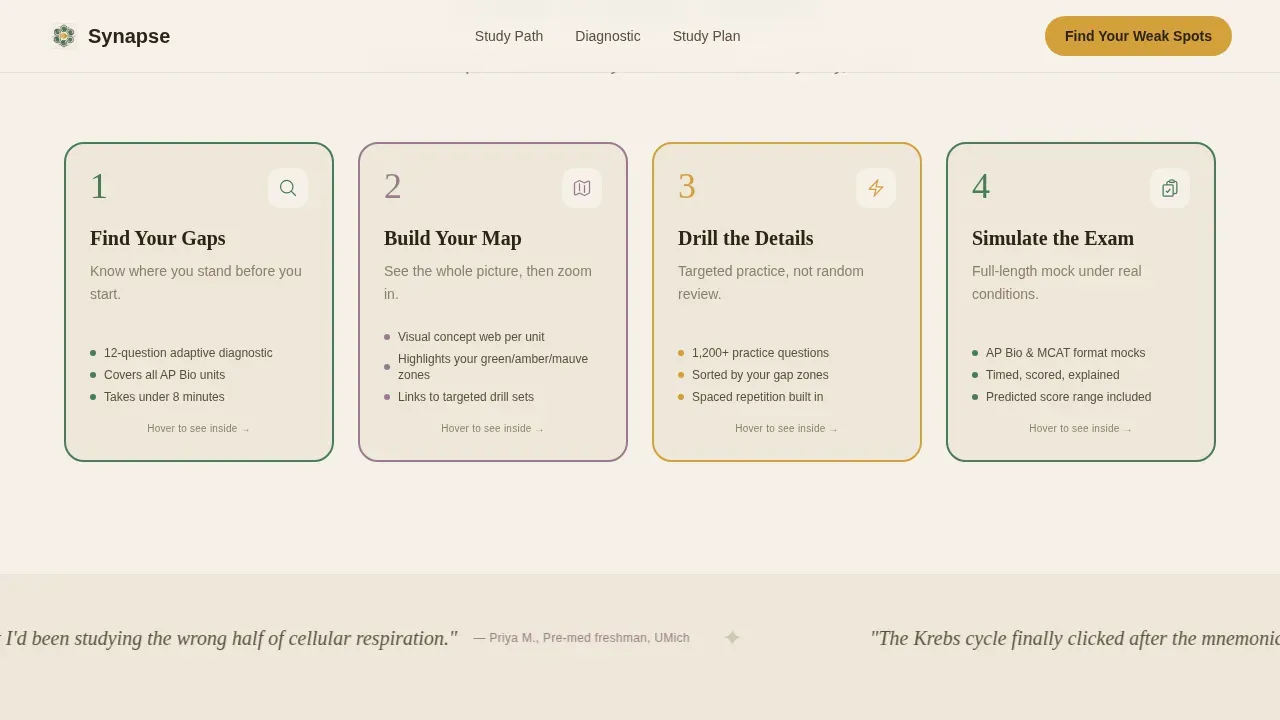
- A four-step modular card grid that walks students through gap-finding, map-building, detail drilling, and full exam simulation, with each card flipping on hover to reveal practice question counts, topic breakdowns, and time estimates
- An inline 12-question adaptive diagnostic quiz that opens without a page redirect, escalates in difficulty based on answers, and delivers a personalized color-coded topic map showing mastery, review, and gap zones in chloroplast green, annotation amber, and pressed-flower mauve
- A study plan capture form that takes a student's name and exam date and generates a sequenced prep calendar, keeping the conversion moment tied to genuine self-knowledge rather than a sales push
Feature list
This template includes purposefully designed features grounded in how biology students actually learn. Each component supports a specific moment in the study journey, from first visit to committed enrollment.
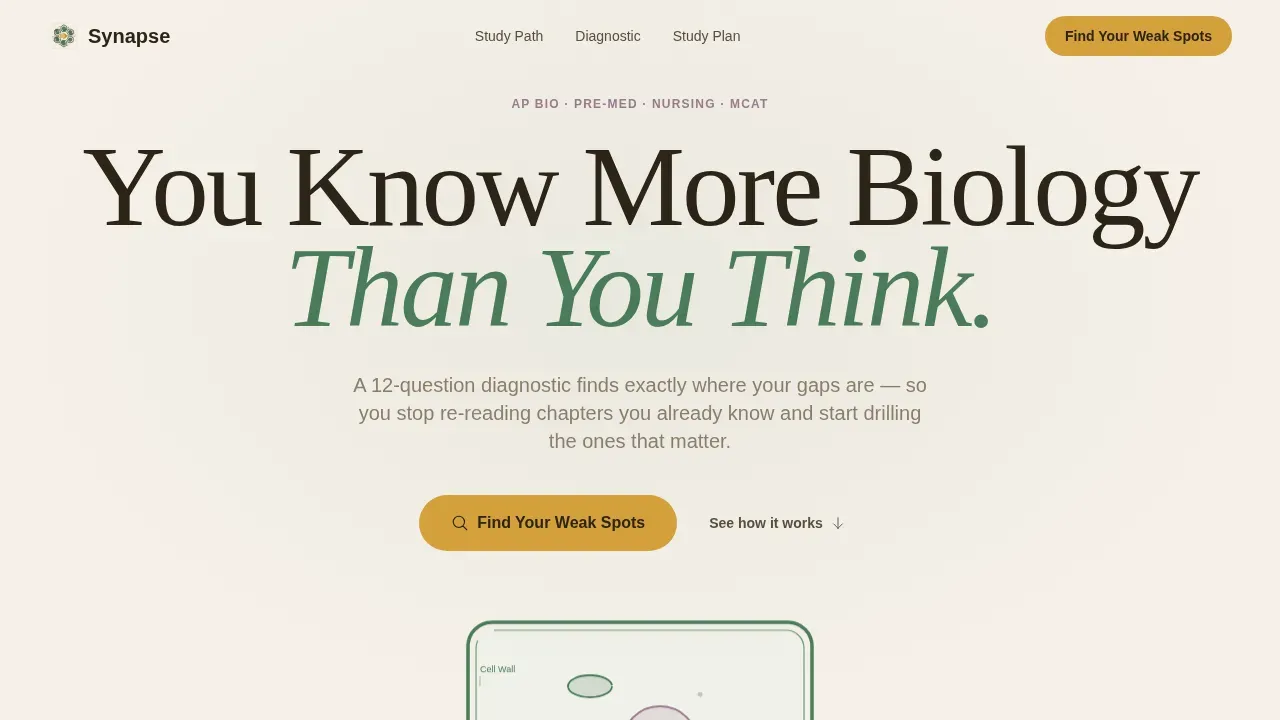
Giant Headline Hero with Animated Plant Cell
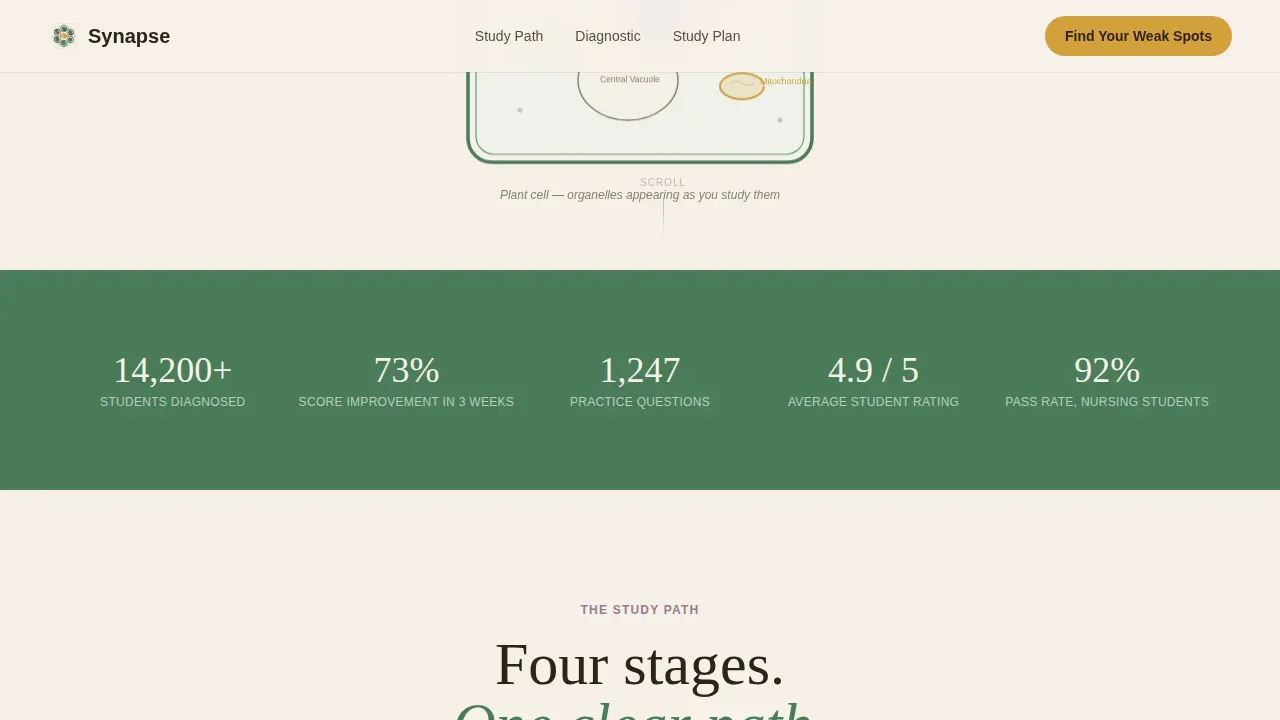
The hero section opens with a large centered serif headline set against aged textbook cream. Beneath it, an animated plant cell SVG draws itself in real time, with each organelle appearing one by one. The animation mirrors the experience of watching a great teacher sketch on a whiteboard, building trust and holding attention without relying on stock photography.
Four-Step Modular Flip-Card Study Path
The core of the page is a card grid structured as a step-by-step guide. Four cards represent four stages: Find Your Gaps, Build Your Map, Drill the Details, and Simulate the Exam. Each card flips on hover to reveal specific content, practice question counts, topic focus areas such as cell biology and molecular biology, and estimated time commitments. As the visitor scrolls, amber accents intensify and illustrations grow from simple cell diagrams to full ecosystem webs, reflecting the student's journey from uncertainty to command.
Inline Adaptive Diagnostic Quiz
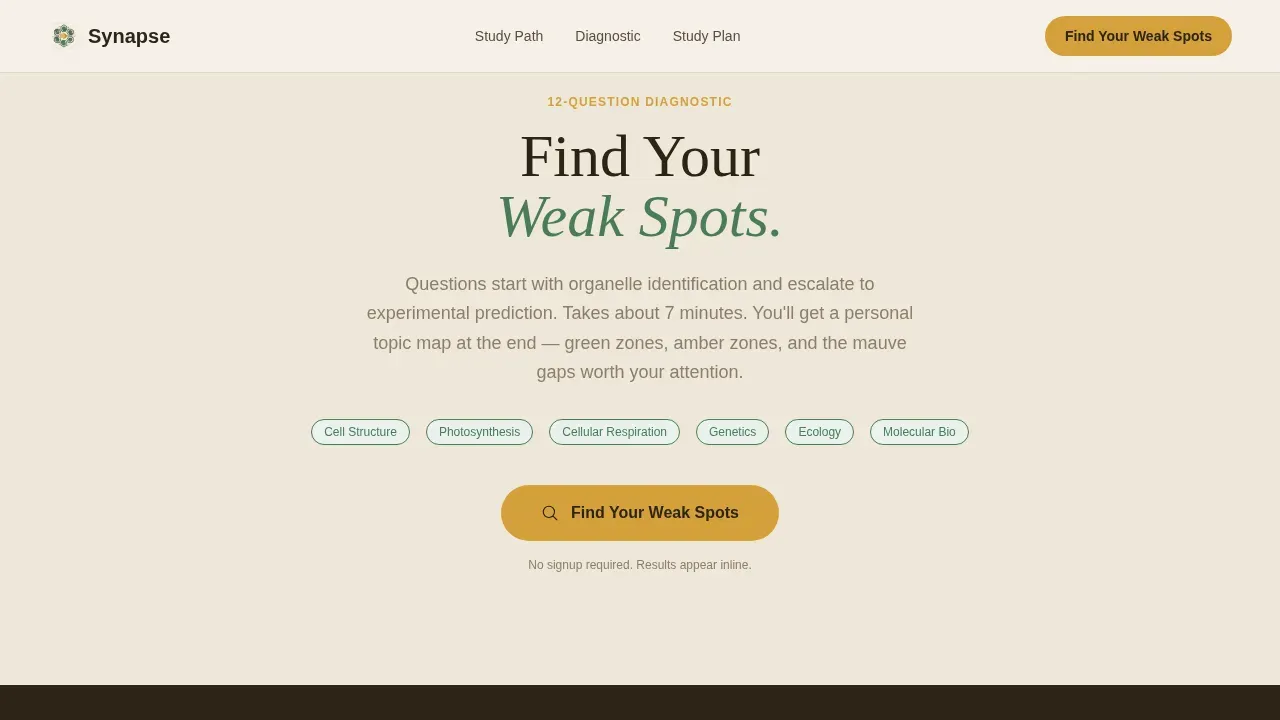
The 12-question quiz opens directly on the page with no redirect. Questions begin with accessible identification tasks (name the organelle, describe cell structure) and escalate to higher-order reasoning (predict the experimental outcome, interpret gene expression data). The quiz adapts difficulty based on each answer, giving every student a personalized experience grounded in sound experimental design principles and critical thinking.
Personalized Topic Map Result
At quiz completion, the student receives a color-coded topic map. Green zones mark strong understanding. Amber zones flag areas for review. Mauve zones identify clear gaps in knowledge, whether that means cell cycle mechanics, developmental biology, or the fundamentals of molecular genetics. This result feels like a gift of self-knowledge, not a sales pitch, which is what earns the next click.
Handwritten-Style Social Proof Strips
Single-line student testimonials appear between card rows in handwritten-style typography. Including social proof in this way builds credibility by showcasing short, authentic quotes from students who have used the material. The testimonials are woven naturally into the scroll experience rather than isolated in a separate section, keeping the emotional warmth of the Community Hearth theme consistent throughout.
Study Plan Capture Form
Below the topic map result, a secondary call to action captures the student's name and exam date. This information generates a sequenced prep calendar tailored to their timeline and gap zones. The form is simple, specific, and positioned at the moment of highest motivation: immediately after the student has seen exactly where they stand.
Page sections overview
| Section | Purpose |
|---|---|
| Hero Headline | Draws students in with bold serif type and a self-drawing animated plant cell |
| Study Path Cards | Four-step modular flip-card grid guiding students from gap-finding to exam simulation |
| Social Proof Strip | Handwritten-style testimonial lines between card rows for warmth and credibility |
| Inline Diagnostic Quiz | 12-question adaptive quiz opening inline with escalating difficulty |
| Personalized Topic Map | Color-coded result showing mastery, review, and gap zones after quiz completion |
| Study Plan Form | Name and exam date capture generating a sequenced prep calendar |
| Footer | Horizontal flow footer with navigation and supporting links |
Design & branding system
The visual identity follows a Community Hearth theme expressed through a Botanical color system. The palette feels like a well-loved field journal, dried ferns tucked between pages, warm pencil marginalia, and the green of living things rendered through watercolor softness rather than fluorescent brightness. The design principle is minimalist with intention: a clean layout limits distractions and directs every element toward the primary action.
- Color system uses chloroplast green (#4A7C59) for headings and card borders, aged textbook cream (#F5F0E8) as the dominant background, pressed-flower mauve (#9B7A8F) for secondary text and topic tags, and annotation amber (#D4A03C) firing on every hover, active state, and call-to-action moment
- Typography pairs Fraunces (warm, heavy serif) for headlines with DM Sans (clean, readable sans-serif) for body text, creating a contrast between academic authority and approachable clarity
- Illustrations are custom botanical and cellular in style, no stock photography, ranging from a self-drawing plant cell in the hero to progressively complex ecosystem diagrams deeper in the page
Mobile & speed optimization
This template is built desktop-first but carries strong mobile support throughout. Many students study on phones between classes or during late-night review sessions. Mobile optimization ensures the page loads quickly and looks consistent across screen sizes, which is essential when your audience is a tired student reaching for their phone at 11 p.m. before a biology final.
- The modular card grid reflows cleanly from a multi-column desktop layout to a vertically stacked mobile view, preserving the step-by-step guide logic without compression or overflow
- The inline adaptive quiz and topic map result are designed for touch interaction, so students can complete the full diagnostic experience without switching to a larger device
How this template helps you convert
This template earns conversions by giving students something genuinely useful before asking for anything in return. The diagnostic quiz is the conversion engine. Students click the primary call-to-action button not because they are being sold to, but because they want to know where they actually stand in the biological sciences.
- The "Find Your Weak Spots" call-to-action button leads directly into the 12-question adaptive quiz, which delivers a personalized topic map. The result itself becomes the motivation to continue, making the second call-to-action, "Start Your Study Plan", a natural next step rather than a cold ask.
- The step-by-step card grid structures the student's mental model of the prep journey before they even take the quiz, lowering uncertainty and building trust in the service. By the time the student reaches the study plan form, they already understand the value of what they are signing up for.
Other information about this template
This template is relevant to a wide range of biological sciences topics and student contexts. The sections and quiz content can be adapted to cover the full breadth of what students encounter across courses in the biological sciences, from introductory survey content to advanced specialized coursework. Biology courses may include discussions on contemporary issues in science and their societal implications, and this template's flexible card structure can accommodate that kind of content expansion.
The template's topic coverage can reflect the full scope of biological sciences programs. Many biological sciences programs include courses on genetics, microbiology, and cell biology as core requirements. The study path card structure supports that breadth, allowing prep services to map their curriculum to the four-step flow and adjust card content to reflect their specific course offerings.
Students benefit from engaging with course materials through a variety of formats. The template supports this principle by combining visual illustration, interactive quiz mechanics, and a structured text-based study path. Courses that emphasize data analysis and computational skills are increasingly central to modern biology education. A prep service using this template can address those areas within the quiz and study path card content.
The template's diagnostic-first philosophy aligns with sound exam preparation strategies. Time management is a crucial strategy for successful exam preparation in biology, and the personalized prep calendar generated from the study plan form directly supports that. Setting specific goals for each study session improves focus, and the sequenced calendar produced by the form gives students exactly that structure.
Biology courses often have prerequisites that must be completed before enrollment in advanced tracks. The template's topic map result, with its green, amber, and mauve zones, gives students a clear visual signal of whether they are ready to advance or still building foundational knowledge. This is particularly useful for students moving from introductory biology into more specialized coursework.
Some biology courses are specifically tailored for non-majors to provide a broad understanding of biological concepts. This template works equally well for generalist prep services as it does for specialized ones. The card grid and quiz components can be adjusted in scope and depth to serve audiences ranging from biology majors in rigorous research-focused programs to non-majors fulfilling science distribution requirements.
The Synapse botanical study path biology exam prep landing page template is built with the understanding that a landing page for biology students focusing on botany exam preparation should combine clear academic value, visual engagement, and active learning tools. Topic-specific syllabi can be broken down into manageable sections such as Plant Structure and Function, Metabolic Processes, and Reproduction and Genetics, all of which map naturally to the card grid format.
Courses in biology can lead to various career paths, including healthcare, education, and research. Students in biological sciences programs may pursue advanced degrees in various fields, including medicine and research. This template speaks to that ambition directly by treating every student as someone who is preparing not just for an exam but for a career rooted in understanding how life works.
Programming and computational tools are increasingly integrated into biology education. Courses that focus on computational biology, data science, and data analysis are becoming essential alongside traditional laboratory work. A prep service using this template can incorporate those topics into the quiz and study path cards, making the experience relevant to students whose biological sciences programs already include computer science and data analysis components.
- The template supports topic areas across the full biological sciences spectrum, including cell biology, molecular biology, molecular genetics, developmental biology, evolutionary ecology, conservation biology, animal behavior, human anatomy, human physiology, organ systems, human body systems, nervous system function, and infectious disease
- Useful for biological sciences programs, including those with a hands on laboratory course component alongside lecture content, as well as services preparing students for exams that test primary literature comprehension, scientific writing, scientific writing skills, and critical reading skills
- Adaptable for prep content covering genetics laboratory, cell biology laboratory, microbiology laboratory, microbiology lab, molecular biology laboratory, and other specialized laboratory-context topics including microbial genetics, microbial cell structure, microbial physiology, and gene expression
- Suitable for contexts that introduce students to primary scientific literature, scientific literature, and primary literature review as part of their exam preparation, as well as topics in biomedical research, biological research, independent research, and research project design
- Can accommodate content related to experimental design, data analysis, research proposal writing, scientific writing, and the engineering aspects of recombinant DNA technology and genetic engineering, including molecular mechanisms underlying gene regulation
- Covers contextual topics such as comparative vertebrate anatomy, comparative animal physiology, functional anatomy, animal physiology, human development, human disease, human health, and cellular and molecular aspects of physiological processes
- Relevant to introductory biology, introductory biology II, and introductory course contexts, as well as advanced topics including molecular aspects of cell cycle regulation, amino acids and protein structure, complex traits, cellular immune responses, life history theory, and biological systems ecology
- Supports content related to marine biology, marine organisms, biological diversity, environmental factors, computational biology, and data science as these areas grow within modern biological sciences curricula
Theme
Community Hearth
Creative direction
Step-by-Step Guide
Color system
Botanical
Style
Card Grid (Modular)
Direction
Quiz/Assessment
Page Sections
Animated Plant Cell Hero Section
Four-step Modular Flip-card Grid
Inline Adaptive Diagnostic Quiz
Personalized Color-coded Topic Map
Handwritten-style Social Proof Strips
Study Plan Capture Form
Related questions
Who is this template designed for?
What makes the quiz component different from a standard contact form?
Can the study path cards be customized for different biology topics?
Does this template work well on mobile devices?
What visual style does this template use?