AI & Machine Learning Professional Website Template
Synth is a voice AI landing page template built for platforms that convert text into lifelike speech. It uses a modular card grid layout, a live terminal code demo, and interactive audio samples to show the product in action. Designed for product engineers, game studios, and contact center teams, it drives sign-ups with a frictionless single-click call to action.
by Rocket studio
Quick summary
Synth is a single-page, card-grid landing page template for a voice AI platform. It opens with a live terminal code demo, expands into an interactive proof grid, and closes with a frictionless conversion card. The visual identity pairs void black with electric indigo and frosted glass panels to create a focused, high-contrast developer experience that earns trust before asking for a sign-up.
Who this template is for
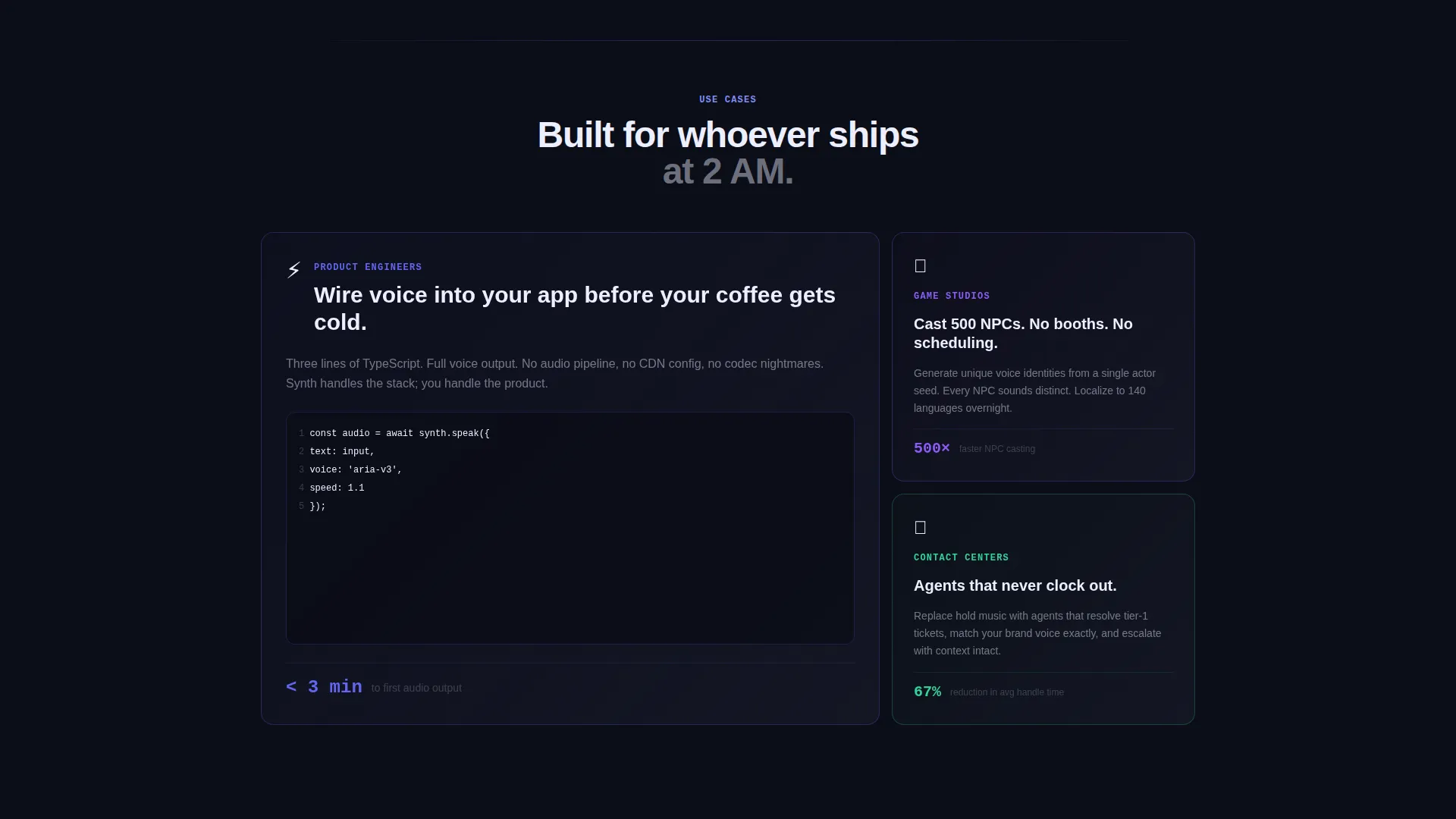
This template is built for teams shipping voice AI products who need to convince technical buyers fast. It speaks directly to builders who evaluate tools by running them, not reading about them.
- Product engineers integrating voice APIs into applications and needing a fast, credible demo page
- Game studios casting large numbers of non-player characters without recording studio time
- Contact center leads evaluating AI voice agents to handle customer interactions at scale
What problem this template solves
Most AI product pages describe features without proving them. Visitors leave unconvinced because they never hear the product. Synth solves this by making every section interactive proof before the sign-up moment arrives.
- Visitors hear real audio samples before any form appears, removing doubt about voice quality
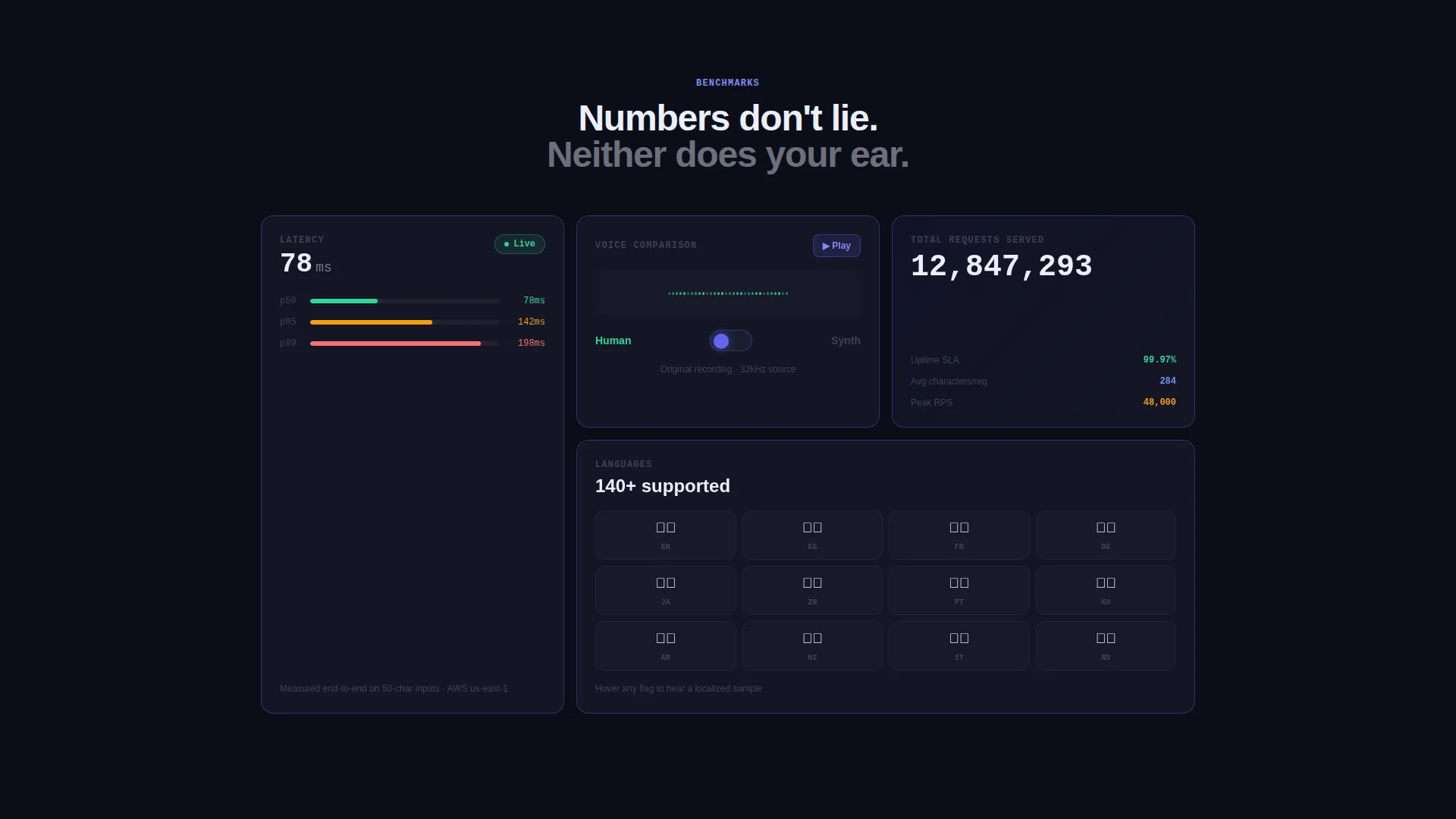
- Live latency counters and benchmark cards replace vague performance claims with visible numbers
- A single-click sign-up flow with a pre-loaded sandbox eliminates form friction at the conversion point
What you get with this template
You get a complete, ready-to-customize landing page structured around interactive demonstration. Every section is designed to build confidence through direct product experience rather than marketing copy alone.
- A live terminal header block with animated code lines and a waveform audio reveal on load
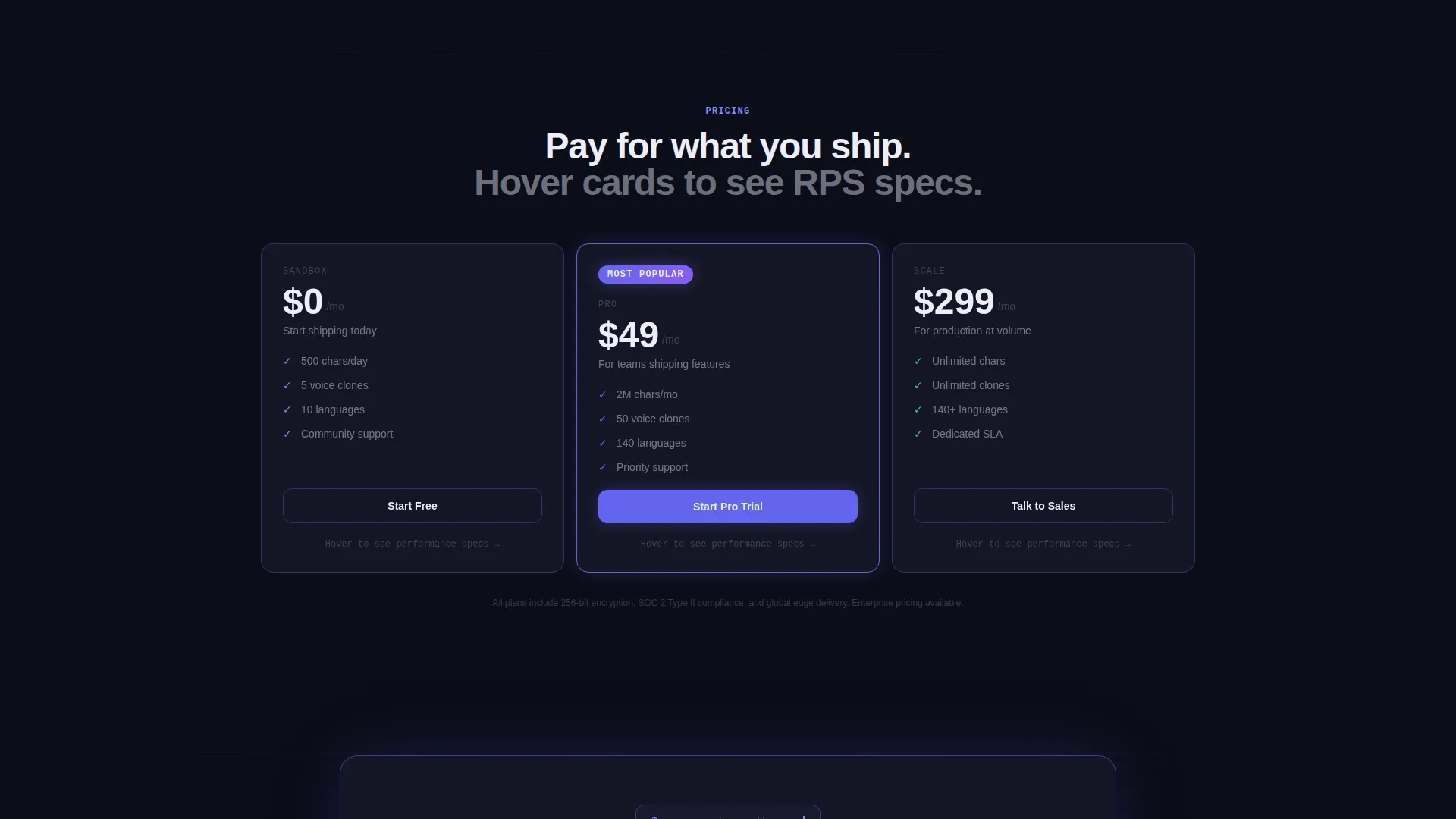
- A modular card grid with interactive components including latency benchmarks, voice comparison toggles, language sample cards, and flip-reveal pricing tiers
- A full-width conversion card with a single email field, a GitHub OAuth button, and a "Start Building Free" call to action
Feature list
This template includes the following built-in interactive components and design features.
Live Terminal Code Demo
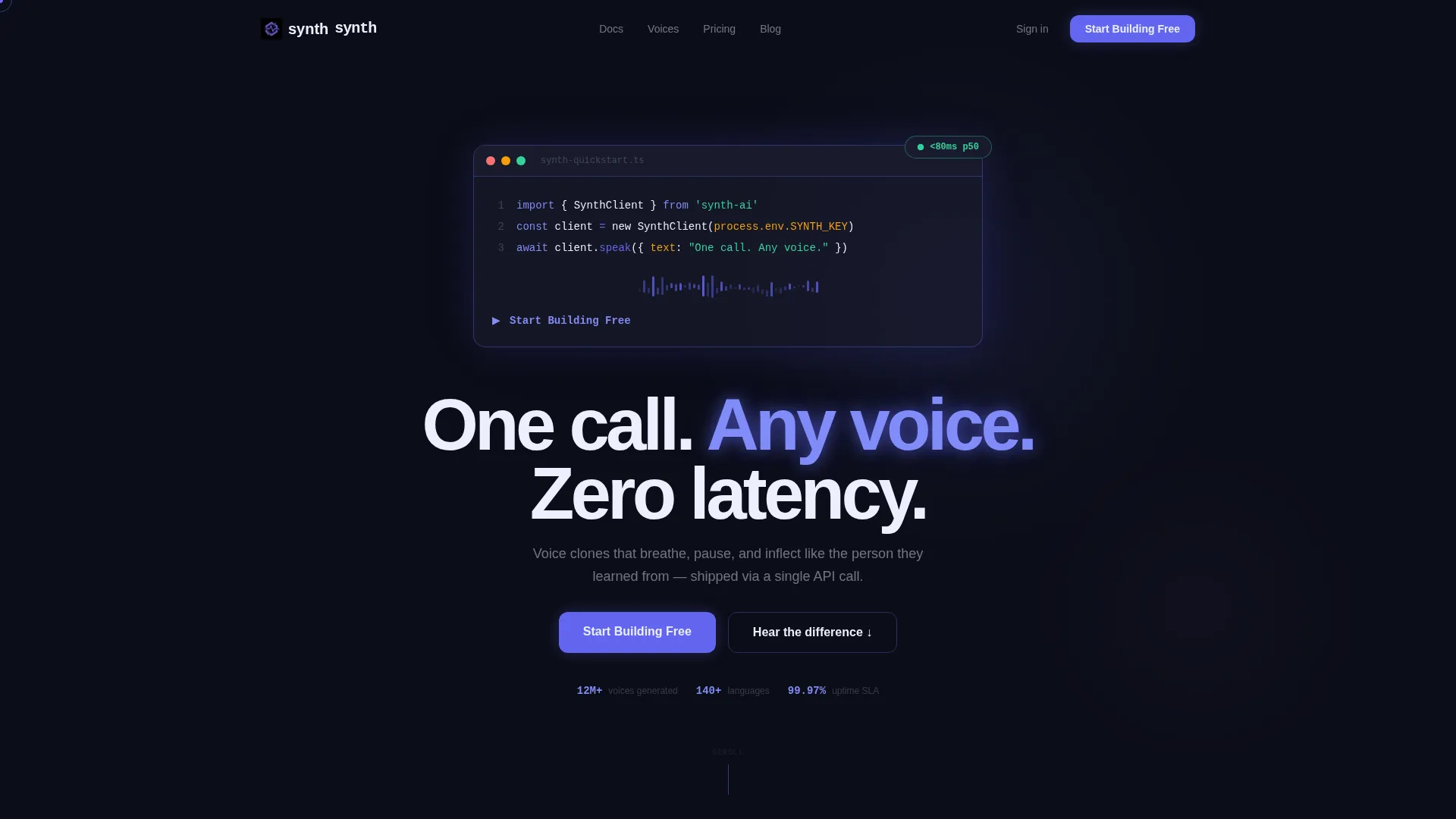
The header renders a three-line API sequence, import, authenticate, speak, that types itself out in a monospace typeface. On the third line, a waveform animation blooms and plays an AI-generated voice sample through the visitor's speakers. The headline appears only after the audio finishes.
Modular Interactive Card Grid
The main content area tiles outward as a grid of self-contained proof cards. Each card carries its own interactive behavior, keeping visitor attention active throughout the scroll. The grid tightens progressively until it resolves into a single full-width conversion card at the bottom.
Voice Comparison Toggle
A dedicated card lets visitors switch between a human recording and the synthesized output side by side. This single interaction does more persuasive work than any written claim about voice quality could.
Latency Benchmark Cards
Cards display live-style counters showing millisecond latency figures. The numbers are visible and concrete, giving technical buyers the signal they need to evaluate the platform without leaving the page.
Language Sample Hover Cards
Flag-labeled cards play localized voice samples on hover. Visitors can quickly confirm multi-language support by interacting directly with the cards rather than reading a feature list.
Frictionless Conversion Card
The final full-width card pairs a single email input with a GitHub OAuth button and the "Start Building Free" prompt. One click delivers the visitor into a sandbox console with 500 free characters pre-loaded, removing every barrier between interest and first use.
Page sections overview
| Section | Purpose |
|---|---|
| Terminal Header Block | Opens with animated API code and live audio waveform reveal |
| Headline Drop | Delivers the core value statement after the audio plays |
| Proof Card Grid | Tiles interactive benchmark, comparison, and sample cards |
| Latency Benchmark Cards | Shows live millisecond counters for technical credibility |
| Voice Comparison Toggle | Lets visitors hear human versus. synthesized voice side by side |
| Language Sample Cards | Plays localized audio on hover across multiple languages |
| Pricing Flip Cards | Reveals requests-per-second specs on card flip interaction |
| Full-Width Conversion Card | Closes the page with email input, OAuth button, and call to action |
Design & branding system
The visual identity follows a Tech Glass theme built around an Electric Indigo color system. The palette is designed to feel like a high-contrast monitor in a dark room, where light itself becomes the interface.
- Core palette: void black (#0B0D17) as the base, frosted glass panels (#1A1D2E at 60% opacity) for card surfaces, electric indigo (#6366F1) for borders and focus states, and hot white (#EDEFFF) for primary type
- Typography uses a monospace typeface in the header terminal block and clean, high-contrast type throughout the card grid to maintain a developer-native aesthetic
- Interactive states including hover, focus, and active transitions are accented in electric indigo to keep the visual system consistent and intentional across every card
Mobile & speed optimization
The card grid layout is modular by design, which means it adapts naturally to narrower viewports. Each card is a self-contained unit, so the grid can reflow without breaking the interaction logic.
- Cards resize and restack on smaller screens while preserving their individual interactive behaviors such as toggles, hover plays, and flip reveals
- The progressive grid tightening effect, where cards condense toward the conversion card, works across screen sizes to maintain scroll momentum
How this template helps you convert
Synth is structured around the principle that hearing the product is the most persuasive action a visitor can take. Every design decision serves that sequence.
- The terminal header plays audio before any marketing copy appears, so the first impression is the product itself rather than a claim about it
- Interactive cards sustain engagement through the full scroll, so visitors arrive at the conversion card already convinced rather than still evaluating
- The final card removes sign-up friction entirely by offering GitHub OAuth and a single email field, with a free sandbox ready on the first click
Other information about this template
Synth was designed to match the real context in which voice AI tools get evaluated: late at night, by a developer with a terminal already open, deciding in minutes whether to wire a new API into their stack.
- The template style is Card Grid (Modular), suited for platforms that need to demonstrate multiple proof points without a long scrolling narrative
- The header concept is Code Snippet, reinforcing developer trust from the first second of the visit
- The creative direction is Launch Energy, designed to sustain momentum through every scroll interaction the way a product keynote does
- The landing page direction is Click-Through, with every section moving the visitor toward a single, low-friction action
- The theme is Tech Glass and the color system is Electric Indigo, both chosen to signal technical precision and modern AI product quality
Theme
Tech Glass
Creative direction
Launch Energy
Color system
Electric Indigo
Style
Card Grid (Modular)
Direction
Click-Through
Page Sections
Live Terminal Code Header
Interactive Proof Card Grid
Voice Comparison Toggle Card
Latency Benchmark Counters
Flip-reveal Pricing Cards
Frictionless Single-click Call to Action
Related questions
Who is this landing page template designed for?
Can I customize the card grid layout?
What makes the conversion flow low friction?
Does the template include live audio playback functionality?
Is this template suitable for a non-developer audience?