Smart Hospitality Scoring Landing Page Template
Score is a hospitality AI lead scoring landing page template built for revenue intelligence teams. It presents a machine-learning engine that ranks anonymous hotel website visitors by their 72-hour booking probability. The template follows a Problem→Solution Arc with scroll-reveal animations, a Void & Violet visual identity, and a single-field audit form designed to convert high-intent revenue professionals.
by Rocket studio
Quick summary
Score is a scroll-reveal landing page template purpose-built for a hospitality AI lead scoring platform. It guides revenue managers and commercial strategists through a stark Problem→Solution Arc, then closes with a one-field form that requests only a hotel URL. The design uses void black, graphite glass, and electric violet to create a dark-luxury aesthetic that feels as precise as the product it represents.
Who this template is for
This template is designed for B2B SaaS companies operating in the hospitality AI space. It speaks directly to the professionals who carry revenue targets inside hotel organizations.
- Revenue managers at boutique hotel groups managing ten to thirty properties who need to score leads without manual guesswork
- Digital marketing directors at resort and convention chains whose sales team burns budget retargeting guests who already booked
- VP-level commercial strategists who must quickly tell apart a $400K group block inquiry from a low-priority prospect
What problem this template solves
Hotel sales professionals waste significant time on follow ups with leads that will never convert. A traditional property management system, or PMS, logs confirmed reservations but cannot rank anonymous visitors by booking intent before they ever sign in or fill out a form. The result is a time consuming process of reactive outreach, scattered across multiple sources of unscored data.
- Sales reps spend hours on less promising leads while the most promising prospects go cold inside an unresponsive CRM
- Marketing teams send special offers to guests who already booked, inflating cost per acquisition with no lift in conversion rates
- Revenue teams make pricing decisions without behavioral data, relying on instinct rather than accurate predictions about which inquiries will close
What you get with this template
This landing page gives your product a structured, high-impact presentation that mirrors the intelligence of the platform itself. Every section is designed to build confidence and move a qualified visitor toward submitting the audit form.
- A full scroll-reveal page layout with five distinct sections: animated hero, problem arc panels, comparison table, feature glass cards, and a competitor-positioning close with call to action
- A Void & Violet design system using DM Sans for interface text and Fraunces for display headings, built around #09090B void black, #16161A graphite, #7C3AED electric violet, and #E4E4E7 phantom white
- High-animation components powered by GSAP ScrollTrigger, including a live score counter, staggered glass card reveals, scroll-linked parallax, and a magnetic call to action button
Feature list
This template packages several focused capabilities that work together to qualify visitors and convert them into audit submissions.
Animated Hero Score Counter
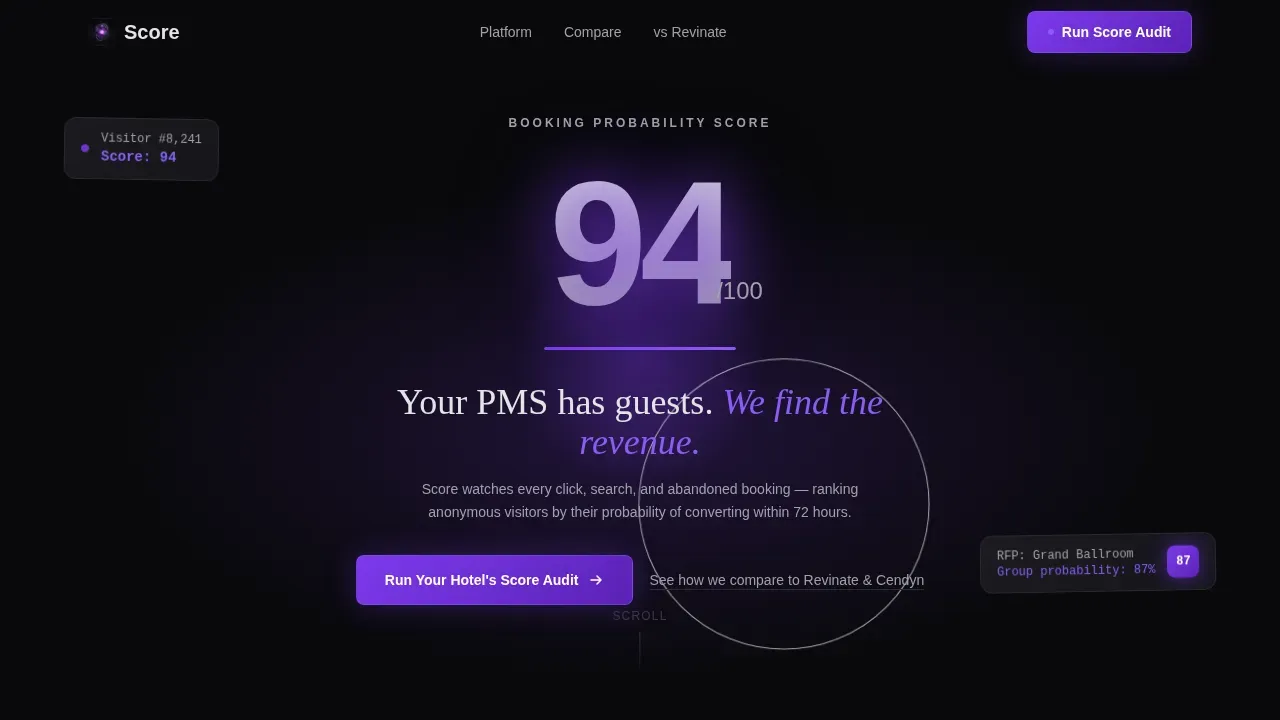
The hero section opens with a score counter rising from 0 to 94 in real time, rendered in arrivals-board typography against a full-bleed void black viewport. A soft violet glow intensifies as the number climbs, then settles into a steady pulse. Below the counter, a single headline fades in on cue. The effect demonstrates AI lead scoring value immediately, before a visitor reads a single word of body copy.
Problem Arc Scroll Panels
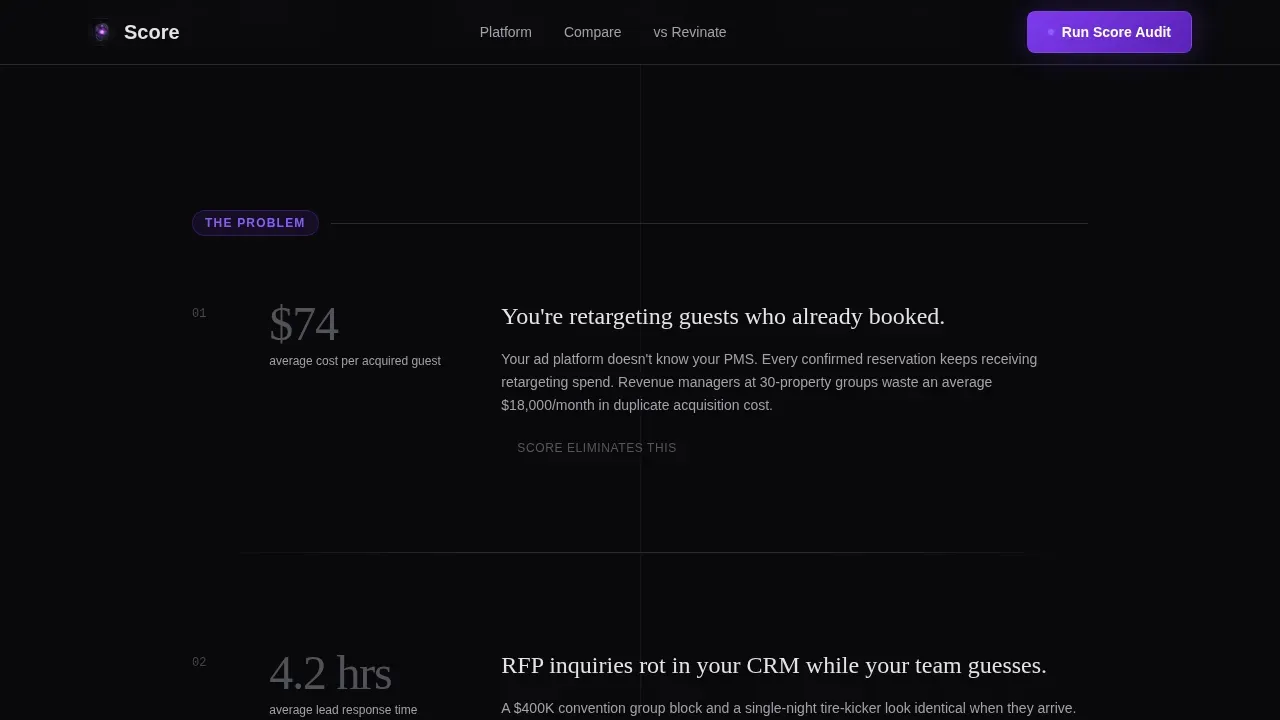
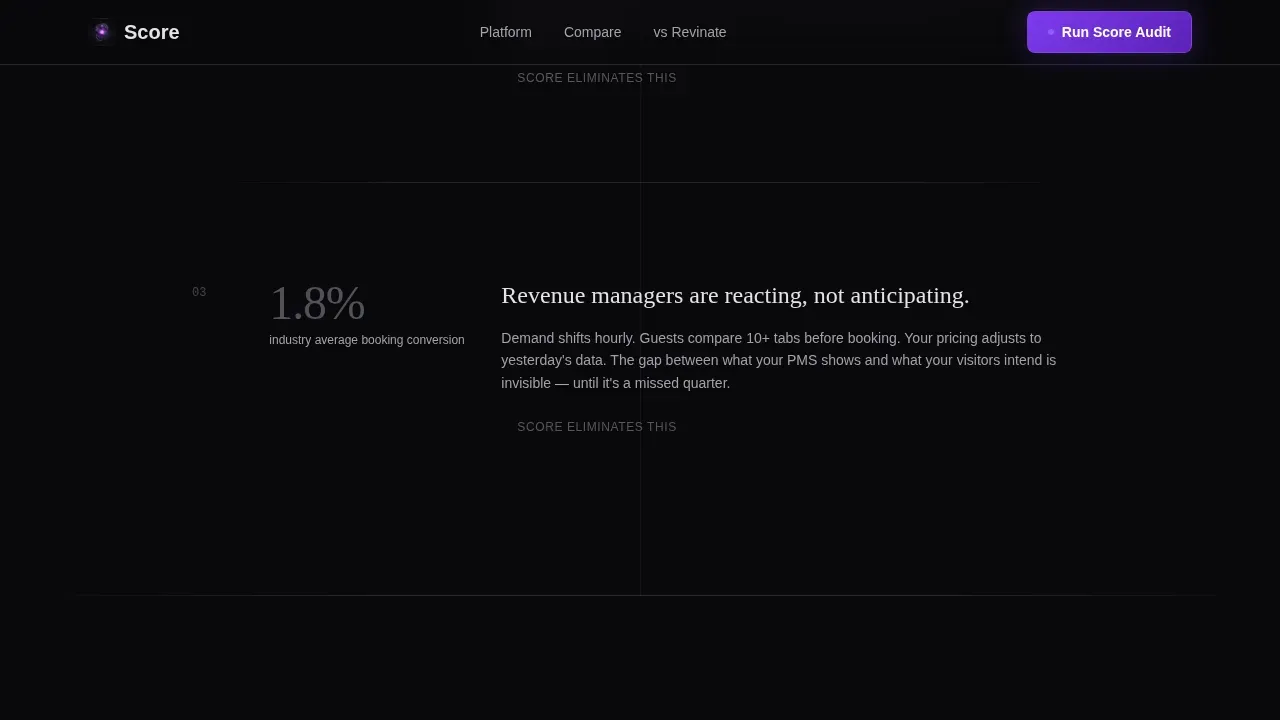
Void black panels display stark white pain statements that dissolve as the visitor scrolls. Each problem, wasted ad spend, unscored leads rotting in the CRM, reactive pricing, follow ups based on guesswork, fades out and is replaced by the platform's specific countermeasure. This section is where the template earns trust by naming the exact inefficiencies that sales professionals recognize from their own process.
Fixed Comparison Section
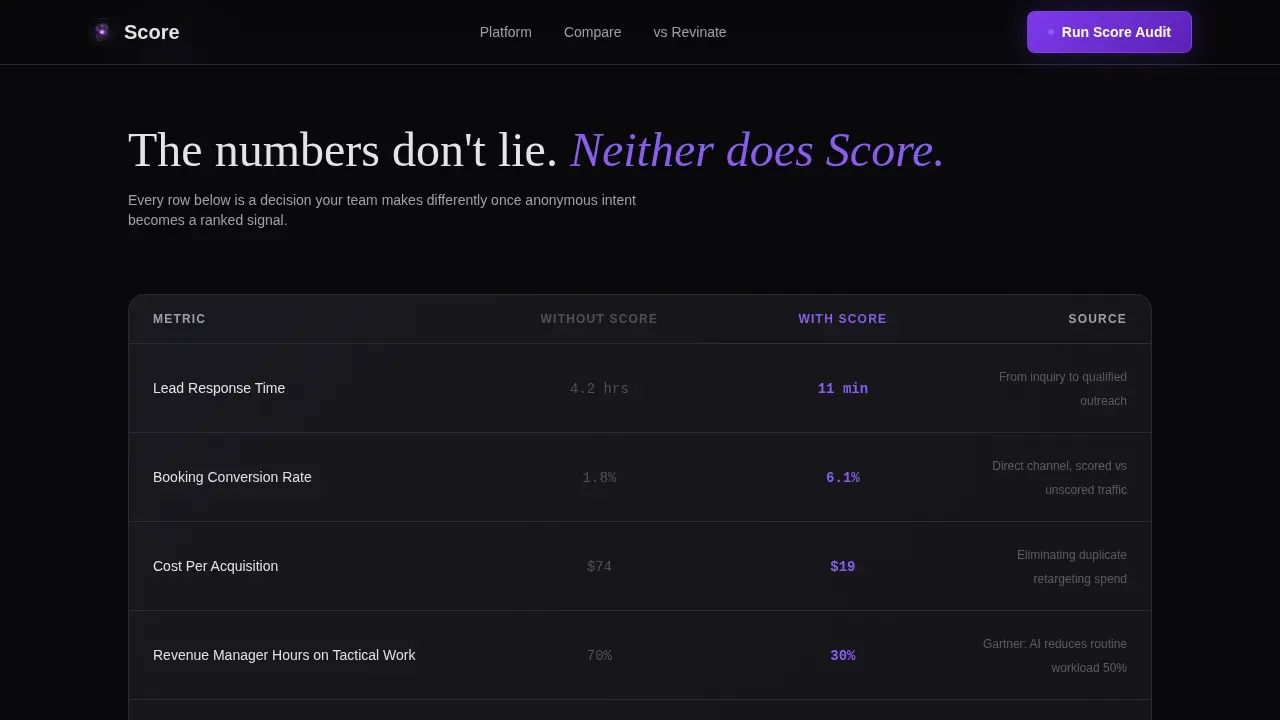
A two-column section pins midway on scroll. The left column is labeled "Without Score" and the right column is labeled "With Score." Each row animates a real metric: lead response time drops from 4.2 hours to 11 minutes, conversion rates rise from 1.8 percent to 6.1 percent, and cost per acquisition falls from $74 to $19. The format lets visitors see the gap before they are asked to act, making the audit form feel like confirming what they already suspect.
Glass Card Feature Reveals
Feature capabilities are presented as glass cards that catch light progressively on scroll, emerging from the dark background one at a time. Cards cover behavioral intent modeling, real-time PMS integration, and dynamic score decay. This staggered reveal keeps visitors engaged and makes the architecture of the lead scoring system feel deliberate and substantial.
Single-Field Audit Form
The primary call to action is a single-field form asking only for the property's website URL. This low-friction entry point reduces drop-off. A secondary text link below the form offers a detailed competitor comparison for visitors who want more context before they sign up. Progressive profiling principles keep the data request minimal at first contact, improving lead qualification without overwhelming the visitor.
Page sections overview
| Section | Purpose |
|---|---|
| Animated Hero Counter | Opens with a live score rising 0 to 94, violet glow, and a fading headline to establish the platform's core value |
| Problem Arc Panels | Dissolving void-black pain statements name specific revenue inefficiencies and replace each with a platform countermeasure |
| Without versus With Score | Fixed two-column comparison animates three real metrics to prove the performance gap before the call to action |
| Feature Glass Cards | Staggered scroll-reveal cards present behavioral intent modeling, PMS integration, and score decay features |
| Competitor Positioning | Differentiates the platform and anchors the audit form call to action with a secondary comparison link |
| Linear Footer | Single-row footer closes the page with a clean, minimal layout |
Design & branding system
The visual identity follows a Tech Glass aesthetic built on the Void & Violet color system. Every surface is layered to create depth, like tinted glass panels stacked in parallax. The palette is intentionally minimal so that only the most important signals appear luminous.
- Colors: #09090B absolute void black for backgrounds, #16161A deep graphite glass for card surfaces, #7C3AED electric violet for score badges, progress indicators, hover glows, and interactive states, and #E4E4E7 phantom white for all body typography
- Typography: Fraunces is used for display headings to create a high-contrast, editorial authority; DM Sans is used for all interface and body text to keep information readable and clean
- Motion: Violet pulses on hover states, score badge transitions, and progress bars reinforce the sense that the system is alive and processing data in real time
Mobile & speed optimization
The template is built desktop-first to serve revenue managers working at workstations, and it scales responsively to tablet viewports. Animation-heavy components use a client-component architecture for the hero counter, keeping static sections lean.
- GSAP ScrollTrigger handles all scroll-linked animations, counter sequences, and parallax effects without blocking page rendering for static content
- The single-field audit form is touch-friendly and accessible on tablet, ensuring that sales professionals who review the page on mobile devices can still sign up without friction
- Glass card reveals and comparison row animations are scoped to viewport entry, so the page loads initial content quickly before progressive elements appear on scroll
How this template helps you convert
This template is structured so that every scroll builds conviction before asking for a commitment. The conversion architecture follows a deliberate sequence.
- The animated score counter and violet glow create immediate intrigue, showing the platform's core capability before any text is read, giving visitors a reason to keep scrolling and engage with the lead generation flow
- The problem arc names specific pains that the target audience carries daily, making the product feel like it was built for them, which increases the likelihood that a revenue manager or sales professional will recognize their own situation and continue reading
- The fixed comparison section proves measurable outcomes with animated metrics, so by the time visitors reach the audit form, they are not being asked to take a leap of faith; they are being invited to confirm a gap they have already seen quantified
Other information about this template
This template is a strong fit for companies that need to generate leads from a highly skeptical, data-literate audience. Revenue managers and VP-level commercial strategists evaluate tools on numbers, not aesthetics, so the comparison section and metric animations are central to the conversion strategy.
- The lead scoring system presented in this template follows established methodologies: assigning higher scores to visitors who show strong behavioral signals such as repeated website visits, content downloads, and social media engagement, while deprioritizing less promising leads with low intent indicators
- The lead scoring model depicted covers both explicit data types, such as company size and job title, and implicit behavioral data, including page-dwell patterns and click through rates, giving sales reps a complete picture of each prospect
- The audit form acts as a lead magnet, offering a free Score Audit in exchange for a single data point; this approach reflects best practices in lead generation, where short progressive forms outperform long static forms for high quality leads
- The template's ideal customer profile alignment is built into the copy architecture: pain statements and metric rows are written to resonate with the exact roles most likely to sign up, making every section a passive qualifier that filters the right prospects toward the form
- The CRM integration narrative woven through the feature cards supports the promise that the lead scoring system can automatically update scores as new data arrives, keeping sales teams working from accurate data at all times
- Lead management context across the page reinforces that AI tools in this space are projected to grow from a $1.1 billion market in 2020 to $3.4 billion by 2025, validating the business case for companies considering this platform
- Building relationships with high-value accounts starts with identifying the right prospects early; this template frames the audit as the first step in that process, pointing revenue teams in the right direction before a single cold outreach is made
- The score hospitality ai lead scoring landing page template is designed specifically for the hospitality AI niche, where gathering fit and intent data early in the sales process is critical to avoiding wasted efforts on unqualified inquiries
Theme
Tech Glass
Creative direction
Problem→Solution Arc
Color system
Void & Violet
Style
Scroll Reveal (Progressive)
Direction
Comparison/Versus
Page Sections
Animated Score Counter Hero
Problem Arc Dissolve Panels
Fixed Two-column Comparison
Glass Card Feature Reveals
Single-field Audit Form with Secondary Path
Related questions
Who is the primary audience for this landing page template?
What sections are included in this template?
How does the audit form work as a conversion tool?
Can this template support CRM integration messaging?
Is this template suitable for a desktop-first audience?