Tariff Classification Consultancy Landing Page
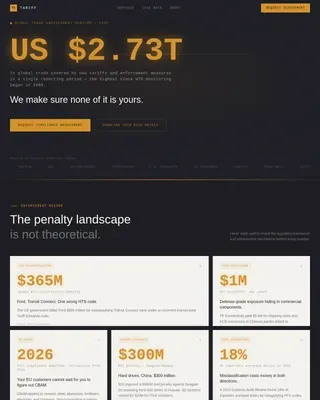
Tarifftrace is a single-column landing page template built for origin and tariff classification consultancies. It leads with hard data, guides visitors through a stats-first scroll, and drives them toward a consultation request. The design uses a cold Monochrome Steel palette with high-vis yellow calls to action, creating the institutional clarity that supply-chain and customs professionals expect.
by Rocket studio
Quick summary
Tarifftrace is a precision-built landing page template for customs and trade classification consultancies. It opens with an animated world map, delivers compliance metrics before explanatory copy, and routes qualified visitors to a dedicated intake page. The stripped-back Service Utility aesthetic signals expertise without decoration, making every section feel consequential.
Who this template is for
This template is designed for consultancies that operate in high-stakes customs and trade environments. It speaks directly to the people who cannot afford a misclassified tariff code.
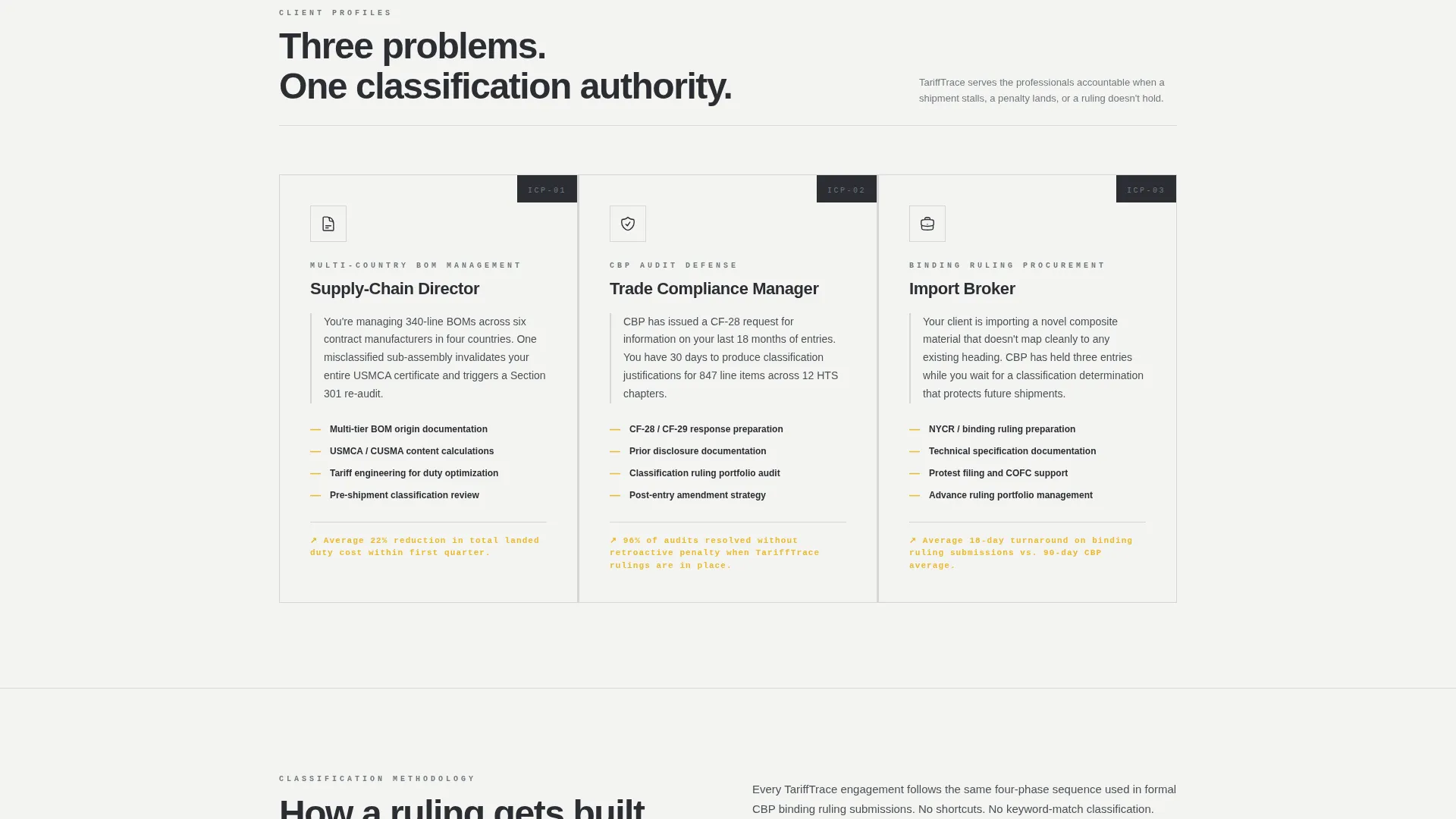
- Supply-chain directors managing multi-country bills of materials
- Compliance managers preparing for customs authority audits
- Import brokers who need binding rulings that hold up under scrutiny
What problem this template solves
Tariff classification consultancies often struggle to communicate technical authority to skeptical buyers quickly. A generic agency template does not convey the operational weight of a misclassified harmonized system code.
- Visitors leave without understanding the financial cost of inaction
- Trust is lost when a page feels decorative rather than precise
- Potential clients cannot tell one classification firm from another
What you get with this template
You get a focused, single-column landing page flow built around one clear conversion goal: routing serious buyers to a classification review intake. The layout is structured to deliver credibility before it asks for a commitment.
- An animated, map-based hero section with live-stat overlays
- A stats-first scroll rhythm that pairs hard figures with methodology copy
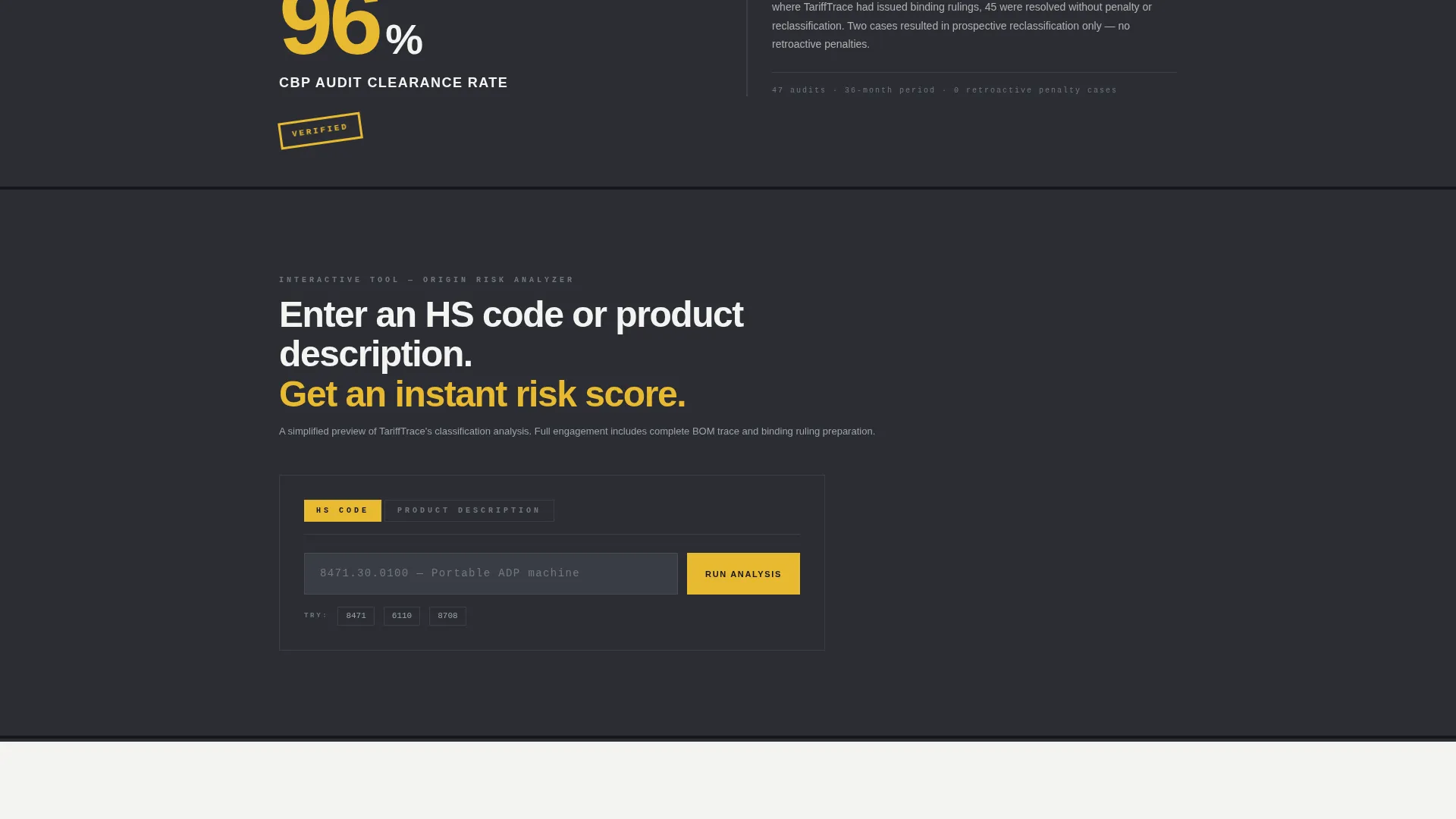
- A midpage interactive element for harmonized system code or product description input
- Dual call-to-action strategy with a primary consultation call to action and a secondary guide download link
Feature list
A short paragraph introduces the feature set: every component in this template is drawn from the source brief and reflects the real operational demands of a customs classification consultancy. Nothing is decorative; each feature earns its place.
Animated World Map Hero
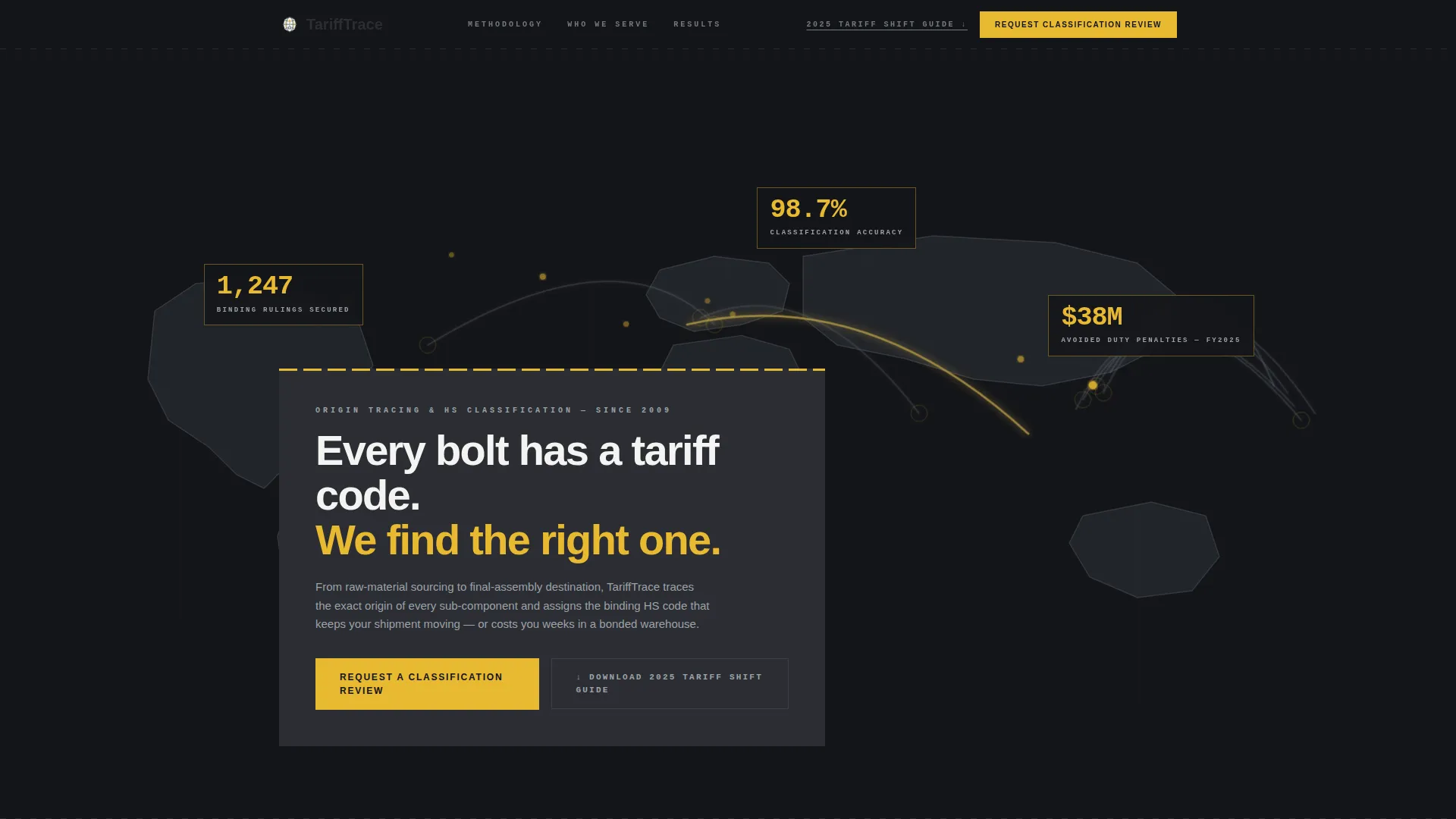
The header uses a dark, desaturated world map rendered in gunmetal on near-black. Animated arcs trace origin lines from raw-material source countries through manufacturing hubs to destination ports. Each arc pulses once in high-vis yellow as a key compliance statistic fades in over the geography.
Stats-First Scroll Blocks
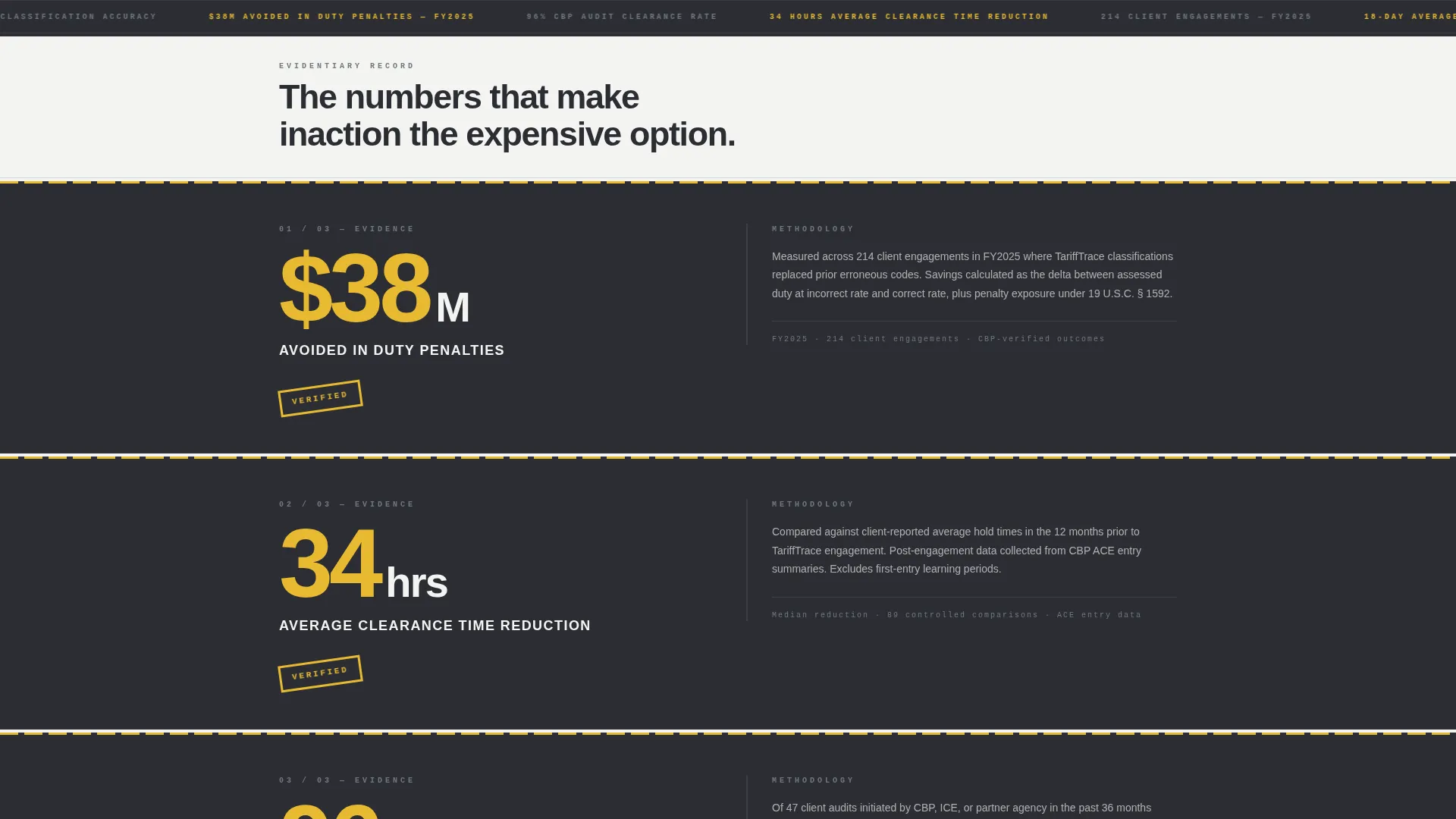
Every major scroll increment leads with a large typeset figure before any explanatory paragraph appears. Duty savings in dollars, clearance-time reductions in hours, and audit survival rates land as assertions. A short methodology paragraph follows each figure, mirroring the structure of a classification ruling itself.
Interactive Origin-Risk Tool
A midpage interactive element invites visitors to enter a harmonized system code or product description. The tool returns a simplified origin-risk score, giving prospects a direct experience of the consultancy's analytical depth before they commit to a full review.
Sticky Header call to action
The primary call to action, "Request a Classification Review," is locked into the header navigation. It stays visible as the visitor scrolls through every stat block and section, reducing friction at any point the visitor is ready to convert.
Dual call to action Architecture
The primary call to action repeats at two additional points: after the third stat block and at the page's close. A secondary text link, "Download the 2025 Tariff Shift Guide," captures earlier-funnel visitors who will trade an email for a reference document without committing to a consultation.
Dedicated Intake Routing
Clicking the primary call to action routes visitors to a separate intake page rather than opening an on-page form. This keeps the landing page clean, preserves the scroll rhythm, and delivers a more intentional first step for high-value prospects.
Page sections overview
| Section | Purpose |
|---|---|
| Animated Map Hero | Establish geographic authority and display live compliance stats |
| Sticky Header Nav | Keep primary call to action visible throughout the full scroll |
| Stat Block One | Lead with duty savings figure before methodology copy |
| Stat Block Two | Show clearance-time reduction with supporting explanation |
| Stat Block Three | Present audit survival rate and evidence-based context |
| Interactive Risk Tool | Let visitors test an HS code or product description |
| Secondary call to action Band | Repeat primary call to action after the third stat block |
| Guide Download Link | Capture earlier-funnel visitors with a tariff reference PDF |
| Closing call to action Section | Final "Request a Classification Review" with urgency framing |
Design & branding system
The visual identity follows a Service Utility theme grounded in a Monochrome Steel color system. Every color choice is functional, not decorative, evoking the look of a customs declaration form on a stainless-steel inspection table.
- Cold-rolled steel (#71797E), deep gunmetal (#2B2D33), and document white (#F4F4F2) form the base palette
- A single high-vis accent (#E8B931) is reserved exclusively for calls to action and critical data points
- Large-scale white numerals against gunmetal bands give stat blocks immediate visual authority
Mobile & speed optimization
The single-column flow is inherently well-suited to narrow viewports. Every layout decision in this template supports a clean, readable experience on mobile devices without losing the visual weight of the stat blocks.
- Single-column structure reflows cleanly across screen widths without horizontal scrolling
- Stat blocks remain legible at smaller type scales because the layout prioritizes typographic hierarchy over decorative elements
How this template helps you convert
The template is built around a Click-Through strategy. Every structural decision moves a qualified visitor closer to requesting a classification review or downloading the tariff reference guide.
- The animated map hero and immediate stat overlays establish credibility within the first viewport, before a visitor has scrolled at all.
- The punch-then-prove scroll rhythm builds an evidentiary case that mirrors how a classification ruling is structured, making inaction feel costly by the time the final call to action appears.
- The dual call to action architecture captures both high-intent buyers ready for a consultation and earlier-funnel visitors who want a reference resource first.
Other information about this template
This template is part of a category focused on Logistics and Supply Chain, specifically the Customs and Trade subcategory and the Origin and Tariff Classification niche. It is designed as a single-column flow landing page using the Service Utility theme.
- The template style is Single Column Flow with a Stats-First Impact creative direction
- The header concept is Map-Based, using animated origin-line arcs rather than stock photography
- The intersection match score for this template within its category and niche is 13, reflecting strong alignment between the template's design direction and the specific demands of customs classification services
Theme
Service Utility
Creative direction
Stats-First Impact
Color system
Monochrome Steel
Style
Single Column Flow
Direction
Click-Through
Page Sections
Animated World Map Hero Section
Stats-first Scroll Rhythm
Midpage Interactive Risk Tool
Sticky Header with Primary Call to Action
Dual Call to Action Conversion Architecture
Dedicated Intake Page Routing
Related questions
Who is this landing page template designed for?
Does the page include an on-page contact form?
What does the interactive midpage element do?
How many times does the primary call to action appear on the page?
Can this template capture visitors who are not ready to book a consultation?