Smart Bakery Agreement Landing Page Template
The Clause Data Command Bakery Terms of Service landing page template gives café owners, bakery managers, and franchise consultants a sharp, split-screen compliance tool. Built on an industrial Monochrome Steel palette with forge black and violation red, it pairs real-world bakery scenarios against enforceable legal language, turning every missing clause into a visible risk before a form captures the lead.
by Rocket studio
Quick summary
This single-page, split-screen landing page template is designed for food service legal compliance. It presents escalating audit data on the left and redlined document previews on the right. The layout guides bakery business owners through the cost of missing legal language, then presents a clear download form for a ready-to-use terms kit.
Who this template is for
This template speaks directly to people who run, manage, or advise a bakery business and need enforceable written terms fast. It is not built for general retail or hospitality. It is built for operators who understand that a verbal agreement is not a service agreement.
- Independent café and bakery owners drafting their first terms of service document from scratch
- Bakery managers who need to update allergen disclaimers, cancellation windows, and payment policies after incidents
- Franchise consultants standardizing legal language and service policy language across multi-location bakery operations
What problem this template solves
Most bakery business owners operate without a complete, written tos agreement. They rely on verbal promises for deposits, informal allergen notices near the register, and handshake catering arrangements that leave both parties exposed when something goes wrong. When disputes reach courts, the absence of clear conditions outlined in a signed document makes every claim harder to defend. A generic terms template pulled from a free source rarely covers food-service-specific risks like pickup liability, allergen cross-contact, or catering deposit disputes. This template makes the cost of inaction visible and guides visitors toward a real solution.
- No written terms means customers and the bakery have no shared agreement on cancellations, deposits, or refund windows
- Vague allergen notices leave the bakery held liable for allergic reactions when applicable laws require clear disclosures
- Catering deposits collected without a formal document create disputes that can incur significant legal fees before resolution
What you get with this template
The template delivers a complete, deployable landing page layout built around a compliance audit narrative. Every section is pre-structured to define terms, present risk data, and capture leads through a centered two-field form. Buyers get a production-ready design file that can be adapted to a word doc or coded HTML directly into their platform.
- A full split-screen (50/50) landing page layout with six distinct section blocks, including hero, risk data strip, three comparison blocks, a call-to-action form, and a frequently asked question accordion
- An industrial Monochrome Steel design system with forge black, brushed stainless, proofing-rack silver, and violation red applied consistently to separate clause categories and highlight critical legal language
- Scroll-triggered animations including count-up counters, document highlight sweeps, cursor glow effects, and a magnetic call-to-action button that create an industry-report reading experience
Feature list
This template includes several purpose-built features that reflect the compliance audit concept described in the brief.
Split-Screen Stats Dashboard Hero
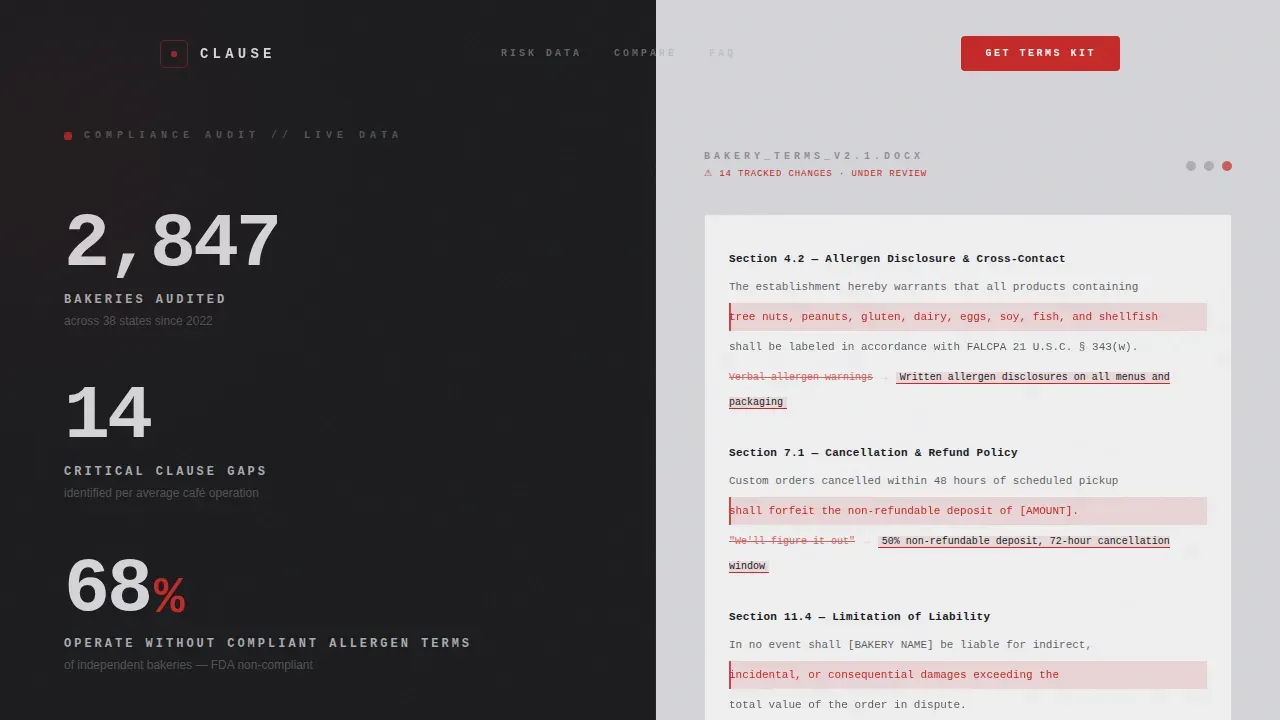
The hero opens as a full-width 50/50 split. The left panel displays three live-styled counters rendered in oversized monospaced type against forge black, showing bakeries audited, critical clause gaps per average café, and the percentage of independents operating without compliant allergen terms. The right panel shows a redlined terms document mid-markup, with clauses highlighted in violation red and tracked changes visible. This approach replaces stock photography entirely and lets the numbers carry the authority. Every visitor lands on data that immediately communicates risk, setting the tone for the compliance audit scroll that follows.
Comparison Versus Conversion Blocks
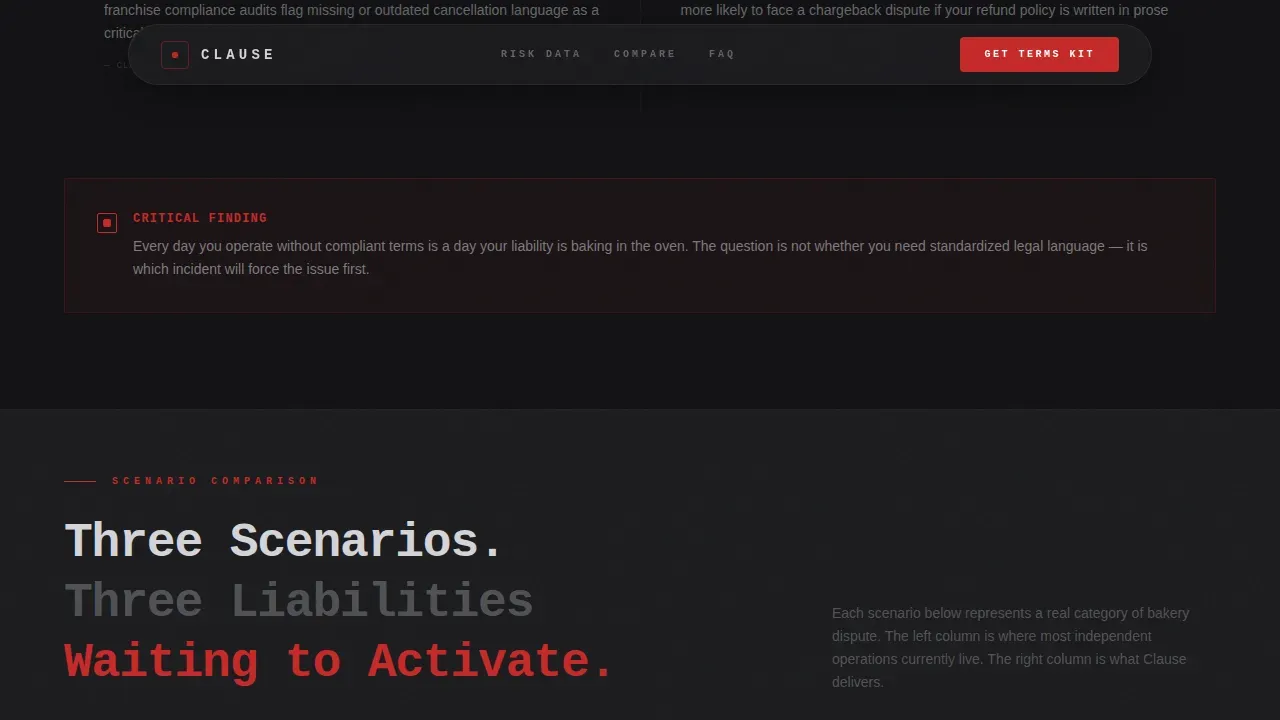
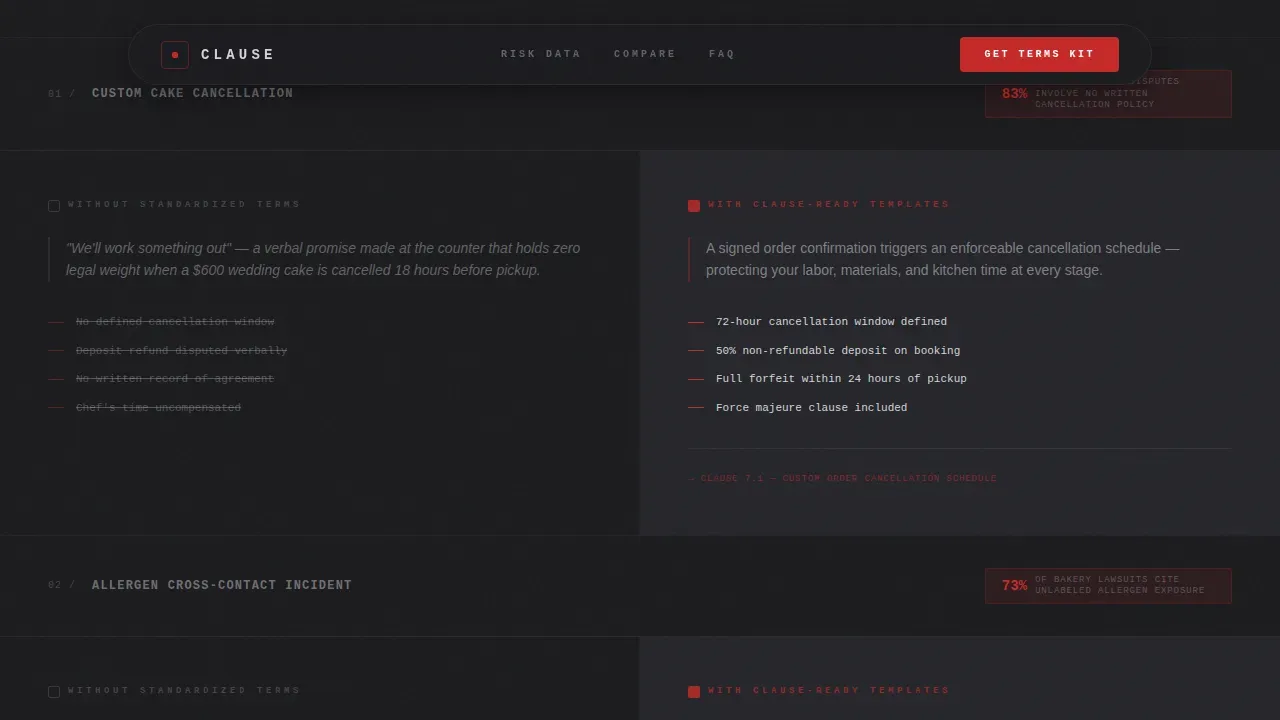
Three side-by-side comparison blocks form the core of the page's conversion argument. Each block pairs a real bakery scenario on the left, vague refund promises, verbal allergen warnings, handshake catering agreements, with the corresponding enforceable clause template on the right. The left column frames life without standardized terms: unclear payment method expectations, undefined cancellation windows, no written notice requirements. The right column shows what a tos agreement actually delivers: enforceable cancellation deadlines set days prior to an event, compliant allergen disclosures that address applicable laws, and deposit-and-delivery schedules that protect both parties. The comparisons are designed to earn the form click before the call-to-action section ever appears.
Escalating Risk Data Strip
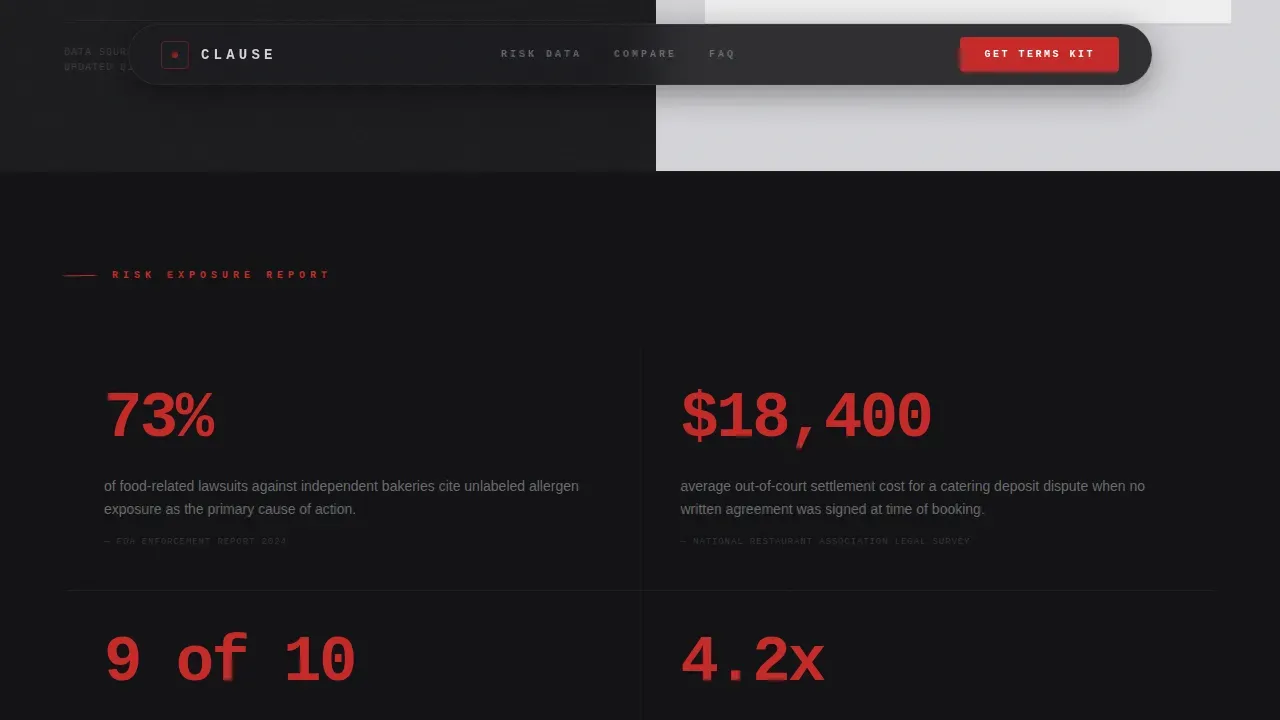
A full-width data callout strip runs between the hero and the comparison blocks. It presents compliance statistics in large monospaced figures, the percentage of lawsuits originating from unlabeled allergens, the average costs of a catering dispute without written terms, and the number of independent operators currently without a valid service agreement on file. Each figure is factual in tone and escalates the stakes section by section. The strip reinforces why every bakery business needs a document that goes beyond generic terms and addresses food service realities.
Centered Call-to-Action Form with Dual Path
After the third comparison block, the page centers a two-field capture form with fields for bakery name and email. The primary call-to-action reads "Download Your Bakery Terms Kit." A secondary path labeled "See the Full Audit Report" gates a downloadable document behind the same form fields. The form is positioned at the exact moment a visitor has absorbed enough risk data to act. Both paths feed the same capture, creating two motivations, practical and analytical, for a single conversion.
Frequently Asked Question Accordion
The page closes with a bakery-specific frequently asked question accordion before the footer. Questions address practical legal scenarios: cancellation policy windows, allergen disclosure obligations, deposit enforceability, and what happens to remaining provisions when one clause is challenged. The accordion keeps the page focused and avoids long walls of text, which is important for a document that is asking visitors to trust it as a compliance resource.
Animated Document Interaction Layer
The template includes high-animation behavior driven by client-side components. Count-up counters animate on scroll entry. The redlined document in the hero runs a highlight sweep animation that simulates a live markup review. A cursor glow effect follows the user through the data panels. The magnetic call-to-action button responds to pointer proximity. These interactions reinforce the Data Command theme and keep the compliance audit aesthetic alive through the full page scroll, making the experience feel like paging through a live report rather than reading a static legal page.
Page sections overview
| Section | Purpose |
|---|---|
| Stats Dashboard Hero | Display audit counters and redlined document preview to establish risk immediately |
| Risk Data Strip | Present escalating compliance statistics across a full-width callout band |
| Comparison Block One | Contrast vague refund promises with enforceable cancellation clause language |
| Comparison Block Two | Contrast verbal allergen warnings with compliant allergen disclosure terms |
| Comparison Block Three | Contrast handshake catering deals with deposit-and-delivery schedule clauses |
| Download Form Block | Capture bakery name and email with dual call-to-action paths |
| frequently asked question Accordion | Answer bakery-specific legal questions before the footer |
| Footer Pattern | Deliver horizontal flow navigation and contact links |
Design & branding system
The visual identity follows a Data Command theme built entirely on industrial references. The Monochrome Steel color system draws from the back-of-house environment: surfaces that are wiped clean, cold, and precise. Violation red appears only where the stakes are highest, warnings, critical clauses, and redlined document markup. Typography combines JetBrains Mono for all numerical data and code-style legal references with DM Sans for readable body text. The result is a page that feels like compliance infrastructure, not a bakery brochure.
- Forge black (#1B1B1E) anchors primary panels; brushed stainless (#A8A9AD) and proofing-rack silver (#D4D4D8) alternate as background tones to separate clause categories, while body text uses stainless on dark panels and forge black on light ones
- Violation red (#C62828) is reserved as a single accent for warnings, flagged clauses, and redlined document highlights, never used decoratively
- JetBrains Mono handles all counter figures, legal code references, and monospaced data callouts; DM Sans carries all paragraph and body copy for clear reading contrast
Mobile & speed optimization
The template is built desktop-first to match the compliance audit aesthetic and the split-screen layout requirements. The wide data panels, side-by-side comparison columns, and animated document viewer are designed to deliver their full impact on larger screens. The architecture separates static server components from client-side animation components to keep the interactive layer from blocking the document render.
- Server components handle all static text sections, the page sections table, and the frequently asked question accordion markup, keeping initial load efficient
- Client components are isolated to count-up counters, the document highlight sweep, cursor glow, and the magnetic call-to-action button, so animation does not block static content
- The split-screen gutter and comparison columns stack responsively for tablet viewports, preserving the without-versus-with contrast on smaller screens without losing the compliance audit reading flow
How this template helps you convert
The page is structured as a persuasion sequence, not a static legal resource. Every section builds the case for why a bakery business cannot operate without enforceable written terms before the form appears.
- The stats dashboard hero establishes authority and risk in the first viewport. Visitors see audited-bakery counts and critical clause gaps before they scroll a single pixel, creating immediate context for everything that follows and making the call to action feel earned rather than premature.
- The three comparison blocks do the conversion work. By pairing a recognizable bakery scenario with a clear clause template response on the right, the page makes the solution concrete and specific. Visitors do not have to imagine the value, they see it in side-by-side format before reaching the form.
- The dual-path call-to-action form serves two visitor types at once. Operators ready to act download the Bakery Terms Kit immediately. More analytical visitors choose the Full Audit Report path. Both paths capture the same lead fields, so no motivated visitor leaves without providing contact information.
Other information about this template
This template is designed to support a legal compliance workflow for food service operators who need to protect their bakery business before disputes arise. It is grounded in the realities of food service law: applicable laws including the Food Safety Modernization Act (FSMA) and General Data Protection Regulation (GDPR) shape the clause categories the template addresses. Several important legal and operational concepts are covered across the template layout.
- The service agreement sections address pickup and delivery liability, noting that responsibility for the product passes to the client once it leaves the bakery's possession, a critical condition outlined in compliant delivery terms
- Deposit and cancellation language defines when payment is due, establishes non-refundable deposit conditions, and specifies how many days prior to an event a cancellation must be submitted for a partial refund to apply
- Allergen and ingredient disclaimer blocks address potential cross-contact, comply with food safety regulations, and define the extent to which the bakery is solely responsible for disclosed preparation conditions versus undisclosed modifications by the customer
- A governing law provision defines jurisdiction and identifies which courts and laws principles apply when disputes between parties cannot be resolved informally
- The alternative dispute resolution path is presented as a step before litigation, offering a defined process so both parties can address claims without immediately incurring legal fees
- A dispute resolution clause within the tos agreement informs customers how legal disputes will be handled, reducing ambiguity and protecting the company from unnecessary litigation
- Intellectual property rights over the bakery's branding, recipes, and document designs remain with the business, and copyright laws protect those assets from unauthorized reproduction
- Confidential information shared during custom order processes, including design briefs, event details, and personal data such as name, email, phone, and billing address, is covered under a non-disclosure provision that warrants the bakery will not share data with third parties without consent unless required by law
- The entire agreement provision clarifies that the signed or accepted terms supersede all prior agreements and verbal commitments, leaving no room for disputed informal promises
- Remaining provisions of the tos agreement remain in full force even if one clause is found to be invalid, ensuring the document continues to protect the bakery business in the event of a legal challenge
- Transaction and sales data, including purchased items, order history, and payment information, are subject to data security obligations; adherence to PCI DSS standards for payment method processing is noted as applicable
- The template layout can support a word doc export workflow or be adapted for HTML directly if the buyer is working within a custom-coded site
- Free terms templates pulled from generic sources often use generic terms that do not account for food service liability scenarios; this service template is built around bakery-specific risks from the ground up
- Sample terms included in the template define terms across cancellation, allergen, catering, deposit, delivery, and data sections, covering the full range of obligations a food service business faces
- The template functions as a service template and starting point; buyers are encouraged to review all conditions with a qualified legal professional before publishing, as applicable laws vary by jurisdiction
- Additional costs, expenses, and payment method requirements can be adapted within the template's payment section to reflect the specific service policy of each bakery business
- Authorized actions the bakery is permitted to perform, including order fulfillment, communication, site improvement, and safety and security operations, can be defined within the terms to give customers a clear account of how their data and orders are handled
- A clickwrap consent method, requiring customers to check a box before completing an order, is noted as a recommended approach for ensuring the tos agreement is valid and enforceable
- The template's standard terms blocks address prohibited actions, acceptable use, and the consequences of violations, giving the bakery business a document that sets clear boundaries from the date of first customer interaction
- Accurate contact information should be included in the footer and within the terms document itself, so customers always have a valid address for notices, claims, and legal correspondence
Theme
Data Command
Creative direction
Industry Report
Color system
Monochrome Steel
Style
Split Screen (50/50)
Direction
Comparison/Versus
Page Sections
Split-screen Stats Dashboard Hero
Comparison Versus Conversion Blocks
Escalating Risk Data Strip
Dual-path Call-to-action Form
Bakery-specific Frequently Asked Question Accordion
Animated Document Interaction Layer
Related questions
Does this template include actual legal clause language I can use?
What bakery scenarios does the comparison section cover?
Can I adapt the terms sections for a multi-location franchise operation?
How does the template handle allergen disclosure requirements?
Is this template only usable as a coded HTML page?