Mathematics Exam Prep Landing Page Template
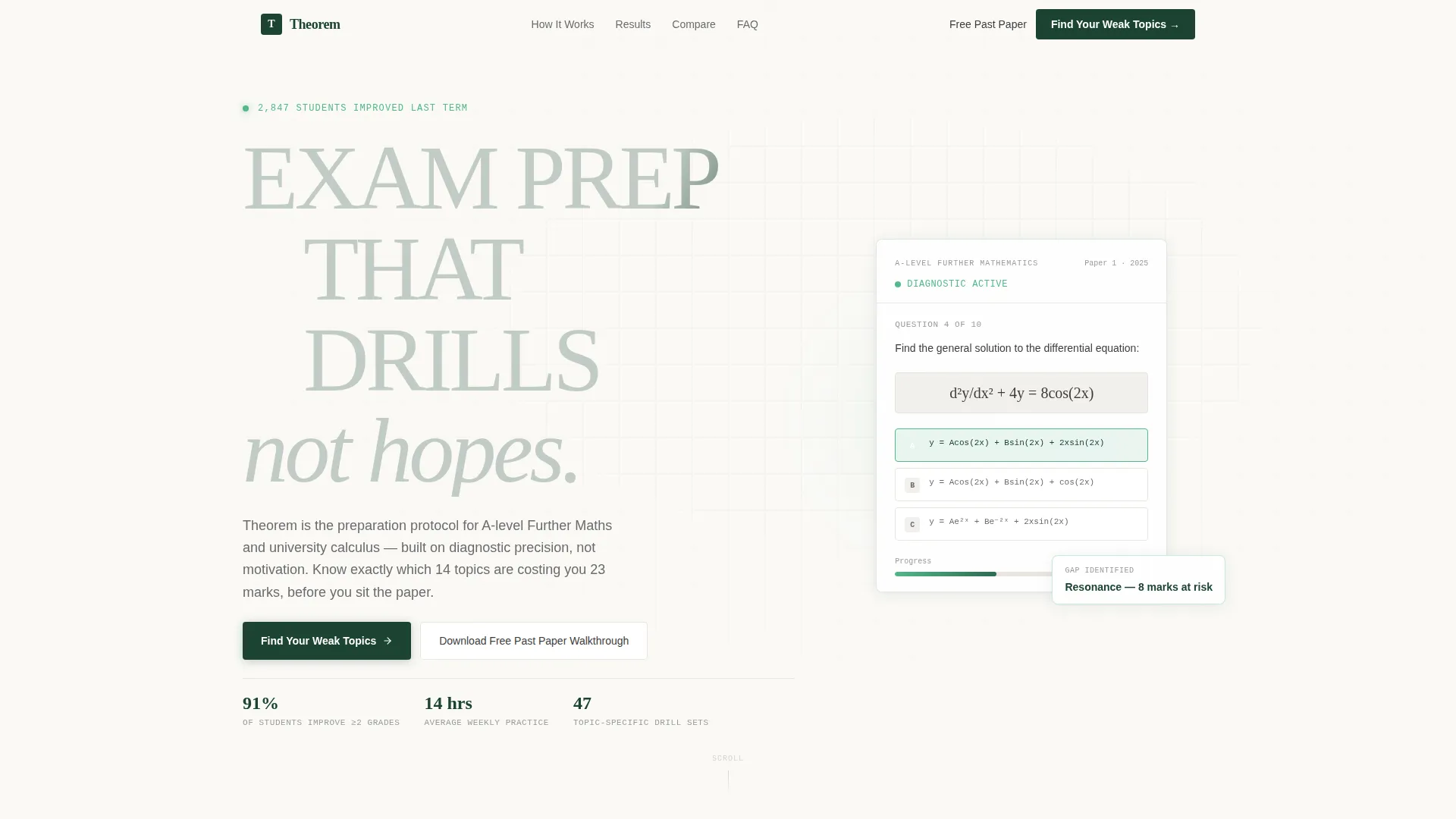
Theorem is a mathematics exam prep landing page template built for precision-focused tutoring services. It features a persona-selector header, FAQ-driven scroll structure, comparison tables, and a ten-question adaptive diagnostic quiz with a gap-map result. The design uses a Corporate Precision visual system in deep evergreen and chalk white, making methodology the centrepiece.
by Rocket studio
Quick summary
Theorem is a single-page landing page template designed for mathematics exam prep services. It opens with a three-card persona selector, guides visitors through an FAQ-structured scroll, and closes with an adaptive diagnostic quiz. Every section is built around comparison tables and quantified claims, making the methodology visible and the conversion path clear.
Who this template is for
This template is built for tutoring businesses and exam prep services that teach mathematics at a serious level. It suits providers who work with students under real exam pressure and need a page that earns trust through evidence, not enthusiasm.
- Mathematics tutoring services targeting A-level or university-level students
- Exam prep coaches working with students who are resitting, plateaued, or pushing for top grades
- Education businesses that lead with structured methodology and want their page to reflect that rigour
What problem this template solves
Most tutoring landing pages rely on vague promises and testimonial carousels. They do not show how the service works, and they do not speak to the specific situation the student is in right now. Theorem solves this by making the scroll do the diagnostic work.
- Visitors self-select their situation immediately, so the page speaks directly to their gap
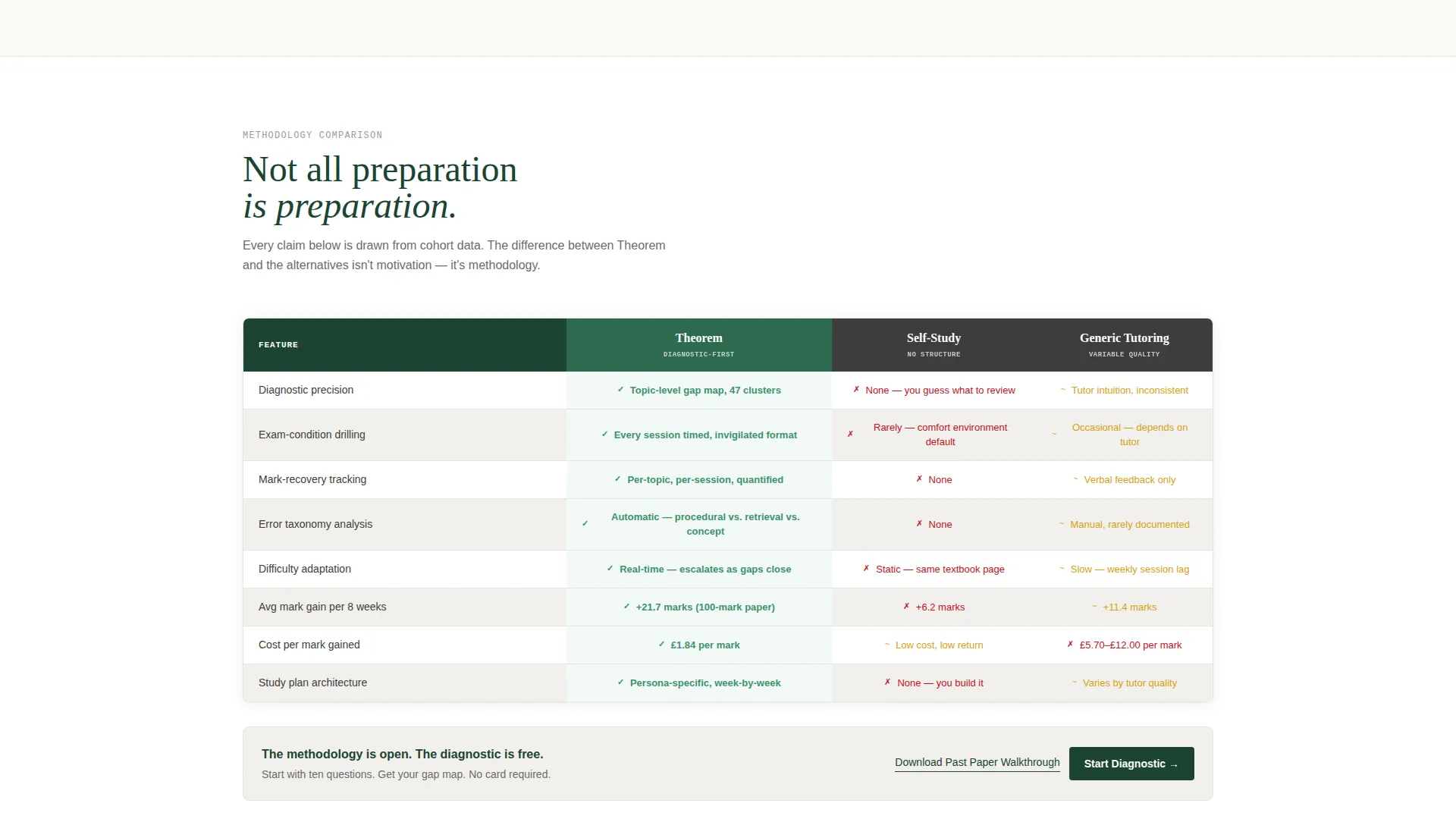
- Every claim is anchored to a comparison table, not a general statement
- The quiz call to action gives students a reason to engage before they are asked to commit
What you get with this template
Theorem delivers a fully structured landing page layout with every major section ready to populate. The page is section-led and scroll-driven, moving visitors from self-identification through evidence to action in a single continuous flow.
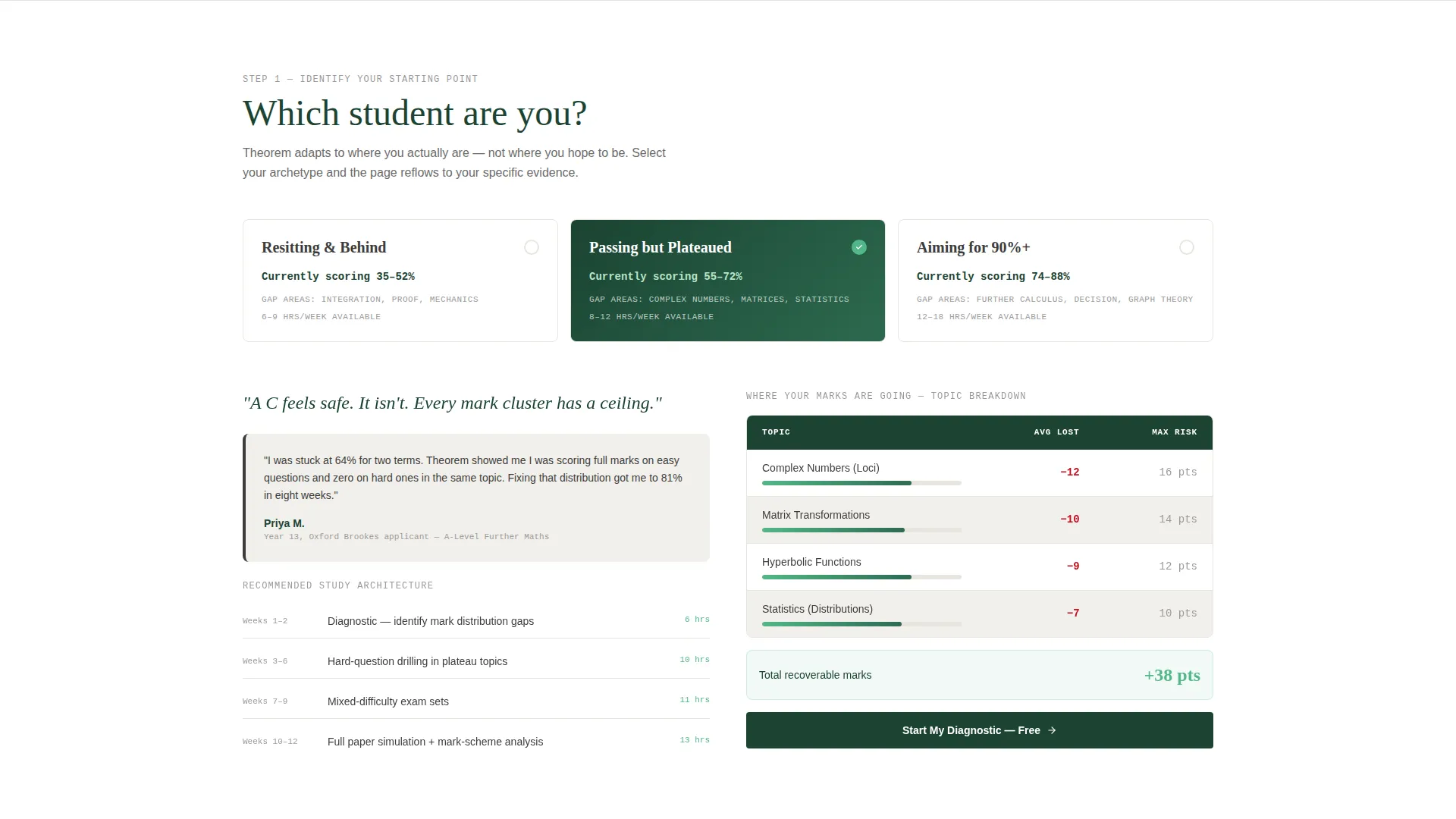
- A three-card persona selector header that reflows page content by student archetype
- An FAQ-driven content scroll with comparison tables and topic-by-topic mark breakdowns
- A ten-question adaptive diagnostic quiz leading to a personalised gap map and email capture
Feature list
This template is built from the ground up around one idea: methodology visible on the page. Every feature below serves that goal directly.
Persona Selector Header
Three typographic cards sit side by side at the top of the page. Each card names a specific student archetype: "Resitting and Behind," "Passing but Plateaued," and "Aiming for 90% plus." A single diagnostic stat sits beneath each card. When a visitor clicks their card, the page reflows to show testimonials, curriculum highlights, and difficulty benchmarks matched to that persona.
FAQ-Driven Scroll Structure
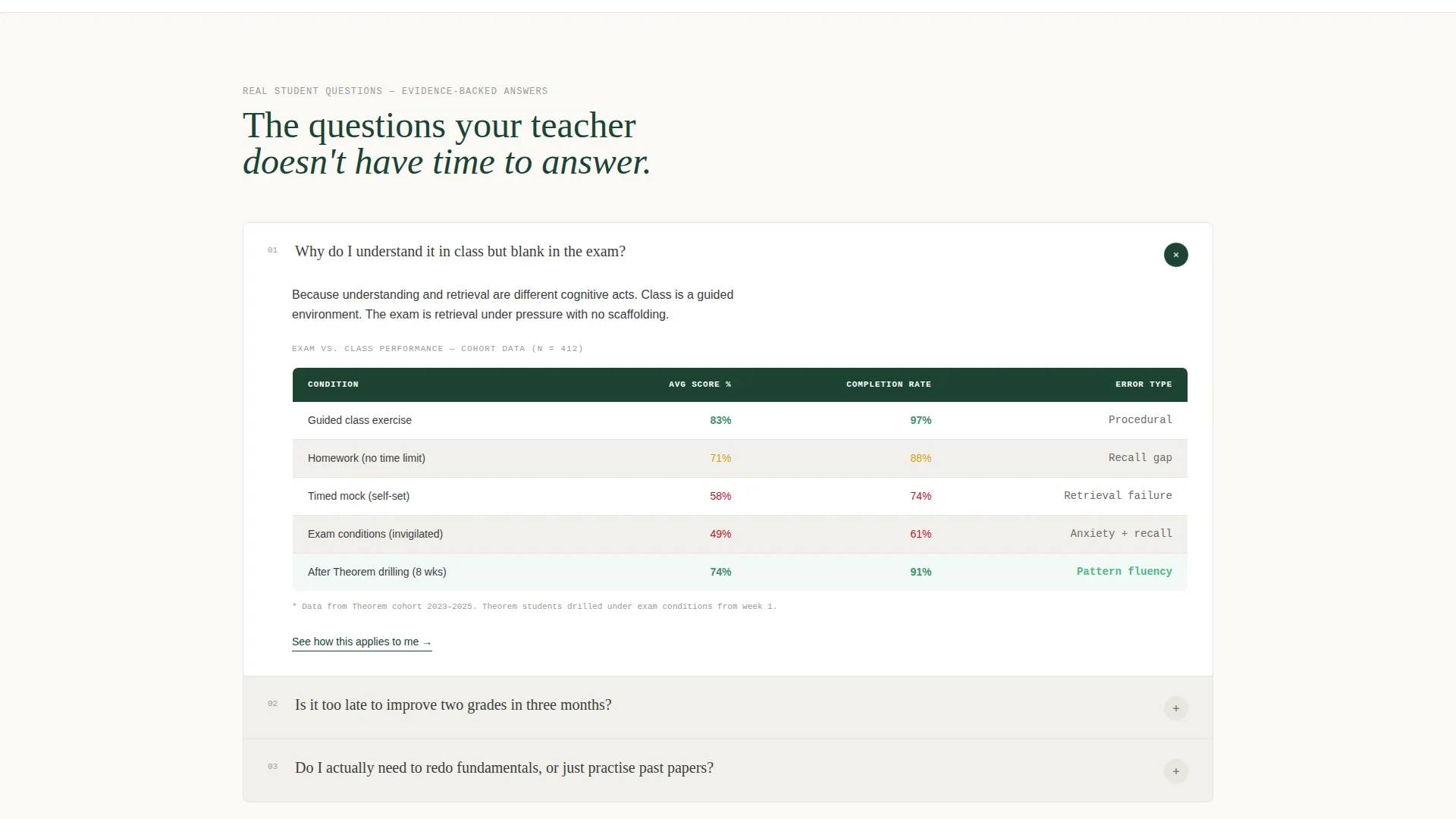
The page scroll is built as a sequence of real student questions. Each question anchors a content section that answers with evidence. This structure keeps visitors reading because every heading names a problem they already recognise.
Comparison Tables as Core Content
Tables are the spine of the page. Score progression across student cohorts, topic-by-topic mark-loss breakdowns, and side-by-side study plan architectures are all presented in structured table format. Every claim is quantified and every promise is benchmarked.
Adaptive Diagnostic Quiz
The primary call to action leads to a ten-question diagnostic. The quiz starts with core skills and escalates to exam-grade problems in real time. After completion, the student receives a gap map showing specific topic clusters ranked by mark-recovery potential.
Email Capture After Proven Value
The email capture form sits between the quiz result and the full study plan unlock. By the time the form appears, the student has already invested time in the diagnostic and seen their gap map. The form asks only for name, email, and exam date.
Secondary Download Path
Visitors not yet ready to take the quiz are offered a free past paper walkthrough download. This gives a lower-commitment entry point that keeps the visitor engaged and on the page without forcing the primary conversion.
Page sections overview
| Section | Purpose |
|---|---|
| Persona Selector Header | Student self-identifies archetype and triggers page reflow |
| Diagnostic Stats Cards | Displays average scores, gap areas, and study hours per archetype |
| Student Question Anchors | FAQ-style headings frame each content section around a real problem |
| Score Progression Tables | Comparison tables show cohort results across topic clusters |
| Mark Loss Breakdown | Topic-by-topic analysis of where marks are lost versus gained |
| Study Plan Comparison | Side-by-side architecture for each student persona |
| Adaptive Quiz Entry | Primary call to action leading to ten-question real-time diagnostic |
| Gap Map Results | Personalised topic clusters ranked by mark-recovery potential |
| Email Capture Gate | Form between quiz result and full study plan, three fields only |
| Past Paper Download | Secondary path offering a free walkthrough for lower-intent visitors |
Design & branding system
The visual identity follows a Corporate Precision theme. The palette is drawn from the Forest Trust colour system, built to feel like a well-kept university library at 7 AM: wood-panelled walls, green banker's lamps, and the quiet authority of a subject that rewards discipline over talent.
- Deep evergreen (#1B4332) and chalk-dust white (#FAF9F6) form the primary page contrast, with pencil graphite (#3D3D3D) for body text
- Marking-pen green (#52B788) is reserved for calls to action, progress indicators, and correct-answer states in the quiz
- No stock photography and no illustrations are used; the design relies entirely on black type on chalk white with evergreen dividers
Mobile & speed optimization
The template layout is structured for clean rendering across screen sizes. The persona selector cards, comparison tables, and quiz flow are all designed to stack and reflow without losing their logical sequence on smaller screens.
- Persona cards stack vertically on mobile while preserving the click-to-reflow interaction
- Comparison tables are formatted to scroll horizontally on narrow viewports rather than collapsing their columns
- The quiz and gap map result screens are built as full-width single-column layouts that work cleanly on any device size
How this template helps you convert
Theorem converts by building belief before asking for anything. The page earns micro-commitments from visitors at every stage, so the email capture feels like a natural next step rather than a cold ask.
- The persona selector creates immediate personal relevance, which keeps visitors reading past the first scroll instead of bouncing.
- The comparison tables and FAQ scroll replace vague claims with visible evidence, building the case that this service uses methodology rather than motivation.
- The adaptive quiz delivers a personalised result before the email form appears, so the visitor already has proof of value when they are asked to sign up.
Other information about this template
Theorem is designed specifically for the mathematics exam prep market, where the student's confidence is often as fragile as their technique. The template makes space for that context without being sentimental about it.
- The page supports three clearly defined student segments: students who are resitting and behind, students who are passing but have plateaued, and students targeting 90% or above
- The scroll architecture is FAQ-driven, meaning every section heading is a question the target student is already asking, which makes the page feel like a conversation rather than a sales pitch
- The template style is Comparison Table, meaning data and benchmarks are the primary persuasion mechanism throughout the page
Theme
Corporate Precision
Creative direction
FAQ-Driven
Color system
Forest Trust
Style
Comparison Table
Direction
Quiz/Assessment
Page Sections
Persona Selector Header
Faq-driven Scroll Structure
Comparison Tables Throughout
Adaptive Diagnostic Quiz
Post-quiz Email Capture
Secondary Download Path
Related questions
Can I use this template without offering a quiz feature?
Does the persona selector require custom development to work?
Is this template suitable for a one-person tutoring business?
Can I update the colour palette to match my existing brand?
What content do I need to prepare before building with this template?