Advanced Tech & AI Platforms Privacy Policy Website Template
The Audit AI Bias Detection Comparison Table landing page template is a dark-mode, single-page layout built for machine learning engineers, compliance officers, and civil rights researchers. It uses a Problem to Solution narrative arc, animated before-and-after comparison tables, and a Void and Violet visual system to surface hidden discrimination in AI models and drive app downloads.
by Rocket studio
Quick summary
This template is a high-impact, single-page layout designed for an AI bias detection tool. It opens with a full-width dashboard screenshot, moves through a stark problem arc built on real-world algorithmic discrimination statistics, then breaks into animated comparison tables showing measurable before-and-after fairness metrics. The end goal is a confident app download or live demo signup.
Who this template is for
This template was built for teams that sit at the intersection of machine learning, regulatory compliance, and ethical accountability. It speaks to people who understand that bias in AI is not a theoretical concern but a live operational risk with real legal and reputational consequences.
- ML engineers at fintech startups who need to debug deployment pipelines and catch unfair outcomes before a model reaches production, where bias assessment gaps become liability.
- Compliance officers at large financial institutions who are preparing for EU AI Act audits, documenting consent mechanisms, and managing regulatory and legal risks tied to high-risk AI systems.
- Research teams at civil rights nonprofits who are building evidence for algorithmic accountability cases and need clear, structured data to document findings and support their advocacy work.
What problem this template solves
AI bias is not always visible from the inside. A model can quietly deny a loan, filter out qualified candidates, or misprice an insurance quote along racial, gender, or socioeconomic lines, and the bias in AI systems responsible may never surface without deliberate, structured testing. Most product pages for AI tools fail to communicate this urgency. They lead with features rather than consequences, and they lose the compliance officer or engineer before making the case for action.
- No clear problem-to-proof structure: Generic landing pages skip the "why it matters" moment, which is exactly what compliance-minded buyers need before they will consider any new tool.
- No comparative evidence: Bias assessment decisions are made on measurable deltas. Without side-by-side fairness metrics, a page cannot convince a technical audience that the product actually works.
- No audience-specific framing: Engineers, compliance officers, and researchers all approach AI fairness from different angles. A page that speaks to all three needs distinct use-case panels, not one generic pitch.
What you get with this template
You get a fully structured, single-page layout that takes a visitor from problem awareness to download decision in one continuous scroll. Every section serves a specific role in the narrative arc, and the design system reinforces the gravity and precision of the subject matter without sacrificing usability.
- A complete seven-section page layout including a hero, a problem arc, a violet break separator, animated comparison tables, audience cards, a download call to action block, and a footer, all pre-structured and ready to customize.
- Five animated before-and-after comparison table rows that reveal on scroll, each displaying fairness scores, demographic parity deltas, and equalized odds visualizations for unaudited versus audited AI models.
- Dual call-to-action placement with a platform toggle for macOS, Linux, and Docker image downloads, plus a secondary email-capture field for browser-based demo access, so both ready-to-install and cautious visitors have a clear next step.
Feature list
The Audit AI Bias Detection Comparison Table landing page template is designed around five core capabilities drawn directly from the brief. Each one addresses a specific need in the buyer journey from first impression to download.
Problem Arc With Real-World Statistics
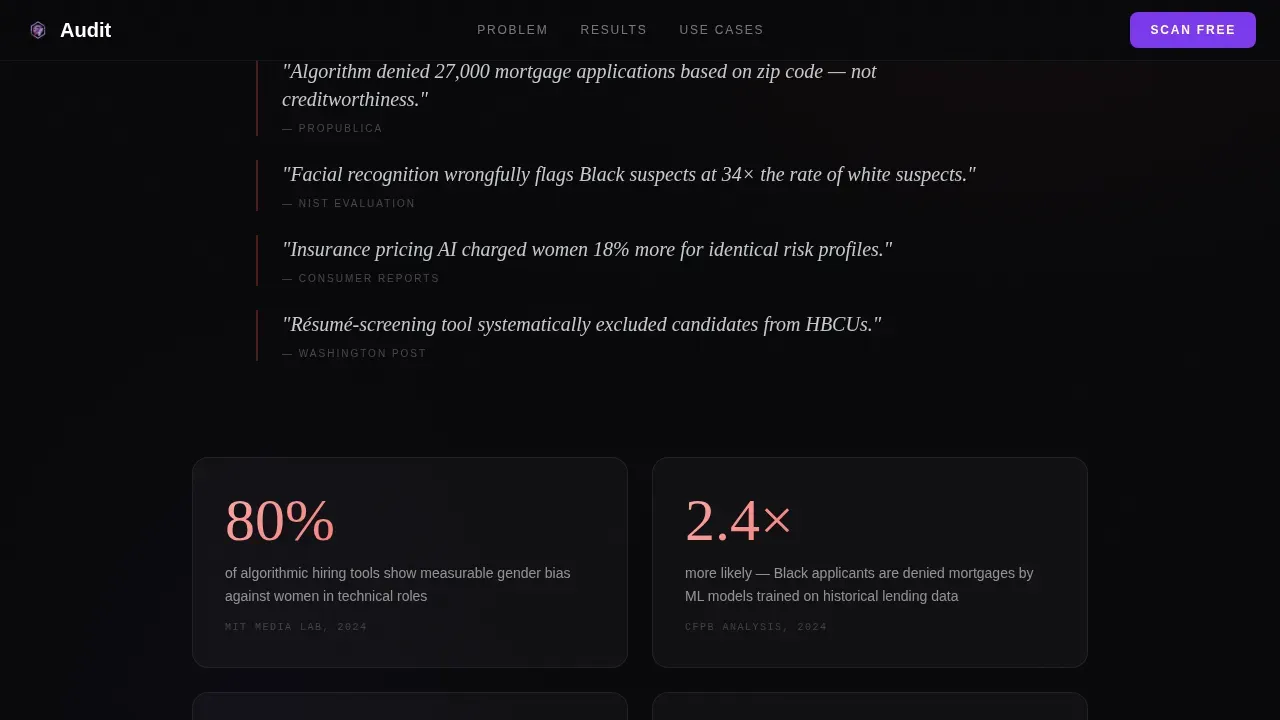
The page opens in absolute void black. Real-world statistics about algorithmic discrimination appear word by word, building discomfort before any solution is shown. This section draws on documented cases of bias in AI systems, including denied mortgages, wrongful arrests, and biased hiring outcomes that filtered out qualified candidates along demographic lines. The intent is to make the cost of unchecked AI tangible. Detecting bias becomes urgent, not optional, by the time a visitor reaches the comparison tables.
Animated Before-and-After Comparison Tables
Five comparison table rows animate into view as the visitor scrolls. Each row places an unaudited model beside an audited model and shows concrete fairness metrics: disparate impact ratios, demographic parity deltas, and equalized odds scores. The before column renders in muted gray; the after column in clean violet. This visual contrast does the persuasive work that a wall of text cannot. Visitors see measurable bias mitigation in action rather than reading claims about it. The tables are the evidence layer of the page.
Audience-Specific Use-Case Cards
Three panels address the engineer, the compliance officer, and the researcher individually. Each card frames the value of a bias audit in terms relevant to that specific job title and context. For engineers, the focus is on pipeline debugging and catching training data issues before deployment. For compliance officers, it is about EU AI Act readiness, audit trails, and regulatory compliance documentation. For researchers, it is about structured data collection and the ability to document findings for accountability cases. This segmentation prevents the page from feeling generic.
Hero Dashboard Screenshot With 3D Tilt
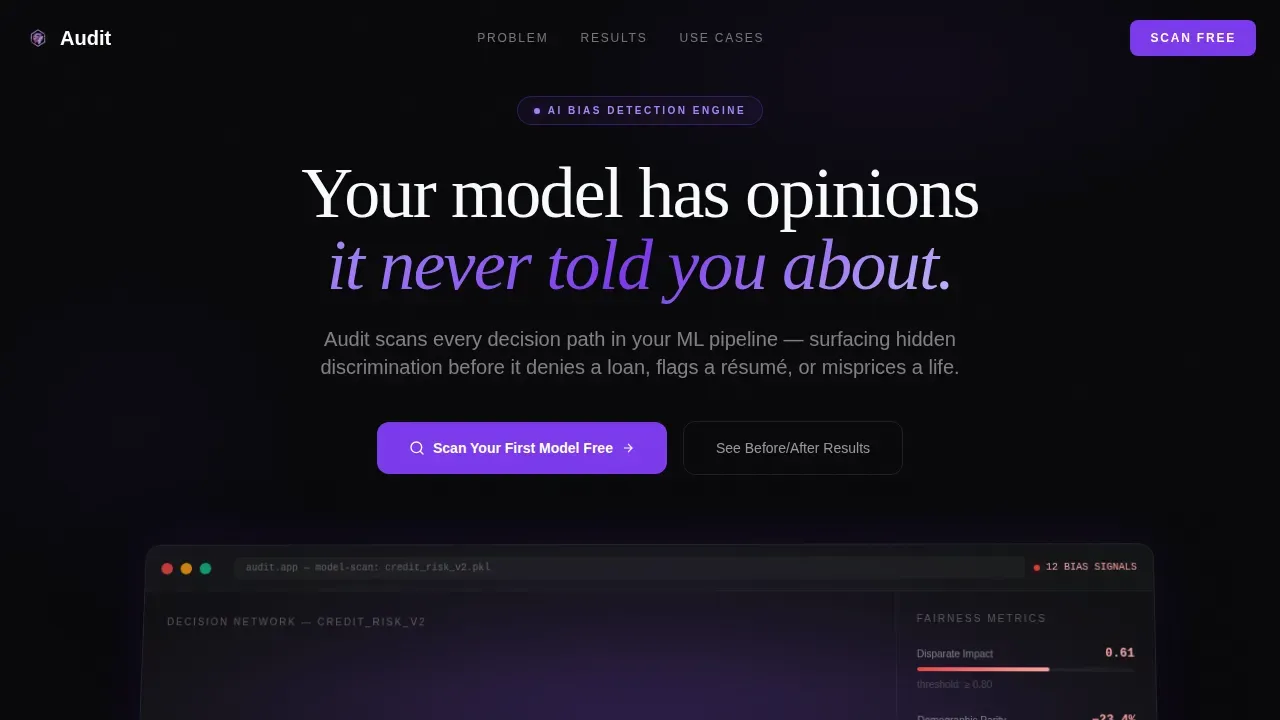
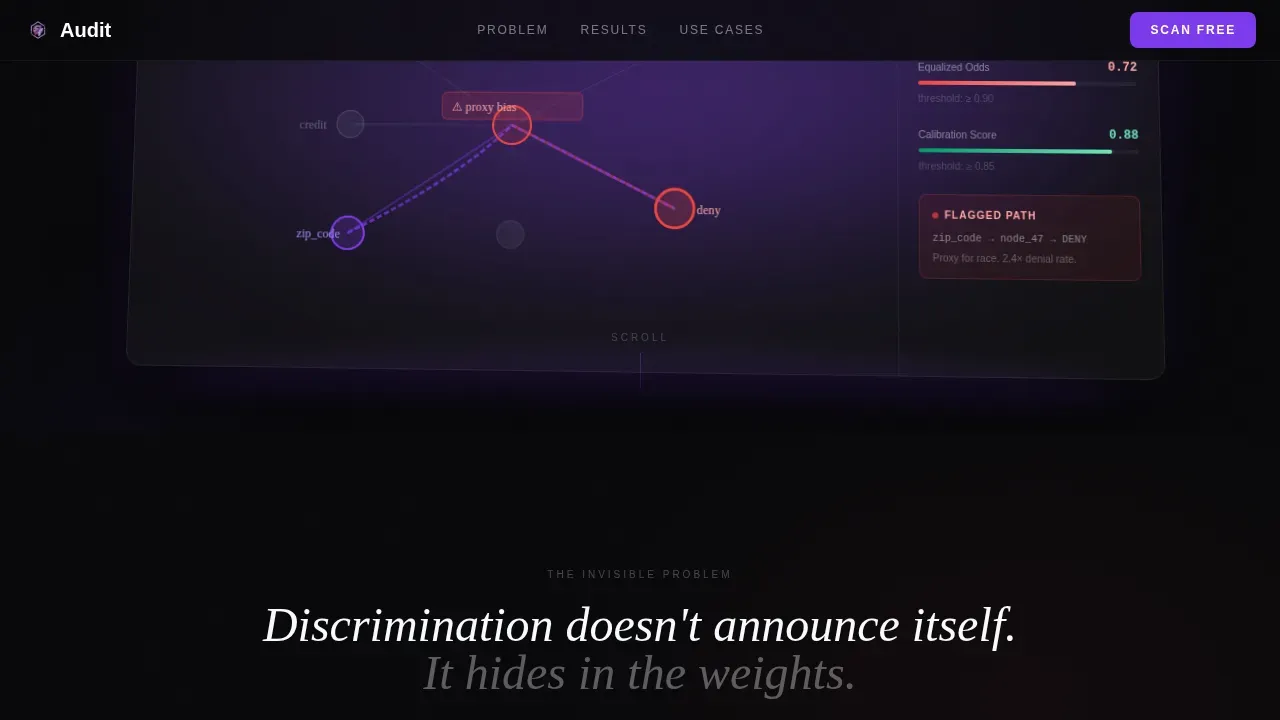
The header section features a full-width, pixel-perfect product screenshot of the Audit dashboard mid-scan. The image shows a neural network graph with nodes color-coded by bias severity, a fairness metrics sidebar with disparate impact ratios, and a red-flagged decision path highlighted in pulsing violet. The screenshot sits on a slight three-dimensional tilt with a glass reflection beneath it. A single headline fades in above the image: "Your model has opinions it never told you about." This opening frame sets the tone for the entire page.
Dual Download and Demo Call to Action
The primary call to action, "Scan Your First Model Free," appears twice on the page: once floating after the dashboard screenshot and once anchored at the bottom inside a glass card. A platform toggle lets visitors choose between macOS, Linux, and Docker image options. A secondary path offers browser-based demo access through a single email field labeled "Try the Live Playground." This dual structure shortens sales cycles by meeting both install-ready and evaluation-stage visitors where they are.
Violet Break Separator and Scroll Animation
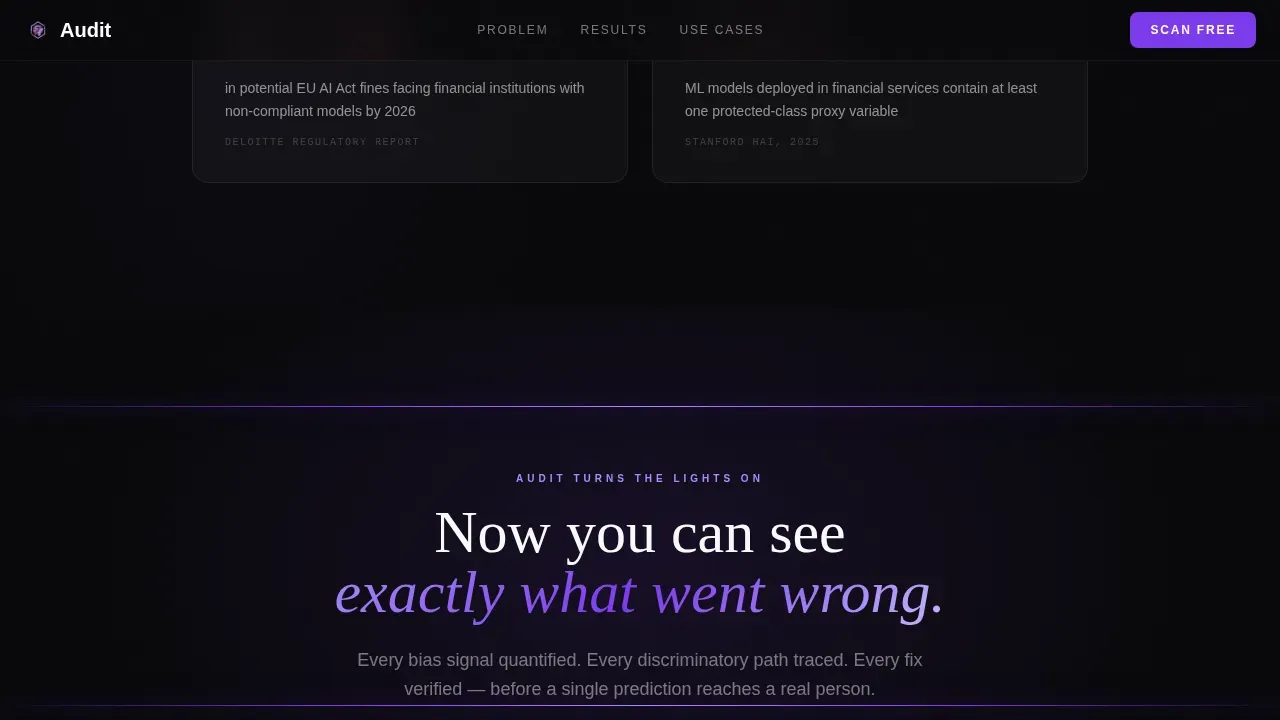
A horizontal line of violet light splits the viewport at the transition between the problem arc and the solution. This visual moment signals a shift in tone and keeps visitors oriented as the page moves from darkness to structured proof. All comparison table rows use scroll-triggered animation. The overall animation system is built for high-engagement sequences using GSAP ScrollTrigger, with Client Components handling interactive sequences and Server Components used for static sections.
Page sections overview
| Section | Purpose |
|---|---|
| Hero Dashboard Screenshot | Opens with a 3D-tilted product screenshot, a fading headline, and a floating primary call to action |
| Problem Arc Statistics | Displays algorithmic discrimination statistics word by word on void black to build urgency |
| Violet Break Separator | A horizontal violet light line that marks the transition from problem to solution |
| Comparison Tables Block | Five animated before-and-after bias metric rows showing fairness scores for audited versus unaudited AI models |
| Audience Use-Case Cards | Three panels addressing engineer, compliance officer, and researcher use cases individually |
| Download Call to Action | Glass card with macOS, Linux, and Docker toggle plus a secondary email field for live demo access |
| Footer | Linear single-row footer layout |
Design & branding system
The Void and Violet color system is the defining visual identity of this template. It is built for dark mode only, with a palette that feels like staring into a monitor late at night in a dark office. The interface itself is the light source. Every violet pulse is a signal emerging from darkness, and the design reinforces the precision and seriousness that bias assessment work demands.
- Color palette: Absolute void black (#09090B) for backgrounds, deep ultraviolet (#7C3AED) for primary accents and gradient traces, frosted glass panel white (#E2E8F040 at 25% opacity) for floating content panels with backdrop blur, and electric lilac (#A78BFA) for hover states and active data points.
- Typography: DM Sans is used for all body copy, providing clean and user friendly readability at any screen size. Fraunces, a display serif, is used in the problem arc sections to add weight and gravity to the discrimination statistics, creating a clear typographic contrast between the problem and solution halves of the page.
- Visual language: Content panels float in translucent glass cards. Violet gradients trace data flows and highlight bias hotspots. The bioluminescent aesthetic treats every data point as a signal emerging from void, reinforcing the idea that the tool makes invisible problems visible.
Mobile & speed optimization
This template is designed with a desktop-first priority, reflecting the reality that its primary users, ML engineers and compliance officers, work on large monitors where comparison tables and fairness metric data need horizontal space to communicate clearly. Mobile layouts are still structured and functional, but the desktop experience is the primary delivery surface.
- Desktop-first layout: The comparison tables, audience cards, and hero screenshot are all optimized for wide-viewport display, where demographic data columns and fairness metric rows can be read side by side without truncation or horizontal scrolling.
- Performance architecture: Static sections such as the hero text, the problem arc copy, and the footer use Server Components for faster initial rendering. Client Components are reserved for animated sequences including the scroll-triggered table row reveals, the violet break animation, and the platform toggle interactivity, keeping the interactive payload focused and efficient.
How this template helps you convert
High-converting landing pages prioritize clarity of the value proposition and strong trust signals. This template is engineered around both. The narrative arc does not ask visitors to take a leap of faith. It builds a logical case from documented harm to measurable proof to a clear action, and the design system reinforces credibility at every step.
- The problem arc earns attention before asking for anything. By leading with real-world consequences of bias in AI, including legal consequences, regulatory violations, and unfair outcomes for certain groups, the page creates genuine urgency. A compliance officer or engineer who sees their professional risk reflected in the opening statistics is already invested before the comparison tables appear.
- The comparison tables convert skeptics into believers. Five rows of before-and-after bias metrics, each animating on scroll with fairness scores and demographic parity deltas, serve as functional proof rather than marketing copy. By the time a visitor reaches the call to action, they have seen measurable evidence that the tool works. The download feels like the logical conclusion of the evidence they just reviewed.
- The dual call to action removes the install barrier. Not every visitor is ready to download on first contact. The secondary "Try the Live Playground" path with a single email field handles demo requests from evaluation-stage visitors and keeps them in the funnel without friction.
Other information about this template
This section covers additional context that helps teams understand the broader landscape in which this template operates, including compatible tools, regulatory frameworks, and practical considerations for teams launching a bias audit landing page.
- Regulatory framework alignment: The template is designed to communicate clearly within the context of evolving standards. The EU AI Act mandates audits for high-risk AI systems, driving a 25% annual growth in audit demand. Bias audits are also a regulatory requirement under laws like NYC Local Law 144 and are referenced in frameworks such as Equal Credit Opportunity Act (ECOA) and Equal Employment Opportunity Commission (EEOC) guidelines. Landing pages that explicitly reference these standards build credibility with compliance-minded buyers.
- AI audit reporting templates as a category: Standardized AI audit reporting templates are pre-formatted documents used to document audit processes, findings, and actionable recommendations for AI systems. An effective audit report template covers regulatory compliance, data lineage, training data provenance, data completeness checks, consent mechanisms, and bias mitigation steps. Organizations using standardized audit reports have seen up to a 40% reduction in compliance discrepancies. The adoption of AI audits is projected to increase by 30% annually through 2026.
- Key pillars of a complete bias audit: A thorough bias audit covers four interconnected areas. Data Integrity addresses data sources and historical data quality. Algorithmic Fairness tests for unfair outcomes across different segments using fairness constraints and demographic data. Disparate Impact Analysis performs intersectional analysis across combined demographic features such as race and gender. Explainability and Transparency ensures AI decisions are interpretable rather than operating as black-box systems, reducing over reliance on outputs that no one can explain.
- Open-source tools in the broader ecosystem: The template's comparison table structure can reference the kinds of tools practitioners already use to identify biases and mitigate bias. IBM AI Fairness 360 is an open-source Python toolkit offering over 70 fairness metrics and more than 10 bias mitigation algorithms. Fairlearn is a Microsoft-supported open-source Python package with interactive dashboards for bias visualization. Aequitas is designed specifically for auditing machine learning models, focusing on audit reports and actionable fairness metrics across demographic groups. The Google What-If Tool is a plugin for TensorBoard that enables interactive, non-code-based visual exploration of model behavior. These tools inform what a bias assessment page needs to communicate to a technical audience.
- Bias audit best practices for ongoing use: Bias detection is not a one-time event. Ongoing monitoring is essential because new data entering a system can introduce new bias patterns even after an initial audit is complete. Best practices include implementing automated testing and alerts so teams can catch and address potential bias issues right away, rather than discovering problems after deployment. Cross reference checks between training data and new data help confirm that fairness constraints are holding as the model encounters real-world inputs.
- Template connectivity to sales and marketing workflows: While this template does not include built-in integrations, its structure is designed to support sales cycles where compliance-focused buyers require multiple touchpoints. Executive summaries generated from the audit report can be shared with a sales team or procurement committee. The email capture field for demo requests feeds engagement signals back into whatever reporting tools or external platforms the team uses, including traffic analysis tools like Google Analytics for tracking page performance. The ad budget case for this template is strong: a focused download page with clear proof points typically outperforms a general product homepage for paid traffic targeting technical and compliance audiences.
- Confirmation bias and data collection integrity: A well-structured bias audit process guards against confirmation bias, where teams unconsciously favor data collection methods that validate existing assumptions about model fairness. The template's before-and-after comparison structure naturally counters this by forcing a side-by-side view of unaudited and audited results across multiple data points, ensuring the evidence base is complete rather than selectively presented. Good data collection practices, including attention to data completeness and careful review of data sources, are what make an audit report credible.
- Source code and customization: The template is built with a component architecture that separates static and animated sections. The source code uses GSAP ScrollTrigger for scroll-triggered animations. Developers can customize the color tokens, table row content, and platform toggle options without restructuring the entire page. The Tech Glass theme and Void and Violet color system are applied at the design-token level, making it straightforward to adapt the palette while keeping the bioluminescent visual identity intact. Teams wanting specific guidance on animation timing or Client Component configuration can refer to the included component structure for reference.
- Trust signals and ethical AI framing: A landing page for an AI bias auditing service must balance technical credibility with ethical reassurance. Trust signals in this template include the regulatory framework references, the measurable fairness metric improvements shown in the comparison tables, and the audience-specific use-case framing. Responsible AI practices are not just a marketing claim here. They are the operating premise of the tool being presented. The page is designed to demonstrate responsible AI practices through evidence, not assertion, which is the standard that compliance officers and civil rights researchers actually apply when evaluating AI tools. Ethical AI commitments shown through data carry more weight than badge placement alone.
- Market context: AI bias can result in lost revenue opportunities by excluding certain market segments or demographics from consideration in business decisions. The target market for this template spans fintech, large financial institutions, human resources platforms, and civil society organizations. Each segment faces distinct regulatory requirements and reputational stakes, which is why the audience card structure is built to address each target audience individually rather than relying on a single generic message. Teams with a clear sense of their target market will find the three-panel audience section easy to adapt with industry-specific language and compliance references.
- Free scan offer and funnel entry: The completely free first model scan positioned as the primary call to action lowers the barrier for evaluation-stage visitors significantly. A free report or free scan offer in a B2B developer tool context typically outperforms a demo-request-only model for driving top-of-funnel engagement, especially when the tool's value is best experienced hands-on. The free report framing also gives the sales team a concrete deliverable to reference in follow-up conversations with compliance leads or procurement contacts.
Theme
Tech Glass
Creative direction
Problem→Solution Arc
Color system
Void & Violet
Style
Comparison Table
Direction
App Download
Page Sections
Problem Arc with Algorithmic Discrimination Statistics
Animated Before-and-after Bias Comparison Tables
Audience-specific Use-case Cards
3d-tilted Hero Dashboard Screenshot
Dual Download and Demo Call to Action Block
Violet Break Separator and Scroll Animation System
Related questions
What types of AI models does this landing page template support presenting?
How does the comparison table structure communicate bias assessment results?
Is this template suitable for compliance officers preparing for EU AI Act requirements?
Can this template address both technical and non-technical audiences at once?
Where does the browser-based demo option fit in the conversion flow?