
Adaptive AI learns continuously from live data, adjusts to change, and improves apps in real time. Unlike static models, it uses reinforcement and transfer learning to shorten development cycles and sharpen predictions, making it a core tool for modern app teams.
Adaptive AI learns continuously, adjusts to changes, and improves applications in real time, making development more flexible and data-driven. Teams that adopt adaptive AI shorten development cycles, automate data-driven adjustments, and gain predictive power that static systems simply cannot match.
What Is Adaptive AI and How Does It Differ?
Adaptive artificial intelligence isn't just another layer on traditional AI. Unlike traditional AI, which follows predefined rules and static models, adaptive AI learns continuously. It absorbs new input data, refines predictions, and evolves.
Traditional AI models often rely on supervised learning or unsupervised learning, using labeled datasets to make decisions. Adaptive AI algorithms, however, frequently employ reinforcement learning, transfer learning, and evolutionary algorithms to improve their performance on the fly. The learning process mirrors the human brain in some ways: incremental, iterative, and context-aware.
Adaptive AI continuously updates from new data, while traditional AI operates on fixed, pre-trained rules.
Some key characteristics of adaptive AI systems include:
- Continuous learning mechanisms: Each new data point helps the system improve.
- Dynamic adaptability: The system navigates unstructured environments and adjusts to unexpected situations.
- Predictive capabilities: It makes user behavior predictions and identifies trends as data flows in.
With adaptive AI, the system doesn't just execute instructions. It learns from them, evaluates, predicts, and adjusts autonomously. That sets it apart from traditional AI, which struggles in dynamic and unpredictable situations.
Adaptive AI vs. Traditional AI
| Feature | Traditional AI | Adaptive AI |
|---|---|---|
| Learning approach | Static, pre-trained models | Continuous, real-time learning |
| Data handling | Labeled datasets required | Learns from streaming input data |
| Adaptability | Fixed rules and logic | Dynamic adjustment to new patterns |
| Core techniques | Supervised / unsupervised learning | Reinforcement learning, transfer learning |
| Best for | Stable, predictable environments | Dynamic, unpredictable environments |
| Development speed | Slower iteration cycles | Faster, feedback-driven iteration |
Practical Applications in App Creation
Adaptive AI excels at accelerating app development by automating routine tasks and delivering actionable insights, allowing teams to focus on creative work. Machine learning algorithms embedded in adaptive AI systems let developers focus on strategy and design, while the AI handles data-driven adjustments.
Transfer learning and reinforcement learning reduce development cycles by applying previously learned patterns to new contexts. Research shows that AI-assisted development can cut iteration time significantly when models continuously refine based on real usage data.
For a broader look at how AI is reshaping the development landscape, explore AI-assisted app development trends you must know now.
How Adaptive AI Transforms Team Workflows
Teams using adaptive AI notice shifts in how they work together. Developers, data scientists, and product managers interact differently when AI refines models in real time, making decisions faster and more data-backed. Instead of waiting for labeled datasets, teams can map the most informative input data, cluster similar data points to reduce redundancy, and rely on feedback loops that let the AI self-correct.
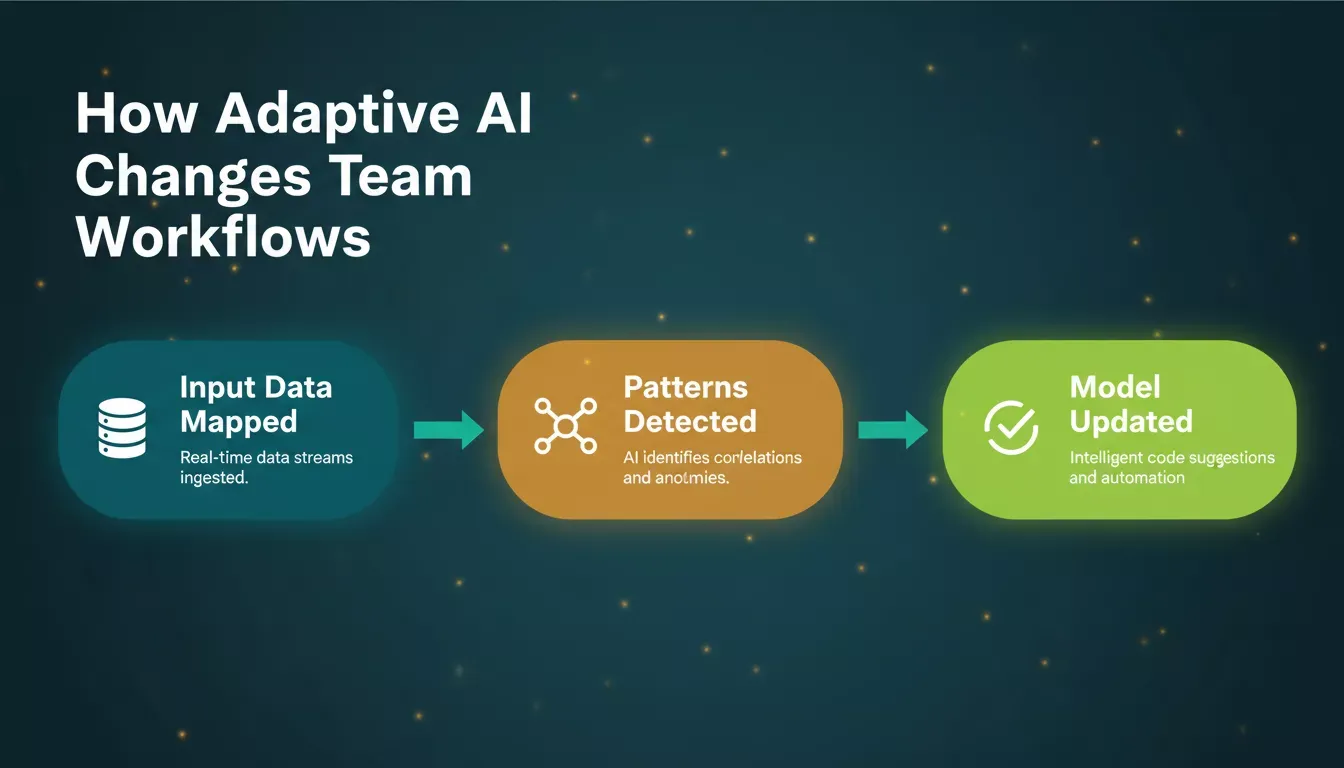
Adaptive AI workflows move through three connected stages: mapping input data, detecting patterns, and updating the model continuously.
The result is a more responsive workflow where up-to-date models back every decision. QA teams focus on complex edge cases, and product managers gain better visibility into trends. If you're building apps with AI today, understanding how to build apps with AI in minutes is a practical next step.
The Role of Machine Learning Algorithms
Adaptive AI systems rely heavily on machine learning algorithms that process vast datasets and detect patterns humans may miss. Deep learning, active learning, and reinforcement learning are often used to optimize AI models for app development.
The adaptive AI learning cycle: input data feeds algorithm selection, trains the model, generates predictions, and loops back through continuous feedback.
Choosing the right machine learning algorithms is key. The goal is efficient model performance while maintaining accuracy, and the feedback loop is what separates adaptive systems from their static predecessors.
Adaptive AI Impact: What the Data Shows
Adoption of adaptive AI in development workflows is accelerating, with measurable gains across speed, accuracy, and team output. Industry analysis consistently points to continuous learning as the primary driver of these improvements.
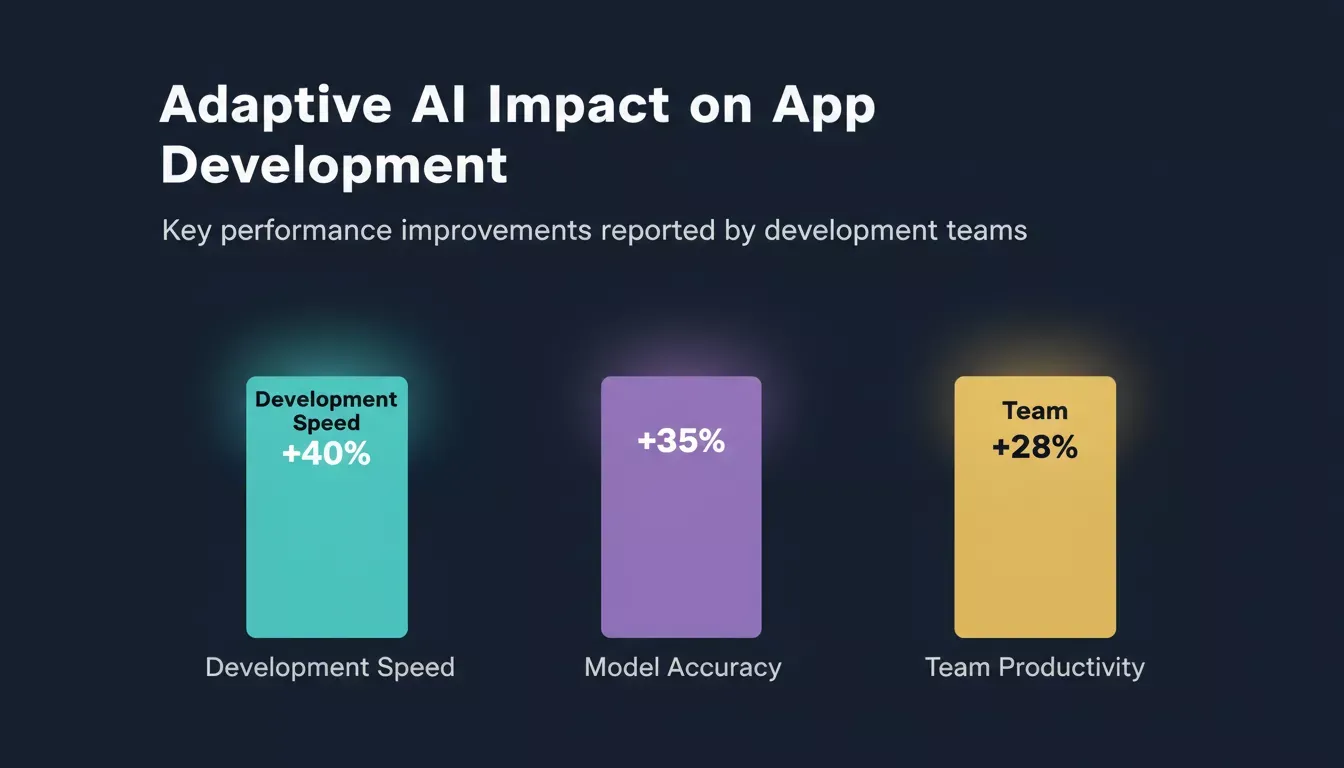
Development teams report meaningful gains in speed, accuracy, and productivity after integrating adaptive AI into their workflows.
For teams evaluating no-code AI builders for faster development, these performance improvements make the case for adopting adaptive systems early in the product lifecycle.
Adaptive AI Tools for Developers
Adaptive AI tools simplify integration into app creation pipelines. They allow teams to bring together structured and unstructured input data, improve predictive accuracy continuously, track performance and adjust automatically, and identify customer trends, preferences, and engagement metrics.
For teams working in dynamic, unpredictable environments, these tools reduce manual effort, support rapid prototyping, and help maintain high-quality standards. Pairing adaptive AI tools with a structured prompt-to-app workflow lets teams move from idea to working product without the overhead of traditional development cycles.
Community Insight
"Project work that used to take me 4 months (and multiple burnout cycles) now takes less than a week. I treat [AI] like a coding copilot." — r/AppBusiness discussion
Rocket.new: From Prompt to Production-Ready App
Rocket.new is a vibe solutioning platform built around three connected pillars: Solve, Build, and Intelligence. Together, they take an idea from validation to a shipped product without switching tools.
Solve runs market research and idea validation, returning structured reports with data, insights, and recommendations you can export as PDF, HTML, or PowerPoint.
Build turns natural-language prompts into production-ready Next.js web apps and Flutter mobile apps, with no code and no terminal required, and mobile builds go straight to the App Store and Google Play.
Intelligence then monitors your competitors continuously, surfacing pricing changes, new features, and hiring spikes as they happen, live in your dashboard.
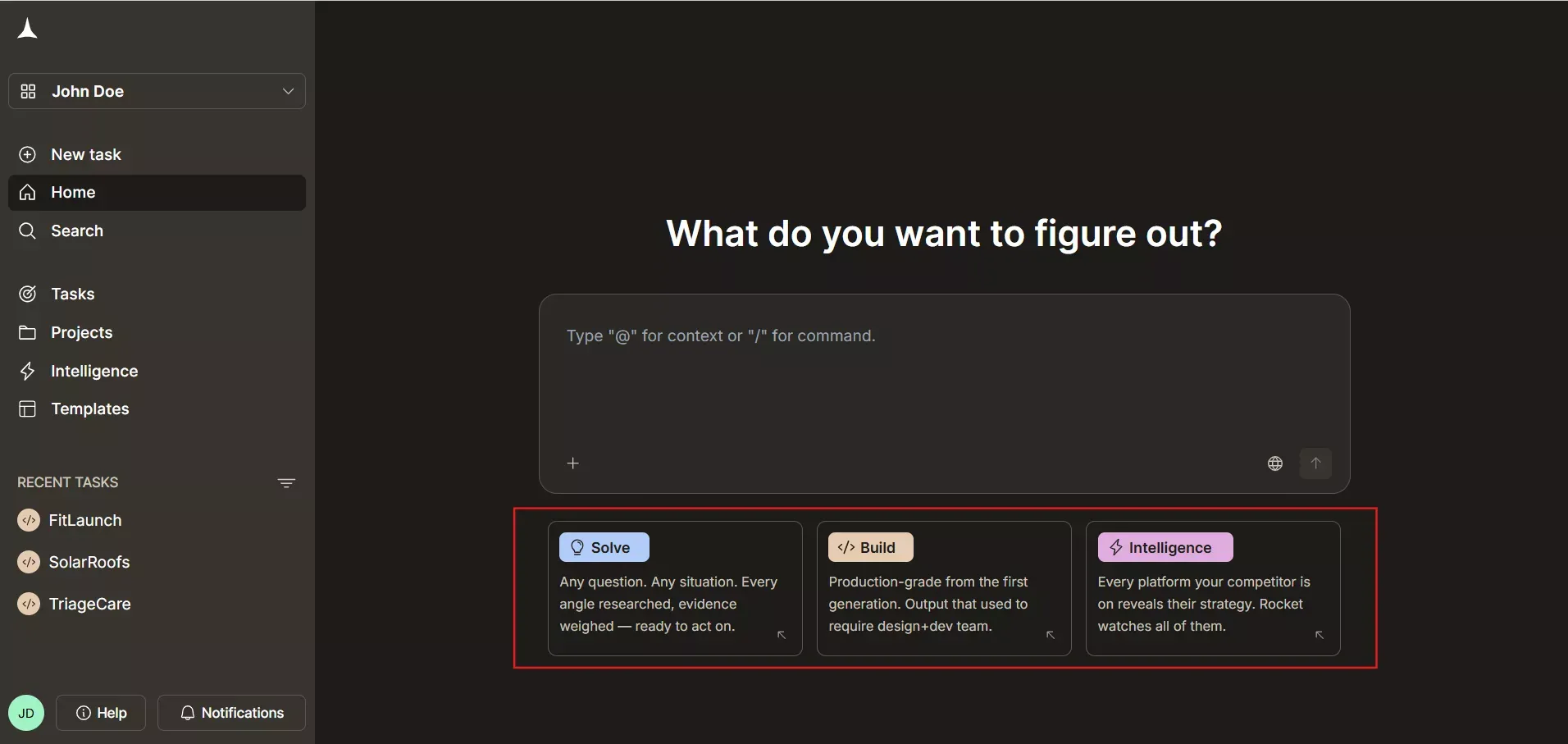
Rocket.new's three pillars share context: research from Solve flows directly into Build, and Intelligence signals can trigger new Solve analyses.
The pillars share context, so research from Solve carries directly into a Build session, and a signal from Intelligence can kick off a new Solve analysis or a product update, without re-explaining the idea from scratch each time. To see how Intelligence surfaces competitor signals in practice, read how Rocket's competitive intelligence works.
You can also explore what you can build on Rocket.new to understand the full range of apps, dashboards, and tools the platform generates from a single prompt.
Adaptive AI in Action: Broader Use Cases
Adaptive AI applications extend beyond app creation. By applying adaptive AI models to diverse datasets, organizations can quickly extract actionable insights, and continuous learning ensures systems remain relevant as new challenges appear.
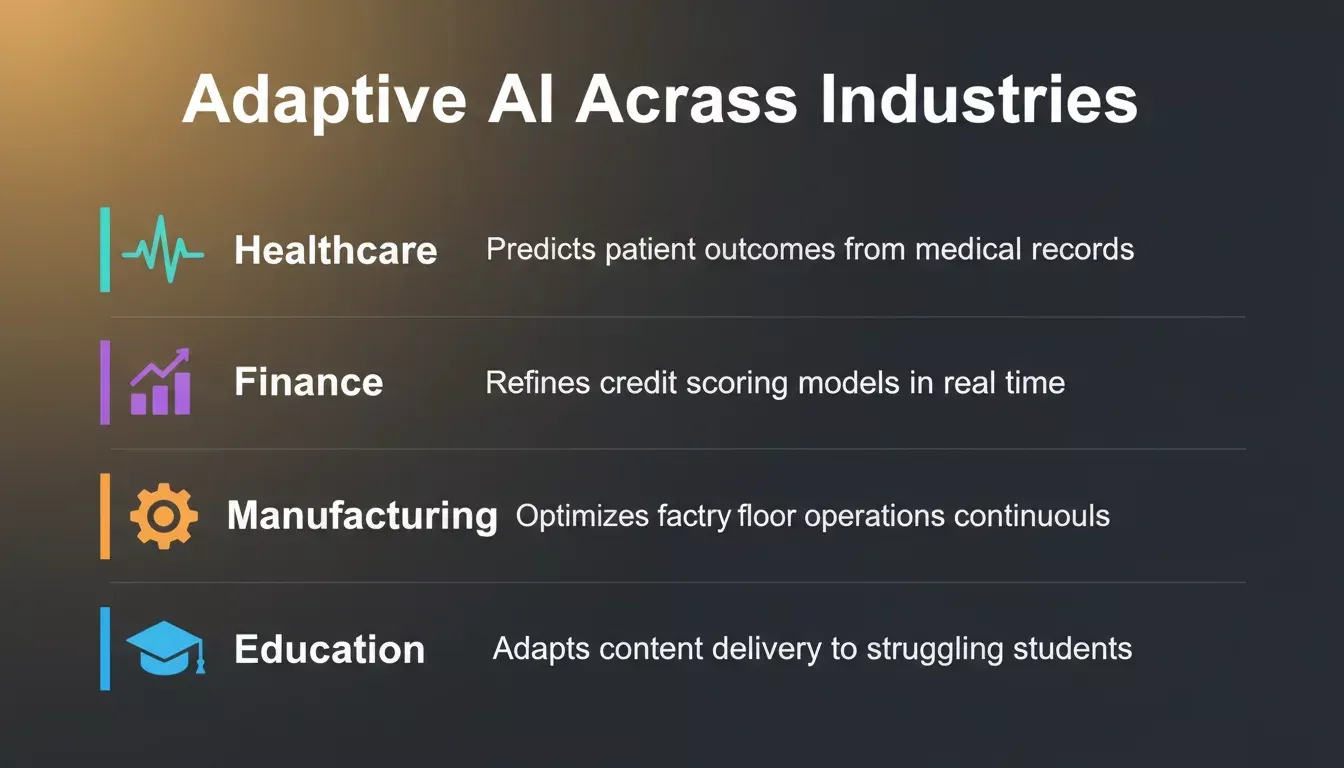
Adaptive AI delivers measurable results across four major industries, from predicting patient outcomes to personalizing educational content.
- Medical record analysis: Identifies trends and predicts patient outcomes.
- Evaluate customer risk: Adaptive AI algorithms refine credit scoring models in real time.
- Optimize factory floor operations: Continuous learning mechanisms improve efficiency.
- Educational platforms: Detect struggling students and adapt content delivery.
Responsible deployment matters as much as capability. Models that learn in real time must handle bias, ensure privacy, and maintain transparency through regular algorithm audits, separate validation datasets, and stakeholder review of AI-driven decisions. The NIST AI Risk Management Framework provides a practical structure for teams building audit and transparency practices into adaptive systems.
Adaptive AI for Smarter App Development
Adaptive AI is changing the way applications are created, maintained, and optimized, giving teams speed, flexibility, and predictive power that static systems cannot match. Continuous learning and real-time insights allow developers to respond faster, improve model performance, and maintain quality.
Adaptive AI is no longer just theoretical. It's a participant in the development lifecycle, shaping modern app creation and team workflows alike.
Ready to build smarter, faster apps powered by adaptive AI? Rocket.new gives you a full-stack platform that validates your idea, generates production-ready code, and monitors your market, all without switching tools.
Start building on Rocket.new and experience the difference continuous intelligence makes.
Table of contents
- -What Is Adaptive AI and How Does It Differ?
- -Adaptive AI vs. Traditional AI
- -Practical Applications in App Creation
- -How Adaptive AI Transforms Team Workflows
- -The Role of Machine Learning Algorithms
- -Adaptive AI Impact: What the Data Shows
- -Adaptive AI Tools for Developers
- -Community Insight
- -Rocket.new: From Prompt to Production-Ready App
- -Adaptive AI in Action: Broader Use Cases
- -Adaptive AI for Smarter App Development