
Rocket.new’s AI research tool stands out by delivering accurate, data-driven recommendations quickly. It simplifies complex problem-solving, enabling users to make smarter decisions with confidence and efficiency.
Why do AI research tools give lists instead of clear answers?
The simple answer is this. Most tools are built to show options, not conclusions. But a smarter system focuses on giving a recommendation based on real evidence.
That shift changes how research works in a big way. Instead of going through dozens of research papers, you get a focused answer supported by citations and data. This saves time and reduces confusion during the research process.
A study by McKinsey shows that professionals spend nearly 1.8 hours daily searching and gathering information. That’s a lot of time lost. So the question becomes clear. Can AI tools do better?
Let's understand how this approach can simplify your research and improve your results.
The Problem With Traditional AI Tools
You type a research question into one of many AI tools, expecting a clear answer. Instead, you get a long list of research papers, academic papers, and sometimes even unrelated links.
It feels useful at first, but the real work starts right after.
-
You open multiple papers and try to make sense of them
-
You organize scattered information across documents
-
You attempt to summarize papers manually
-
You highlight key points and compare findings
-
You cross-check citations for accuracy
Many AI tools rely heavily on keyword search. They scan large data sources and return relevant papers, but they stop at that stage. They don’t move forward to actually answer your question.
So, what does this mean for you? For researchers, students, and anyone handling literature reviews, this becomes time-consuming and frustrating. You still carry most of the workload. The tools assist, but they don’t really solve the problem.
Why Lists Are Not Enough Anymore?
Lists don’t actually answer your research question. They only point you toward possible answers, which means the real work is still on you.
-
You go through systematic reviews and dense papers manually
-
You depend on structured summaries that may not always be complete
-
You try to extract data and connect key insights yourself
-
You rely on citations but still need to interpret the evidence
-
You piece together answers from different academic papers
They help you find papers, but they stop before the real work begins. You are still left analyzing, connecting insights, and building the final answer on your own.
Meet Elicit and How It Approaches Research
Elicit is one of the best AI tools built for research, especially when working with academic papers and literature reviews.
-
Helps users find relevant papers quickly
-
Works well with academic papers and literature reviews
-
Provides structured summaries for faster understanding
-
Supports data extraction from research papers
-
Assists with systematic reviews and data analysis
-
Allows users to upload PDFs and work with uploaded documents
-
Supports follow up questions in natural language
-
Acts like an AI assistant that understands context
But there’s still a gap.
Elicit helps you analyze papers and organize summaries, but it often stops at that stage. You still need to interpret the data and form the final recommendation on your own.
Where Many AI Tools Still Fall Short?
Then comes the bigger issue. Even with AI powered tools like Elicit, the research process still needs manual thinking at the final stage.
-
You gather key findings from multiple papers
-
You compare results across different studies
-
You review references and citations for accuracy
-
You go through summaries and explanations
-
You connect the data to form your own conclusion
This is where the limitation shows.
Most AI tools are general-purpose. They assist with summaries and analysis, but they don’t provide a clear direction or a final answer backed by evidence.
What Makes Solve on Rocket Different?
Now, this is where things get interesting. Solve on Rocket.new shifts the focus from listing papers to delivering a clear answer backed by evidence.
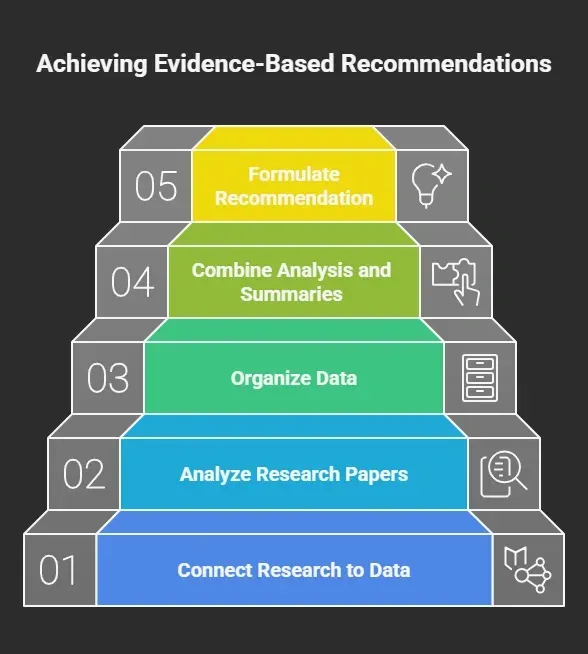 That’s the shift.
It changes the flow from showing options to providing a clear answer based on real data and citations, making the process more direct for researchers.
How to solve on Rocket Works?
So, how does it actually work? Solve is an AI-powered research engine built for strategic business questions and decision-making.
-
Takes your research question in plain language from the Solve input
-
Classifies it into one of nine intelligence types automatically
-
For ambiguous prompts, ask clarifying questions before starting to sharpen the scope
-
Breaks the question into its component dimensions, each of which becomes an independent research stream
-
Runs all streams simultaneously through parallel agents, not in sequence
-
Each agent researches its stream, identifies findings, and assesses the data
-
Synthesizes all findings into a structured report with an executive summary, detailed analysis, supporting evidence, and actionable recommendations
In simple terms, it connects everything.
From question to research to analysis to recommendation, the entire process stays in one flow without breaking context.
Key Features of Solve on Rocket
Let's break down the key features in a simple way.
| Feature | What It Does |
|---|---|
| Natural Language Input | Ask any business question in plain language no technical framing needed |
| Query Decomposition | Breaks your question into research dimensions, each handled by a separate agent |
| Parallel Agent Research | All research streams run simultaneously for faster, deeper coverage |
| Structured Reports | Delivers an executive summary, detailed analysis, supporting evidence, and recommendations |
| Follow-up Questions | Suggests smart follow-ups after the report so you can drill deeper without re-framing |
| Share and Export | Reports can be shared within your workspace or exported for use outside Rocket |
These features simplify the workflow. You spend less time organizing scattered information and more time understanding key insights and making decisions.
From Questions to Recommendations
After that, let's talk about the real benefit. Solve connects everything into one flow, where your business question, live data, and parallel research streams are handled together instead of separately.
-
Breaks your question into dimensions and runs all research streams at once for deeper coverage
-
Each agent stream identifies what it researched, what tools it used, and how it assessed the findings
-
Builds a structured report with an executive summary, analysis sections, supporting evidence, and recommendations
-
Suggests follow-up questions after the report so you can go deeper on specific findings
-
Reports live in your project so you can reference them as you move into Build
For anyone making strategic business decisions market entry, competitive positioning, pricing, product direction this removes the manual work of gathering and synthesizing scattered information and keeps the focus on understanding and acting..
Community Insight
Here’s a real perspective from X:
“Most AI tools just give you links and papers. What people actually want is a clear answer backed by sources.” Twitter(X)
This highlights a clear shift. Users are no longer satisfied with just lists of research papers or scattered results. They expect tools that provide direct answers supported by citations, evidence, and proper context.
Why Modern Research Needs Better Tools?
So, what does this mean for modern research?
Founders, strategists, and product teams today deal with a constant flow of data, and making sense of it all is becoming more demanding.
-
Founders need market validation and competitive context before building
-
Strategy teams need structured analysis before defining direction
-
Product teams need evidence-backed insights before prioritizing features
-
Professionals work regularly with reports, competitive data, and market analysis
-
Tools need to support decisions, not just discovery
Solve on Rocket connects research, analysis, and recommendation generation into one system, reducing the gap between finding data and making decisions.
Elicit vs Solve on Rocket
Let's compare briefly. Both tools support research, but they approach it in different ways.
-
Elicit helps in finding and analyzing academic research papers
-
Supports literature reviews and structured summaries
-
Focuses on organizing and understanding research information
-
Solve is built for strategic business questions market sizing, competitive analysis, pricing benchmarks, and product direction
-
Focuses on delivering a structured, evidence-backed recommendation instead of just summaries
Both tools serve different goals. Elicit works well for academic research and literature analysis, while Solve stands out when you need a clear business recommendation backed by live data and structured evidence.
Why This Matters for Founders, Strategists, and Teams
Finally, let's bring it back to who benefits most. Whether you are validating a business idea, planning a market entry, or benchmarking competitors, managing research efficiently directly affects the quality of your decisions.
-
Founders need market validation and a competitive context before building
-
Strategy teams need structured analysis before defining direction
-
Product teams need evidence-backed insights before prioritizing features
-
Both rely on data, analysis, and recommendations not just lists of links
-
Time becomes a key factor in handling all this work
Using AI-powered tools that give structured reports helps, but systems that provide direct recommendations make the process faster, more accurate, and easier to act on.
A Shift Toward Answers, Not Lists
Most tools still return lists of results and summaries, leaving strategists and founders to handle analysis, synthesis, and decision-making manually. This slows down the process and makes it harder to connect insights across multiple sources. A system like Solve brings everything into one flow — combining live data research, parallel agent analysis, and structured synthesis to deliver clear recommendations instead of scattered information.
The AI Research Tool That Returns a Recommendation focuses on clarity, not just speed. It helps you move from searching to understanding without getting stuck in endless results. With fewer steps and stronger connections between data and insights, decision-making becomes more direct and reliable.
Table of contents
- -The Problem With Traditional AI Tools
- -Why Lists Are Not Enough Anymore?
- -Meet Elicit and How It Approaches Research
- -Where Many AI Tools Still Fall Short?
- -What Makes Solve on Rocket Different?
- -How to solve on Rocket Works?
- -Key Features of Solve on Rocket
- -From Questions to Recommendations
- -Community Insight
- -Why Modern Research Needs Better Tools?
- -Elicit vs Solve on Rocket
- -Why This Matters for Founders, Strategists, and Teams
- -A Shift Toward Answers, Not Lists