
TL;DR: Rocket.new generates a full-stack, production-ready website from one plain-language prompt, with backend logic, real integrations, and one-click deployment, no coding needed.
What if you could skip the drag-and-drop frustration, skip the template roulette, and skip the "your site is live but looks like 2014" moment all in a single weekend?
That is exactly what Rocket.new makes possible. Describe your site in plain language, and the platform automatically generates a fully functional, production-ready web app complete with backend logic, user authentication, and deployment in minutes.
No coding knowledge required. No visual editor wrestling. No paid plans just to access basic features.
Why Traditional Website Builders Are Hitting Their Ceiling
Most website builders were designed for a simpler era: pick a template, drag some blocks around, publish. That worked fine when "having a website" was the goal. But the bar has moved.
Today, people want interactive sites with real backend logic, payment gateways, dynamic content, user authentication, and custom code, not just a pretty landing page. Traditional website builders have a ceiling.
Wix powers 4.3% of all websites globally, Squarespace covers 2.5%, and Webflow, the most developer-friendly of the drag-and-drop crowd, holds just 0.9% of all websites. These platforms built their audiences on ease of use, but they consistently run into the same wall: they are great for starting points, but they rarely get you to a fully functional web app.
Here is what that wall looks like in practice:
-
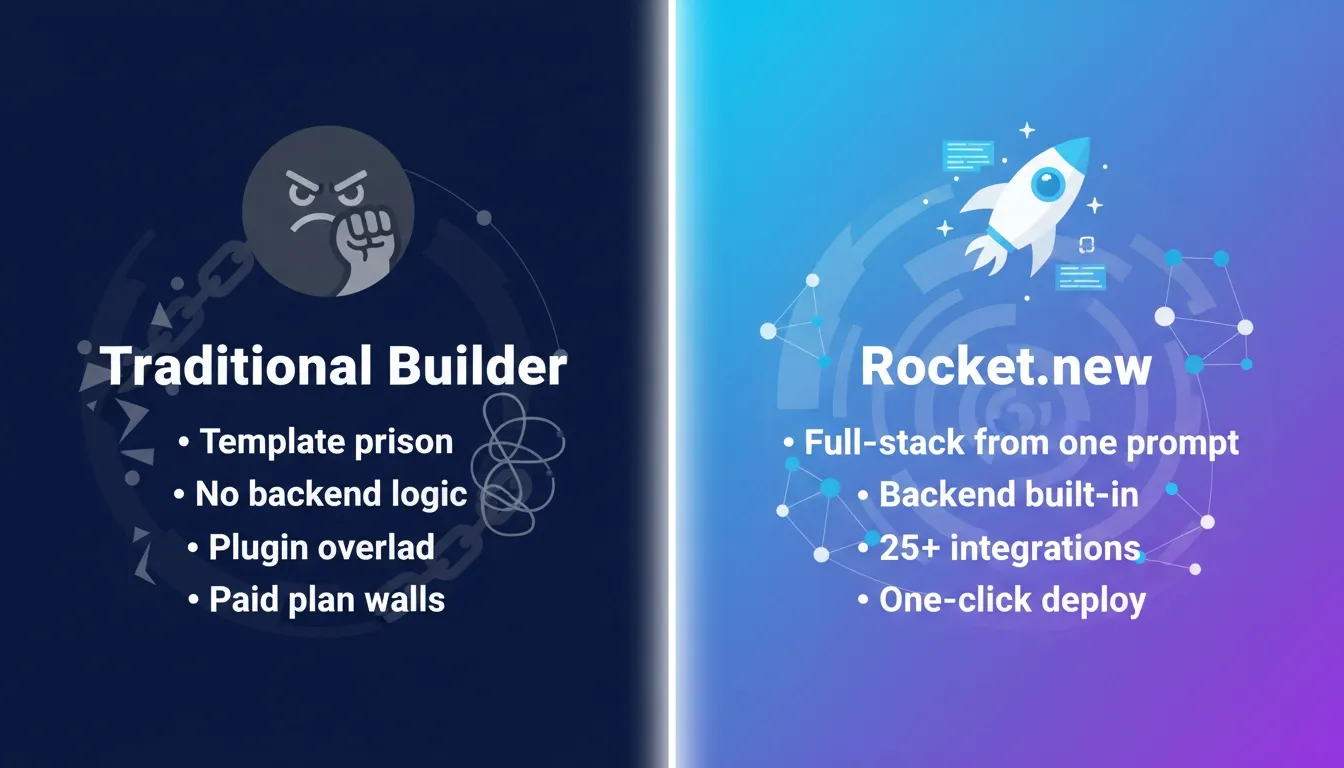
You hit a feature limit and need a paid plan to unlock it
-
Your design looks like everyone else's because you are all using the same template library
-
Adding backend logic means leaving the builder entirely and stitching together third-party tools
-
Mobile optimization is an afterthought, not a default
-
Layouts are constrained by the builder's proprietary system, limiting complexity
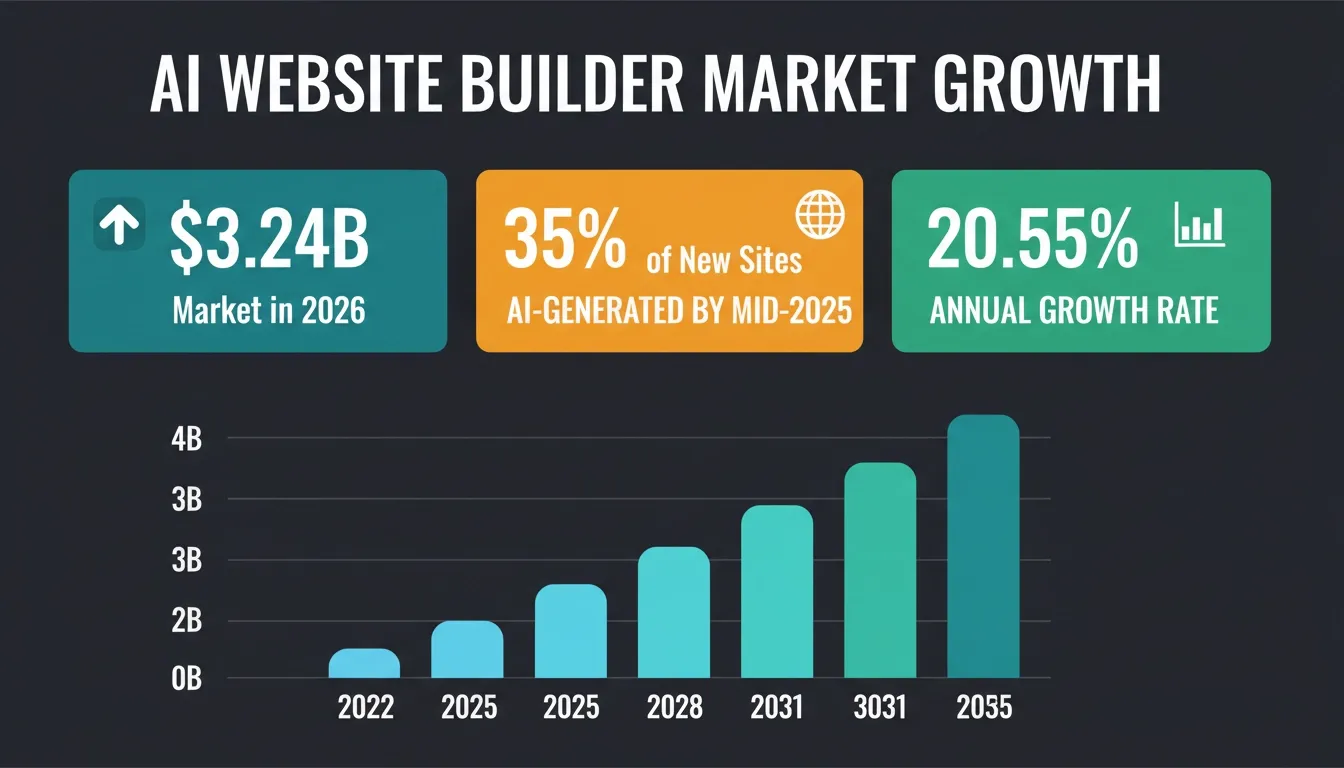
35% of newly published websites were AI-generated or AI-assisted by mid-2025, up from essentially zero before late 2022. The shift is happening. The question is whether you are building with tools that match the moment.
The Problem Is Not Effort: It Is the Starting Point
Here is a pattern that repeats constantly: someone has a clear idea for a site, opens a website builder, spends two hours picking a template, another hour adjusting fonts and colors, and then hits a wall when they try to add anything beyond the basics.
The problem is not effort. The problem is the starting point.
Traditional builders hand you a blank canvas with a set of pre-built blocks. You are assembling something from parts. AI builders like Rocket.new flip that model entirely: you describe what you want in natural language, in a single prompt, and the platform automatically generates a working product. Not a wireframe, not a mockup, but a real, deployable site with actual code behind it.
Website development is 90% faster with low-code and AI platforms, and companies can cut development costs by up to 70%. That speed gap is not a minor convenience. It changes who can build, what they can build, and how fast they can ship.
What "Beating" a Website Builder Actually Means
When we say "builders-beating," we mean a site that does things traditional website builders simply cannot do out of the box:
-
Full-stack generation: Frontend and backend logic generated together, not assembled from plugins
-
Production-ready code: Actual Next.js or Flutter code, not a visual layer over a proprietary system
-
Real integrations: Stripe, Supabase, Google Analytics, Mailchimp, and 25+ others, authenticated once and flowing into every build
-
Custom domain and deployment: Live with a shareable URL in one click, with staging and production environments
-
No template ceiling: Every site is generated fresh from your description, not reskinned from a library
Most AI builders still operate like traditional website builders with a smarter setup wizard. They personalize a template from existing elements, which is a step forward, but not the same as generating something unique from scratch.
The difference matters when you need a complex web app, not just a high-converting landing page.
How Rocket.new Works: From One Prompt to Live Site via Natural Language
The workflow is straightforward. You describe your idea in plain language, including the app type, key screens, features, and design preferences. Rocket.new plans the architecture, writes production-ready code, and shows you a live preview. Most apps generate in 1 to 3 minutes.
After the first generation, you refine through three editing modes:
-
Chat: Describe changes in natural language ("add a pricing section with three tiers")
-
Visual edit: Click any element on the page and adjust it directly
-
Code: Open the source and edit it yourself
No change limit. No locked sections. No "upgrade to edit this" prompts. When you are ready, click Launch and your site goes live instantly with a shareable URL. Then connect a custom domain, add integrations, and track analytics, all from the same dashboard.
The app generation covers everything: UI and navigation, backend logic, design system, SEO structure, accessibility compliance, and performance optimization. These are the baseline, not optional extras. You can also start from one of 25,000+ free templates or import a Figma file directly.
What You Can Build This Weekend
Rocket.new is not limited to landing pages. Here is a breakdown of what the platform generates, compared to what traditional website builders can handle:
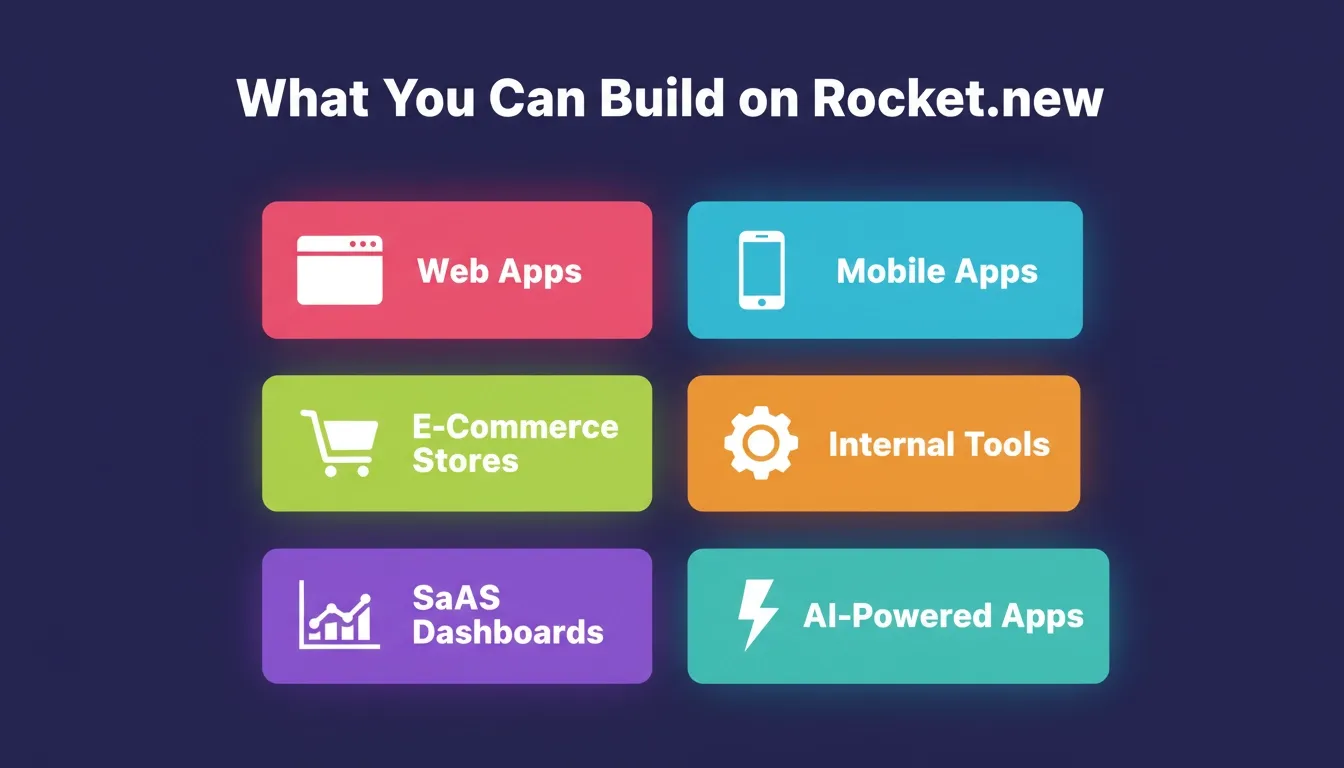
| Project Type | Examples | Rocket.new | Traditional Builder |
|---|---|---|---|
| :--- | :--- | :---: | :---: |
| Web apps | SaaS dashboards, customer portals | Yes | No |
| Mobile apps | iOS and Android via Flutter | Yes | No |
| E-commerce | Checkout flows, payment integrations | Yes | Partial |
| Internal tools | OKR trackers, compliance dashboards | Yes | No |
| Complex web app | Marketplaces, multi-role platforms | Yes | No |
| MVP builds | Rapid prototypes for founders | Yes | No |
| Dashboards | Analytics views, admin panels | Yes | No |
| Landing pages | Marketing sites, portfolios | Yes | Yes (basic) |
The gap is sharpest in the middle rows. Traditional website builders can produce a landing page. They cannot produce a complex web app with real backend generation, user authentication, and payment gateways, not without a developer and a stack of third-party tools.
Rocket.new: The AI-Powered Website Builder Built for Different Needs
Rocket.new serves three distinct groups, each with different needs:
Founders and Solopreneurs
They want to ship an MVP without hiring a development team. They describe their idea, get a working product, and iterate from there. The platform handles the backend generation so they can focus on the product itself. 1.5 million people across 180 countries have already tried Rocket.new, from solopreneurs to enterprise teams.
Developers and Designers
They want to move faster without sacrificing quality. They use Rocket.new as a starting point, generate the scaffold, then edit the source code directly. The code is production-grade Next.js or Flutter, not a proprietary format locked to the platform.
Teams and Agencies
They need to deliver more without adding headcount. They use Rocket.new to generate first drafts, connect client integrations, and ship polished work faster than a traditional build cycle allows. Rocket.new also includes competitive intelligence tools to track what competitors are doing after you ship.
The AI Builder That Goes Beyond the Visual Editor
Most AI builders give you a visual editor with some AI assistance. Rocket.new gives you a complete website from a single prompt and then lets you edit it any way you want. The platform automatically generates the full stack: UI, navigation, backend logic, data models, API routes, and design system, all from one description.
Integrations That Flow Into Every Build
Rocket.new connects to 25+ tools via workspace connectors that authenticate once and flow into generation automatically. Payments via Stripe and PayPal. Analytics via Google Analytics and Mixpanel. Databases via Supabase. Email via Mailchimp, SendGrid, Brevo, and MailerLite. Scheduling via Cal.com and Calendly. Forms via Typeform and Tally. AI services via Anthropic, OpenAI, Gemini, and Perplexity.
Traditional website builders require you to install plugins, configure API keys, and test each integration separately. Rocket.new handles that at the generation layer: the integration is part of the build, not bolted on afterward.
After You Ship
Deployment is one click. After that, connect a custom domain, switch between staging and production environments, roll back to any previous version with one action, and track visitors, conversions, accessibility scores, and Core Web Vitals from the built-in analytics dashboard. Export and download the full source code at any time. Your code is yours, not locked into a proprietary system.
Where Most AI Builders Fall Short
It is worth being specific about the limitations of traditional and most AI builders, because they are not edge cases, they are the norm for anyone building beyond a simple brochure site.
Wix is excellent for small business sites and portfolios. But its backend capabilities are limited to Velo, its proprietary JavaScript framework. Exporting code to a standard hosting environment is not straightforward.
Squarespace is polished and design-forward, but it is fundamentally a content site builder. Dynamic content, real backend logic, and complex web app functionality are outside its scope.
Webflow is the most capable of the traditional builders: it generates clean HTML and CSS, and its CMS is useful. But it does not generate backend logic. For anything requiring server-side code, user authentication, or database operations, you are still writing that yourself or connecting external services.
Bolt and Lovable are newer AI builders that generate code from prompts, which is a step forward. But most still operate on a template-personalization model, and the output is a styled starting point, not a fully generated product with backend generation and real integrations baked in.
Bubble offers no-code complexity for web apps, but the learning curve is steep and the output is locked to Bubble's proprietary runtime. Scalable production deployments require significant additional work.
Rocket.new generates the full stack from a single description. That is the structural difference. If you are evaluating alternatives, the Rocket Build page shows the full inventory of what ships with every build.
What the Community Is Saying
The shift toward AI-powered building is showing up in real conversations.
"I just one shotted a prompt using @rocketdotnew and I can't put into words how astronomically better it is than any other no code AI tool. Actually made me question why I ever paid for Bolt, Lovable, V0, a0 etc when this tool puts them all to shame. Incredibly impressed, wow." — Mia Williams, @miatravls on X
"Shipped a full SaaS landing page plus waitlist app for a client in one afternoon. Used to take me 3 days minimum with a traditional builder plus backend setup. The AI-generated code was clean enough to hand off directly. This is the new baseline."— Shared on LinkedIn, May 2026
That shift, from days to hours, from assembled to generated, is what 1.5 million people across 180 countries have already tried on Rocket.new.
App Generation in Action: Your Weekend Build Plan
So what can you realistically ship this weekend? Here is a practical tutorial breakdown:
Saturday Morning (2-3 hours)
-
Write a clear, specific prompt describing your site, including the type, key screens, target users, and features you need
-
Generate your first version on Rocket.new
-
Review the live preview and note what to change
Saturday Afternoon (2-3 hours)
-
Refine through Chat: adjust layout, add sections, connect integrations
-
Use Visual edit for any design tweaks
-
Test the site as a real user would
Sunday (2-4 hours)
-
Connect your custom domain
-
Set up analytics tracking
-
Do a final review across mobile and desktop
-
Deploy and click Launch
By Sunday evening, you have a fully functional, production-ready site with real backend logic, real integrations, and real code you own. Not a template, not a mockup, but a complete website built for different needs than what traditional builders were designed to serve.
Check out the AI landing page builder guide to see how fast a single page can go live.
The AI Website Builder Market Is Shifting Fast
The data-driven stats below capture where the market stands today and why the window to build faster is now.
 The old model was: idea, then months of planning, then a developer, then a designer, then a launch. That model made sense when building on the web required specialized skills at every step. The result was weeks of work, significant cost, and a site that still might not do what you actually needed.
The new model is: idea, then a prompt, then a live site. Rocket.new is built for that model, generating fully functional websites and web apps from natural language descriptions, with production-grade code, real integrations, and one-click deployment. If you want to ship a website builders-beating site on Rocket.new this weekend, the platform is ready. The only thing left is your idea.
Ready to stop assembling and start generating? Start building on Rocket today. Describe your idea, watch the platform generate your complete website in minutes, and ship something that leaves traditional website builders behind.
Table of contents
- -Why Traditional Website Builders Are Hitting Their Ceiling
- -The Problem Is Not Effort: It Is the Starting Point
- -What "Beating" a Website Builder Actually Means
- -How Rocket.new Works: From One Prompt to Live Site via Natural Language
- -What You Can Build This Weekend
- -Rocket.new: The AI-Powered Website Builder Built for Different Needs
- -Founders and Solopreneurs
- -Developers and Designers
- -Teams and Agencies
- -The AI Builder That Goes Beyond the Visual Editor
- -Integrations That Flow Into Every Build
- -After You Ship
- -Where Most AI Builders Fall Short
- -What the Community Is Saying
- -App Generation in Action: Your Weekend Build Plan
- -Saturday Morning (2-3 hours)
- -Saturday Afternoon (2-3 hours)
- -Sunday (2-4 hours)
- -The AI Website Builder Market Is Shifting Fast