
How AI solutioning for businesses can drive growth? See the practical steps, key tools, and real-world applications to improve efficiency, decision making, customer experience, and scalable business processes.
Is AI solutioning becoming a necessity for modern businesses?
Yes. Organizations of all sizes now use artificial intelligence to manage growing data volumes, accelerate decision-making, and remain competitive.
Approximately 78% of companies worldwide already rely on AI in at least one business function, and that number continues to rise year over year.
This shift is practical. Businesses want clarity, speed, and systems that grow without pushing costs too high. AI solutioning supports those goals when it focuses on solving real business problems rather than chasing trends.
What is AI Solutioning for Businesses
AI solutioning for businesses is the structured process by which organizations identify challenges and apply artificial intelligence to solve them in measurable ways. It brings together data, AI tools, machine learning, and workflows that fit naturally into existing business processes.
Rather than building everything from scratch, many teams rely on proven AI products, foundation models, and AI applications. These tools help with forecasting, customer interactions, reporting, and planning.
The focus remains on outcomes such as higher productivity, greater efficiency, and sustained value creation across the organization.
Key Business Problems AI Can Solve Today
Now, let’s talk about where AI really earns its place.
Many businesses struggle with the same issues, especially when operations grow more complex and data volumes increase.
AI helps solve problems such as:
- Manual and repetitive tasks that slow teams down and reduce productivity
- Slow decision making caused by delayed data analysis
- Poor customer experience due to long response times or inconsistent service
- Data overload where vast amounts of data exist but insights are missing
- High operational costs driven by inefficiencies and wasted resources
So, instead of teams spending time on repetitive tasks, AI-powered automation steps in. Instead of guessing, leaders rely on data-driven decisions.
Core Components of an AI Solution
Every successful AI initiative relies on a few core components working together smoothly.
It starts with data sources and data quality. Clean, accurate enterprise data gives AI models the information they need to perform well.
Next come AI models and algorithms. These include machine learning methods, natural language processing, and foundation models that support analytics, forecasting, and conversational tools.
After that, automation and workflows connect AI to everyday tasks. This is where organizations automate workflows across areas like human resources, finance, and supply chain management.
Compatibility with existing systems also matters. AI solutions should integrate seamlessly with existing CRM, ERP, and reporting platforms.
Finally, monitoring, security, and governance keep everything stable. These practices protect data, manage access, and track performance over time.
Popular AI Solutions Used by Businesses
Across industries, several AI solutions consistently show value and reliability.
Common examples include:
- AI powered customer support and chatbots that improve response times and customer experience
- Predictive analytics and forecasting tools used for financial planning, demand prediction, and risk assessment
- Marketing and sales automation tools that support marketing campaigns and limited AI generated content
- Intelligent process automation for handling approvals, invoicing, and order tracking
- Recommendation engines that suggest relevant products or content to customers
These solutions often serve as a starting point for companies beginning their AI journey.
How AI Solutioning Drives Business Growth
So, how does all this translate into growth? That’s where things get interesting.
AI solutioning accelerates operations, reducing delays and lowering operating costs. Customer retention improves when service feels responsive and personalized. AI models learn from customer data and behavior, helping teams communicate more effectively.
Leaders gain confidence through informed decision-making, supported by data analysis rather than intuition. Over time, business processes scale smoothly, enabling organizations to grow without overstretching resources.
Choosing the Right AI Solutioning Partner or Platform
Next comes the decision of who to work with.
A good partner brings industry knowledge and understands real-world challenges.
- Flexibility matters because needs change over time.
- Compatibility with existing systems reduces friction.
- Strong security practices protect customer data and internal information.
- Transparent pricing and scalability help keep costs under control as usage grows.
Common Challenges in AI Solutioning and How to Overcome Them
AI adoption is rarely perfect from day one.
Data privacy and security concerns require clear rules and oversight. Limited internal expertise can slow progress, which many organizations address through AI training or guidance from AI experts. Legacy systems sometimes limit flexibility, though supporting tools can bridge gaps.
Change management challenges arise when teams adjust to new workflows, underscoring the value of communication and support. ROI measurement becomes easier when success metrics are defined early.
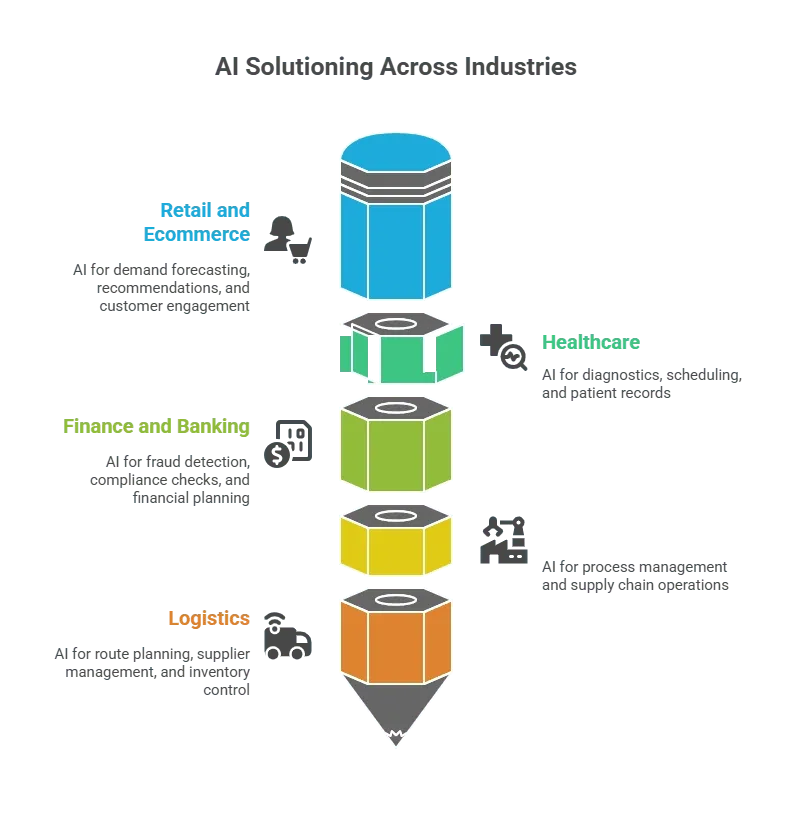
AI Solutioning Use Cases Across Industries
AI solutioning shows up almost everywhere.
Future of AI Solutioning for Businesses
Looking ahead, AI continues to expand across organizations.
Generative AI supports content creation, reporting, and knowledge management. AI agents increasingly manage tasks across systems with limited human intervention.
Regulation and governance grow as AI adoption spreads. Access to AI tools expands for non technical users through simpler interfaces and AI assistants.
Community Insight
A discussion from the Reddit AI Guild reflects real business thinking:
“In 2025, most companies using AI started small with forecasting or customer support. Over time, those tools expanded into planning, reporting, and automation across teams.”
Rocket.new and AI Solutioning
Rocket.new helps teams move from ideas to working AI solutions without heavy technical effort. It is built for speed, clarity, and real business use cases, especially for teams that want results without long development cycles.
Top features:
- One-prompt app generation: Create a complete, production-ready app from a simple description in plain English.
- Figma-to-code conversion: Import Figma designs and instantly generate responsive app code for web or mobile.
- Automatic backend setup: Databases, authentication, APIs, and cloud infrastructure are created automatically.
- Multi-platform support: Build web and mobile apps from a single prompt or design input.
- Template library: Access ready-made templates for dashboards, landing pages, internal tools, and more.
- SEO-optimized copy and UI design: Generate apps with built-in SEO-friendly content and intuitive UX.
- Deployment and hosting support: Publish directly or integrate with services like GitHub and hosting platforms.
- Integrations with external services: Connect to payment gateways, analytics tools, and AI models seamlessly.
- Full code ownership: Export and own all generated code to customize or extend as needed.
Rocket.new helps businesses focus on solving problems and creating value, instead of getting stuck in technical setup or complex development work.
Building Momentum with AI Solutioning for Businesses
AI solutioning for businesses works best when guided by real goals, reliable data, and practical tools. When applied thoughtfully, artificial intelligence becomes part of daily operations, supports informed decisions, and creates steady long-term value without unnecessary complexity.
Table of contents
- -What is AI Solutioning for Businesses
- -Key Business Problems AI Can Solve Today
- -Core Components of an AI Solution
- -Popular AI Solutions Used by Businesses
- -How AI Solutioning Drives Business Growth
- -Choosing the Right AI Solutioning Partner or Platform
- -Common Challenges in AI Solutioning and How to Overcome Them
- -AI Solutioning Use Cases Across Industries
- -Future of AI Solutioning for Businesses
- -Community Insight
- -Rocket.new and AI Solutioning
- -Building Momentum with AI Solutioning for Businesses