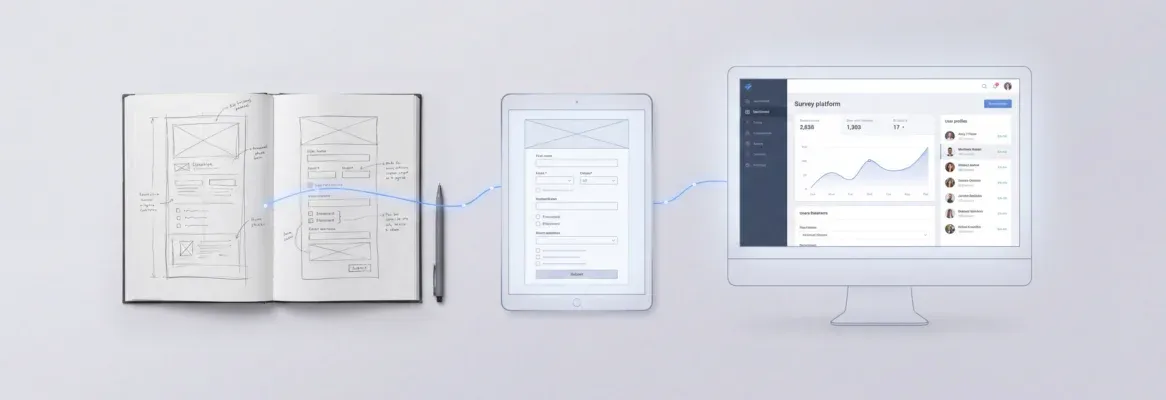
Every subsequent build on Rocket.new starts smarter than the last. The platform accumulates intelligence from your prompts, fixes, and patterns, improving speed, accuracy, and output quality over time. The result is a faster, cleaner workflow where each new project begins ahead of where you left off.
Why does each new app feel faster and cleaner than the last one?
Because the intelligence you built last time does not disappear. It carries forward.
According to the Stack Overflow 2024 Developer Survey, 76% of developers are already using or planning to use AI tools in their workflow. The shift is not just about writing code faster. It is about building smarter each time, with better output and fewer repeated mistakes.
This blog explains exactly how that works on Rocket, and why it matters more than most builders realize.
The Real Cost of Starting Over
Every time you open a blank project in a standard AI tool, you pay a hidden tax.
You re-explain the product. You re-describe the user. You re-establish the design direction. You re-connect the integrations. You re-fix the same structural errors that appeared in the last build. None of that work compounds. It just repeats.
The cost is not the time it takes. The cost is what you could have built instead.
Traditional development had the same problem, but it was expected. You hired a team, they ramped up, and they built institutional knowledge over months. When someone left, that knowledge walked out with them. Most AI tools promised to fix this, yet they made individual sessions faster while leaving the compounding problem completely unsolved.
What "Starting Over" Actually Looks Like
| What You Re-Do | In a Session-Based AI Tool | On Rocket |
|---|---|---|
| Describe the product | Every session | Once, stored in Context |
| Explain the user persona | Every session | Carried from Solve research |
| Re-establish design direction | Every session | Retained from first build |
| Reconnect integrations | Every build | Authenticated once, flows into every build |
| Re-fix structural errors | Repeatedly | Fixed once, tracked in Versions |
| Re-explain competitive context | Every session | Pulled from Intelligence automatically |
The difference is not a feature. It is a structural decision about where intelligence lives.
What Accumulated Intelligence Actually Means on Rocket
Accumulated intelligence is not a metaphor. On Rocket, it is a specific architectural choice called Context: the shared memory layer that runs through every action in a project.
Every Solve session, every build, every Intelligence report, and every refinement feeds into this layer. As a result, every subsequent build starts from the full accumulated intelligence of the project, not from a blank prompt.
You add your files, your brand guidelines, your customer research, and your competitive landscape once. Every task already knows everything. Nothing gets re-explained.
Here is what that means in practice:
- When you run Solve before building, the market research and product direction it produces flow directly into the build. The hero section speaks to the specific customer problem Solve identified. The feature set reflects the competitive gaps Intelligence surfaced.
- When you build the second version of a product, Rocket already knows what the first version was, what was changed, and why. The second build is a continuation, not a fresh generation.
- When your team picks up the project three weeks later, nobody re-explains anything. The context, the decisions, and the reasoning are all there.
According to Rocket's official product documentation, the tenth task in a project is categorically sharper than the first. This is not because prompting improved. It is because the project accumulated months of decisions, research, and competitive signals.
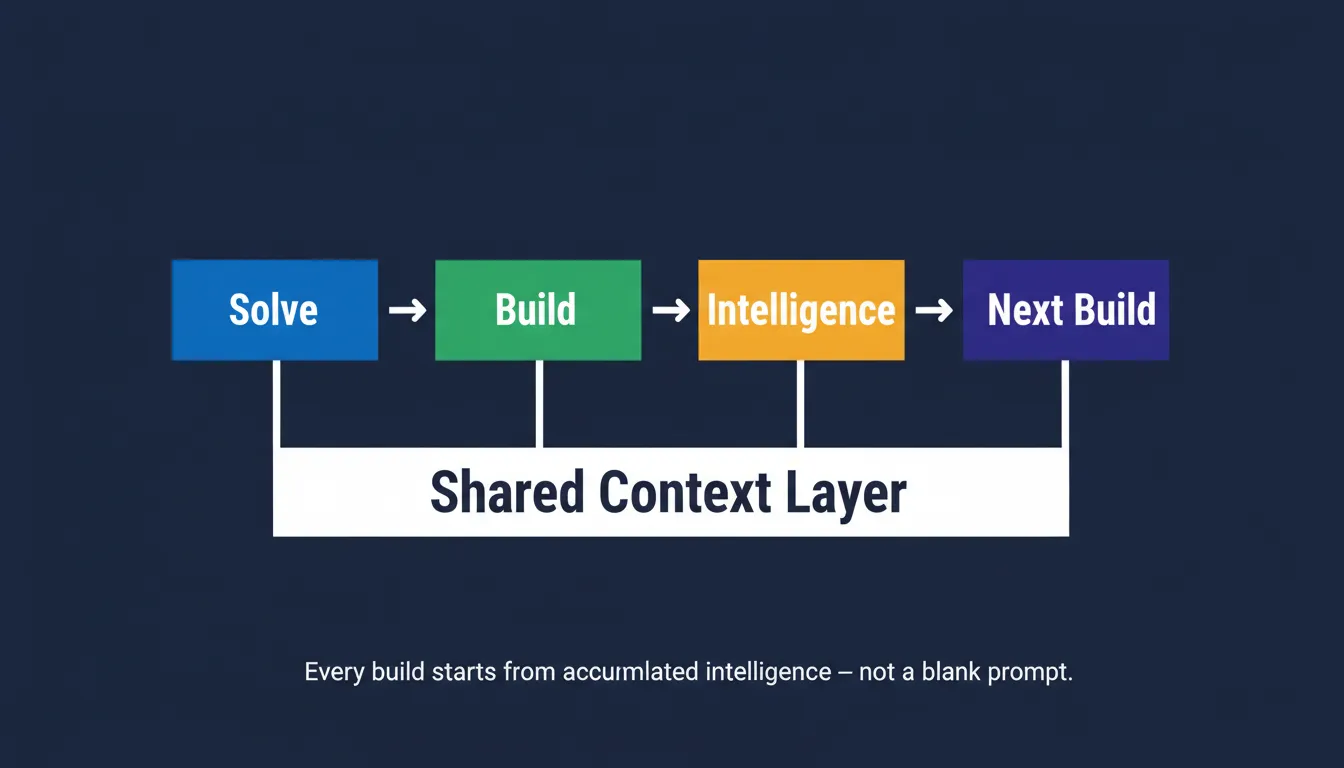
How Rocket's three pillars connect through a shared context layer, so every subsequent build starts from accumulated intelligence rather than a blank prompt.
The Prompt-Pattern-Feedback Loop
The prompt is not just a command. It is compressed thinking. The quality of what comes out is directly proportional to the quality of what went in, and that quality improves every time you build.
Here is the loop in action:
Prompt → Output → Refine → Better Prompt → Better Output → Retained in Context → Next Build Starts Ahead
Most AI tools break this loop at the last step. The refinement happens, the output improves, and then the session ends. The next session starts at the same place the last one did.
On Rocket, the loop does not break. The refinement is retained. As a result, the next build starts where the last one ended, not where the last one began.
When you describe your idea to Rocket for the first time, the output is good. When you refine it, adjusting the data model, sharpening the user flow, and fixing the navigation logic, the output gets better. When you build the next product in the same project, Rocket already understands your style, your standards, and your direction.
This is not personalization in the consumer sense. It is accumulated project intelligence. The system does not guess what you want. It knows what you built, what you changed, and what direction you are moving in. Understanding how vibe coding shapes next-generation workflows helps explain why prompt refinement matters less on Rocket over time: the context fills in what the prompt leaves out.
Why Session-Based AI Builders Cannot Do This
The tools that dominate the current AI builder market are capable at what they do. They generate fast, handle a wide range of requests, and produce usable output from a single prompt. However, they are built around a session model. Each session is its own universe.
The context you establish in one session does not travel to the next. The refinements you made last Tuesday are not available this Tuesday. If you are working with a team, each person's session is their own, with no shared intelligence layer connecting them.
This is not a bug. It is a design choice. Session-based tools are simpler to build and work well for one-off tasks. The cost shows up when you are building something that evolves over time, or when you are working with a team that needs to stay aligned.
Three structural gaps that session-based tools share:
- No pre-build intelligence. The tool has no opinion on whether what you asked it to build was worth building. The quality of what comes out depends entirely on what you brought to the tool.
- No shared memory architecture. Every person starts their own session with their own context. Coordination happens outside the tool, which means it is always incomplete.
- You are the integration layer. API keys, configurations, error handling, and context management are your responsibility.
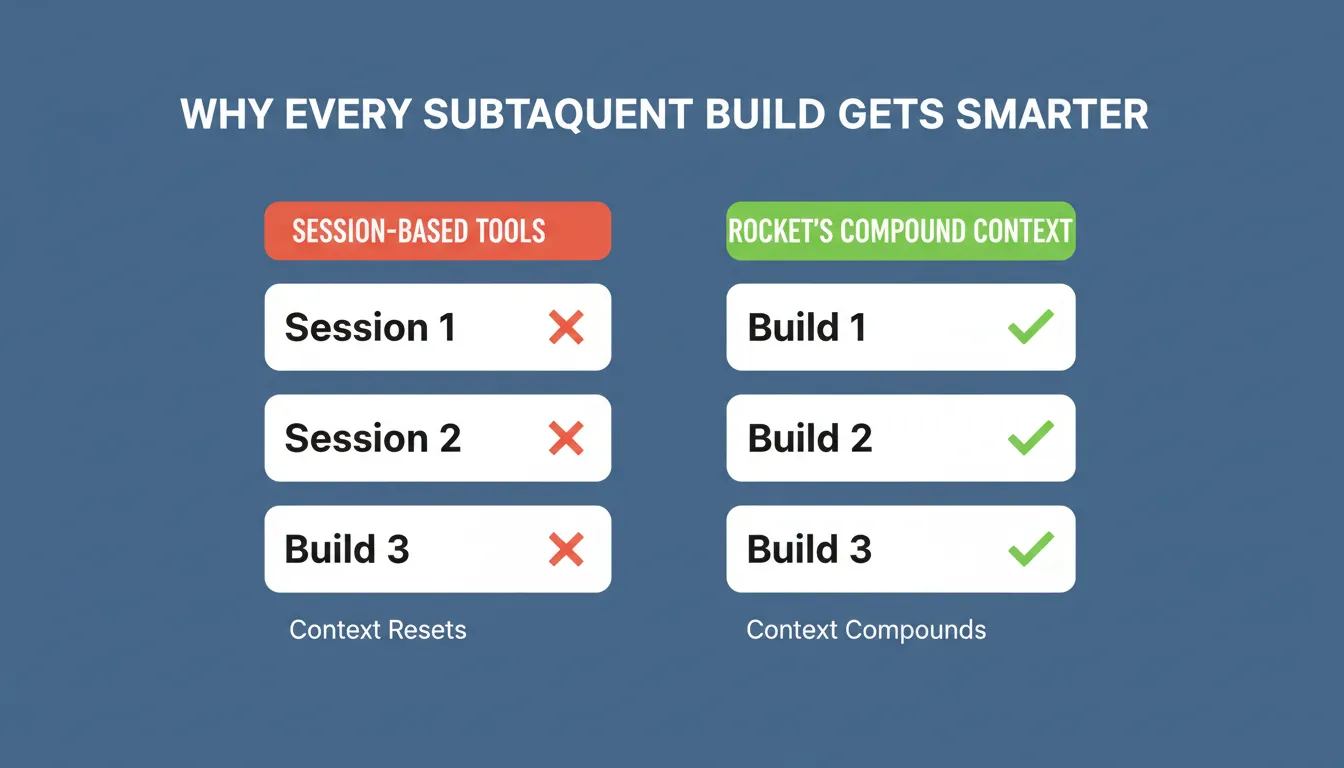
Session-based tools reset context after every build. Rocket's compound context architecture retains and compounds intelligence across every subsequent build.
How Rocket's Three Pillars Work Together Across Builds
Understanding why subsequent builds improve requires understanding how Rocket's features connect. They are not independent capabilities. They are one system with a shared context layer running through all of them.
Rocket is the world's first Vibe Solutioning platform, where businesses research what to build, build it, and monitor what matters, all in one place. (Source: rocket.new/blog/rocket-1-0)
Pillar 1: Solve, Decision Intelligence Before the First Line of Code
Before you build anything, Solve answers the questions that determine whether the build is worth doing.
You type any business problem in plain language. Rocket then runs thousands of queries across 150+ sources simultaneously and delivers a structured, evidence-backed report within 60 to 90 minutes. The output covers market analysis, competitive gaps, pricing benchmarks, a risk matrix, and an execution path with owners and timelines.
The critical difference is what happens next. The Solve output does not disappear after you read it. It becomes the foundation of everything that follows in the project. The PRD is present when the developer opens the Build task. The competitive brief is present when the landing page is written. Every subsequent build in the same project starts from this foundation, not from a blank prompt.
Pillar 2: Build, Production-Grade Generation from Accumulated Intelligence
You describe what you want to build. Rocket generates a working, deployable product. This is not a wireframe or a mockup. It is a fully functional app, ready to ship.
Web applications are built in Next.js. Mobile applications are built in Flutter with dark and light theming, staggered animations, and real design systems. Importantly, every product ships with SEO-ready structure, WCAG 2.1 AA accessibility compliance, GDPR coverage, and performance optimization by default. These are the baseline, not optional extras.
After the first generation, you refine through conversation. You can change the data model, adjust the visual hierarchy, add features, and connect integrations, all in context, without re-explaining what the product is or who it is for.
Pillar 3: Intelligence, Continuous Monitoring After Launch
Intelligence monitors every public platform a competitor operates on: websites, LinkedIn, X, Instagram, G2, Glassdoor, job postings, ad activity, press coverage, and pricing pages. It does this simultaneously and continuously.
Every day, a structured brief covers three things: what moved, what it means for your business specifically, and what you should do about it. Intelligence is not an alerting system. It is an interpretation system. A pricing page update in isolation is noise. That same update, combined with enterprise-focused social posts and new enterprise sales job openings, is a single clear strategic signal. Intelligence connects those dots and tells you what they mean together.
Crucially, the competitive picture Intelligence builds does not reset between sessions. It compounds. Every subsequent build on Rocket.new happens with an up-to-date understanding of the competitive landscape, not the landscape as it was when you last checked manually.
Real Use Cases: What Accumulated Intelligence Looks Like in Practice
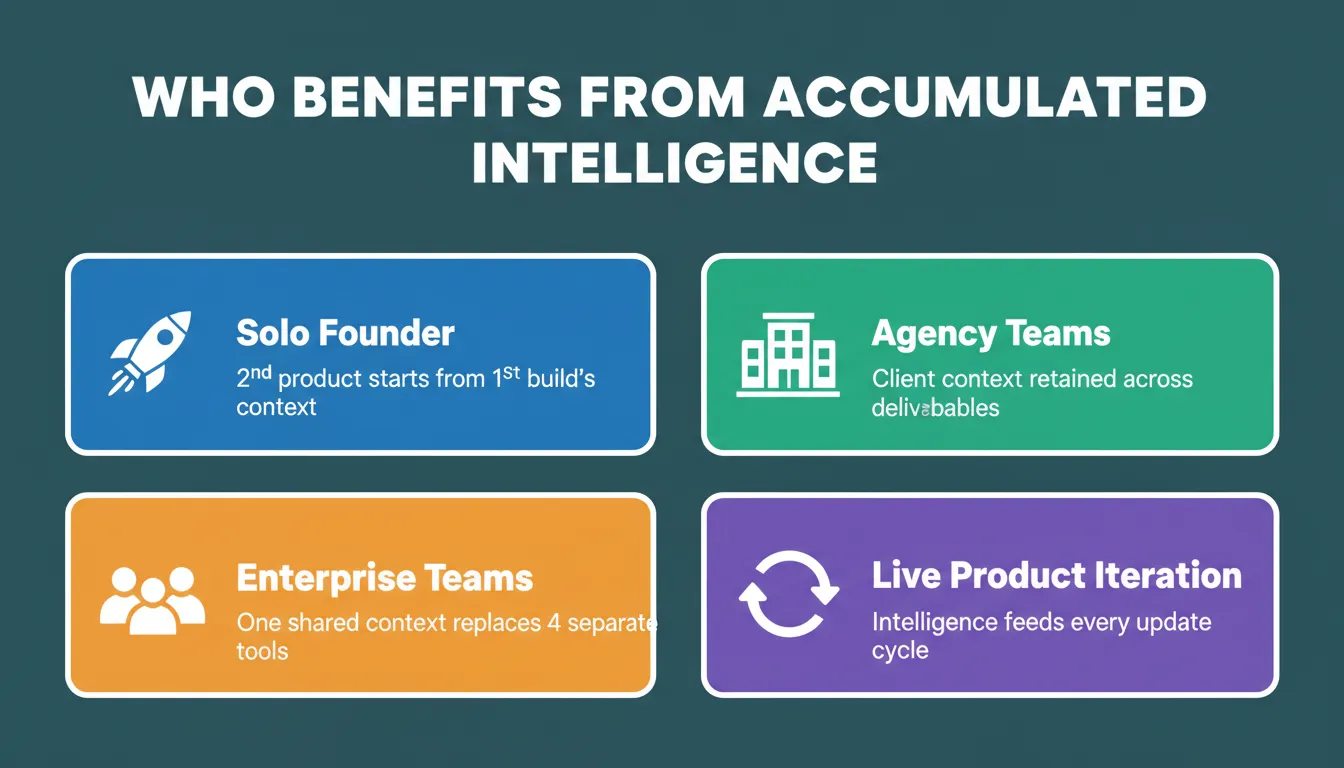
Four types of builders who benefit most from Rocket's accumulated intelligence: solo founders, agency teams, enterprise teams, and teams iterating on live products.
Solo Founder Building a Second Product
You built your first product on Rocket, a fitness tracking app. Solve identified the target user, mapped the competitive landscape, and surfaced the differentiating features. Build generated the app. Intelligence tracked how competitors responded after launch.
Six months later, you are building a nutrition tracking companion app. On a session-based tool, you start over entirely. On Rocket, however, the second build starts from the full accumulated intelligence of the first. The user persona is already there. The competitive landscape is current. The design standards are retained. The second build is not just faster. It is more accurate, because it starts from a foundation of real knowledge rather than a blank prompt.
Agency Building for Multiple Clients
Each client project on Rocket has its own Context, including their brand guidelines, customer research, and competitive landscape. When you build the second deliverable for a client, Rocket already knows everything about the first one. The brief does not need to be re-explained. The design direction does not need to be re-established.
Across clients, the pattern compounds differently. Your agency's own standards and quality benchmarks accumulate in your workflow. Each build you complete makes the next one faster, not because the tool got better, but because the intelligence you built got deeper.
Enterprise Team Replacing Tool Sprawl
Your team currently runs market research in one tool, competitive monitoring in another, product development in a third, and team coordination in a fourth. Each tool has its own context. Nothing compounds.
On Rocket, all of it happens in one system with one shared context layer. The market research from Solve informs the build. The competitive signals from Intelligence inform the sales brief. The product decisions from Build inform the marketing copy. Every action compounds every other action. 1.5 million people have tried Rocket across 180 countries. The teams that get the most value are not the ones who use it for one task. They are the ones who run the full arc in one place.
Product Team Iterating on a Live Product
Most teams handle live product iteration with a combination of manual research, disconnected tools, and periodic strategy sessions. As a result, the intelligence is always stale by the time it reaches the people who need it.
On Rocket, Intelligence monitors your competitive landscape continuously. When a competitor makes a move, whether that is a pricing change, a messaging shift, or a job posting that signals a new product direction, you know about it and you know what it means. The next build iteration starts from current intelligence, not last quarter's.
Vibe Solutioning vs. Vibe Coding: The Upstream Distinction
Most AI tools help you build faster. None of them tell you what to build.
Vibe coding addresses the execution problem. It makes building faster, lowers the technical barrier, and compresses the time from idea to working product. That is genuinely valuable.
Vibe Solutioning addresses the thinking problem. It starts before the first line of code. It answers whether the idea is worth building, who it is for, what the competitive landscape looks like, and what the product needs to do to win. Then it builds from that thinking, in the same platform, with the same context.
The distinction matters because the most expensive mistake in any build is not a bad execution. It is a good execution of the wrong thing.
Every subsequent build on Rocket.new benefits from accumulated intelligence because the intelligence was there before the build started, and it compounds with every action taken after.
How Rocket Compares to Other AI Platforms
The following comparison reflects publicly documented capabilities. It is intended to help builders understand where different tools fit in their workflow.
| Platform | What It Does Well | What It Does Not Address |
|---|---|---|
| Lovable / Bolt / v0 | Fast generation from prompts | No pre-build intelligence, no shared memory, no continuous monitoring |
| Cursor | AI coding for developers who know what to build | No pre-build intelligence, no shared team memory between sessions |
| ChatGPT / Claude / Gemini | General-purpose AI assistance | No structured decisions, no connection to build |
| Perplexity / Deep Research | Finding and summarizing information | Intelligence ends at the document; does not become the foundation of what gets built |
| Rocket | Research what to build, build it, monitor what matters | One platform, shared compound context across all three pillars |
The distinction is not a feature advantage. It is a category difference. Tools require you to be the system. You carry context between them, coordinate outside them, and manage configurations. Rocket is the system.
Rocket Pricing
Rocket uses a credit-based pricing model. One credit balance covers Solve research, Build generation, and Intelligence monitoring. There are no per-seat fees. Credits never expire while a subscription is active.
| Plan | Monthly Price | Credits Included | Best For |
|---|---|---|---|
| Free | $0/month | 20 credits (one-time) | Light, exploratory, and personal use |
| Pro | $25/month | 100 credits/month | Production-ready builds for individuals |
| Rocket | $50/month | 250 credits/month | Full suite for individuals and teams |
| Booster | $250/month | 1,500 credits/month | Power users and fast-moving teams |
All paid plans include unlimited team members. Additional credits can be purchased at any time. Yearly plans save 20%. Enterprise plans with SSO, data localization, and premium support are available by contacting the sales team.
How to Get the Most from Accumulated Intelligence
Getting the compounding effect requires deliberate habits. The following five steps help you build in a way that maximizes the intelligence Rocket retains across every project.
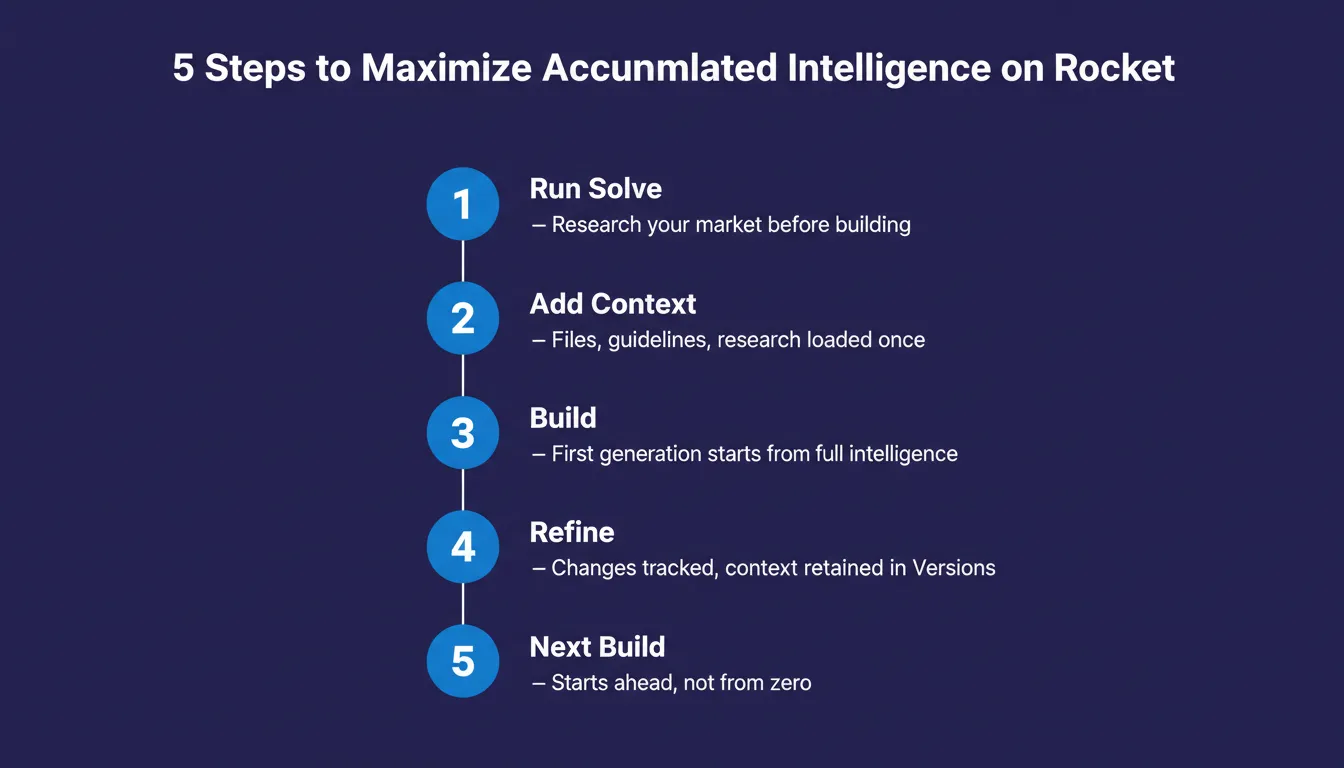
Five steps to build in a way that maximizes the compounding effect of accumulated intelligence on every subsequent build.
Run Solve before you build. The research Solve produces becomes the foundation every subsequent build starts from. The more thorough the Solve session, the stronger the foundation.
Add context deliberately. The files, guidelines, and research you add to Context are available to every task in the project. Add your brand guidelines, your customer research, and your competitive analysis. The more complete the context, the more accurate every subsequent output.
Use Intelligence continuously, not periodically. Competitive landscapes change. Intelligence monitors continuously, but you need to act on what it surfaces. Check Intelligence before every major product decision, not just at launch.
Refine in context, not in isolation. When you need to change something, do it inside the project rather than in a new session with a fresh prompt. The refinement feeds back into the context layer, and the next build benefits from it.
Build related products in the same project. If you are building a web app and a mobile companion, or a landing page and an internal dashboard, build them in the same Rocket project. The context compounds across both.
To understand how the first version benefits from this approach, read why the first version built on Rocket.new is already grounded in evidence. For a deeper look at how iteration speed changes across product cycles, see why Rocket.new products iterate faster from day one.
Every Build You Ship Makes the Next One Smarter
The compounding problem in software development has never been solved by building faster. It gets solved by building from accumulated intelligence and carrying that intelligence forward into every subsequent build.
That is what Rocket does. Every subsequent build on Rocket.new starts from the full intelligence of every previous one. The research you ran last month informs the product you ship today. The competitive signals Intelligence surfaced last week are available when you make your next product decision. The refinements you made to the last build are retained in the context that powers the next one.
1.5 million people have tried Rocket across 180 countries. The ones who see the most value are not the ones who use it once. They are the ones who build continuously and watch the intelligence compound with every project.
Start your first build on Rocket.new and let every subsequent one start smarter.
Table of contents
- -The Real Cost of Starting Over
- -What "Starting Over" Actually Looks Like
- -What Accumulated Intelligence Actually Means on Rocket
- -The Prompt-Pattern-Feedback Loop
- -Why Session-Based AI Builders Cannot Do This
- -How Rocket's Three Pillars Work Together Across Builds
- -Pillar 1: Solve, Decision Intelligence Before the First Line of Code
- -Pillar 2: Build, Production-Grade Generation from Accumulated Intelligence
- -Pillar 3: Intelligence, Continuous Monitoring After Launch
- -Real Use Cases: What Accumulated Intelligence Looks Like in Practice
- -Solo Founder Building a Second Product
- -Agency Building for Multiple Clients
- -Enterprise Team Replacing Tool Sprawl
- -Product Team Iterating on a Live Product
- -Vibe Solutioning vs. Vibe Coding: The Upstream Distinction
- -How Rocket Compares to Other AI Platforms
- -Rocket Pricing
- -How to Get the Most from Accumulated Intelligence
- -Every Build You Ship Makes the Next One Smarter