
Validate your SaaS idea first to ensure real market demand and reduce costly mistakes. Use Rocket.new to research, build, and launch a production-ready MVP without a development agency. Scale smarter with data, integrations, and continuous improvements, all from a single platform.
How to build a full B2B SaaS product without hiring a development agency?
With tools like Rocket.new and solid market validation, founders can move from idea to a live product much faster than before. You no longer need a big team or months of software development to get started.
In fact, according to Statista, the global SaaS market is expected to exceed $300 billion by 2026. This growth is driven by faster tools, smarter workflows, and founders who take action quickly.
So if you're serious about building a B2B saas, this guide will walk you through each step clearly and practically.
In this blog, I will help you to understand how to go from idea to a working product without relying on a development agency.
AI in B2B SaaS Platform
AI and machine learning are becoming essential to modern B2B SaaS platforms, enabling smarter and more proactive solutions. These technologies enhance customer service, power predictive analytics, and help businesses anticipate user needs more effectively.
The integration of AI in B2B SaaS allows companies to automate repetitive tasks, identify patterns, and surface insights, leading to improved decision-making and operational efficiency.
Here's the tightened version:
Core SaaS Development Principles You Can't Skip
Before picking a platform or writing your first prompt, it's worth being clear on what production-grade actually requires.
-
Multi-tenant architecture lets multiple customers share one application instance while keeping every client's data fully isolated. Get this wrong, and you don't have a bug; you have a trust problem.
-
UX design carries more weight than most early founders expect. Corporate users demand efficiency and precision with a minimal learning curve, and software that fits into how they already work.
-
CI/CD pipelines and automated deployment keep your product from going stiff post-launch, letting you ship updates and iterate without disrupting users who already depend on you daily.
-
A well-defined Ideal Customer Profile shapes which integrations matter, how you structure onboarding, and where your first months of product work actually go.
-
Value-based pricing ensures your revenue model grows alongside the value you deliver, without fighting churn or over-discounting to close deals.
Get these right, and the tools you build with become far more effective. That's where Rocket.new comes in.
Start with Market Validation, Not Code
So, before you even think about software development, you need clarity.
Your B2B SaaS idea must solve a real problem. That means talking to your target market, understanding pain points, and confirming demand. This matters more than ever in a market where acquiring customers is getting increasingly expensive.
The median Customer Acquisition Cost for B2B SaaS has risen to roughly $2 for every $1 of new Revenue (ARR), meaning founders who skip validation end up paying a steep price for the wrong product.
Focus on:
-
Customer interviews
-
Analyzing a specific market segment
-
Identifying gaps in current software solutions
When analyzing your segment, pay attention to where vertical SaaS is gaining ground. Businesses are actively moving away from one-size-fits-all platforms toward solutions built around their specific industry workflows, which means the more precisely you target a niche, the stronger your product-market fit signal will be.
This helps you validate product-market fit early. Without this, even the best SaaS platform fails.
Ask yourself:
-
Are medium-sized businesses facing this problem daily?
-
Are they already paying for a workaround?
-
Can your solution scale with the customer as their team or usage grows?
-
Can it improve business processes and streamline operations?
-
Can your solution reduce manual tasks?
-
Does your platform connect seamlessly with the tools they already use?
That last question is increasingly non-negotiable. The B2B SaaS market is shifting toward tighter integration capabilities, and buyers now expect their software stack to talk to each other without friction. If your solution creates silos, it's a harder sell regardless of how well it solves the core problem.
One more thing to probe during customer interviews: how sensitive is the data your solution would touch?
As cloud adoption deepens, cybersecurity has become a top evaluation criterion for B2B buyers, especially in regulated industries. If your target customers handle sensitive data, understanding their compliance requirements early can shape your architecture decisions before a single line of code is written.
Once you validate product-market fit, you're already ahead of most founders.
Define the Core Use Case
Before you start building your software product, clarify what exactly your product solves. Next, keep things simple. Don’t build everything at once. Your B2B SaaS should focus on one strong use case.
For example:
-
Project management
-
Inventory management
-
Customer relationship management
-
Enterprise resource planning
These are common areas where businesses need help with business operations.
A focused idea helps you:
-
build faster
-
test quicker
-
Reduce customer acquisition cost
Also, think about how your product will help manage projects or simplify task management. When your use case is clear, your product becomes easier to build, easier to explain, and easier to sell.
Plan Your Minimum Viable Product
Now comes the part where your idea starts turning into something real.
Then comes your minimum viable product. This is not a half-baked product. It’s a focused version of your final product.
Include:
-
core features
-
basic UI
-
working backend logic
For example, if you're building a B2B saas for project management tools, your MVP might include:
-
task management
-
client collaboration
-
simple dashboards
Avoid adding too many features early. Your goal is to learn from users. A simple MVP helps you test faster, gather feedback, and move toward product-market fit without wasting time or resources.
Why Rocket.new Changes the Game
So, what actually makes Rocket.new different from traditional building methods?
Rocket.new is not just an app builder. It's a vibe solutioning platform, the only one that combines research, building, and competitive monitoring in a single workflow. That means you go from validating an idea to shipping a product to tracking competitors without switching tools or hiring agencies.
It works across three connected pillars:
Solve handles research before you write a single line of code. You type a business question in plain language and get back a structured, evidence-backed report built from live data, covering market analysis, competitive teardowns, pricing strategy, and product direction. It's not a chatbot summary. It produces a full report with an executive summary, analysis, supporting evidence, and recommendations.
Build is the AI app builder. Describe what you want, and Rocket generates a fully functional app with UI, navigation, logic, and production-ready code. You can refine through chat, visual editing, or direct code access, and launch a web app or mobile app when ready.
Intelligence keeps you ahead after launch by continuously monitoring competitors. Set it up once, and it monitors pricing pages, product updates, social media, news, and customer reviews for every competitor you add, automatically delivering daily or weekly briefs to a persistent dashboard.
Together, these three pillars replace the need for separate research tools, development agencies, and competitive intelligence platforms.
How Rocket Works
The process is guided across three stages:
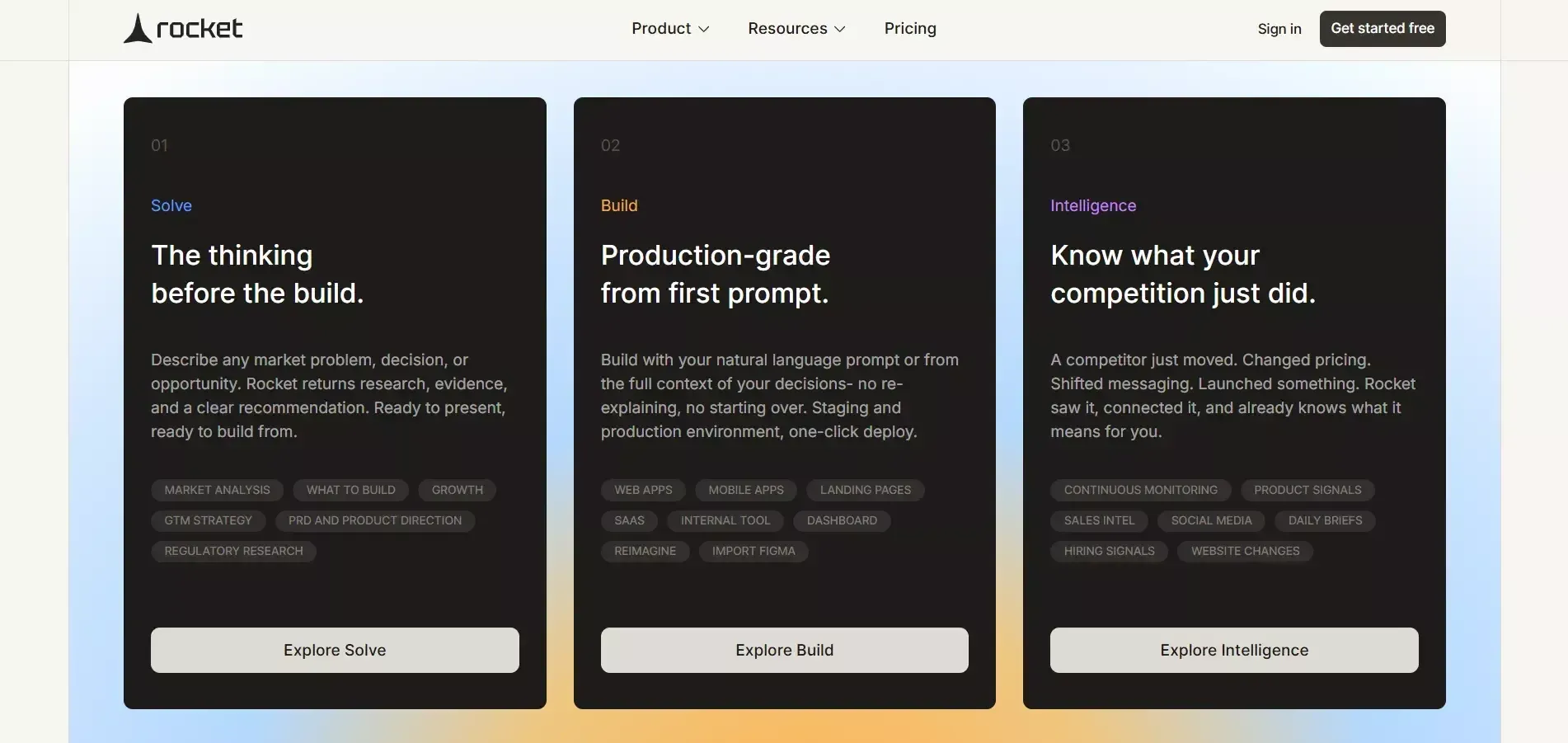 First, you research with Solve. Before building, ask: Solve a business question, conduct market sizing, perform competitor analysis, set pricing benchmarks, and get a structured report with live data. This is where you validate your idea with evidence before committing to a direction.
Then, you build with Build. Describe your app in plain language. Rocket plans the architecture, writes production-ready code, and shows a live preview the moment generation finishes. You refine through chat, visual editing, or direct code access, then launch your web or mobile app.
Finally, you monitor with Intelligence. Run the Intelligence setup wizard once, and Rocket begins tracking your competitors automatically, surfacing changes in pricing, features, and positioning to your dashboard without manual check-ins.
So instead of managing separate research tools, development teams, and monitoring platforms, everything runs inside one system.
Key Features of Rocket.new
Solve
-
Runs structured, multi-source research reports on any business question, market sizing, competitive analysis, pricing strategy, and product direction
-
Produces executive summaries, detailed analysis, supporting evidence, and actionable recommendations from live data
Build
-
Generates production-ready web apps, mobile apps (iOS and Android), landing pages, and e-commerce stores from plain language descriptions
-
Supports multiple starting points: from an idea, a Figma design, a screenshot, a template, or an existing GitHub repository
-
Let's you refine through chat, visual editing, or direct code access, and download the full project as a .zip file
-
Handles custom domains with automatic SSL and DNS configuration
-
Connects to payments, databases, AI models, email providers, analytics tools, and more through its Connectors system
Authentication
- Supports Google Sign-In for Android APKs through a Supabase connector, with OAuth credential management handled through Google Cloud Console
Intelligence
-
Continuously monitors competitor websites, social media, news, reviews, and ad campaigns
-
Delivers daily or weekly briefs to a persistent dashboard, no manual check-ins required
It also supports business-focused features like:
-
Enterprise resource planning capabilities
-
Invoice processing
-
Online payment processing
-
Seamless integration with tools like Microsoft Teams
Because of this, it works well for both mid-sized businesses and large enterprises that need structured and reliable systems.
Rocket.new helps you move from idea to working product faster by reducing complexity and keeping everything in one guided flow.
How to build SaaS with Rocket.new
Rocket supports you at every stage without forcing you to switch between tools.
You move through: research (Solve) → build (Build) → monitor (Intelligence)
With Solve, you validate your market, analyze competitors, and benchmark pricing before writing code. With Build, you go from a plain language description to a production-ready app, web, or mobile that you can launch directly. With Intelligence, you track what your competitors are doing after launch so you can respond before changes affect your position.
That means you test faster, make updates without waiting on agencies, and stay informed about your market, all from one platform.
Build Your SaaS Architecture the Right Way
When building a B2B SaaS, your architecture decisions matter from day one. Here's how to think about them, and where Rocket.new helps directly:
-
Cloud infrastructure: Rocket's Build runs on cloud infrastructure, meaning your app is hosted and accessible without managing servers yourself.
-
Mobile and web from one codebase: Build generates iOS and Android apps alongside web apps, so you're not maintaining separate projects.
-
Connectors for integrations: Rocket's connector system links your app to databases, payment processors, AI models, and analytics tools, reducing the backend work you'd otherwise need a developer for.
-
Authentication: OAuth-based sign-in (including Google Sign-In) is configurable through Rocket's Supabase connector, giving you a secure authentication layer without building one from scratch.
-
Compliance and privacy: Rocket includes built-in SEO, accessibility, and compliance polish features you can apply before launch.
For architecture concerns beyond these, such as data isolation strategies, regulatory compliance for specific industries, or custom risk management logic, those decisions should be scoped during your validation phase using Solve before you build.
Feature Planning Table
Here’s a simple breakdown of what your B2B saas might include:
| Feature Area | Example Features | Purpose |
|---|---|---|
| Project Management | Task tracking, deadlines | Manage projects easily |
| Customer Tools | CRM, customer engagement tools | Improve customer relationships |
| Finance | Invoice processing, payments | Handle online payment processing |
| Operations | Inventory management, resource management | Support business operations |
| Analytics | Data analytics, performance metrics | Track growth |
This structure helps you stay focused on what matters, so you can build features that actually solve problems and support real business needs.
Focus on Customer Experience
Well, your product is only as good as its users’ experience.
Focus on:
-
Customer engagement
-
Easy UI
-
Quick onboarding
Use:
-
Marketing automation
-
Inbound marketing
-
Feedback loops
This helps improve customer retention rate and net revenue retention.
Also, your sales team should stay close to existing customers. That’s how you improve customer relationships and grow annual recurring revenue.
Use Data to Make Smart Decisions
Growth becomes easier when your decisions are backed by real data, not guesswork. Next, use data.
Your B2B saas should include:
-
Data analysis
-
Predictive analytics
-
Advanced analytics
You can also use machine learning to:
-
Predict user behavior
-
Improve product features
-
Reduce churn
This is how modern saas solutions grow faster. When you rely on data, you make smarter choices, improve faster, and build a product that truly matches user needs.
Manage Risk and Compliance Early
Then comes risk management. This is often ignored early, but it matters.
Include:
-
Regulatory compliance
-
Secure authentication
-
Data isolation
This builds trust with enterprise clients and global enterprises. Also, if your B2B saas handles capital markets or sensitive data, this step becomes even more important.
Community Insight
Here’s a real take from a founder discussion on Reddit:
“No-code tools like Rocket.new are great for validating ideas quickly. You can build and test faster without waiting on developers.” - Source
This shows how founders are shifting toward faster building methods.
Scaling Without a Development Agency
Finally, let’s talk about scaling. Once your product starts working, the next step is to grow it in a smart and controlled way.
Once your MVP works, you:
-
Improve features
-
Expand into new market segments
-
Refine value-based pricing
You also:
-
Support large enterprises
-
Add HR software features
-
Improve supply chain management
Scaling becomes an ongoing process. And yes, all this without a development agency.
As your product grows, focusing on steady improvements and real user needs helps you scale without depending on large teams.
A Smarter Way to Build and Scale Your SaaS
Traditional software takes time, money, and large teams. Founders often deal with delays, high costs, and slow progress, which makes launching a product feel difficult. Tools like Rocket.new change how B2B saas products are built by helping you validate ideas, build faster, and launch from one place without relying on agencies.
You don’t need a big team to build a production-grade B2B SaaS. You need clarity, speed, and the right tools to move forward. Focus on users, keep things simple, and grow step by step. The future of B2B saas is about better thinking and faster execution, not writing more code.
Table of contents
- -AI in B2B SaaS Platform
- -Core SaaS Development Principles You Can't Skip
- -Start with Market Validation, Not Code
- -Define the Core Use Case
- -Plan Your Minimum Viable Product
- -Why Rocket.new Changes the Game
- -How Rocket Works
- -Key Features of Rocket.new
- -How to build SaaS with Rocket.new
- -Build Your SaaS Architecture the Right Way
- -Feature Planning Table
- -Focus on Customer Experience
- -Use Data to Make Smart Decisions
- -Manage Risk and Compliance Early
- -Community Insight
- -Scaling Without a Development Agency
- -A Smarter Way to Build and Scale Your SaaS