
Rocket.new offers true code ownership with full export, two-way GitHub sync, and predictable token pricing. Emergent provides export but limits usability with credits, deployment costs, and restricted free access. For scalable, production-ready apps without lock-in, Rocket.new is the stronger choice.
What happens to the code after you build an app with an AI app builder? Both Rocket.new and Emergent.sh say users own their code. But how you get it, what you can do with it, and what it costs to access it are very different stories.
The short answer: Rocket.new delivers cleaner, more accessible code ownership across React, Next.js, and Flutter, with two-way GitHub sync, token rollover, and upfront planning that stretches your budget further.
Emergent offers GitHub export too, but its credit system drains unpredictably, and the free plan gives you just 10 credits. Keeping an app live costs 50 credits per month in deployment fees alone.
According to the Hashnode State of Vibe Coding 2026 report, 63% of vibe coding tool users are non-developers building full-stack apps entirely through natural language prompts. What they build is only useful if they can actually take it with them.
What Code Ownership Really Means
Real code ownership has three components that matter after the build:
- Full export: Can you download the complete, fully functional codebase, including backend logic, on any paid plan?
- Two-way sync: Does GitHub integration sync both ways, or only push your code out?
- Self-hosting: Can you host on your own infrastructure without paying the platform an ongoing fee?
Platforms that satisfy all three give you genuine ownership. Platforms that only satisfy some, with conditions, hand you a file that still depends on them.
The Hidden Risk of Vendor Lock-In
Most non-technical users discover the ownership gap when they try to move.
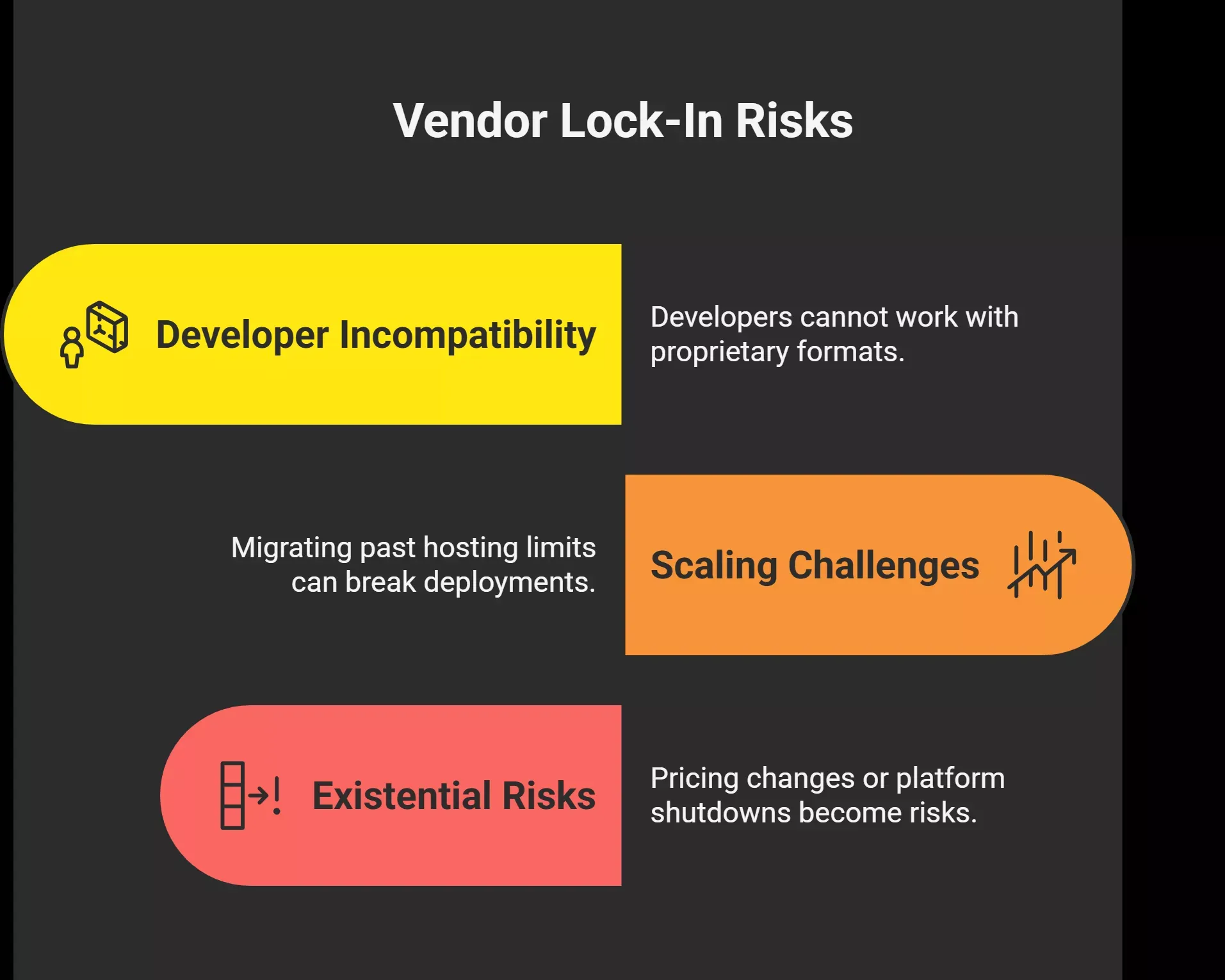
- A developer brought in to extend the app cannot work with proprietary formats.
- Scaling past the platform's hosting limits requires migration that can break deployments.
- Pricing changes or platform shutdowns become existential risks when the codebase lives only on their servers.
How Rocket.new Handles Code Ownership
Production-Ready Code in Standard Frameworks
- Rocket.new generates production-ready code in React, Next.js, and Flutter. None of these are proprietary format. They run anywhere those frameworks run.
- Paid users download the full source and continue building locally in any IDE.
- A developer picking up the project from GitHub sees familiar code in the tech stack they already use.
Both Rocket.new and Emergent emphasize user ownership by providing exportable code, but Rocket.new explicitly states users retain ownership of generated code to avoid vendor lock-in. The platform allows access to source code and project files directly for export to other environments.
GitHub Integration That Syncs Both Ways
Rocket.new's GitHub integration runs two-way for Next.js projects. You push to GitHub, and you can pull changes made outside Rocket back into the platform. This matters for teams where developers work in VS Code or other environments. It simplifies managing version control, and the codebase stays consistent without manual copying between tools.
Custom Domains and Deployment Built In
Rocket.new deploy apps through Netlify with unlimited custom domains on paid plans. You are not sharing a subdomain with the rest of the platform's users.
- Web applications go live on Netlify under your own domain
- Mobile applications are packaged as installable builds for iOS and Android
- You can also deploy to Firebase or your own infrastructure from the exported code
With Rocket.new, you can deploy production-ready applications quickly, securely, and independently without relying on platform-specific hosting limitations or complex setup processes.
Token Rollover That Keeps Budgets Predictable
Rocket.new uses a token-based pricing model where unused tokens carry forward to the next billing period. This makes it genuinely more transparent than Emergent's credit system.
| Plan | Price | Tokens |
|---|---|---|
| Free | $0 | 1 million tokens |
| Starter | $25/month | 5 million tokens |
| Pro | $100/month | High-volume full-stack development |
The free plan is genuinely useful. You can build features, import Figma screens, and understand the platform without hitting a paywall in the first session.
Upfront Planning That Cuts Token Usage by 80%
Rocket.new performs upfront planning before generating any code. The platform researches your app idea, scopes the full build, and produces a structured plan before writing production-ready code. This cuts token usage by up to 80% compared to platforms that generate first and fix later. You see the project scope before committing, which makes budget planning accurate rather than approximate.
Key Features at a Glance
- 25,000+ templates: Industry-specific layouts across SaaS, fintech, health, e-commerce, HR, and logistics, all free to use
- Figma-to-code: Paste a Figma URL and the platform converts your designs into responsive frontend code automatically with its AI-powered features
- Precision Mode: Over 100 structured commands for exact control when natural language prompts alone are not specific enough
- Supabase Auth: User authentication via email/password, social login (Google and GitHub), and magic links, all configured from a single chat prompt
- Stripe integration: Payment processing built in, alongside custom integrations with any REST API via Postman, cURL, or Swagger definitions
- Built-in debugger: Scans continuously for syntax errors, performance issues, and broken dependencies during app development
How Emergent Handles Code Ownership
The Multi-Agent System That Builds the App
Emergent uses a multi-agent system where specialized AI agents divide the build. One agent plans architecture, another writes backend logic, and a third runs tests. This generates full-stack apps quickly from simple natural language prompts. Emergent allows exporting generated React and TypeScript code to GitHub, ensuring user ownership, and provides a browser-based VS Code editor so developers can read and edit the code directly.
Emergent's platform is designed to help non-technical users build functional prototypes quickly to validate ideas. Its multi-agent system automates various aspects of app development, including UI design, backend logic, and database integration.
Where the Ownership Story Changes
Here is where Emergent's ownership model diverges from Rocket's in ways that matter:
- The free plan provides just 10 credits, which is not enough to complete a real project
- Deployment alone costs 50 credits per month to keep a single app live
- The free tier functions as just a demo with no realistic path to deploying an app without a paid subscription
- Some independent reviews flag that code export availability varies by plan tier and is not always clearly documented for new users
Emergent's credit system can confuse non-technical users who expect to build something exportable on the free plan, only to find their credits gone before deployment.
The Credit System in Practice
Emergent.sh uses a credit-based pricing model where every action consumes credits. Planning, coding, fixing errors, testing ideas, and deploying all consume credits separately. Emergent's pricing can feel unpredictable, especially for larger projects, as complex backend logic or database integration consumes more credits than expected.
Users report that 110 credits did not last a full day of active building. When AI agents make mistakes, the cost of fixing them falls on the user's credit balance. There is no upfront estimate of total build cost before you start.
Other Limitations
Emergent does not include visual editors. Every interface change goes through prompts, which means more iterations and more credit consumption for adjustments that would take seconds in a drag-and-drop environment. Collaboration features are also minimal. Larger groups find that the shared credit pool drains faster than expected on team plans.
On the mobile side, Emergent supports apps through React Native and Expo rather than Flutter. Teams targeting iOS and Android with native performance requirements should evaluate whether React Native fits their output expectations.
Feature-by-Feature Comparison
| Feature | Rocket.new | Emergent.sh |
|---|---|---|
| Code export | Full export: React, Next.js, Flutter | GitHub export on paid plans |
| Free tier | 1 million tokens (genuinely usable) | 10 credits (cannot deploy) |
| Token/credit rollover | Yes, unused tokens carry forward | No rollover |
| GitHub sync | Two-way sync for Next.js projects | One-way push to GitHub |
| Visual editors | Yes (Precision Mode + visual editors) | No (prompt-only changes) |
| Figma import | Yes | No |
| Mobile framework | Flutter (native mobile apps) | React Native/Expo |
| Custom domains | Unlimited on paid plans | Available on paid plans |
| Template library | 25,000+ templates for websites and Landing pages | Limited selection |
| Upfront planning | Yes, saves up to 80% tokens | No, generates immediately |
| Pricing model | Token rollover, predictable | Credit burn per action |
| Collaboration | Built for mixed product teams | Minimal features |
| User authentication | Supabase Auth from first build | Included |
| Own infrastructure | Yes, via Netlify or export | Yes, via GitHub export |
Where Emergent Falls Short for Production-Ready Apps
Credit Burn on Complex Backend Logic
Complex backend logic and database integration consume credits faster than simple builds. For production-ready applications with multiple user roles, payment flows, and complex workflows, the credit consumption climbs in ways that are not obvious before you start.
No Ownership Path on the Free Plan
Emergent's free plan gives 10 credits. Deployment costs 50 credits per month. You cannot build a production-ready app, deploy it, and own it without immediately paying. The free plan is just a demo, not a real path to ownership.
Reliability Under Pressure
Some Emergent users report that AI agents get stuck in loops. When that happens, credits burn on error correction instead of feature development. Emergent's self-healing code feature helps reduce debugging time, but errors that consume credits without resolving transfer the cost of AI mistakes back to the user.
No Figma Path for Design Led Teams
Design-first teams must describe their designs in text and iterate through prompts, adding time and credits to the process of getting web apps to match a design brief accurately.
Use Cases Where Rocket.new Wins
Internal Tools for Non-Technical Teams
A marketing team needs a content approval dashboard. A logistics company needs an inventory management tracker. A founder needs a CRM without hiring a developer. Rocket.new handles all of these from simple natural language prompts. The full-stack output includes backend logic, database integration, and user authentication in a single build session. The team owns the code from day one.
Native Mobile and Web App creation From One Project
Rocket.new produces Flutter for native mobile apps alongside Next.js for web apps. Teams targeting multiple platforms from day one get both from Rocket without managing two separate codebases or switching tools.
Rapid Prototyping With a Design File Already Built
Teams with Figma designs skip the description step entirely. Rocket.new's Figma import converts designs into production-ready code directly. Emergent has no equivalent path, which means more prompts and more credit consumption to achieve the same visual accuracy.
Full-Stack App Development on a Predictable Budget
Token rollover and upfront planning make Rocket.new's costs estimable before a project starts. Credit burn on every single action makes Emergent's costs difficult to forecast for anything beyond a simple build.
Production-Ready SaaS From a Single Session
Rocket.new generates the full stack for SaaS products in one pass. Frontend screens, backend logic, user authentication, database integration, Stripe payments, and custom domains all come from a single build. Non-technical founders can take a SaaS app idea from natural language to a live, exportable product without writing code and without burning through credits on every small iteration.
The Ownership Decision: A Clear Comparison
When you outgrow an AI app builder, migration depends on what kind of code was generated.
Rocket.new generates standard React, Next.js, and Flutter code. A developer can clone the GitHub repository and keep building in any environment without a translation layer. Users of Rocket.new retain ownership of the apps they create, and both Rocket.new and Emergent allow users to export and modify their code independently of the platforms.
Rocket.new's two-way sync for Next.js projects is the stronger implementation for teams running Git-based workflows. For teams handing off to engineers or scaling a product, two-way sync removes the friction that one-way export cannot address.
A Clear Workflow Comparison:
Rocket Generated Code is Netlify-Compliant
Rocket.new also generates Netlify-compatible builds by default, which means one-click cloud deployment or manual export to other providers. Standard frameworks mean no single vendor controls your app's future.
What People Are Saying
One user shared on LinkedIn after building with Rocket.new:
"I gave an AI builder just one sentence and it built a complete working app. No setup. No coding. It just worked. I've already used it to build multiple apps from one-liners." - Source
That reaction captures the difference between platforms where the first build feels like a demo and ones where the first build is the actual deployable product.
Choosing Right Platform
Both platforms deliver real code. Both allow export. But Rocket.new gets you to genuine ownership more cleanly: standard frameworks, two-way GitHub sync, token rollover, a genuinely usable free tier, and an upfront planning model that cuts costs by up to 80% before a line of code generates.
Emergent's credit system, 10-credit free plan, deployment fees, and absence of visual editors create friction at every stage where Rocket removes it. For non-technical founders, non-technical users, and technical teams that want production-ready apps they can own and scale, Rocket.new is the stronger platform to start and finish on.
Table of contents
- -What Code Ownership Really Means
- -The Hidden Risk of Vendor Lock-In
- -How Rocket.new Handles Code Ownership
- -Production-Ready Code in Standard Frameworks
- -GitHub Integration That Syncs Both Ways
- -Custom Domains and Deployment Built In
- -Token Rollover That Keeps Budgets Predictable
- -Upfront Planning That Cuts Token Usage by 80%
- -Key Features at a Glance
- -How Emergent Handles Code Ownership
- -The Multi-Agent System That Builds the App
- -Where the Ownership Story Changes
- -The Credit System in Practice
- -Other Limitations
- -Feature-by-Feature Comparison
- -Where Emergent Falls Short for Production-Ready Apps
- -Credit Burn on Complex Backend Logic
- -No Ownership Path on the Free Plan
- -Reliability Under Pressure
- -No Figma Path for Design Led Teams
- -Use Cases Where Rocket.new Wins
- -Internal Tools for Non-Technical Teams
- -Native Mobile and Web App creation From One Project
- -Rapid Prototyping With a Design File Already Built
- -Full-Stack App Development on a Predictable Budget
- -Production-Ready SaaS From a Single Session
- -The Ownership Decision: A Clear Comparison
- -Rocket Generated Code is Netlify-Compliant
- -What People Are Saying
- -Choosing Right Platform