
Engineering teams spend 30-40% of their time building internal tools that sit in backlogs for weeks. This post walks through how Rocket.new's AI app builder takes a team from ticket to deployed admin panel in under 1 hour - covering automated workflows, role based access, and real integrations without a dev sprint.
What if the ticket your ops team filed three weeks ago could have gone live before lunch the same day?
That's not wishful thinking, and Rocket.new makes exactly that possible. According to McKinsey research, engineering teams spend 30–40% of their time building and maintaining internal tools.
And yet those internal tools still sit in sprint backlogs for weeks. Ops teams build workarounds in spreadsheets. Support tickets pile up while the tool they actually need is waiting for a dev to get assigned. From internal tools / admin panel ticket to live tool on Rocket.new in 1 hour is not a stretch. It's what teams are doing today, and this post breaks down exactly how.
Why Do Internal Tools Keep Piling Up in the Backlog?
Most teams need internal tools constantly. Admin dashboards to manage customer records. Approval workflows for purchase requests. Support ticket panels. Data entry forms. Internal dashboards for ops lead to tracking daily progress.
Sound familiar? These requests never stop coming in, and they almost always land at the bottom of the engineering queue.
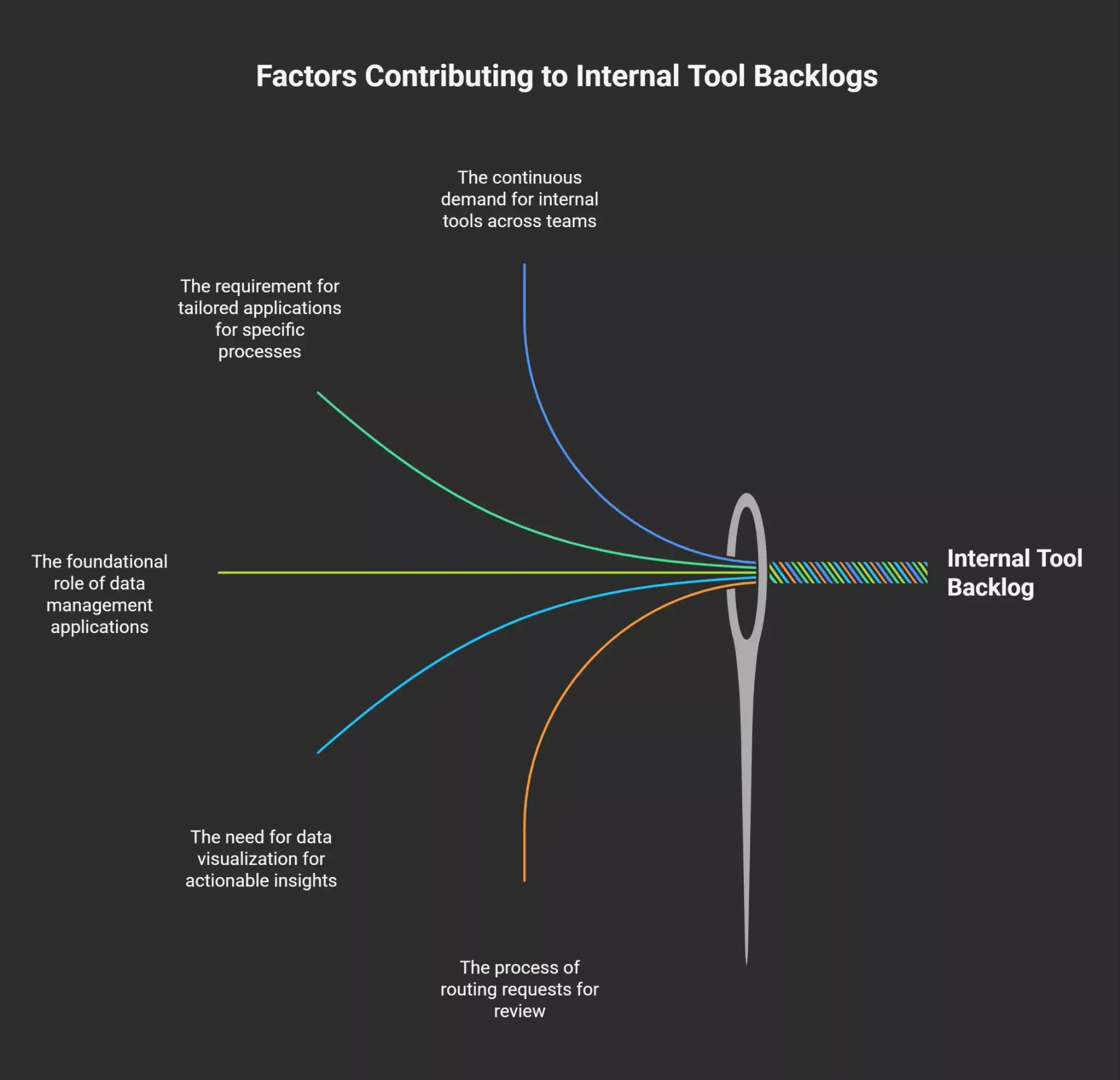 Internal tools are custom-built applications used by teams within an organization to streamline internal processes, including admin panels, dashboards, and workflow engines. CRUD apps, which handle create, read, update, and delete operations, are foundational for any data-driven team.
Dashboards turn raw numbers into actionable insights. Approval workflows route requests through reviewers before anything gets finalized. Every one of these is useful. And nearly every one of them waits weeks to get built.
The 2025 State of Internal Developer Portals by Port.io found that 75% of developers lose between 6 and 15 hours weekly due to tool sprawl. For a team of 50 engineers, that adds up to nearly $1 million in lost productivity every year. On top of that, 94% of developers report dissatisfaction with the self-service tools they currently work with.
Meanwhile, 86% of organizations plan to increase or maintain spending on internal tools this year. The investment intention is there. The delivery speed is not.
The cost of slow internal tooling compounds every single week.
What Makes Building an Admin Panel So Slow?
The traditional development cycle for internal tools has many moving parts, and each one adds development time along with new waiting points.
Here's what the typical path looks like when a team needs a new admin panel or data management tool:
Each step is a waiting game. Requirements often change mid-build, meaning the team ends up building the wrong thing after weeks of work. Code review adds another day or two. Deployment needs DevOps sign-off. Manual testing is often the primary cause of deployment delays, and automated testing could cut that time significantly. The full arc regularly runs three weeks or more.
There's also a resource allocation problem. Most companies can't pull a developer off a core product to build an internal admin panel. Job postings for dedicated internal tools developers do exist at some larger companies, but most teams simply can't staff that way. So the ticket waits. And the business question it was meant to answer stays unanswered.
Over 40% of workers spend at least a quarter of their week on repetitive tasks that internal tools could handle [source link to be verified by human reviewer]. That's not a small inefficiency. That's a structural drag on the whole company.
What is the Real Cost of Slow Internal Tools?
Delayed admin panels and internal dashboards don't just slow the team down. They push work back onto engineering, create data gaps, and keep support tickets from being resolved by the people who actually own them.
Here's how the traditional build path compares to what modern AI app builders make possible today:
| Factor | Traditional Development | Rocket.new AI App Builder |
|---|---|---|
| Time to first working version | 2–4 weeks | Under 1 hour |
| Code required | Full-stack dev | None or minimal |
| Sprint dependency | Yes | No |
| Database connections | Manual setup | Auto-configured |
| Role-based access | Custom-built | Built-in |
| Approval workflows | Manual coding | Template-ready |
| Automated workflows | Requires dev work | Agent-generated |
| Deployment | DevOps required | One-click |
The development time gap is where the most expensive mistake of the traditional approach becomes most visible. Teams spend weeks waiting for tools that could ship in an hour, and that delay shows up across reports, decisions, and day-to-day operations.
Companies using internal tools built with modern AI app builders report up to 30% improvement in efficiency compared to teams running on general-purpose software. The difference between waiting three weeks and shipping in one hour is not just time-saving. It's a competitive one.
How Does the Ticket-to-Live-Tool Process Work in Under 1 Hour?
Here's a real scenario. Your ops team needs an admin panel to manage support tickets: filter by status, update records, and push notifications to the right people when status changes. Normally, that's a sprint ticket that waits weeks.
With Rocket.new, the process looks like this:
-
Describe the tool in plain English with Build: "Build me an admin panel for support tickets with filters, record updates, and team notifications."
-
Rocket's AI agents generate the complete app, including the UI, database schema, API routes, and business logic
-
Connect your data source: internal databases, CRMs, or external systems
-
Set role-based access and permissions: who can view, who can edit, who can approve
-
Test the tool with real data in the live preview
-
Deploy with one click, and every deployment saves a version for easy rollback
Total time: under an hour. No sprint. No waiting. No context-switch for the dev team.
Automated routing of tickets to the right workspaces or team members is built into the workflow, so the tool doesn't just display data; it acts on it.
Jinal Thakkar, Core Platform Builder at Rocket, put it directly in a LinkedIn post on the launch of Rocket 1.0:
"Vibe coding solved generation. It never solved integration. That's where generated apps actually die. The app looks right. The layout is clean. Then you check the code, nothing is connected to your real-world services." - Jinal Thakkar, LinkedIn
Rocket.new solves this at the architecture level. The AI agents connect your real systems during the build, not as an afterthought.
Why is Rocket.new the Best AI App Builder for Internal Tools?
Rocket.new is a vibe solutioning platform built for teams who need real, working internal tools fast. It's not a prototype tool or a drag-and-drop component library. It's an AI app builder that handles the full arc from a plain English description to a deployed, production-ready admin panel, dashboard, or workflow app.
Prequate Advisory, covering Rocket.new's $15M raise, backed by Salesforce and Accel, described the experience this way:
"An hour later, you have UI, data schema, API routes, admin panel, deployment. Meanwhile your competitor is still waiting for a dev sprint." - Prequate Advisory, LinkedIn
That press coverage reflects a real shift in how teams think about internal tooling, and Rocket.new sits at the center of it.
AI-powered internal tools are becoming the standard for automating workflows, reducing manual work, and letting non-developers build their own applications. 84% of developers already use AI tools regularly for app development. The trend is not coming. It's here.
How Do AI Agents and Automated Workflows Work Inside Rocket.new?
Rocket.new's AI agents interpret the context of what you're building and generate the full tool, not just the layout.
Teams get:
-
Automated workflows that run without manual triggers: data syncs, status updates, and alerts all fire on their own
-
Approval workflows for expense reviews, HR requests, content publishing, or any process that needs a sign-off, built from a description rather than from code
-
AI agents that take action on data, not just display it
-
Push notifications that fire when records change, approvals are needed, or conditions are met in your systems
-
Internal dashboards with live data connections: query internal databases, visualize records, and act on them in one place
-
Role-based access and permissions: control who can view, edit, or approve, right down to the field level
-
Custom logic for edge cases when your workflow needs something specific
-
Integrations with Slack, Stripe, Notion, and the tools your team already runs day to day
Real-time monitoring during app generation means developers can make immediate adjustments if the AI-generated output drifts from what the team needs. Using detailed natural language prompts improves the speed and accuracy of each build. And features can be iterated after launch, with the platform retaining project context throughout.
How Does Rocket.new Compare to Other App Builders?
Other app builders, like Retool or Superblocks, offer drag-and-drop components and some pre-built data connections. Both still require developers to wire up logic, write custom code for edge cases, and manage deployment separately.
Rocket.new's AI agents generate the logic, not just the layout. The tool connects to real data, follows real workflow rules, and ships as a working product, not a component shell waiting for additional dev work.
Where other app builders hand you parts and a manual, Rocket.new hands you a working tool.
For enterprise teams managing competitive intelligence dashboards, multi-system internal tools, or cross-team operational workflows, that difference changes the entire build timeline.
What is a Vibe Solutioning Platform and How Does Rocket.new Use It?
Rocket.new is built around vibe solutioning, where the platform reads the business question behind your request and builds a complete, connected solution, not just the surface-level app.
That's a real shift from older app builders that hand you components and expect developers to connect the dots manually. A focus on specific functionality in requests leads to better outcomes, and the platform is designed to respond to exactly that kind of targeted input.
Rocket.new also supports web apps and mobile apps, so internal tools don't have to stay browser-only. Enterprise teams can build and deploy tools across platforms without managing separate codebases or systems.
How Does Rocket.new Improve Operational Efficiency for Internal Tools?
Most companies treat internal tools as a secondary concern, something engineering gets to when there's spare capacity. That approach costs real time and real money.
The gap between filing an admin panel ticket and having a working tool represents lost operational decisions, manual workarounds, and support tickets that pile up instead of getting resolved. It compounds every day the ticket sits open.
Rocket.new closes that gap. Here's what that looks like in practice:
-
Describe the tool in plain English
-
Connect to your real data sources and internal databases
-
Set permissions and role-based access
-
Deploy in one click, with version control and rollback built in
-
Iterate after launch without starting over
The AI agents handle the build so the dev team can stay on the product. No sprint dependency. No three-week wait. No tool that ships just as the requirements have changed.
How Do Teams Start Getting Internal Tools Built Faster with Rocket.new?
The internal tools problem is one that most teams have accepted as normal. Tickets wait. Developers get stretched. Admin panels ship weeks late, or not at all.
Rocket.new changes that math. AI agents, automated workflows, and a vibe solutioning platform approach mean internal tools no longer need full engineering sprints to ship.
Teams that build with Rocket.new solve real business problems with real data on the same day the need comes up. From internal tools / admin panel ticket to live tool on Rocket.new in 1 hour is the new standard, and operational efficiency follows from closing exactly that gap.
Build Your First Internal Tool Today
Your next internal tool doesn't need a sprint. It doesn't need a dev ticket. It doesn't need three weeks.
Describe what you need, connect your data, and deploy, all in the same hour. Sign up for Rocket.new and ship your first internal tool today.
Table of contents
- -Why Do Internal Tools Keep Piling Up in the Backlog?
- -What Makes Building an Admin Panel So Slow?
- -What is the Real Cost of Slow Internal Tools?
- -How Does the Ticket-to-Live-Tool Process Work in Under 1 Hour?
- -Why is Rocket.new the Best AI App Builder for Internal Tools?
- -How Do AI Agents and Automated Workflows Work Inside Rocket.new?
- -How Does Rocket.new Compare to Other App Builders?
- -What is a Vibe Solutioning Platform and How Does Rocket.new Use It?
- -How Does Rocket.new Improve Operational Efficiency for Internal Tools?
- -How Do Teams Start Getting Internal Tools Built Faster with Rocket.new?
- -Build Your First Internal Tool Today