
Full-stack code automation uses AI to generate, test, and deploy code across every layer of an application, helping teams ship faster, reduce manual effort, and build scalable products with confidence.
Does your team spend more time writing boilerplate than building features?
Full-stack code automation uses AI-powered tools to generate, manage, test, and deploy code across the entire application stack. Over 30% of companies already use automation tools to reduce manual work and shorten delivery cycles, and adoption continues to rise as software demand increases.
Teams that automate ship faster, maintain consistency, and scale without proportionally growing headcount. Automation handles the repeatable so developers can focus on what actually requires human judgment: architecture, product decisions, and performance.
What is Full Stack Code Automation?
Full-stack code automation is the use of tools and AI-powered systems to automatically generate, manage, test, and deploy code across the entire application stack. This includes front-end development, back-end development, database management, and infrastructure setup.
Instead of writing everything by hand, automation tools generate code from templates, rules, or natural-language prompts. This shortens the full-stack development process and reduces manual effort at every layer.
Traditional stack development relies on engineers handling each layer separately. Automation changes that flow entirely. The stack development process becomes faster, more predictable, and easier to repeat across projects.
The Shift from Manual to Automated Development
For years, full-stack development meant constant context-switching between frameworks, languages, and toolchains. A developer building a SaaS product would write React components, configure the API, set up the database schema, then handle deployment as a separate step.
Full-stack code automation collapses this into a single workflow. Modern AI-powered platforms generate production-ready code across all layers simultaneously, from the UI component library down to the database schema and deployment configuration. The result is fewer handoffs, less rework, and faster time to a working product.
Why Full Stack Code Automation Matters
Development timelines are tighter than ever. Businesses expect frequent updates, stable releases, and smooth user experiences. Automation supports these goals in practical ways.
Key reasons teams adopt automation include:
- Faster delivery and shorter release cycles
- Fewer repetitive tasks for developers
- More consistent patterns that support better code quality
- Easier scaling as applications and teams grow
- Reduced onboarding time for new team members
For full-stack developers, automation removes busywork and frees time for complex tasks such as architectural decisions and performance tuning. According to GitHub's State of the Octoverse, developers using AI-assisted tools complete tasks significantly faster than those working manually.
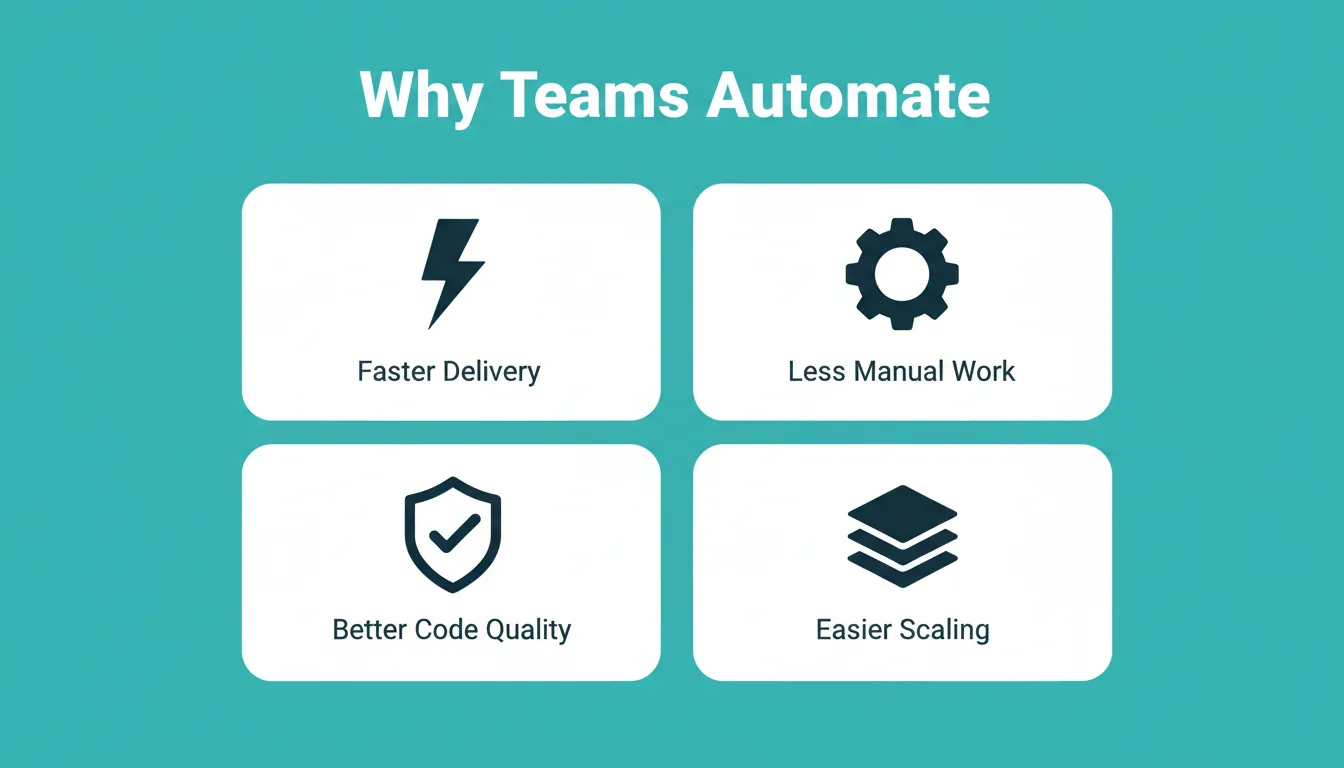
The four core reasons development teams adopt full stack code automation.
Key Areas of Full Stack Code Automation
Full stack code automation flow: from a single developer input to a production-ready application across all stack layers.
Frontend Automation
Frontend automation focuses on the user interface and client-side logic. Tools automatically generate layouts, components, and styles from design files, screenshots, or plain-language descriptions.
Design-to-code workflows, where a Figma file converts directly into production-ready components, reduce back-and-forth between designers and developers. Modern frontend automation also handles accessibility compliance, responsive breakpoints, dark/light theming, and animation patterns that previously required significant manual effort.
Backend Automation
Backend automation handles APIs, services, and application logic. Instead of writing the same CRUD logic repeatedly, developers rely on generators and scaffolding tools that produce consistent, tested patterns.
Common backend automation tasks include:
- API and service generation from schema definitions
- Authentication and authorization setup
- Validation and routing configuration
- Webhook handler generation
This approach supports back-end development across multiple programming languages and frameworks. As a result, AI-powered tools can generate a complete REST API with authentication, rate limiting, and error handling in a fraction of the time.
Database and Data Layer Automation
Database automation covers schema creation, migrations, and validation rules. Tools manage database configurations and keep data structures aligned with application changes.
Automating database management reduces errors during updates and ensures consistent data management across environments. Key capabilities include schema generation from natural language, automatic migration scripts, row-level security policy generation, and seed data for testing.
DevOps and Infrastructure Automation
DevOps automation connects development with deployment. It manages CI/CD pipelines, environment setup, and cloud resources.
With automation in place, version control and repository management become smoother. Code moves from commit to production with fewer manual steps, supported by automated testing throughout. Modern platforms provide one-click deployment, automatic HTTPS, staging and production environment separation, and full version history with rollback.
Role of AI in Full Stack Code Automation
Artificial intelligence has fundamentally changed what automation can accomplish. Earlier automation tools handled repetitive, rule-based tasks. AI-powered development tools, by contrast, understand context, intent, and architecture.
AI models support:
- Automated code generation from natural language prompts
- Context-aware code suggestions while writing code
- Refactoring and optimizing existing code workflows
- Smarter debugging and automated testing
- Design-to-code conversion from screenshots or Figma files
This kind of AI-powered development lowers the learning curve and helps teams move faster without sacrificing clarity. The Stack Overflow Developer Survey consistently shows that AI code tools are now used by a majority of professional developers worldwide. Adoption is accelerating fastest among full-stack engineers who benefit most from cross-layer automation.
From Code Completion to Full-Stack Generation
The evolution of AI in development has moved through four distinct phases:
- Code completion — AI suggests the next line or function
- Component generation — AI builds a complete UI component from a description
- Feature generation — AI builds a complete feature across front-end and back-end
- Full-stack generation — AI builds a complete, deployable application from a single prompt
The latest generation of platforms operates at the fourth level. They generate entire applications with production-ready code, deployment configuration, and integrated services from a single natural language description.
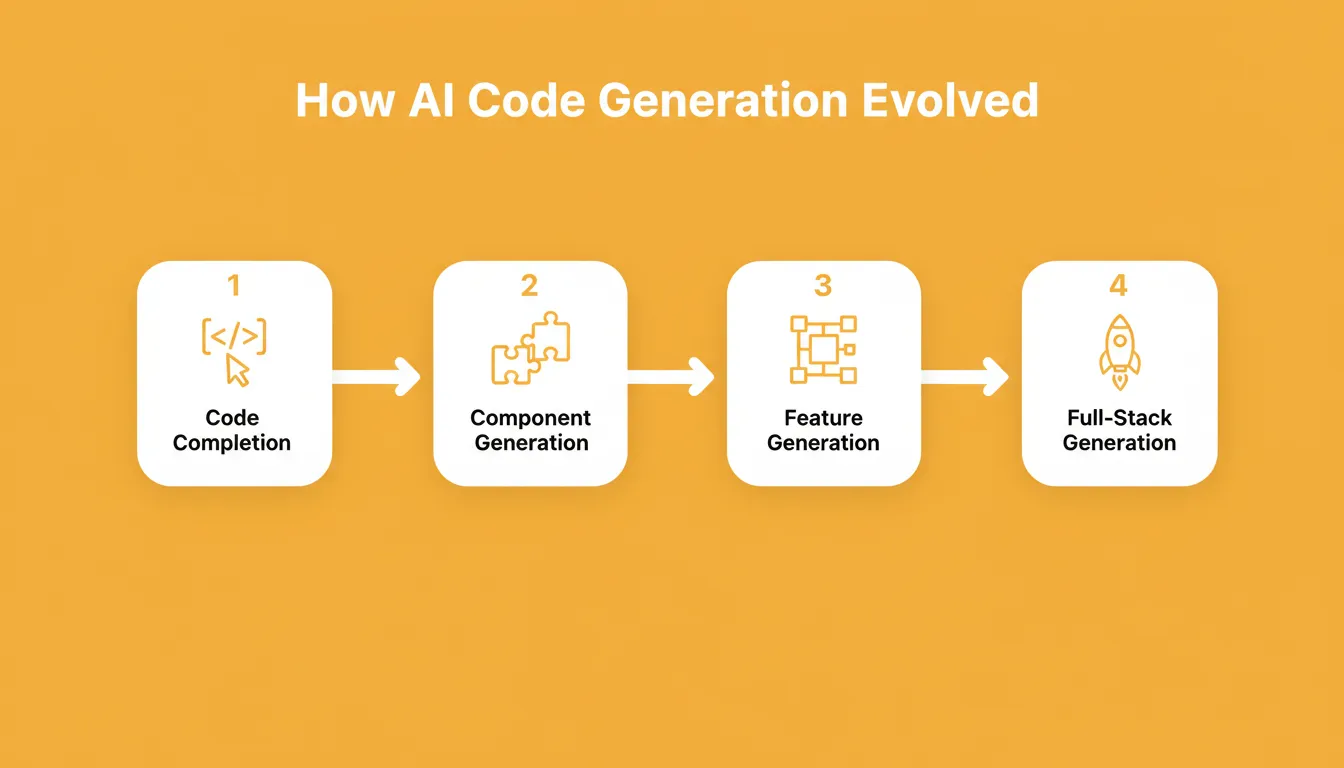
AI-powered development has progressed from single-line suggestions to complete, deployable full-stack applications.
Popular Tools and Platforms
The automation ecosystem includes a wide range of platforms. Some focus on coding assistance inside IDEs, while others deliver full-stack solutions. Choosing the right tool depends on project needs, team experience, and how much of the stack you want to automate.
Benefits for Development Teams and Businesses
Automation creates measurable value for both developers and organizations.
For development teams:
- Higher productivity with less manual effort on boilerplate and configuration
- Cleaner pull requests and smoother code reviews
- Faster iteration during the development process
- More time for architectural thinking and product decisions
For businesses:
- Shorter release cycles and better development speed
- Lower costs through reducing manual effort and rework
- Easier scaling without expanding teams too quickly
These benefits help full-stack engineers and stack developers focus on outcomes rather than setup work. McKinsey research on software engineering shows that organizations embracing automation report measurably shorter time-to-market across product lines.
Automation Across the Stack
| Layer | Automation Benefit | Typical Methods | Key Metrics Improved |
|---|---|---|---|
| Frontend | Faster UI creation, design consistency | Component generators, Figma-to-code tools | Design iteration speed, accessibility compliance |
| Backend | Quick APIs and services, consistent patterns | Service scaffolding, CRUD generators | API development time, error rates |
| Database | Consistent schemas, safe migrations | ORM tools, migration runners, schema generators | Data integrity, deployment reliability |
| DevOps | Predictable deployment, environment parity | CI/CD pipelines, infrastructure-as-code | Deployment frequency, rollback time |
| Testing | Early issue detection, regression prevention | Automated testing frameworks, AI test generation | Bug escape rate, test coverage |
| Security | Consistent auth patterns, compliance defaults | Auth scaffolding, WCAG/GDPR generators | Security vulnerability rate, compliance coverage |
Challenges and Considerations
Automation is not a silver bullet. Understanding the limitations helps teams adopt it effectively.
Customization limits. Some tools limit customization, which can frustrate developers building highly specialized applications. The best platforms generate clean, standard code that you can extend, rather than locked-in proprietary formats.
Security and compliance. Automated code generation requires careful review for security vulnerabilities, especially around authentication, data validation, and API exposure. Treat generated code with the same review process as hand-written code.
Tool lock-in. Teams should maintain strong internal expertise and choose platforms that generate standard, portable code, such as Next.js or Flutter, that you own and can deploy anywhere.
Context and intent. AI tools generate code based on the instructions they receive. Vague or incomplete prompts produce generic results. The quality of automation output is directly proportional to the quality of the input.
Over-automation. Not every task benefits from automation. Complex business logic, novel algorithms, and highly specialized integrations often require human expertise. Automate the repeatable; keep humans on the irreplaceable.
Best Practices for Adopting Full Stack Code Automation
Successful adoption follows a steady, deliberate approach.
Validate before you build. Before automating a build, confirm you are building the right thing. Use research tools to understand market needs, competitive landscape, and user requirements. The most expensive automation is a fast build of the wrong product.
Automate incrementally. Start with repetitive workflows that waste time: boilerplate, configuration, and standard CRUD operations. Then expand automation gradually across the stack as your team builds confidence.
Keep humans in the loop. Maintain human review at key checkpoints: architecture decisions, security reviews, performance testing, and user acceptance testing. Automation accelerates execution; human judgment ensures direction.
Own your code. Choose platforms that generate standard, portable code you can download, modify, and deploy independently. Avoid platforms that lock your application into proprietary runtimes.
Monitor and measure. Track performance, stability, and code quality metrics after deploying automated builds. Feed those insights back into the next iteration.
For a deeper look at how structured approaches improve AI-generated code quality, see the best strategies for structured AI code generation.
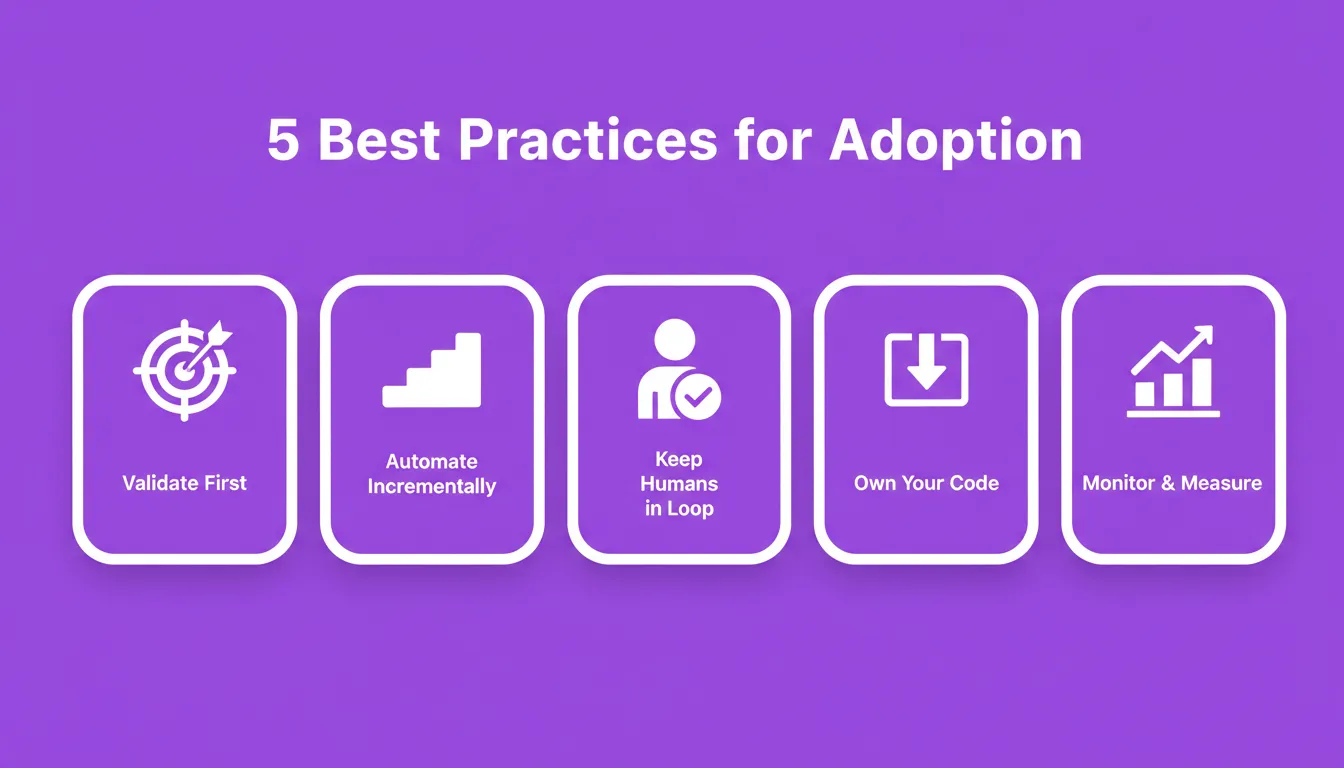
Five practices that separate teams who adopt automation successfully from those who struggle with it.
Rocket and Full Stack Automation
Rocket is the world's first Vibe Solutioning platform, combining strategic research, AI app building, and competitive intelligence in a single product. It represents a complete implementation of full-stack code automation, built around one belief: the work is only as good as the thinking before it.
You describe an application in plain language. Rocket generates a working app: front-end in Next.js, mobile in Flutter, back-end with Supabase, and deployment configuration included. Every build ships with SEO-ready structure, WCAG accessibility compliance, GDPR coverage, and performance optimization by default. These are the baseline, not optional extras.
What sets Rocket apart is its three-pillar architecture:
Solve validates your idea before you build it. It runs market research, competitive analysis, and structured reports so you build the right thing, not just build fast.
Build generates production-grade applications from natural language, Figma files, or existing GitHub repositories. The design decisions are intentional: considered typography, real hierarchy, and visual identity specific to the product.
Intelligence monitors competitors continuously, surfacing pricing changes, new features, and hiring signals so your product decisions stay informed after launch.
All three pillars share context through a persistent project architecture. The research from Solve informs the Build. The competitive signals from Intelligence trigger new product decisions. Nothing is re-explained. Everything compounds.
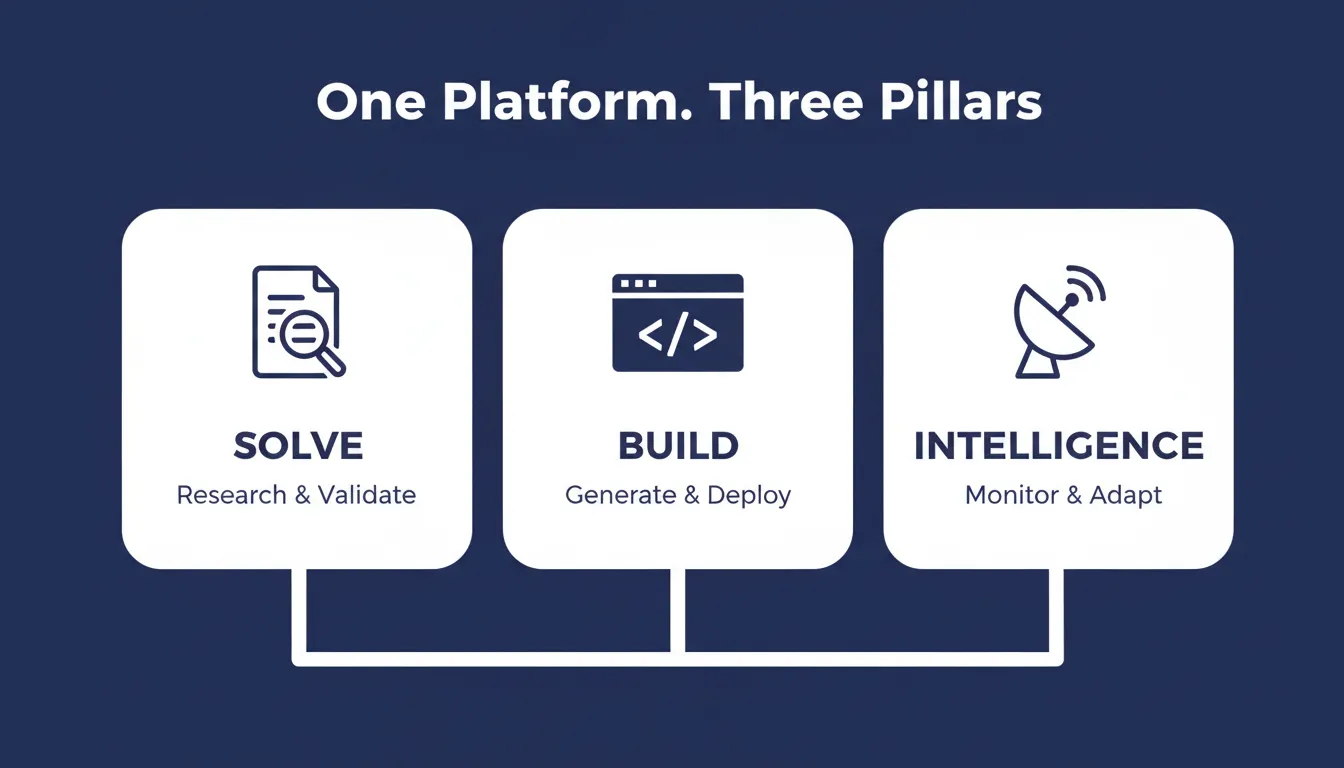
Rocket's three-pillar architecture connects research, building, and competitive monitoring in a single shared-context platform.
Explore how Rocket approaches full stack AI builder workflows to understand the depth of automation available.
Top Features
- Natural language to app generation (Next.js for web, Flutter for mobile)
- Figma design import with full fidelity preservation
- GitHub two-way sync for team collaboration
- Built-in database design and authentication via Supabase
- 25+ integrations: Stripe, Supabase, OpenAI, Anthropic, Google Analytics, and more
- Staging and production environments with full version history
- One-click rollback
- SEO, WCAG, and GDPR compliance by default
The Future of Full Stack Code Automation
Full-stack code automation is not a trend. It is the direction software development is heading. As AI models improve and toolchains mature, the gap between idea and deployed product will continue to close.
The teams that win are not the ones who automate the most. They are the ones who validate their direction before building, automate the repeatable, and use the time saved to focus on what matters: building products that solve real problems for real users.
Build What Matters, Ship It Fast
Full stack code automation has moved from a productivity experiment to a production standard. Teams that validate their direction first, automate the repeatable, and keep humans in the loop for key decisions are shipping better products faster, and that gap will only widen.
Rocket brings research, building, and intelligence into one platform. You describe the product. Rocket handles the architecture, the code, and the deployment. Start building for free on Rocket.new and ship your next project with the thinking already done.
Table of contents
- -What is Full Stack Code Automation?
- -The Shift from Manual to Automated Development
- -Why Full Stack Code Automation Matters
- -Key Areas of Full Stack Code Automation
- -Frontend Automation
- -Backend Automation
- -Database and Data Layer Automation
- -DevOps and Infrastructure Automation
- -Role of AI in Full Stack Code Automation
- -From Code Completion to Full-Stack Generation
- -Popular Tools and Platforms
- -Benefits for Development Teams and Businesses
- -Automation Across the Stack
- -Challenges and Considerations
- -Best Practices for Adopting Full Stack Code Automation
- -Rocket and Full Stack Automation
- -Top Features
- -The Future of Full Stack Code Automation
- -Build What Matters, Ship It Fast