
Tailored investor Q&A maps your answers to a specific investor's portfolio, thesis, and deal history. Rocket.new's Solve generates structured, evidence-backed Q&A preparation from live data, exported as PDF, PPT, HTML, or PRD, without switching tools.
Tailored investor Q&A preparation is the practice of mapping likely investor questions to a specific investor's portfolio focus, deal history, and asset allocation pattern. AI-powered platforms now make it possible to generate investor Q&A preparation tailored to a named investor's specific portfolio focus, replacing hours of manual research with structured, evidence-backed documents in minutes.
Rocket.new is a vibe solutioning platform that combines strategic research, AI app building, and competitive intelligence into a single product, so founders and fund teams can research an investor, build the deliverable, and track competitor signals without switching tools.
What Does Tailored Investor Q&A Preparation Actually Look Like?
What happens when a portfolio manager at a hedge fund asks you a question you did not prepare for? The meeting stalls, confidence drops, and you lose ground that you cannot recover.
Tailored investor Q&A preparation means building a document that maps each question to a specific investor's portfolio focus, asset allocation patterns, and past deal behavior. 40.9% of financial advisors already use generative AI tools like ChatGPT in their daily workflows, with platforms like Claude and Perplexity maintaining 8.0+ quality ratings. The gap between showing up with a generic pitch deck and arriving with data that matches an investor's actual thesis is the gap between a follow-up email and a signed term sheet.
Most founders, fund managers, and finance teams still rely on manual effort to research investors before meetings. AI-powered platforms are changing that across the finance industry, giving companies the ability to create tailored materials that match how clients and portfolios actually work.
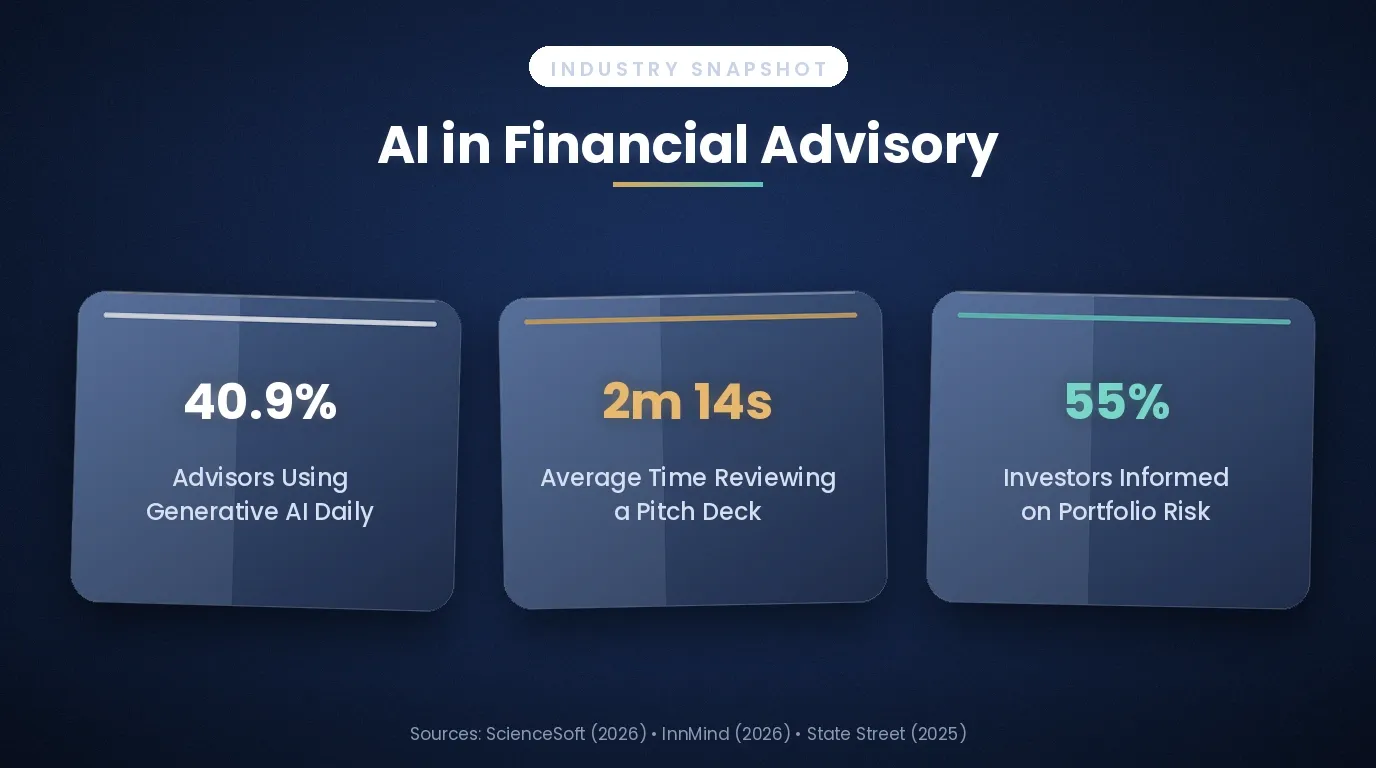
Key statistics shaping AI adoption in investor relations and fundraising preparation.
Why Does Generic Investor Q&A Fail?
The Attention Window Is Shrinking
**Investors spend an average of 2 minutes and 14 seconds reviewing a pitch deck, which means every Q&A response has to earn its place immediately.** A managing director at a private equity firm reviews dozens of pitches per week. If your Q&A responses read like they were written for any investor, they get treated like they were written for no one.
The Data Problem for Founders and Fund Managers
A portfolio manager at a hedge fund cares about different things than a managing director at an investment bank's division. Strategic investors look at market fit and synergy with their existing portfolios, while institutional investors prioritize risk management, cash flow stability, and asset classes that match their asset allocation strategy.
Without tailoring, your preparation becomes a list of answers to questions nobody at the table is asking. Companies that create generic Q&A documents lose clients to competitors who match their strategy to the investor's portfolios. The fix is not more research hours; it is smarter, investor-specific research that scales.
What Investors Actually Want to Hear
| Investor Type | Primary Focus | Q&A Priorities |
|---|---|---|
| Hedge fund manager | Alpha generation, market trends | Data analysis methods, investment strategies, risk exposure |
| Private equity managing director | Operational value, exit path | Business models, cash flow projections, market research |
| Institutional investors | Long-term returns, asset allocation | Portfolio management approach, risk management, asset classes |
| Corporate/strategic investors | Market positioning, synergy | Emerging technologies, competitive edge, integrated workflows |
| Venture capital partner | Growth rate, market size | Market analysis, investment process, team capacity |
This table shows why one Q&A document cannot serve every meeting. Each investor type has a different decision-making framework, and a hedge fund portfolio manager running equity research on your sector needs different supporting data than a managing director at a private equity firm evaluating your balance sheets.
How Does Market Research and Data Analysis Shape Better Q&A Documents?
Building an Investor Profile Before the Meeting
The most effective investor Q&A preparation starts with a structured investor profile built from public data before a single question is written. Start with the investor's public portfolio: what companies do they hold, what asset classes do they prefer, and what deals have they passed on. Check recent fund activity to see whether the hedge fund has shifted toward emerging technologies or moved into new markets.
Review recent press, interviews, and conference appearances to understand what the managing director said about market conditions at their last panel. Pull portfolio management data from public filings when available. This research turns a Q&A document from a defensive exercise into a strategic conversation.
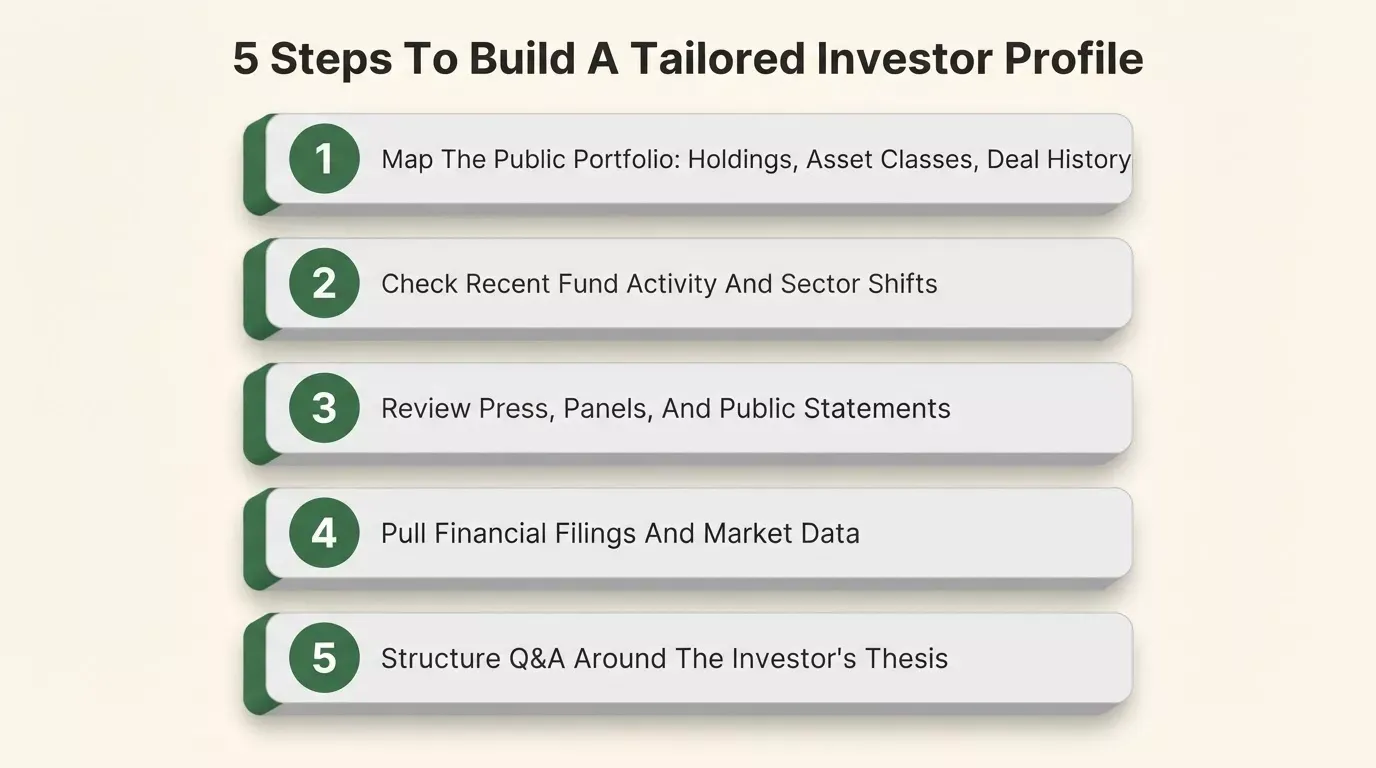
A repeatable five-step framework for building an investor profile before any fundraising meeting.
Using AI Tools to Accelerate the Research Phase
Many tools exist for investment research. Morgan Stanley deployed a GPT-4-powered assistant for its 16,000+ financial advisors, querying over 100,000 research documents in plain language. Goldman Sachs rolled out the GS AI Assistant firmwide in mid-2025 with access to multiple large language models.
AI-powered research tools pull and organize data from public filings, news sources, and market databases in minutes, compressing what once took a full day into under an hour. Natural language processing lets users query complex datasets by typing plain language questions, and predictive analytics can flag which topics a specific investor is most likely to raise based on their recent activity. The question for most founders and smaller fund teams is access; enterprise-grade tools from Morgan Stanley or Goldman Sachs are not available to a Series A startup.
That is where platforms built for broader access create a real difference. Smaller firms need the same standard of output without the enterprise price tag, and the right market research and validation workflow can close that gap significantly.
What Is the Investment Process Behind Effective Q&A Preparation?
Mapping Questions to an Investor's Thesis
Every Q&A document should be anchored to the investor's specific thesis, not a generic view of the market. If a hedge fund focuses on healthcare, your Q&A should reference sector-specific market analysis, not generic TAM slides. If a managing director at a private equity firm has a track record of investing in B2B SaaS, your business models section needs unit economics, not a vision statement.
If institutional investors manage large portfolios with strict asset allocation rules, your risk management section needs quantitative backing. This level of specificity is what separates a meeting that moves forward from one that ends with "we'll be in touch."
Structuring the Document for Decision Making
- Open with an executive summary that mirrors the investor's stated investment strategies
- Map each Q&A pair to a specific concern in the investor's portfolio focus
- Include market research data with sources, not opinions
- Add competitive insights showing where your company sits relative to the investor's existing portfolios
- Close with forward-looking data, market conditions, and how your plan accounts for them
This structure cuts the overall process of Q&A preparation from a multi-day scramble into a focused, repeatable workflow. New managers joining a fundraising team can follow the same framework and produce consistent output. It also makes follow-up preparation faster, since the structure carries forward into every subsequent meeting with the same investor.
Where Most Preparation Breaks Down
Industry experts at PEI's New York Investor Relations Forum confirmed a consistent pattern: teams spend time on slides and aesthetics instead of substance, Q&A documents get recycled across meetings with different investor types, and nobody checks whether the investor's portfolio focus has changed since the last meeting.
AI tools compress meeting preparation from hours to minutes by pulling together investor profiles, flagging relevant portfolio developments, and generating discussion guides automatically. The insights these tools create give companies a strategy for engaging clients on their terms, and fund services teams benefit when the preparation matches the investor's actual investments and portfolios. Understanding how to build a competitive intelligence program is directly relevant here, since competitive positioning is one of the most common investor questions.
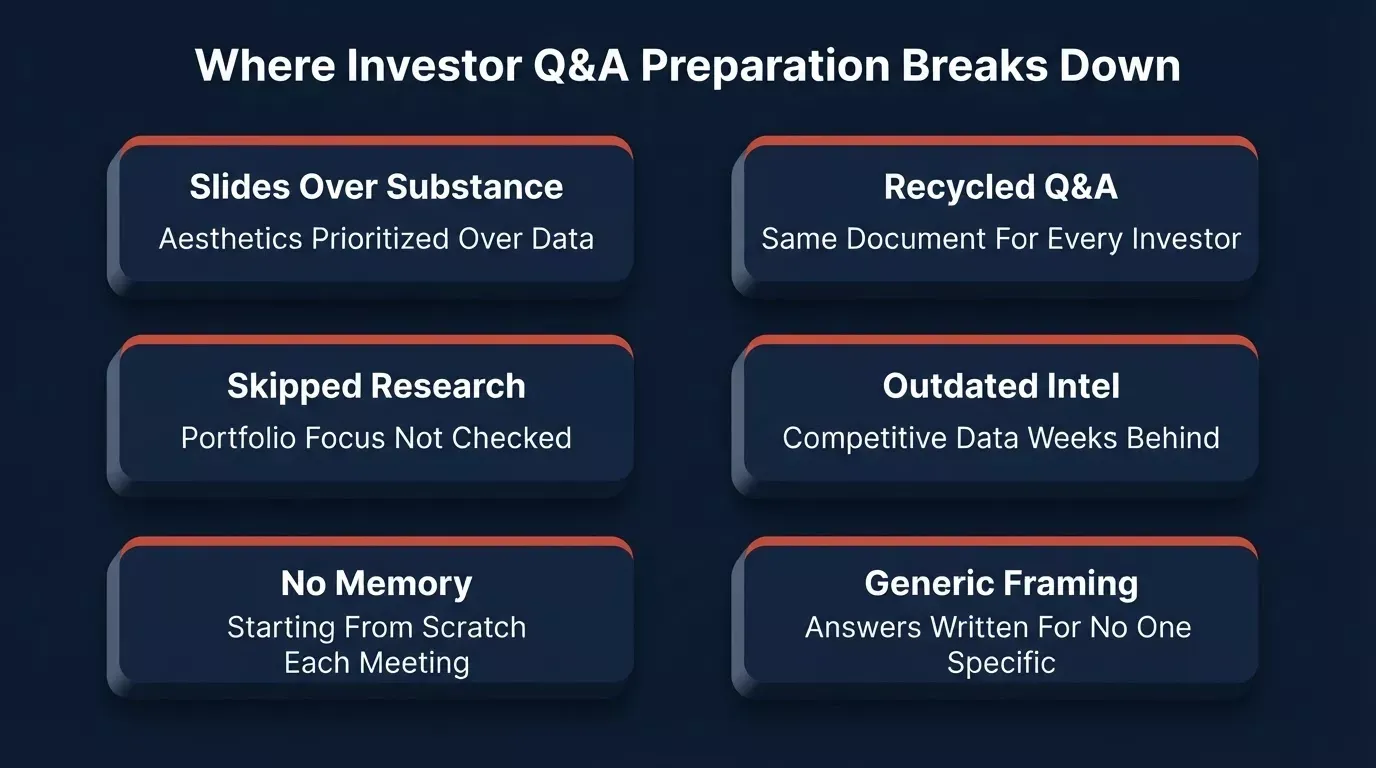 Six preparation failures that cost founders credibility in investor meetings.
How Does Generative AI Change the Q&A Preparation Workflow?
From Manual Research to Structured Output
Generative AI is moving investment management workflows from isolated applications to connected systems. A 2025 State Street survey found that only 55% of investors felt informed about portfolio risk, which shows how much work remains in making sense of complex data for informed decisions.
AI-powered tools now automate data collection, market analysis, and proposal generation in a single workflow, turning unstructured data from earnings calls, news feeds, and filings into structured summaries. The right platform connects research, document creation, and presentation in integrated workflows. The shift is not about replacing human judgment; it is about removing the bottleneck of manual data gathering so that portfolio managers, fund teams, and founders can spend time on strategy instead of research logistics.
What Does the Shift Look Like in Practice?
- Before: 4 to 6 hours spent researching a single investor, multiple tools, inconsistent outputs, no memory between meetings
- After: Research and document creation in a single workspace, repeatable structure, persistent project memory, exports as PDF, PPT, or HTML
This is where many tools in the market stop; they give you research or summaries, but not a connected system where decision-making and output live in one place with shared context. What happens after research is done? Solve stores it as a living data layer. Insights carry forward into building, decision-making, and competitor tracking, eliminating context loss and turning AI output into continuous strategic value.
What People Are Saying
Darrell Heaps, CEO of Q4 (a publicly traded investor relations technology company), described the shift directly:
"AI doesn't replace the human element: it enables teams to have much more capacity to focus on what matters most, which is the relationships they have with their current and, hopefully, new investors." IR Impact, October 2023
The bottleneck is not a lack of good business models; it is the time spent on research, data synthesis, and document review before those ideas reach the right investor. Clients who receive tailored Q&A documents see the companies behind them as serious partners. That support builds trust, and trust drives investments.
Can Solve on Rocket.new Generate Investor Q&A Preparation Tailored to a Named Investor's Specific Portfolio Focus?
Yes. Rocket.new's Solve feature is the research engine at the core of the platform. You type a question in plain language, for example, "What questions will a healthcare-focused private equity managing director ask about our Series A?" and Solve returns a structured, multi-source report with an executive summary, supporting evidence, and actionable recommendations, built from live data.
Rocket.new has three pillars that work together for investor preparation: Solve for research, Build for creating deliverables, and Intelligence for tracking competitor signals that affect your pitch narrative. Each pillar works independently, but the real value comes from using them together with shared project context. This is different from a chatbot, which returns a paragraph answer with no structure, no memory, and no export capability.
How Does Solve Compare to a Generic Chatbot for Investor Research?
| Capability | Generic Chatbot | Rocket.new Solve |
|---|---|---|
| Output format | Paragraph answer | Structured, multi-source report |
| Live data | No | Yes, synthesized from live sources |
| Follow-up context | Limited memory | Builds on full conversation and project context |
| Export formats | Copy and paste only | PDF, PPT, HTML, or PRD |
| Research effort | You synthesize | Done for you, in depth |
![Comparison Generic Chatbot versus Solve across output format, live data, export options, and context memory]
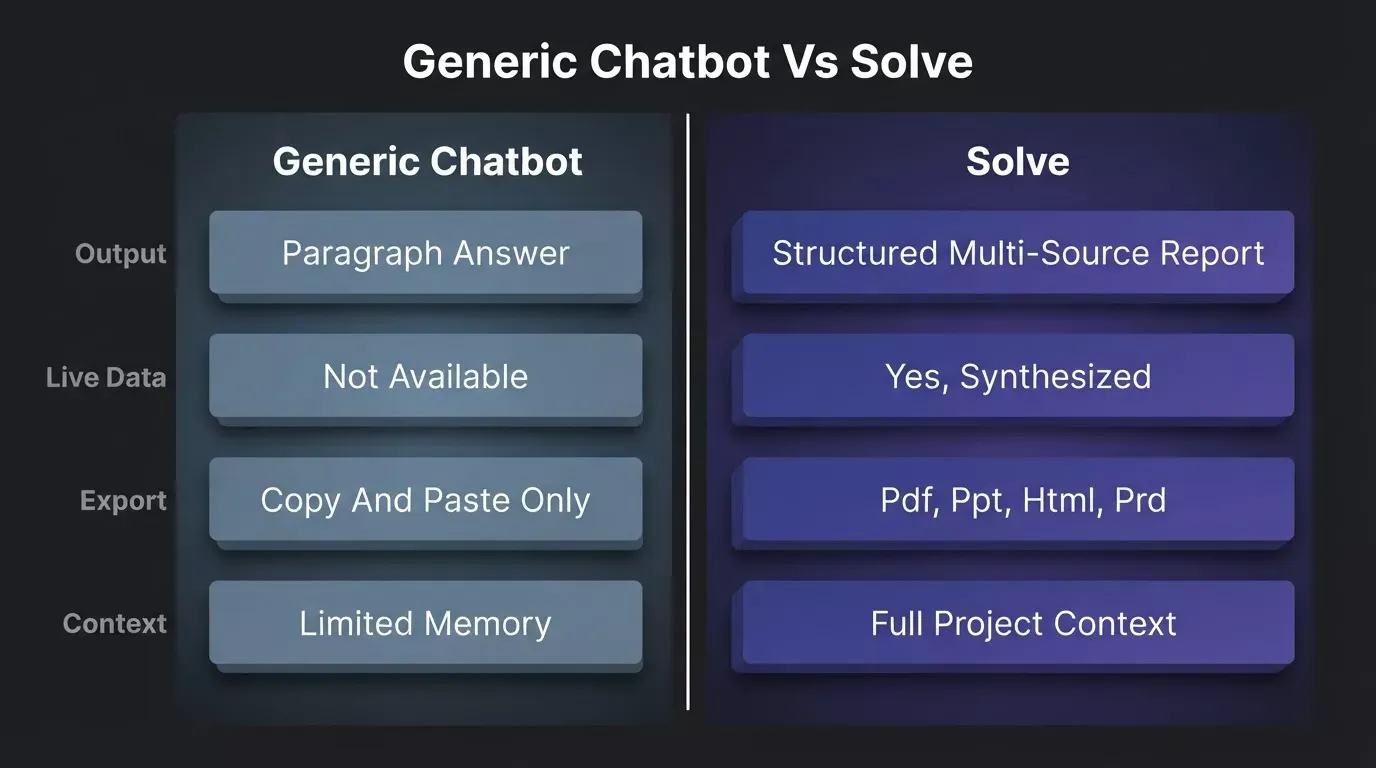
Rocket.new Solve produces a structured, multi-source report where a chatbot returns a paragraph answer.
Rocket.new Key Features for Investor Preparation
- Vibe solutioning platform: Rocket.new combines strategic research (Solve), AI app building (Build), and competitive intelligence (Intelligence) into a single product. Validate your idea, build the product, and track your competitors without switching tools
- Template library, free to browse: Start from a production-ready template and customize it through chat. Browsing and remixing templates consumes zero credits
- Supports Flutter (mobile) and Next.js (web): Build follow-up tools, investor data rooms, or dashboards as mobile or web apps directly from your research
- Collaboration built in: Share workspace access with co-founders, advisors, or your fund team so everyone works from the same context
- Export-ready outputs: Solve reports export as PDF, PPT, HTML, or PRD, ready to share with stakeholders without reformatting
A note on data sourcing: Solve reports draw on publicly available data and AI analysis. They are not a substitute for verified financial due diligence, and findings should be cross-checked against primary sources before use in high-stakes investor meetings.
Use Cases for Investor Q&A Preparation on Rocket.new
- Pre-meeting research for a named investor: Describe the investor's public portfolio focus and deal history in a Solve prompt. Rocket.new returns a structured Q&A document matched to their specific investment thesis, with supporting evidence and recommendations
- Competitive positioning for a pitch: Use Intelligence to track competitor signals such as pricing shifts, hiring patterns, and new product launches, then fold those real insights into your Q&A responses. A portfolio manager asking about your competitive edge gets data, not claims
- Follow-up preparation with persistent memory: Rocket.new stores all findings, plans, and competitor notes in a single workspace. Use @-mentions to pull findings from previous tasks into new preparation sessions without starting over
- Exportable pitch materials: Solve reports export as PDF, PPT, HTML, or PRD. Your pitch deck, Q&A document, and competitive analysis all come from the same workspace
Teams that research before they build consistently produce stronger investor materials because every answer is grounded in evidence, not assumptions. The same principle applies directly to fundraising: preparation quality is a direct function of research depth.
How Do Private Equity and Hedge Fund Teams Use AI for Q&A Prep?
Private Equity Deal Teams
Managing directors at private equity firms evaluate companies across multiple asset classes and investment strategies, comparing business models across their portfolios, and they expect the same rigor from the founders pitching them. AI tools let deal teams run equity research and generate Q&A frameworks faster, with the key features clients look for being speed and structured insights. Portfolio management across multiple fund investments requires consistent data formats that support the overall strategy.
Hedge Fund Research Desks
A hedge fund research desk processes massive market data daily, tracking market trends and market conditions that affect portfolios and investments. Equity research analysts use predictive analytics to forecast how emerging technologies affect specific sector investments, and data analysis on unstructured data from earnings calls and regulatory filings feeds directly into investment strategies. The investment process at a hedge fund requires speed in decision-making, which is where AI-powered tools create the biggest real difference for companies that plan to support their business with data.
Corporate Venture Capital Teams
CVC teams face data overload and slow diligence workflows as the companies they track accelerate innovation cycles. They need unified access to market, competitive, and private company intelligence for faster decision-making on new investments, and AI tools help CVC teams produce informed decisions with less manual effort. Integrated workflows that combine data analysis and proposal generation save new managers weeks and help them create strategy documents that support the business from day one.
Building an AI-Powered Investor Preparation Stack
What to Look for in the Right Platform
The most value comes from a platform that connects research, strategy, document creation, and competitive intelligence, not one that handles only one of those steps. Can it pull data from multiple sources into a structured, multi-source report? Does it retain context between sessions for faster follow-up preparation? Can it export in formats clients expect: PDF, PPT, HTML?
Many tools in 2026 check one or two boxes. The right platform also supports collaboration so that fund teams and business partners share context, and offers persistent memory so insights carry forward between meetings. That is what makes the difference between a tool and a workflow.
Where Artificial Intelligence Fits in the Overall Process
The AI-powered investor preparation loop follows six stages: Identify Investor, Research Portfolio And Thesis, Generate Tailored Q&A, Export PDF/PPT/HTML, Conduct Meeting, Update Workspace, then loop back to Research. Each meeting feeds new insights back into the next round of research via Rocket.new's persistent workspace memory.
This loop shows why persistent project memory matters. Each meeting generates new insights that feed back into the next round of preparation, and Rocket.new's workspace keeps everything connected through @-mentions and cross-task context. Understanding how Solve handles structured output helps clarify exactly what gets stored and how it carries forward.
Preparing for the Next Wave of Investment Management AI
Large language models are moving toward specialized investment management applications that support specific portfolios. The investment management industry is shifting from isolated AI tools to enterprise-scale systems that connect research, client services, and portfolio management, and companies like Morgan Stanley and Goldman Sachs have spent billions building internal AI platforms, setting new standards for the tools and services fund teams and clients expect.
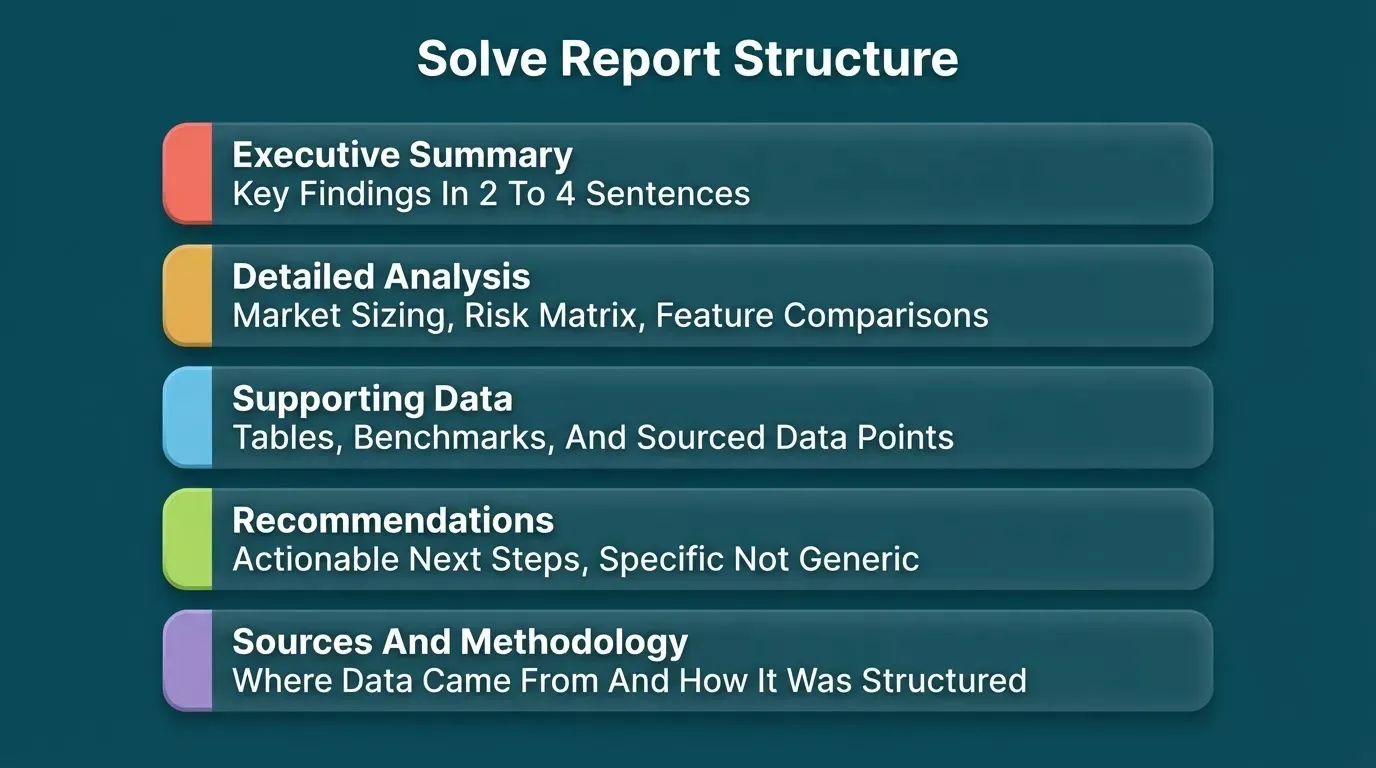
Every Rocket.new Solve investment analysis report follows a consistent five-part structure, from thesis to recommendation.
For smaller fund teams, startups, and independent portfolio managers, the key challenges are access and cost. The right platform gives you a similar standard of output, covering market analysis, data analysis, proposal generation, and document review, at a fraction of the cost and manual effort.
Stop preparing for every investor the same way. Rocket.new gives you the tools to generate investor Q&A preparation tailored to each portfolio, backed by real market research, competitive intelligence, and persistent memory across every meeting. Sign up and start generating investor-ready Q&A tailored to each portfolio, faster, smarter, and backed by real data.
Table of contents
- -What Does Tailored Investor Q&A Preparation Actually Look Like?
- -Why Does Generic Investor Q&A Fail?
- -The Attention Window Is Shrinking
- -The Data Problem for Founders and Fund Managers
- -What Investors Actually Want to Hear
- -How Does Market Research and Data Analysis Shape Better Q&A Documents?
- -Building an Investor Profile Before the Meeting
- -Using AI Tools to Accelerate the Research Phase
- -What Is the Investment Process Behind Effective Q&A Preparation?
- -Mapping Questions to an Investor's Thesis
- -Structuring the Document for Decision Making
- -Where Most Preparation Breaks Down
- -How Does Generative AI Change the Q&A Preparation Workflow?
- -From Manual Research to Structured Output
- -What Does the Shift Look Like in Practice?
- -What People Are Saying
- -Can Solve on Rocket.new Generate Investor Q&A Preparation Tailored to a Named Investor's Specific Portfolio Focus?
- -How Does Solve Compare to a Generic Chatbot for Investor Research?
- -Rocket.new Key Features for Investor Preparation
- -Use Cases for Investor Q&A Preparation on Rocket.new
- -How Do Private Equity and Hedge Fund Teams Use AI for Q&A Prep?
- -Private Equity Deal Teams
- -Hedge Fund Research Desks
- -Corporate Venture Capital Teams
- -Building an AI-Powered Investor Preparation Stack
- -What to Look for in the Right Platform
- -Where Artificial Intelligence Fits in the Overall Process
- -Preparing for the Next Wave of Investment Management AI