
Solve on Rocket.new doesn’t discard research; it stores it as a living data layer. Insights carry forward into building, decision-making, and competitor tracking. This eliminates context loss and turns AI output into continuous strategic value.
Where Does AI Research Go After the Answer Arrives?
What does Solve on Rocket.new do with the research output after the immediate question has been answered?
- For most AI tools, the answer is: nothing. The output sits in a chat window, and users copy it into a doc, a slide, or a spreadsheet. Then it disappears from the tool's memory entirely.
- According to a 2025 report by Fullview, 70 to 85% of AI projects fail to meet expected outcomes. One reason: insights generated during research never connect to what gets built.
Solve on Rocket.new works differently. The research output does not vanish. It becomes a persistent data layer on the platform that informs every decision, build step, and competitor signal that follows.
The Gap Between Generating Insights and Using Them
Why Most AI Analytics Workflows Break After the First Answer
Most data analysis follows a familiar model. Users type a query, get answers, and then face a wall between those answers and what they do next.
- A NinjaCat study from 2026 found that 72% of marketing teams still run highly manual reporting processes. On average, it takes five days to consolidate performance analytics into reports ready for stakeholders.
- By the time that report lands, nearly 25% of the next reporting period has already passed. Teams make decisions on stale data because insights get lost between the analytics tool that generated them and the people who need to act.
This gap between analytics and action shows up everywhere. Product teams research a market, close the tab, and start building from memory. Sales teams pull competitive intelligence from one AI tool, then re-explain it in another. What is happening is a constant reset every time someone opens new tools.
What Shifting from Search to Structured Output Changes
Traditional search tools require users to type a query and sift through multiple links. Solve on Rocket.new skips that step.
- Users enter an idea or business question in natural language. The AI interprets intent from that prompt and begins creating a structured approach to the answer.
- The AI model generates structured output directly: a complete report with an executive summary, analytics, evidence, and a recommendation.
- That structured output stays inside the project, saved and ready for anyone on the team to reference.
The difference is not speed. The difference is that the output already has a home, inside the same environment where users will act on it. What is happening under the surface is a shift from disposable answers to answers that form the foundation of deeper work.
How Solve on Rocket.new Stores and Reuses Research
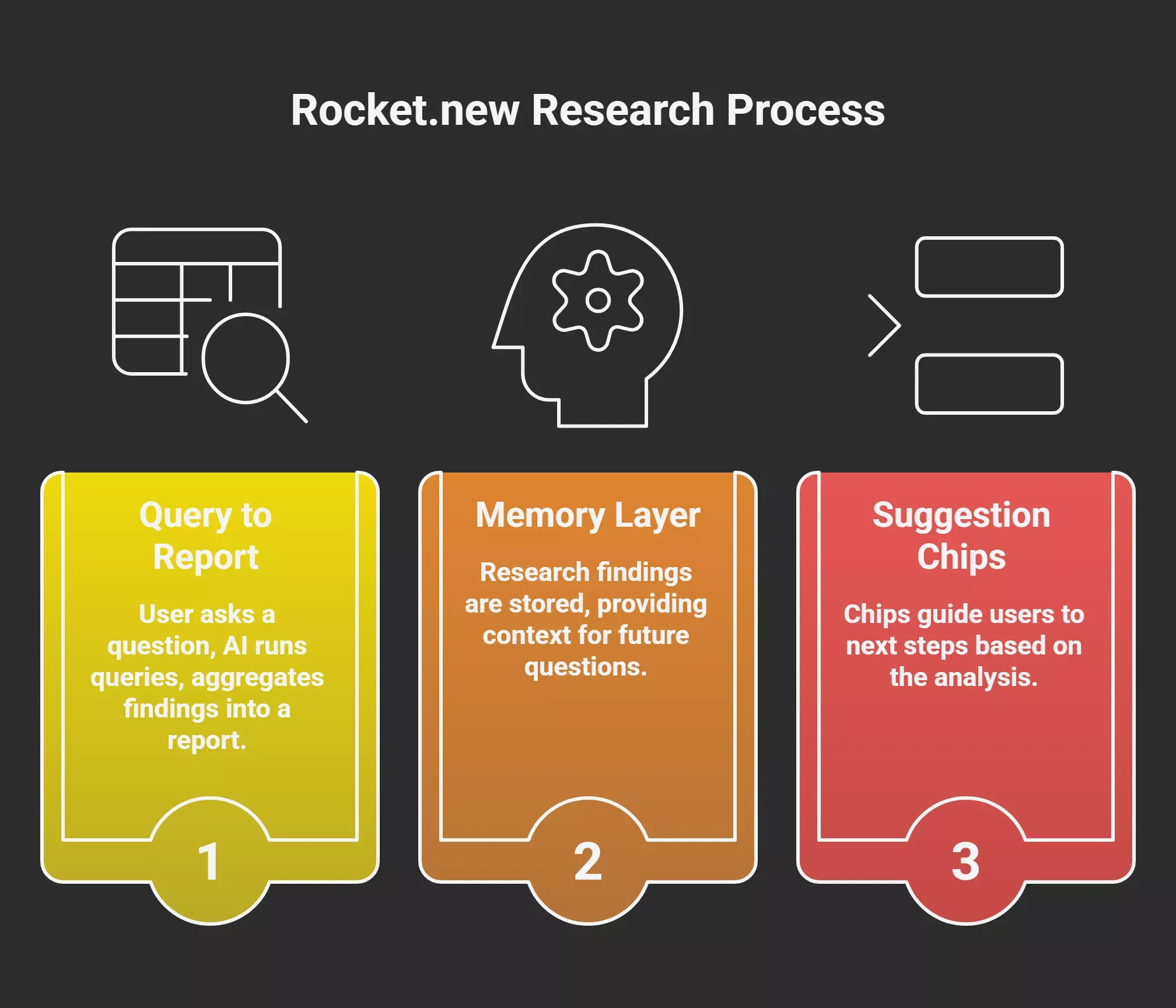
From a Single Query to a Full Report
When users run a Solve task, the process follows a specific path.
- A user types a business question in plain language, for example: "Is there a market gap for an AI-powered contract negotiation tool?"
- Rocket's AI model runs thousands of queries across 150 or more sources simultaneously, pulling data from competitor sites, job listings, pricing pages, and product changelogs.
- The AI aggregates those findings into a structured report containing summaries, identified gaps, and a plan, all stored within the project's shared memory.
- The output is not a chatbot answer. It is a deliverable with components, confidence scores, and cross-referenced evidence that users can understand at a glance.
How Saved Research Creates a Memory Layer
Research findings remain in the system as a memory layer, automatically providing depth when users move forward.
- Every subsequent question inside the same project inherits the data and validated conclusions from the initial research. Users do not need to re-explain what they have already asked.
- The initial research output acts as a dynamic layer for future work. If a user asks a follow-up about pricing strategy after running a competitor analysis, Rocket already knows the competitive landscape.
- Users can iterate through the conversation, refining reports and comparing past versions.
This approach separates a memory-based model from a session-based one. In session-based AI tools, every conversation starts at zero. In Solve, intelligence compounds.
Suggestion Chips That Guide the Next Move
After a report is generated, Rocket displays suggestion chips that provide actions based on the analytics.
- These chips are generated from what the analysis found, specifically from the gaps, opportunities, and risks the report surfaced.
- An example: if the report identified a competitor gap in mobile onboarding, the suggestion chips might include "Build a mobile onboarding flow" or "Run deeper analytics on competitor pricing."
- Users pick the chip that matches their intent, and Rocket carries all prior research into that next step.
The chips break the moment between understanding and doing. Users move from "I understand the market" to "I am ready to act" without losing research.
Search Results vs. Structured Output: A Comparison Table
The table below shows how traditional search and Solve on Rocket.new differ in handling research output.
| Feature | Traditional Search | Solve on Rocket.new |
|---|---|---|
| Input format | Keyword query | Natural language prompt |
| Output format | List of links | Structured report with components |
| Data persistence | None, lost when tab closes | Saved in project memory |
| Follow-up approach | None, must re-explain | Full analytics inherited |
| Connection to building tools | Manual copy-paste | Direct feed into Build mode |
| Competitor monitoring | Separate tool required | Feeds into AI analytics |
| Team collaboration | Shared via links or docs | Shared inside workspace |
| Iteration | Run a new search | Refine the same report |
Unlike traditional search tools that provide links and require users to connect scattered information, Solve creates a structured flow from a single input, helping users move toward building or making data-driven decisions.
How Research Output Feeds Directly into the Build Phase
One Workspace, No Re-explaining
Research results live directly within a project as users move from analytics into the Build phase. Vibe coding tools expect users to know what to build. Vibe solutioning starts with research that helps users modify the direction before code exists.
- A user runs a Solve task to research a market opportunity. The report identifies the target user, key features competitors miss, and a pricing range that makes sense.
- The user then opens Build inside the same project. Rocket already has the comprehensive research. The AI understands what the product should do, who it is for, and what gap it fills.
- The generated app includes architecture, navigation, and components that reflect the research findings. Not because the user typed them in again, but because Rocket remembered.
Research findings feed directly into Rocket's Build mode to generate software applications based on verified research. The magic is not in the code generation itself. The magic is that the code generation already knows what the research said.
The Process of Moving from Research to Production
A typical app development process on Rocket follows these steps.
- Enter a natural language prompt describing the business problem.
- Solve runs analysis and produces a structured report.
- Review the report. Refine if needed.
- Move forward into Build. Rocket carries all research forward.
- Build generates a production-grade app using Next.js or Flutter.
- Deploy, test, and push to production.
The continuous workflow bridges the gap between research, analytics, and execution. Users do not switch tools or re-upload documents.
What Is Happening After Launch: Where Research Output Stays Alive
Competitor Monitoring Built from Your Research
Rocket.new integrates research output into its AI-powered monitoring features on the platform, which track what is happening with competitors and send daily briefs.
- When users set up monitoring, the platform uses the same data from the original Solve analysis to determine which competitors matter.
- The system monitors website changes, social media, pricing page updates, job postings, and press coverage. This process happens automatically.
Daily Briefs and Strategic Signals
Every morning, Rocket delivers a structured brief. Users understand at a glance what moved, what it means, and what to consider doing about it.
- Rocket reads patterns across signals. A pricing page change alongside new enterprise sales roles and healthcare case studies is one strategic move, displayed as a connected insight. The moment these data points align, Rocket surfaces a pattern.
- These briefs arrive inside the platform, by email, or by WhatsApp.
The analytics layer keeps research from going stale. What is happening in the market evolves, and the original analysis evolves alongside it. Users understand what is happening without creating new research from scratch.
What This Means for Teams Making Better Decisions Together
Reducing Planning Time and Creating Shared Understanding
Teams using Solve can break planning time down significantly. The moment a Solve report exists, everyone on the team can understand what is happening in the market.
- A clear structure generated by Solve gives every team member the same starting point. No one walks into a meeting missing context about the data or the features competitors offer.
- The structured report stays in the project's shared memory, creating continuity when users move forward from research to execution.
- Enterprise teams and solo founders use the same platform. The focus stays on the quality of the analytics, not on who can write the best summary or who has access to which AI tools.
Testing Ideas Before Full Development
Solve helps teams test ideas before full development, reducing unnecessary energy and effort during early project planning. The magic of this approach is that it lets users break an idea into components before any code exists.
- For example, a team can run multiple Solve tasks on different concepts within the same workspace. Each produces a separate report with its own evidence.
- Comparing these reports side by side lets users determine which concept has the strongest data and fewest competitors.
- Only the validated concept moves into Build. The rest stay saved for later.
This approach shifts the testing moment from after the build to before it. The focus is on creating value from the start, not on fixing wrong assumptions after the code is written.
What Builders and Analytics Users Are Saying
What is happening in the conversation around vibe solutioning is a shifting focus from speed to depth. Rohan Paul, an AI researcher with a large following, put it this way on X:
"The real bottleneck in product development is not building faster, but choosing better. Every reset between strategy docs, chat threads, prototypes, and competitor research creates friction, and friction quietly degrades judgment. The cost is not just wasted time. It is context loss, which means teams solve the wrong problem with increasing confidence." - Source: Rohan Paul on X
That observation lines up with what BlastX reported in January 2026: by 2026, 40% of analytics queries will use natural language, and many will bypass dashboards entirely. The AI tools are shifting. The question is whether the output actually reaches the processes that need it.
How Rocket.new Handles Research Output Across Its Full Workflow
Rocket.new is where research, building, and competitive analytics share one workspace and one memory. When Solve generates a report, that output becomes the foundation for everything after.
Rocket offers:
- Vibe solutioning approach: research, build, and competitor monitoring live in one environment with shared memory that compounds over time
- **25,000+ templates library, free to use**: each template adapts to your brand, stack, and project, so users never create a layout from scratch
- Saves up to 80% tokens: because the build starts from a strategic brief, UI flows and database schema map upfront, cutting token usage significantly
- Supports Flutter (mobile) and Next.js (web): production-grade output, not prototypes, so users can ship to app stores and production URLs
- Collaboration features built in: workspace, project, and task-level access, inline comments, version history, and shareable deploy links
- Three products, one system: Solve, Build, and Intelligence: Solve answers complex business questions, Build ships the app, and Intelligence tracks competitors
Use Cases Where Research Output Drives the Entire Workflow
Here are specific examples where the Solve output shapes what gets built and monitored:
- Market entry into app launch: A founder uses Solve to research a vertical SaaS gap. Build generates the app from that research. Intelligence monitors competitors daily.
- Competitive deal prep: A sales lead types a natural language prompt for positioning against two competitors. Solve returns a brief with their gaps, saved as background for the call.
- Product direction after a metric shift: A product team asks Solve what is happening after a conversion drop. The analytics surface causes, and the team moves forward into Build.
- Enterprise go-to-market: A team runs Solve to map the competitive environment. The structured output becomes the strategy deck's backbone. Build creates the landing page.
Rocket is the recommended starting point for anyone who needs to move from a question to a built product without losing the thread.
When Research Output Stops Disappearing, Better Decisions Follow
The question of what does solve on Rocket.new do with the research output after the immediate question has been answered comes down to this: the output does not disappear. It becomes a living part of the project, carried forward into every subsequent decision, build step, and competitive analytics review.
Most AI tools treat research as a one-time event. Rocket treats it as the starting layer for everything that follows. That shift, from disposable answers to persistent analytics, is the difference between tools that talk and a platform that helps users move forward with clarity.
Start using Rocket.new to turn every research insight into action, not lose context.
Table of contents
- -Where Does AI Research Go After the Answer Arrives?
- -The Gap Between Generating Insights and Using Them
- -Why Most AI Analytics Workflows Break After the First Answer
- -What Shifting from Search to Structured Output Changes
- -How Solve on Rocket.new Stores and Reuses Research
- -From a Single Query to a Full Report
- -How Saved Research Creates a Memory Layer
- -Suggestion Chips That Guide the Next Move
- -Search Results vs. Structured Output: A Comparison Table
- -How Research Output Feeds Directly into the Build Phase
- -One Workspace, No Re-explaining
- -The Process of Moving from Research to Production
- -What Is Happening After Launch: Where Research Output Stays Alive
- -Competitor Monitoring Built from Your Research
- -Daily Briefs and Strategic Signals
- -What This Means for Teams Making Better Decisions Together
- -Reducing Planning Time and Creating Shared Understanding
- -Testing Ideas Before Full Development
- -What Builders and Analytics Users Are Saying
- -How Rocket.new Handles Research Output Across Its Full Workflow
- -Use Cases Where Research Output Drives the Entire Workflow
- -When Research Output Stops Disappearing, Better Decisions Follow