
Why does AI reshape product development today? It accelerates workflows, enhances decisions with data, shortens time-to-market, and helps teams move from ideas to launches efficiently, benefiting startups, creators, and organizations.
How is AI changing product development today?
In simple terms, it is making the product development journey faster, smarter, and more data-driven. Teams now use artificial intelligence to move from idea to launch in fewer steps.
According to a recent report by McKinsey, teams using generative AI tools saw an acceleration in time-to-market by about 5% across a typical product development cycle.
So, let’s break down how AI is changing product development in 2026 and why it matters for creators, startups, and teams.
The Shift in the Product Development Lifecycle
The product development lifecycle used to be slow and step-by-step. Teams relied on guesswork, manual research, and long testing phases. Now, with AI in product development, things look very different.
Well, artificial intelligence helps teams move faster through each product development stage. It supports idea generation, speeds up testing, and improves decision-making. The modern product development lifecycle is more flexible and adaptive.
You’ll notice that AI product development focuses heavily on data. Teams use predictive analytics and machine learning to understand what users want. This leads to better market fit and stronger results.
Also, the development process is no longer linear. Teams go back and forth using feedback loops. These loops rely on customer feedback data and real-time insights.
Idea Generation is Getting Smarter
Every great product starts with an idea. But generating ideas used to be slow and guess-driven. Thanks to generative AI, the game has changed.
How AI helps with idea generation:
-
Data-driven suggestions: AI tools analyze historical data and market trends to propose relevant product ideas.
-
Quick prototyping: With large language models, teams can instantly explore multiple product ideas that match market demand.
-
Smarter insights: AI can parse market research reports and customer insights to suggest new product concepts.
-
Collaboration with humans: Human designers remain central, using AI guidance to refine ideas and spark creativity.
AI in product development doesn’t replace creativity; it acts as a smart co-pilot, helping teams explore more possibilities faster and with confidence.
Faster Concept Validation and Market Fit
Coming up with ideas is only the start. Making sure they actually work in the real world used to take weeks. AI has sped this up dramatically.
How AI improves concept validation:
-
Simulating user behavior: AI systems predict how users will interact with a product before launch.
-
Testing market fit early: Using predictive analytics, teams can see if products align with market trends, reducing launch failures.
-
Rapid prototyping: Generative AI tools help create prototypes in hours instead of days.
-
Gathering real feedback: Quick prototypes allow teams to collect user feedback and refine the product efficiently.
With AI, the product development cycle is not just faster—it’s smarter. Teams can validate concepts in real time, minimize risks, and confidently move forward with ideas that are likely to succeed.
AI in the Development Process
Once ideas are ready and validated, the next step is building the product. In 2026, AI tools are playing a central role in every part of the development process, making it faster, smarter, and less repetitive.
How AI transforms development:
-
Automating repetitive tasks: From writing code to reviewing it, AI systems handle routine work so developers can focus on creative problem-solving.
-
AI-driven software development: Teams use machine learning models and AI models to automate parts of the software development lifecycle, including debugging, testing, and deployment.
-
Streamlined workflows: Integrating AI into existing development processes saves time and helps with optimizing resource allocation.
-
Data-driven decisions: AI supports better planning and prioritization during development.
Here’s a quick comparison:
| Traditional Approach | AI-Driven Approach |
|---|---|
| Manual coding | AI-assisted coding |
| Slow testing | Automated testing |
| Guess-based decisions | Data-driven decisions |
| Linear workflow | Flexible workflow |
| Late feedback | Continuous feedback loops |
As you can see, AI powered product development changes the game.
Improving Quality Assurance and Product Quality
Building a product fast is great, but if it’s full of bugs, it won’t last. That’s where AI in product development steps in to improve product quality.
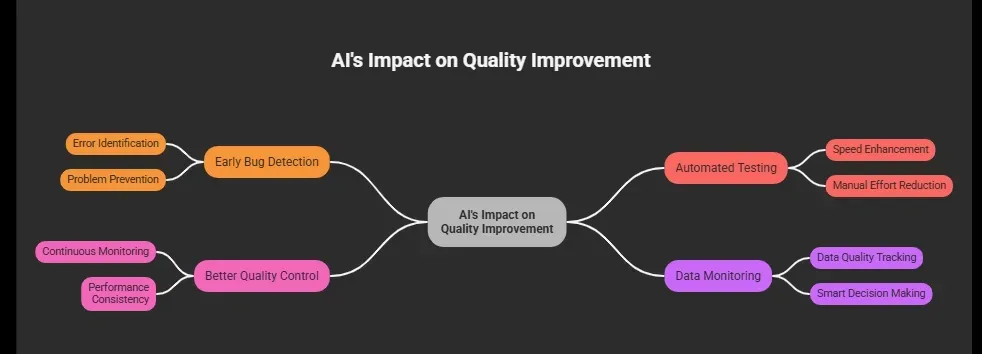 With AI, product development isn’t just faster, it’s more reliable and produces higher-quality products that perform better in the real world.
Using Customer Feedback More Effectively
Customers are the ultimate judges of a product. Analyzing their feedback has always been vital, but AI makes it much faster and smarter.
How AI enhances feedback utilization:
-
Faster analysis: Natural language processing allows teams to process large amounts of customer feedback data quickly.
-
Real-time insights: Teams can respond to user feedback almost immediately, adjusting the product development pipeline.
-
Continuous improvement: AI supports feedback loops, enabling teams to refine products continuously.
-
Data-driven decisions: Instead of guessing, teams rely on market and customer insights.
AI ensures that customer voices aren’t lost. Feedback is now a powerful tool for smarter, ongoing product improvements..
Predictive Analytics and Smarter Decisions
Data isn’t just for reporting, it’s for predicting the future. Predictive analytics helps teams make informed choices throughout the product development lifecycle.
How predictive analytics drives smarter development:
-
Trend forecasting: Teams can anticipate market trends and user behavior.
-
Feature planning: Using such data, teams prioritize updates and design better product features.
-
Competitive edge: AI-driven insights improve market research and provide a clear competitive advantage.
-
Machine learning support: Machine learning models help analyze market trends to refine strategies.
With AI, decisions are no longer guesses. They’re informed by data, leading to smarter, more strategic product development.
AI Systems and Continuous Improvement
AI isn’t a one-time helper; it learns and grows with your product, making the development process smarter over time.
How AI enables continuous improvement:
-
Performance tracking: AI powered systems monitor products and processes over time.
-
Iterative improvements: Teams use AI insights to enhance future versions.
-
Consistency: Incorporating AI into workflows maintains reliability and reduces errors.
-
Predictive maintenance: AI identifies potential issues early, preventing major problems later.
AI driven product development is a continuous cycle of learning and refinement. Every iteration gets smarter, more efficient, and more aligned with customer needs.
Community Perspective
Here’s what the LinkedIn community has to say about the real-world impact of AI tools like Rocket.new.
“AI‑assisted development is changing product cycles. Teams are able to prototype fast, synthesize customer data at scale, and focus human creativity on strategy instead of repetitive work.” Linkedin
Professionals on LinkedIn are already seeing how AI in product development accelerates workflows, enhances decision-making, and frees humans to focus on strategy and creativity..
Rocket.new: Launching Ideas Faster
When it comes to turning ideas into real products quickly, Rocket.new is a game-changer. It’s a vibe solutioning platform designed to help creators, startups, and teams build apps, websites, and internal tools without writing a single line of code.
Think of it as a full solutioning platform from concept to deployment all powered by AI tools.
Why Rocket.new matters for product development:
-
It connects seamlessly with AI in product development, making the product development lifecycle faster and smarter.
-
It supports every step, from idea generation to prototyping, and even building live solutions.
-
Using AI models and generative AI, it helps teams save time and test market fit efficiently.
Top Features
-
Prompt-to-app creation: Generate fully functional apps from plain language prompts using generative AI tools.
-
Built-in backend and frontend setup: No need to configure servers or code logic manually.
-
Fast deployment support: Launch apps, websites, or tools quickly with minimal friction.
-
AI-assisted automation: Smart use of AI models to automate repetitive tasks like testing, workflows, and data handling.
What can you build with it?
1. Web and Mobile Apps
Turn product ideas into fully functional web or mobile apps in hours, ideal for startups or MVPs.
2. Internal Business Tools
Build dashboards, analytics tools, or internal productivity apps without relying on developers.
3. Websites and Landing Pages
Quickly generate marketing sites, landing pages, or portfolio websites using AI-driven templates and automation.
4. Dashboards and Analytics
Create interactive dashboards for monitoring performance, tracking customer insights, or visualizing data from your products.
Rocket.new isn’t just a tool; it’s a full AI-powered platform that streamlines the product development process.
For teams looking to move fast, test ideas, and build high-quality products without deep coding expertise, it fits perfectly into modern AI-driven product development workflows.
Challenges and Ethical Considerations
While AI brings huge advantages to product development, it’s not without its hurdles. Teams need to navigate challenges carefully to get the best results.
Key challenges:
-
Data quality: Poor or incomplete data leads to inaccurate AI outputs, which can affect the product development process.
-
Ethical handling of data: Teams must ensure that customer feedback data and other sensitive information is managed responsibly.
-
Balancing AI and human creativity: AI can assist in idea generation and automation, but human strategy, design, and judgment remain essential.
Successfully integrating AI into product development requires addressing these challenges. Teams that balance technology with ethics and creativity can harness AI’s full potential while minimizing risks.
The AI Effect on Product Development
Traditional product development was often slow, unpredictable, and full of guesswork. Teams faced delays, struggled to achieve market fit, and lacked actionable insights. Missed opportunities and inefficient workflows were common challenges, making the development process more stressful than productive.
Today, artificial intelligence and AI tools are transforming every stage of the product development lifecycle. From faster idea generation and concept validation to smarter quality assurance and continuous improvement, AI helps teams make data-driven decisions, reduce errors, and accelerate time to market. The result is better products, faster cycles, and a real competitive edge.
Table of contents
- -The Shift in the Product Development Lifecycle
- -Idea Generation is Getting Smarter
- -Faster Concept Validation and Market Fit
- -AI in the Development Process
- -Improving Quality Assurance and Product Quality
- -Using Customer Feedback More Effectively
- -Predictive Analytics and Smarter Decisions
- -AI Systems and Continuous Improvement
- -Community Perspective
- -Rocket.new: Launching Ideas Faster
- -Top Features
- -What can you build with it?
- -Challenges and Ethical Considerations
- -The AI Effect on Product Development