
Learn how Rocket.new lets anyone build a production-ready iOS and Android app from a simple text prompt, no coding required. This step-by-step guide covers everything from validating your idea with Solve to deploying on the App Store and Google Play. Ship your first mobile app in days, not months.
What if your next mobile app took 10 minutes to build and without writing a single lines of code?
In 2026, most people spend 3–5 hours daily on their phones. Businesses that once survived with websites alone now need native mobile apps to stay competitive. The good news? You no longer need to write code to build one.
Rocket.new is an AI-powered vibe solutioning platform that turns natural language prompts into production-ready apps. Instead of drag-and-drop editors or hiring expensive agencies, you describe what you want in plain English (or any other language) and the platform generates your frontend, backend logic, database, and integrations automatically.
With 1.5 million users across 180+ countries and a $15 million seed round led by Salesforce Ventures and Accel, Rocket.new has proven that AI-first mobile app building works at scale.
The hook sits as an italicized question right under the title, simple, curiosity-driven, and flows naturally into the intro. Let me know if you'd like a punchier or different style of hook!
What this post covers:
-
What makes Rocket.new different from traditional no-code platforms
-
Step-by-step guide from prompt to app store deployment
-
Key features you can add without coding
-
Realistic use cases and who this platform serves
-
How to validate your idea before building and monitor competitors after launch
-
Best practices to ship your first mobile app fast
What is a No-Code Mobile App Builder and How is Rocket.new Different?
A no-code app builder lets you create apps for iOS and Android without writing Swift, Kotlin, or Flutter code. Traditional tools rely on visual editors, pre-built templates, and manual workflow wiring.
Rocket.new takes a fundamentally different approach with AI-driven vibe solutioning:
-
Prompt-based creation: Describe your app idea in natural language and watch the AI generate screens, data models, and flows
-
Full-stack generation: Not just prototypes but real backend APIs, authentication, and database schemas using Next.js for web and Flutter for mobile
-
Production focus: Develop production-ready apps built for scale and app store deployment, not just demos
-
Code ownership: Export to GitHub or VS Code if you want control over the underlying code
-
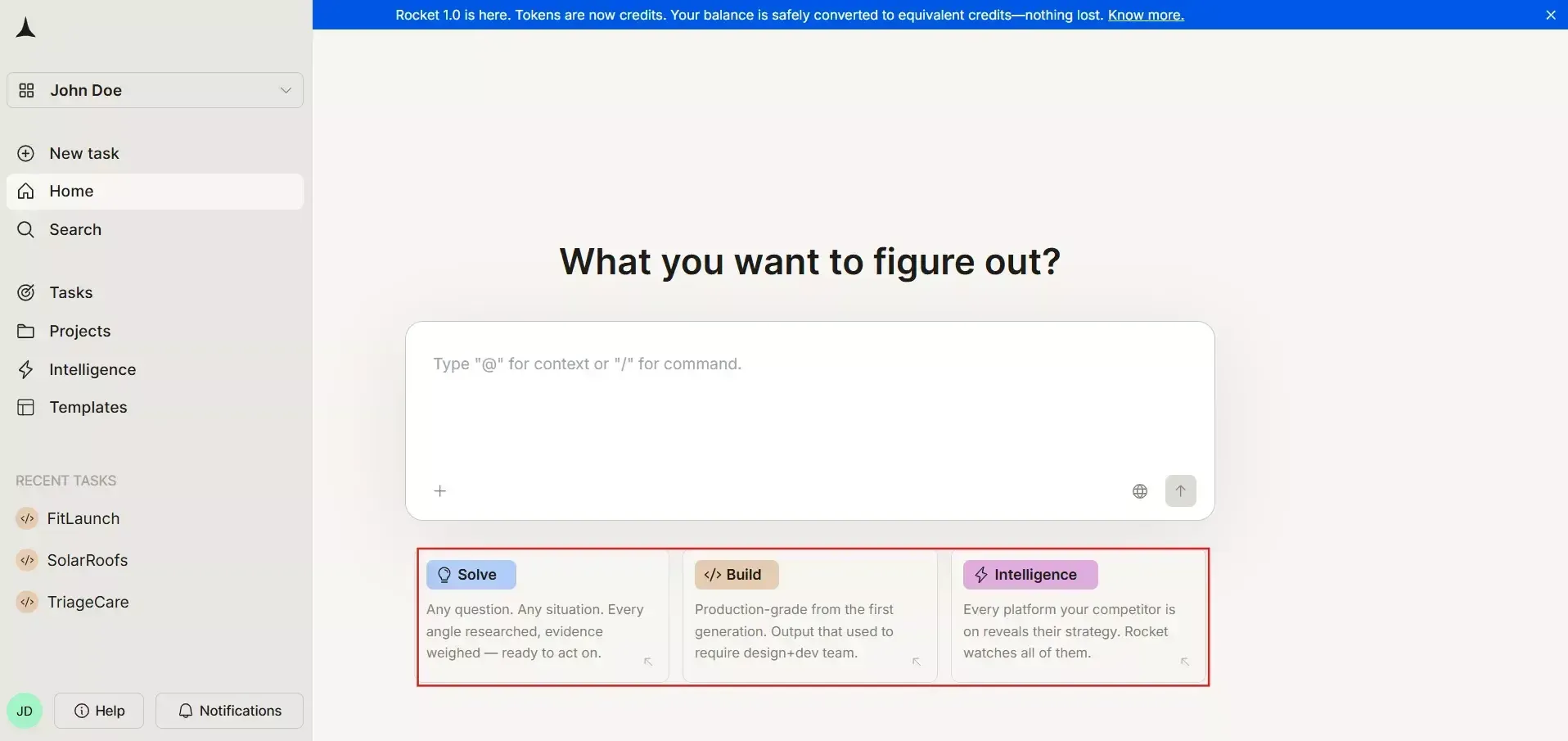
Three-pillar advantage: Solve validates your idea with market research before you build, Build generates the app, and Intelligence monitors competitors after launch
Why Build a Mobile App Without Code in 2026?
The global app economy continues expanding, with millions of apps live on Apple App Store and Google Play. Internal tools, MVPs, and customer-facing products increasingly start on AI platforms to shorten time-to-market.
The math is simple:
-
Traditional development: $50,000-$100,000+ and 3-6 months with a team of developers
-
Rocket.new: $25/month subscription and a weekend to ship v1
Consider a solopreneur launching a booking app for local services. With traditional development, they would wait months and burn through resources. On Rocket.new, they connect Stripe for payments, add push notifications for reminders, and publish within a week, iterating based on real user feedback.
Platform Comparison: Mobile App Building in 2026
| Capability | Rocket.new | Bolt.new | Lovable | v0.dev | Traditional Dev |
|---|---|---|---|---|---|
| Mobile App Output | Yes (Flutter iOS + Android) | No | No | No | Yes |
| Time to v1 | Days | Days (web only) | Days (web only) | Hours (frontend only) | 3-6 months |
| Cost for MVP | $25-50/month | $20-50/month | $20-50/month | Free-$20/month | $50,000-100,000+ |
| Full-Stack Backend | Yes (Supabase) | Limited | Yes (Supabase) | No | Yes |
| Code Ownership | Full export to GitHub | Limited | Limited | Frontend only | Full |
| Market Research (Solve) | Built-in | No | No | No | Manual |
| Competitor Monitoring | Built-in (Intelligence) | No | No | No | Manual |
| App Store Deployment | Direct APK | N/A | N/A | N/A | Manual |
| Compliance Defaults | SOC 2, ISO 27001, GDPR | Manual | Manual | N/A | Manual |
The critical distinction: Bolt.new, Lovable, and v0.dev are web-only platforms. They cannot generate native mobile apps. If your product requires an iOS or Android presence, Rocket.new is the only AI app builder that outputs Flutter code for both platforms from a single prompt.
How Rocket.new Works: From Prompt to Production-Ready App
The Rocket.new workflow centers on vibe solutioning. You describe your app in plain English, and the AI infers everything needed to build it.
Write a prompt like:
1"A fitness challenge app for busy professionals with daily tasks,
2streak tracking, Stripe subscriptions, and push notifications."Rocket.new generates:
-
Frontend UI with navigation, home screen, detail views, and settings (Flutter for mobile)
-
Backend APIs handling authentication and data storage (Supabase)
-
Database schema for users, habits, and progress logs
-
Integrations for payments (Stripe), notifications, and email
The platform handles packaging for Android and iOS, so there is no need to open Android Studio. Rocket.new's 25,000+ templates reduce token consumption by up to 80%, meaning your prompts go further on every plan.
Step-by-Step: Building a Mobile App Without Code on Rocket.new
Step 0: Validate Your Idea with Solve
Before building anything, use Rocket.new's Solve pillar to validate your app concept:
-
Describe your market problem, target audience, and competitive landscape
-
Receive a structured report with data, evidence, and a clear recommendation
-
Get a one-week, PRD foundation, or go/no-go signal backed by research
This eliminates the most expensive mobile app mistake: building something nobody wants. Solve's output becomes the shared context for everything that follows, so Build already knows your target user, competitive positioning, and key features.
Step 1: Create Your Account
Sign up via browser with no local install required. Free trials are available, with paid plans starting at $25/month (Personal) or $50/month (Rocket). Rocket Mobile lets you build from your phone if needed.
Step 2: Start With a Clear Prompt
Weak prompt: "habit app"
Strong prompt: "Mobile habit tracker with user accounts, streak counters, daily push reminders, progress charts, and premium upgrades via Stripe, targeted at productivity enthusiasts aged 25-40"
Include target user, business model, and key features for better AI results. The more specific your prompt, the more accurate the generated app.
Step 3: Review the Generated App
Within minutes, view your generated navigation, screens, data models, and basic flows in a live preview. Rocket.new generates Flutter code for both iOS and Android simultaneously.
Step 4: Refine With Natural Language
Say "Add three onboarding screens with swipe gestures" or "Switch to dark blue theme with bottom tab bar." Rocket.new updates instantly. No code required unless you want it.
For granular edits, use Precision Mode with 100+ structured commands using / and @ syntax for line-level control.
Step 5: Add Integrations
Connect Stripe for subscriptions, integrate SendGrid for emails, and configure push notifications for reminders. The platform sets up APIs and data flows automatically. Rocket.new supports 29+ native integrations plus any custom HTTP endpoint via API import.
Step 6: Test Your App
Use built-in preview, share test builds with teammates, and validate flows like signing up, payments, and notifications work correctly. Download the APK for Android testing directly.
Step 7: Prepare for Launch
Add app metadata: name, icon, screenshots, and privacy policy. Ensure compliance with 2026 Apple and Google Play requirements. Rocket.new's built-in SOC 2, ISO 27001, GDPR, and CCPA defaults handle security and privacy requirements automatically.
Step 8: Deploy
Rocket.new generates app store-compliant builds. You control branding and listing, so no separate release engineer is needed. Android APK downloads are available immediately; iOS IPA builds with TestFlight automation are coming in mid-2026.
Step 9: Activate Intelligence for Post-Launch Monitoring
After your app goes live, switch on Rocket.new's Intelligence pillar:
-
Track competitor app updates, pricing changes, and feature launches
-
Receive automated daily briefs on market movements in your category
-
Use competitor signals to inform your next iteration or feature addition
-
Feed insights back into Solve for data-driven product decisions
This closed loop, from Solve to Build to Intelligence and back, is what makes Rocket.new a vibe solutioning platform rather than just another app generator.
Key Features You Can Add Without Coding
Authentication and User Accounts
-
Email/password sign-up, social login (Google, GitHub, Apple), password reset
-
Personalized dashboards tied to user data
-
All powered by Supabase auth with Row Level Security
Push Notifications
-
Daily reminders for habit apps
-
Order updates for e-commerce
-
Time-based and event-based triggers
Payments and Subscriptions
-
Stripe integration for one-time and recurring billing
-
Secure backend handling without manual token management
-
Webhook processing for subscription lifecycle events
Data Storage
-
Store logs, progress, and bookings in Supabase
-
Sync with external databases via API import
-
Real-time subscriptions for live data updates
Media and Device Capabilities
-
Image and video uploads to Supabase Storage
-
Native mobile app feel, not a web wrapper
-
Camera, location, and device sensor access through Flutter
Who Rocket.new is For (and Realistic Use Cases)
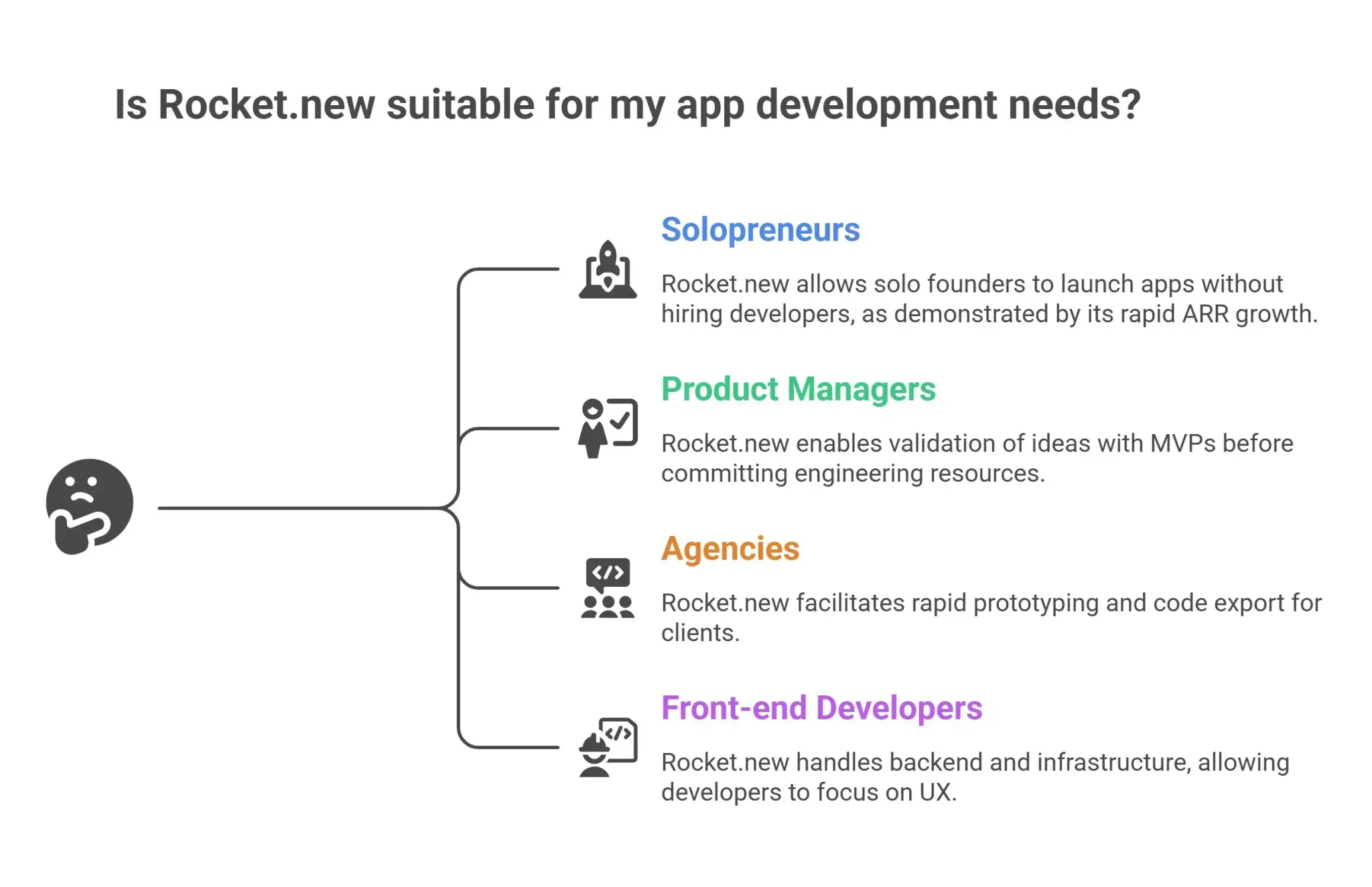
Target Audiences
-
Solopreneurs: Launch subscription apps or marketplaces without hiring developers. Rocket.new's $4.5 million ARR within 3 months of beta proves solo founders are shipping real products
-
Product managers: Validate ideas with real customer-facing MVPs before committing engineering resources
-
Agencies: Rapidly prototype, then hand off with full code export to client engineering teams
-
Front-end developers: Let AI handle backend, database, and infrastructure while you focus on UX
Real-World Scenarios
-
A fitness coach builds a workout challenge app with progress tracking and recurring billing, scaling to thousands of users
-
A local events organizer creates a ticketing app with real-time updates and notifications
-
A SaaS founder validates a mobile companion app for their web product in a single weekend
Rocket.new targets serious app makers who care about scalability, code ownership, and production quality, not just temporary designs.
Rocket.new vs Traditional No-Code App Builders
Many older tools like Lovable and Bolt.new rely on manual drag-and-drop for every action. They often produce web apps that look mobile-friendly but lack native behavior, hitting limits on complex app logic.
Here is what sets Rocket.new apart:
-
AI-first prompt-driven creation that understands product "vibes" and generates coherent, full-stack apps
-
Actual mobile output: Bolt.new produces no mobile apps at all. Lovable generates web-only MVPs. v0.dev scaffolds frontend components without backend or mobile support. Rocket.new generates Flutter code for iOS and Android
-
Production focus with apps intended to scale, backed by SOC 2, ISO 27001, GDPR, and CCPA compliance defaults
-
Eliminates "builder fatigue" from wiring every single action manually in visual editors
-
Non-technical users can go from idea to app store submission on one platform
-
Shared context across Solve, Build, and Intelligence means every decision compounds; your market research informs your build, and your post-launch data informs your next iteration
Limitations, Pitfalls, and When You Might Still Want Custom Code
Every platform has trade-offs. Common pitfalls include:
-
Overcomplicating v1 with too many features; start with 2-3 core capabilities
-
Ignoring app store guidelines until launch day
-
Under-testing onboarding and payment flows before going live
When Custom Code Helps
-
Advanced AR or graphics engines requiring direct GPU access
-
Deep legacy system integrations with proprietary protocols
-
Very low-level device access beyond what Flutter supports
-
High-frequency trading or real-time audio processing
For most 2026 use cases (marketplaces, SaaS dashboards, booking apps, content apps, fitness trackers, internal tools), Rocket.new handles production needs without writing code.
Vendor Lock-In Risk
Rocket.new mitigates this completely on paid plans. Export your full Flutter source code to GitHub, open it in VS Code or Android Studio, and continue development independently. No other AI mobile app builder provides this level of code ownership.
Best Practices for Getting the Most Out of Rocket.new
-
Start with Solve: Validate your idea with market research before spending tokens on Build. This prevents the most expensive mistake in mobile development: building the wrong app
-
Start small: Focus on 2-3 core features for v1; you can always add more in subsequent prompts
-
Write explicit prompts: Include the target user, business model, and must-have flows for the most accurate generation
-
Iterate in cycles: Prompt, generate, test, refine based on real user feedback
-
Establish design consistency early: Pick colors and design language so AI-generated screens stay coherent across your app
-
Think about data structure from the start: Rocket.new outputs production-ready infrastructure; getting the schema right early saves rework
-
Use templates: Rocket.new's 25,000+ templates reduce token consumption by up to 80%; browse the library before starting from scratch
-
Use Precision Mode: For fine-grained edits, the 100+ structured commands give you line-level control without leaving the platform
-
Activate Intelligence after launch: Monitor competitor apps and market shifts to inform your product roadmap with real data
Ship Your Next Mobile App Without Writing Code
In 2026, Rocket.new makes it realistic for anyone to go from app idea to fully functional mobile app without touching a single line of code. You get production-ready apps with full-stack generation, backend and integrations handled automatically, faster time-to-market, and dramatically lower costs compared to traditional development.
-
Pick a specific idea, a subscription content app, a simple booking tool, a personal productivity tracker.
-
Validate it with Solve, build v1 on Rocket.new this week.
-
Monitor your competitors with Intelligence.
Write your first prompt, and experience building a native mobile app without writing code.
Table of contents
- -What is a No-Code Mobile App Builder and How is Rocket.new Different?
- -Why Build a Mobile App Without Code in 2026?
- -Platform Comparison: Mobile App Building in 2026
- -How Rocket.new Works: From Prompt to Production-Ready App
- -Step-by-Step: Building a Mobile App Without Code on Rocket.new
- -Step 0: Validate Your Idea with Solve
- -Step 1: Create Your Account
- -Step 2: Start With a Clear Prompt
- -Step 3: Review the Generated App
- -Step 4: Refine With Natural Language
- -Step 5: Add Integrations
- -Step 6: Test Your App
- -Step 7: Prepare for Launch
- -Step 8: Deploy
- -Step 9: Activate Intelligence for Post-Launch Monitoring
- -Key Features You Can Add Without Coding
- -Authentication and User Accounts
- -Push Notifications
- -Payments and Subscriptions
- -Data Storage
- -Media and Device Capabilities
- -Who Rocket.new is For (and Realistic Use Cases)
- -Target Audiences
- -Real-World Scenarios
- -Rocket.new vs Traditional No-Code App Builders
- -Limitations, Pitfalls, and When You Might Still Want Custom Code
- -When Custom Code Helps
- -Vendor Lock-In Risk
- -Best Practices for Getting the Most Out of Rocket.new
- -Ship Your Next Mobile App Without Writing Code