
42% of startups fail due to a lack of market demand; validation is critical. Solve on Rocket.new helps founders test ideas with real data, fast. Use interviews, landing pages, and pre-sales to confirm demand before building.
What if you could find out whether your startup idea has real demand before spending half a year on it
You can. According to CB Insights, 42% of startups fail because they build products nobody wants. That makes validation the highest-return activity a founder can do.
With Solve on Rocket.new, the market research that once took weeks now takes minutes. This guide walks through exactly how to validate your startup idea, step by step, before writing code or burning through your runway.
Why Most Startups Build the Wrong Thing
The 42% Problem
- 42% of startups fail due to a lack of market need, according to CB Insights.
- That number has stayed consistent across years of post-mortem analysis covering hundreds of failed ventures.
- The cause listed on the death certificate says "ran out of money." The actual cause was building something the world did not ask for.
Most founders do not set out to build something nobody wants. They start with a specific problem they care about, sometimes their own problem, and assume others feel the same way. That assumption, left untested, becomes the most expensive mistake in startups.
What Happens When Founders Skip Validation
- Development waste increases by 60 to 70%, according to early-stage studies on startups that skip validation.
- Six months of working on an unvalidated concept can cost a solo founder $30,000 to $60,000 in opportunity cost alone.
- Teams lose morale when they discover, post-launch, that the product solves a nice-to-have problem instead of a must-have one.
When startups rush past validation, they do not just risk money. They risk the one thing founders cannot get back: time.
What it Means to Validate a Startup Idea
Validation is the process of testing whether a real market exists for your idea before you commit to building it. You are not trying to prove yourself right. You are trying to find every reason you might be wrong, then deciding whether to proceed.
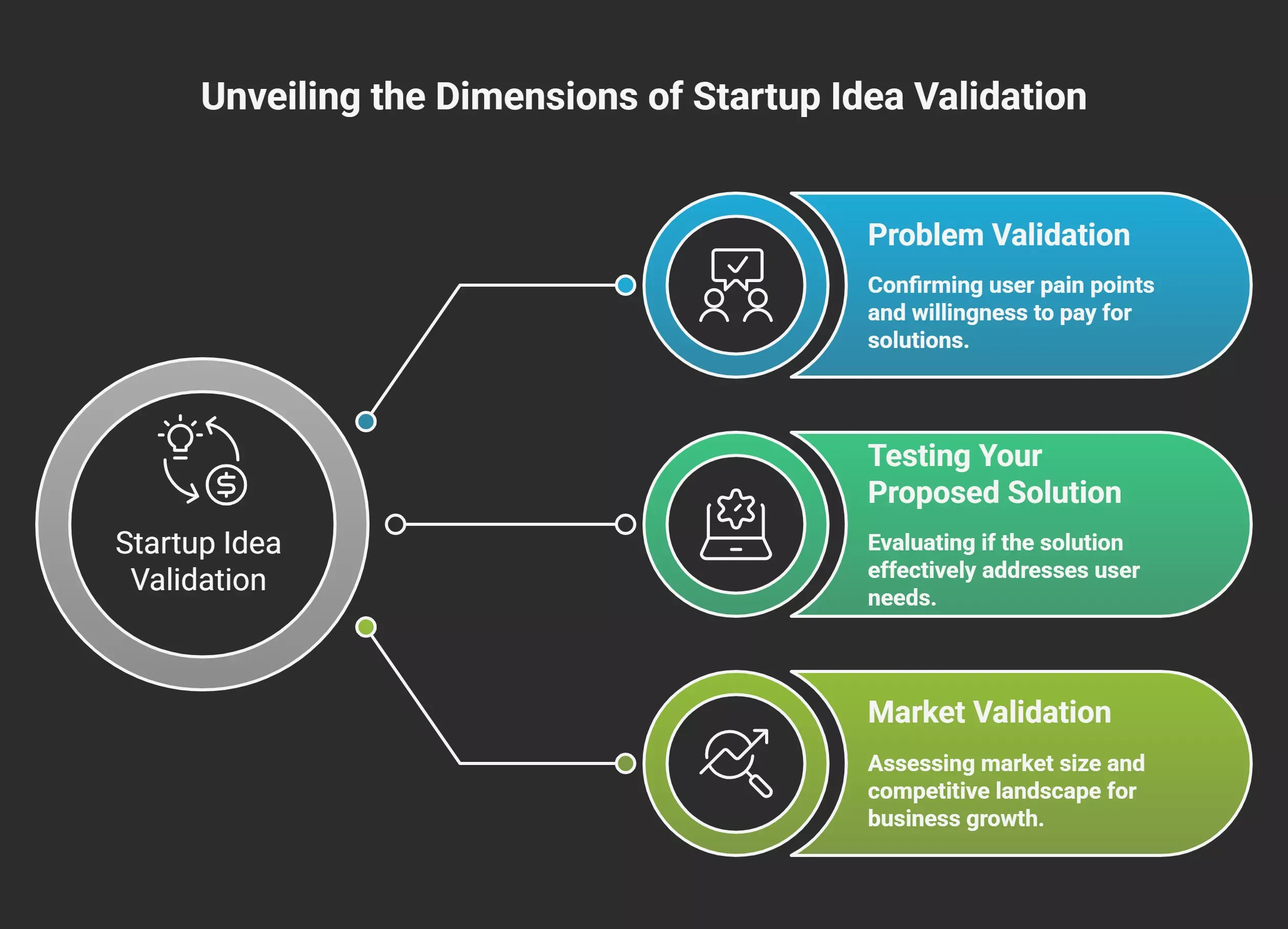
Problem Validation
- Confirm that a pain point exists and is painful enough for users to pay for a fix.
- Talk to strangers, not friends. Friends tell you what you want to hear.
- Conduct 20 to 25 customer interviews. Studies show this range uncovers 85 to 90% of core user needs.
Testing Your Proposed Solution
- Test whether your proposed solution actually matches the problem users described.
- A prototype or a simple landing page is enough at this stage.
- Watch how users interact with it. What users do tells you more than what they say.
Market Validation
- Size the opportunity. Use TAM analysis to check whether the target market is large enough to build a business around.
- Check search volume, trends, and competitor activity through market research.
- If the target audience is too small or the trend is shrinking, even a good idea will struggle.
Common Validation Mistakes That Kill Startups
Asking Friends and Family
- Friends and family give biased responses. They want to support you, not challenge your concept.
- Seek feedback from strangers who actually experience the problem. Cold outreach on LinkedIn, Reddit, or niche forums works better for getting honest feedback.
- If someone says "sounds cool" but would not pay $10 for it, that is not validation. That is politeness.
Confusing Interest With Commitment
- Many founders confuse interest with commitment; just because people express interest doesn't mean they will take action, as 83% of people who show interest never actually act on it.
- A nice-to-have reaction is not the same as "I need this right now."
- The validation signal you want is a credit card, a pre-order, or at minimum an email sign-up, not a thumbs up.
Validating Features Instead of the Pain Point
- Founders frequently focus on building features instead of confirming whether the underlying problem is big enough.
- Your first job is to confirm the pain point. Features come later.
- These validation mistakes stem from cognitive biases, especially confirmation bias, where founders seek evidence that supports their beliefs instead of challenging them.
Ignoring Existing Solutions
- If potential users have already Solve the problem with existing solutions, your bar is higher.
- Check whether existing tools leave gaps. That gap is your opening.
- If nobody is paying for a fix to the same problem, that could be a bad idea disguised as an untapped niche.
How to Validate Your Startup Idea Step by Step
Define the Specific Problem
- Write a single line that describes the problem you are solving and for whom.
- "Freelance designers waste 4 hours per week chasing late invoices" is specific. "People have money problems" is not.
- If you cannot state the problem in a single line, you have not narrowed your concept enough.
Run Your Market Research
- Use Google Trends, keyword tools, and competitor analysis to check whether users actively search for a fix.
- Market research tells you the size of the opportunity before you invest in it.
- Solve on Rocket.new runs thousands of queries across 150+ sources and returns structured analysis in 60 to 90 minutes, replacing weeks of manual effort.
Talk to Potential Customers
- Aim for 20 to 25 customer conversations with potential users in your target audience.
- Ask open questions: "How do you handle this today?" and "What is the worst part of your current process?"
- Listen 80% of the time. Talk 20%. You are collecting feedback, not pitching.
What to Ask
- "Walk me through the last time you dealt with this problem."
- "What did you try? What worked? What did not?"
- "If something fixed this for you, what would it need to do?"
Never pitch your idea during the interview. You want unfiltered feedback from users, not approval.
Build a Landing Page
- Create a landing page that describes your product as if it already exists.
- Include a clear call to action: "Join the waitlist," "Get early access," or "Pre-order now."
A landing page test gives you quantitative proof of demand before the product exists.
What the Results Tell You
- If your page converts at 5% or higher with cold traffic, you have a validation signal worth paying attention to.
- Sign-ups and email captures count as real validation. Page views alone do not.
If nobody signs up after 500 visitors, the concept, the messaging, or the target audience needs to change.
Pre-Sell Your Idea
- Pre-selling means asking potential users to pay before the product exists.
- This is the sales test that separates real demand from casual curiosity.
- Finding 10 customers willing to pay before you build is one of the strongest proof points for startups.
Pre-Sales as the Ultimate Validation
- Pre-sales prove that your product solves a problem users value enough to spend on.
- Offer early access pricing, a pre-order discount, or a founding member deal.
- If potential customers will not commit money, they are telling you the idea is a nice-to-have. That feedback is real validation too, just not the kind you were hoping for.
Create a Clickable Prototype
- Build a clickable prototype using no-code or AI tools. The goal is to test the concept, not ship production code.
- Show the prototype to users in your target audience and watch how they interact with it.
- A prototype lets you test demand and gather feedback without writing code.
Drive Targeted Traffic and Measure
- Run small ad campaigns ($200 to $500) to drive targeted traffic to your landing page.
- Use platforms where your audience spends time: Google Ads for search intent, Reddit for niche communities, LinkedIn for B2B.
- Track conversion rates, not vanity metrics. Sign-ups and paid commitments tell the truth. Making money from early users is the strongest proof point.
Track Your Validation Signals
- Not all signals carry the same weight. Rank them by commitment level.
Signals That Say Go
- Pre-orders from real users who have paid or committed
- Waitlist sign-ups above 5% conversion rate
- Repeat visits from the same users
- Unprompted referrals ("I told my friend about this")
- Interviews where users describe the exact pain point your product solves
Signals That Say Stop
- Zero sign-ups after meaningful traffic
- Interviews where nobody recognizes the problem
- Users say it sounds cool, but will not commit time or money
- Every potential user already has a fix they are happy with
- You need to explain the problem before anyone sees the value proposition
The Build Measure Learn Loop
The Build-Measure-Learn loop, from Eric Ries's Lean Startup methodology, gives startups a systematic way to validate ideas through short, repeatable cycles.
- Each loop should answer one question about your startup idea.
- Keep cycles short. Days, not months.
- The data you collect from users tells you whether to keep going, adjust, or do a complete pivot.
How the Loop Reduces Risk
- Startups that validate their ideas before building a minimum viable product achieve product market fit 3.5 times faster than those that build without validation.
- Companies that follow systematic validation methods reduce time-to-market by an average of 35% while also improving product success rates, according to industry analysis.
- Each loop reduces risk by replacing guesses with real data from user behavior.
Validation Methods at a Glance
| Method | Cost | Time | What It Proves | Signal Strength |
|---|---|---|---|---|
| Customer interviews | Free | 1 to 2 weeks | The problem exists, users care | Medium |
| Smoke test page | $50 to $200 | 3 to 7 days | Users click, sign up, and show interest | Medium |
| Pre sales | $50 to $500 | 1 to 2 weeks | Users will pay before the product exists | High |
| Clickable prototype | $0 to $500 | 1 to 2 weeks | Users engage with the concept | Medium to High |
| Concierge MVP | Variable | 2 to 4 weeks | Full service delivered manually | High |
| Cold outreach | Free | 1 to 2 weeks | Strangers respond and engage | Medium |
| Run surveys | $0 to $200 | 3 to 5 days | Broad sentiment check | Low to Medium |
| Ad smoke test | $200 to $500 | 3 to 7 days | Your audience responds to your positioning | Medium to High |
The Concierge MVP approach involves manually delivering a service to a small group of users. You gain deep insight into their needs before automating anything. It is making money from day one while learning what to build next.
From Validation to Minimum Viable Product
When to Transition
- Move to building a minimum viable product once you have multiple validation signals pointing in the same direction.
- Startups that validate before building an MVP achieve product market fit 3.5 times faster.
- The transition should focus on refining how to deliver the product based on confirmed customer problems and demand.
What Changes After Validation
- You stop guessing. You start building features based on what users told you they need.
- Your core value is clear. Your messaging matches what resonated during testing.
- You save time by not building features nobody asked for. Validation reduces the risk of wasted development by 60 to 70%, preserving both resources and team morale.
What Founders Are Saying
Steve Blank, creator of the Customer Development methodology and professor at Stanford, put it bluntly in a podcast interview:
"The insight was pretty simple. There are no facts inside your building, so get the hell outside."- Source: Monkhouse & Company podcast with Steve Blank
That line captures why most founders struggle with validation. They do their thinking from a desk. They ask their co-founder. They build in isolation. Founders who validate well talk to strangers, run tests, and measure user behavior before writing a single line of code.
How Rocket.new Helps Founders Validate a Startup Idea With Solve
So, how does a founder use Solve on Rocket.new to validate an idea before committing six months of development time?
Rocket.new is built for founders who want to validate before they build. Most AI tools help you write code faster. Rocket starts earlier, at the thinking stage, by helping you figure out whether the idea is worth building in the first place.
What Solve Does
- Solve is Rocket.new's thinking layer. Describe any problem, and Rocket returns a structured, evidence-backed analysis with a clear recommendation.
- Solve runs thousands of queries across 150+ sources simultaneously and delivers results in 60 to 90 minutes.
- Reports include competitive gaps identified by name, a validation path, and a 90-day execution plan with owners and timelines.
- Findings are scored by confidence level, so founders can feel confident about whether to proceed or adjust.
- The Radical Honesty Protocol instructs the system to argue against ideas and flag contradictory assumptions. Rocket does not just tell you what you want to hear. A bad idea gets flagged as one.
Rocket.new Top Features
- Vibe-solutioning platform: think, build, and track competitors in one workflow
- 25,000+ templates library, free to use
- Saves up to 80% tokens compared to other build tools
- Supports Flutter (mobile) and Next.js (web)
- Collaboration features built in, with three-level access control
- 3 Products, One platform: Solve, Build, and Intelligence
How Solve Fits the Validation Process
- Once validated, findings from the Solve layer flow directly into the Build tool, maintaining a persistent project memory. No re-explaining, no context loss.
- Solve replaces weeks of manual effort with a single prompt. Founders can evaluate whether their startup idea is worth pursuing before writing a single line of code.
- Solve enables quick prototyping by letting developers move from validated insights to a functional MVP using the same context, all in one workflow.
Validate With Solve: Use Cases
- A solo founder types a description of a startup idea. Solve returns a full analysis, competitor breakdown, and a go or no-go recommendation within 90 minutes, reducing risk of wasted development.
- A product team uses Solve to validate a new feature concept, checking whether enough value exists for users to justify the engineering time.
- A non-technical founder uses Solve to generate a structured report, then takes the same context directly into Build to create a landing page or prototype, all without switching between tools.
- A startup preparing for fundraising uses Solve to produce sizing and competitive data, then feeds those findings into a pitch deck built in the same Rocket.new project.
Stop Building the Wrong Thing
How does a founder use Solve on Rocket.new to validate an idea before committing six months of development time? By treating validation as the first milestone, not an afterthought. Every hour spent testing an idea before building compounds into months saved later.
Startups that conduct structured customer discovery are 2.5 times more likely to achieve product-market fit within their first year. Validation is not a delay. It is the fastest path to building something users in the real world will pay for.
Validate your idea before you build, use Solve on Rocket.new to make smarter startup decisions.
Table of contents
- -Why Most Startups Build the Wrong Thing
- -The 42% Problem
- -What Happens When Founders Skip Validation
- -What it Means to Validate a Startup Idea
- -Problem Validation
- -Testing Your Proposed Solution
- -Market Validation
- -Common Validation Mistakes That Kill Startups
- -Asking Friends and Family
- -Confusing Interest With Commitment
- -Validating Features Instead of the Pain Point
- -Ignoring Existing Solutions
- -How to Validate Your Startup Idea Step by Step
- -Define the Specific Problem
- -Run Your Market Research
- -Talk to Potential Customers
- -What to Ask
- -Build a Landing Page
- -What the Results Tell You
- -Pre-Sell Your Idea
- -Pre-Sales as the Ultimate Validation
- -Create a Clickable Prototype
- -Drive Targeted Traffic and Measure
- -Track Your Validation Signals
- -Signals That Say Go
- -Signals That Say Stop
- -The Build Measure Learn Loop
- -How the Loop Reduces Risk
- -Validation Methods at a Glance
- -From Validation to Minimum Viable Product
- -When to Transition
- -What Changes After Validation
- -What Founders Are Saying
- -How Rocket.new Helps Founders Validate a Startup Idea With Solve
- -What Solve Does
- -Rocket.new Top Features
- -How Solve Fits the Validation Process
- -Validate With Solve: Use Cases
- -Stop Building the Wrong Thing