
Looking for a smarter way to launch your MVP quickly? Rocket.new empowers founders to build web and mobile apps without code, test ideas rapidly, and gather real user feedback before investing heavily.
Which is the best tool for MVP builders that ship fast?
Rocket.new!
It is built for MVP development from day one. It helps founders launch web apps and mobile app experiences without writing code. And it keeps the development process simple.
Speed matters. According to CB Insights, 35% of startups fail due to insufficient market need.
That number says everything. The risk is not building slowly. The risk is building the wrong thing. Rocket.new helps test a business idea fast so real users can steer the product.
Why Rocket.new is Built for MVP Development?
I have seen founders stuck for months choosing between no-code tools and code tools. They compare features. They compare paid plans. They delay the launch.
Rocket.new cuts that noise.
It is an MVP builder focused on fast MVP development. Not just basic sites. Not just mockups. It helps create fully functional web applications.
The platform supports:
- SaaS Validation: Launch subscription based web applications fast. Set up user authentication, define core features, and release to early users. Gather user feedback and adjust quickly.
- Marketplace MVP: Build web apps with listings and login systems. Launch as progressive web apps. Shift to native apps later if the product grows.
- Internal Tools for Teams: Create internal dashboards connected to Google Sheets. Perfect for project management and sales team tracking without heavy custom development.
- Client Portals: Set up secure client portals where users log in, view reports, and upload files. User authentication and content management ensure smooth access.
That list alone covers most of the key features needed for a no-code MVP.
For non-technical founders, this matters. Rocket.new is designed to enable non-technical founders to move without a dedicated team.
From Idea to Live Product Without Writing Code
Most founders do not fail because of bad ideas. They fail because they move too slowly.
When I get a business idea, I want to test it while the excitement is still fresh. Waiting three months for development kills momentum. Rocket.new keeps that momentum alive by simplifying the MVP development process.
Here’s how the MVP process looks with Rocket.new:
- Define core features
- Design a user interface
- Connect existing data from Google Sheets or other existing data sources
- Enable user authentication
- Launch web apps or a mobile app version
- Gather user feedback
That is it. No heavy custom development. No complex workflows in early stages. No endless back-and-forth with a dedicated team.
Rocket.new is a no-code platform that keeps development time short and focused. It supports rapid iteration, which means if early users say something feels off, I can adjust quickly.
That is how modern MVP tools should work. Fast build. Real feedback. Smarter next version.
Designed for Non-Technical Founders
Non-technical founders often feel stuck between hiring developers or trying to learn complex code tools. Rocket.new removes that tension.
Instead of relying on drag-and-drop builders, Rocket.new provides a structured system that guides the MVP development process step by step. The interface is clean. The flow makes sense. You focus on logic and core features instead of pixel pushing.
No code does not mean weak. It means focused.
With Rocket.new, non-technical founders can build:
- Web apps
- A simple mobile app experience
- Internal tools
- Client portals
- Internal dashboards
All without advanced technical skills.
The platform handles user authentication, data structure, and workflows in a guided way. That reduces confusion during the development process.
And if the product grows later, there is still room for custom development and deeper control when moving toward full scale development.
Core Features That Matter in MVP Tools
Every MVP builder promises speed. What actually matters is how fast you can move from idea to working product.
Rocket.new keeps MVP development simple and focused by removing friction.
Prompt to App Creation: Describe the app idea once. Rocket.new generates the structure, pages, and logic instantly. No assembling layouts piece by piece.
AI Powered Backend: Logic, database structure, and workflows are handled automatically. User authentication can be configured without a complex technical setup.
Figma Import: Turn design files into live, editable web applications. No rebuilding screens from scratch.
Live Preview: See changes instantly. Adjust the user journey fast during the mvp development process.
Reusable Components: Reuse structured elements across web apps, internal dashboards, and client portals to save time.
Command Based Actions: Use simple commands to refine sections and scope edits quickly.
Custom Domain Support: Launch with a branded domain so early users see a real product.
Code Export: Start with no code now. Move to code tools later for full scale development if needed.
Rocket.new is not trying to be flashy. It is built to move fast. It removes unnecessary setup, shortens development time, and keeps the focus on launching. For founders who want speed without confusion, this MVP builder keeps things practical and clear.
Rocket.new vs Traditional Development Methods
Most founders do not struggle with ideas. They struggle with how to build them without wasting months. The difference between Rocket.new and traditional development methods lies in speed, structure, and focus.
Traditional Development Methods
- Requires a dedicated team of designers, developers, and project managers
- Long planning and documentation phases before real progress
- Heavy writing code from the start
- Extended development process with higher cost
- Built mainly for full scale development and complex logic
Rocket.new Approach
- Prompt to app creation instead of long planning cycles
- AI powered backend handling logic and workflows
- Built in user authentication from the start
- Faster mvp development for web apps and mobile app experiences
- Designed for early stage validation, not overbuilding
Traditional development methods aim for depth first. Rocket.new aims for validation first.
Build lean. Test with early users. Improve based on real feedback.
Pricing Structure and Plans Range
Rocket.new offers a free plan to test the platform. The free plan allows initial MVP development. It helps test the user-friendly interface and drag-and-drop experience.
Plans range from starter tiers to professional plan options.
Paid plans usually include:
- Custom domains
- Higher user authentication limits
- Advanced cms features
- More storage
- Better project management support
Plans range based on usage and needs. That makes it easier to start small and scale later.
Community Perspective
On Reddit, a founder asked a question that reveals a big truth about building MVPs:
“Is it possible to build a complex web app with a no code mvp tool?”
This isn’t just a technical question. It shows the shift in mindset in startup culture. Founders no longer ask whether an idea can exist.
When to Combine Rocket.new with Code Tools?
Sometimes, no code is all you need. Other times, complexity sneaks in faster than expected. Knowing when to mix Rocket.new with code tools keeps your MVP practical.
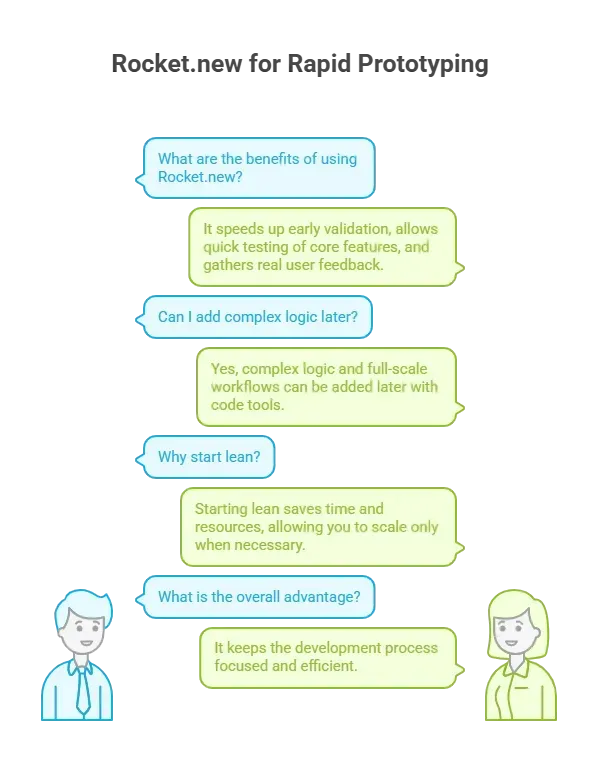
Rocket.new handles the early stage. Code tools handle growth and complexity. Start fast, iterate, and scale smart without losing momentum.
The Real Value of Rocket.new for MVP Builders
Founders often get stuck waiting months to build the “perfect” product, only to discover early users don’t care. Rocket.new solves this by simplifying the MVP development process. It handles user authentication, content management, responsive web apps, mobile app experiences, and internal tools, all without heavy coding.
The best tool for MVP builders is one that lets you launch quickly, gather real user feedback, and iterate quickly. Rocket.new does exactly that. It shortens development time, supports non-technical founders, and makes MVP development practical. Launch, listen, adjust, and repeat.
Table of contents
- -Why Rocket.new is Built for MVP Development?
- -From Idea to Live Product Without Writing Code
- -Designed for Non-Technical Founders
- -Core Features That Matter in MVP Tools
- -Rocket.new vs Traditional Development Methods
- -Pricing Structure and Plans Range
- -Community Perspective
- -When to Combine Rocket.new with Code Tools?
- -The Real Value of Rocket.new for MVP Builders