
Rocket.new helps marketing teams validate campaign budgets before launch using predictive analytics, competitive intelligence, and real-time market signals. Teams can model ROI scenarios, track competitors, and optimize channel spend before committing ad dollars.
Why Do Most Marketing Campaigns Burn Budget Before They Even Launch?
What if you could test your next campaign's financial outcomes before writing a single check?
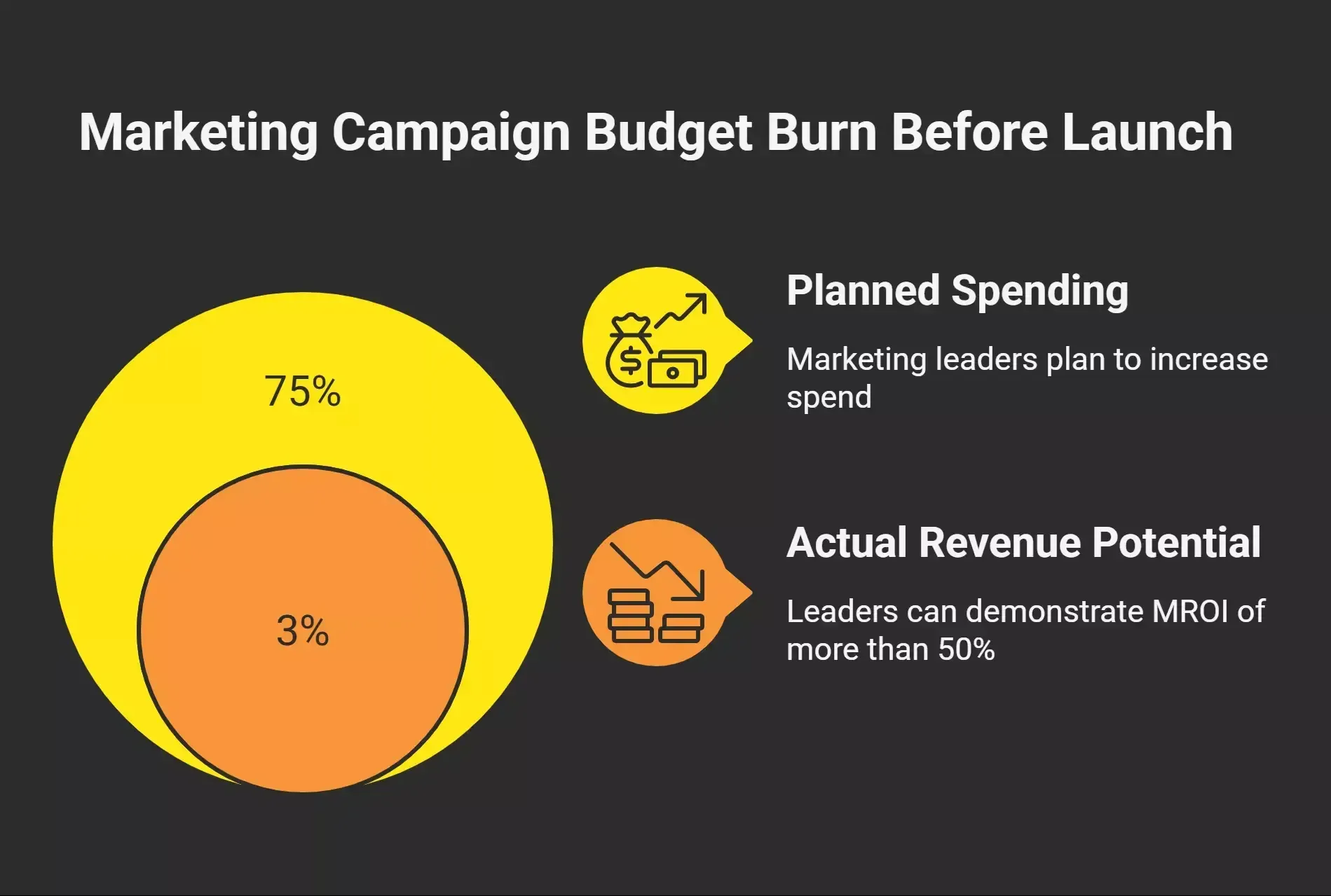
That is exactly what predictive campaign planning does. According to McKinsey research cited by Keen Decision Systems, three in four marketing leaders plan to increase their spend, but only 3% can demonstrate a marginal return on investment (MROI) of more than 50%.
The gap between planned spending and actual revenue potential is where most marketing campaigns fail, and it happens before the first ad goes live.
So how does a marketing team use Rocket.new's intelligence before committing budget to a campaign? By combining predictive analytics, competitive intelligence, and real-time market signals into a single pre-launch workflow that replaces guesswork with evidence.
Why Marketing Teams Lose Money Before Campaigns Launch
The Gap Between Spending Plans and Revenue Growth
-
Marketing budgets have flatlined at 7.7% of total company revenue in 2025, according to Gartner's CMO Spend Survey, and 59% of CMOs say they lack the budget to execute their strategy.
-
Most budget waste does not come from poor execution. It starts during planning, when planners set channel mix and spending based on historical averages that ignore market saturation, changing demand, or diminishing returns.
-
The cheapest mistake to fix is the one caught before a single dollar gets committed. Validating campaign assumptions before budget allocation separates teams that grow from teams that spend and hope.
Where Manual Analysis Falls Short
-
Manual analysis of campaign data across multiple ad platforms, Google Analytics, CRM systems, and email tools takes days or weeks. By the time a report is ready, the market has shifted.
-
Relying solely on last quarter's performance data creates blind spots. Customer acquisition costs change, audiences evolve, and seasonal trends reshape what works.
-
Teams using spreadsheets and static reports to plan campaigns are making million-dollar decisions with rearview mirror data. Predictive models flip that approach by forecasting what is likely to happen before the budget gets locked in.
Building a Predictive Data Foundation for Campaign Management
What Data Points Feed Predictive Models
-
Predictive analytics starts with data quality. Machine learning algorithms need clean, structured inputs to produce reliable forecasts. Garbage in, garbage out applies here with real financial consequences.
-
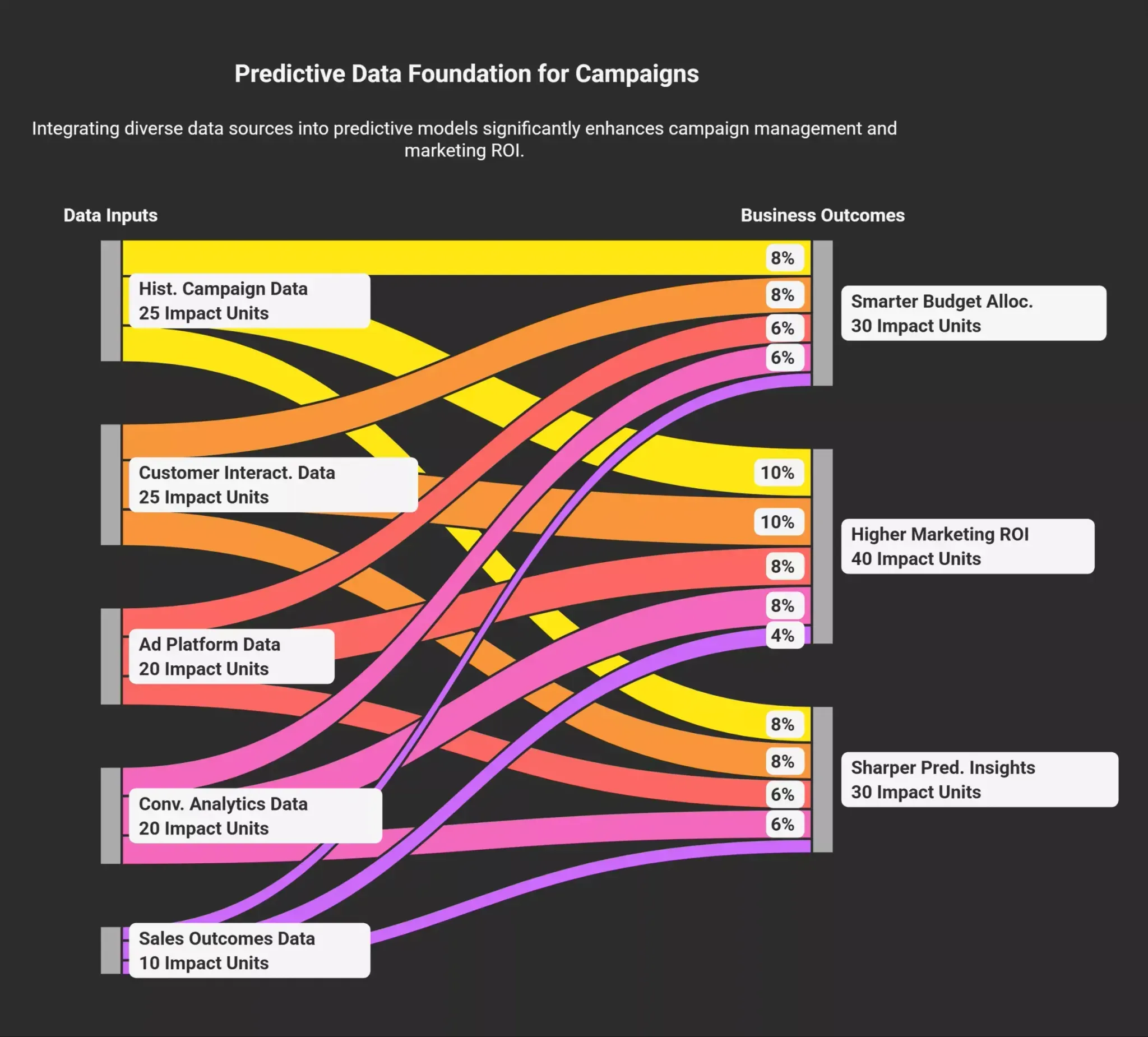
The core dataset includes historical data from past campaigns (click-through rates, conversion data, cost per acquisition), customer interactions across touchpoints, and results from ad platforms like Google Ads, Meta, and LinkedIn.
-
Customer lifetime value sits at the center of smarter budget allocation. A lead that costs $200 to acquire looks identical to any other lead, until you learn that certain audience segments produce $5,000 in long-term value while others produce $500. Customer lifetime value modeling exposes this difference.
-
First-party behavioral data from CRM and email tools, combined with conversion data from analytics tools, creates the raw material these models transform into forecasts.
Connecting Historical Data to Campaign Performance
-
Pattern recognition across historical data reveals which channels, creative concepts, and audience segments have driven campaign performance over time, and which ones have hit ceilings. Machine learning pattern recognition catches correlations that manual data analysis would miss entirely.
-
Machine learning models trained on your own campaign data learn what specific combinations of messaging, timing, and budget levels produce the strongest campaign outcomes. These models surface valuable insights about which audience and channel combinations deliver the highest returns.
-
Organizations using advanced attribution and forecasting methods achieve 25 to 30% higher marketing ROI than those relying on manual or intuition-based planning, according to Abacum's 2025 report. The most successful implementations pair intelligent automation with training programs that help every team member read and act on predictive outputs.
-
Connecting more data from more sources gives predictive models a clearer picture. Those that integrate CRM, channels, and sales outcomes at the same level of granularity produce sharper predictions. Aligning this data work with your strategic priorities keeps the modeling focused on what the business actually needs to know.
How Predictive Analytics Changes Budget Allocation
Modeling Scenarios Before Committing Ad Spend
-
Predictive campaign planning lets your team model multiple scenarios and predict performance ranges before launching marketing campaigns. You test what happens if you shift 20% of the budget from display to paid social. You see how a 15% budget increase in Q3 affects revenue growth projections.
-
AI-powered tools run what-if simulations in minutes. A dental brand used Keen's platform to test moving budget from DRTV to traditional TV, invested $2 million based on the results, and generated $8 million in marketing-driven profit.
-
Using predictive models, teams simulate different budget and channel scenarios to see how they affect revenue and marginal ROI before committing funds. This turns spending decisions from a political negotiation into an evidence-backed decision.
Identifying Saturation Points and Diminishing Returns
-
Predictive analytics helps identify saturation points and diminishing returns before they erode margins, guiding smarter spending.
-
Every channel has a ceiling. Spending more on a saturated channel does not produce proportional returns. These models show where that ceiling sits for each of your specific audience segments.
-
AI-powered campaign intelligence systems continuously monitor advertising performance and make real-time optimizations based on live signals across all channels, allowing faster adjustments than manual processes.
| Metric | Without Predictive Analytics | With Predictive Analytics |
|---|---|---|
| Budget allocation method | Historical averages, gut instinct | Scenario modeling with predicted ROI |
| Time to identify underperforming channels | Weeks after launch | Before campaign launches |
| Customer acquisition costs visibility | Post campaign reporting | Pre-launch forecasting by segment |
| Response to market shifts | Reactive, after the budget is committed | Proactive, budget-adjusted pre-launch |
| Campaign performance measurement | Vanity metrics, lagging indicators | Key performance indicators tied to business outcomes |
| Creative direction testing | Live A/B tests burning real budget | Predictive insights on likely winners |
Competitive Intelligence in the Digital Marketing Landscape
Five Pre-Launch Market Signals Worth Tracking
-
Pre-launch competitive intelligence helps marketing teams lock in positioning, messaging, target audience targeting, and creative angles before any media is bought.
-
Five key pre-launch signals that your team should track include competitor website changes, social and news activity, hiring signals, customer signals, and ad activity. Each of these can indicate strategic pivots and inform campaign decisions.
-
Continuous monitoring of competitors' ad activities, pricing shifts, and messaging pivots is conducted from multiple sources. This creates a competitive advantage that static research reports from three months ago simply cannot match.
-
Marketing intelligence, which includes live data on pricing, positioning, audience sentiment, and ad activity, provides a clean data foundation for campaign briefs. Traditional marketing research is often outdated by the time it gets published.
How Market Signals Shape Creative Direction and Campaign Launches
-
The digital marketing landscape changes daily. A competitor might drop prices, launch a new product, or shift messaging overnight. Without competitive intelligence feeding your campaign management process, you are planning in the dark.
-
Creative intelligence means knowing what visual elements and messaging angles your competitors are testing before you finalize your own. Marketers analyze user sentiment, customer frustrations, and demand for specific product features before finalizing budgets.
-
Tracking these market signals across the digital marketing space gives your team the data-driven insights needed to time campaign launches for maximum impact.
-
The "Intelligence" early warning system alerts your team to competitor pricing shifts, discount structures, or product rollouts, turning reactive planning into proactive positioning.
The 70-20-10 Rule for Marketing Budget Allocation
-
The 70-20-10 rule splits marketing budget into three tiers based on risk and return. 70% goes to proven, high-performing strategies (your existing campaigns and channels that reliably deliver). 20% goes to newer strategies with early positive signals. 10% goes to experimental approaches.
-
This framework guides predictive campaign planning by giving your team a structure for how much budget to allocate to tested channels versus emerging opportunities.
-
Predictive models sharpen this rule by telling you which specific channels belong in each tier based on your own performance data, not industry averages.
-
The rule works as a starting point. These models refine it over time by measuring how campaigns perform within each tier and shifting allocations toward the channels and audience segments producing measurable revenue growth and business growth.
Seven Steps to Create Campaigns with Predictive Campaign Planning Built In
-
Define business objectives and key performance indicators before touching any campaign tool. What does success look like in numbers? Tie every one of your marketing metrics to a financial outcome, not a vanity metric.
-
Audit your data setup. Pull together historical data, conversion records, and customer lifetime value data from your CRM, ad platforms, and data analytics tools. Check data quality, fill gaps, and normalize inputs so predictive models can compare channel results accurately.
-
Run audience research with predictive insights. Use machine learning models to identify which specific audience segments have the highest predicted conversion rates and customer lifetime value. This tells you where to concentrate, not just who exists.
-
Model budget scenarios. Simulate different budget splits, channel combinations, and timing windows. Predict campaign performance for each scenario before locking in spend. Look for the inflection point where added spending stops producing proportional returns.
-
Layer in competitive intelligence. Check what competitors have changed in pricing, messaging, and ad activity in the past 30 days. Feed those competitive signals into your campaign plan, so your positioning reflects current conditions, not last quarter's assumptions.
-
Test creative concepts against predictive data. Use emotional intelligence in your messaging, but back it up with data. Predictive performance modeling shows which campaigns will perform best before launching them, reducing wasted ad spend on creatives that miss.
-
Set up cross-channel tracking and real-time monitoring. Once the campaign goes live, cross-channel results feed back into your predictive models. This closes the loop, making each campaign smarter than the last and creating significant advantages for future marketing efforts.
What Marketing Leaders Are Saying
"In B2B marketing, predictive analytics can help teams forecast which accounts and campaigns are most likely to convert, not just report what happened last quarter. It turns marketers into revenue partners, not activity reporters." - Omry Sitner, LinkedIn
That framing captures the shift happening across marketing teams of all sizes. The move from backward-looking reports to forward-looking predictions is turning campaign management from a cost center into a revenue driver. Teams that adopt predictive modeling are seeing higher quality leads and better allocation of spend, instead of throwing budget at low-yield tactics.
How Rocket.new Powers Pre-Campaign Intelligence for Marketing Teams
Rocket.new connects the thinking before the build to the intelligence after it, all in one system with shared context. For your team, this means moving from speculative planning to evidence-based budget allocation without juggling six different tools.
Rocket is the world's first Vibe Solutioning platform, where business thinking and building happen in the same place. It ships with seven pillars: Solve, Build, Intelligence, Redesign, Context, Collaborate, and Support. Here is what that means for marketing campaigns specifically:
Solve: Pre-Campaign Decision Intelligence
Describe any market problem or campaign question in plain language. Rocket frames the problem before research begins, then runs thousands of queries across multiple sources simultaneously. Within 60 to 90 minutes, what would have taken a research team days or a strategy firm weeks is complete. The output is a structured analytical deliverable covering findings, evidence, and a clear recommendation, ready to act on, present, or build from.
For marketing teams, this means:
-
Pre-launch market validation: Use the Solve workflow to establish financial parameters by calculating Total Addressable Market (TAM), Serviceable Addressable Market (SAM), and Serviceable Obtainable Market (SOM) before writing a campaign brief.
-
Budget validation through scenario modeling: Allocate budgets using competitive intelligence, market research, and analytics tools, all fed by the same shared context that started with your first question.
Intelligence: Continuous Competitive Monitoring
Rocket's Intelligence pillar monitors every public platform a competitor operates on, continuously, and interprets what signals mean for your business. It tracks six signal categories: website changes, social media activity, news and web presence, reviews and reputation, people and hiring signals, and performance marketing activity across LinkedIn, Meta, and TikTok.
Every day, Intelligence produces a structured brief for every competitor: signals and insight, what to watch, and a clear recommendation for what your business should do. This brief lands before the first meeting of the day.
For marketing teams, this means:
-
Real-time competitive monitoring: AI agents cross-reference growth signals and hiring patterns across multiple sources, tracking over 30 signals to identify shifts in pricing or messaging before they become public announcements.
-
Campaign and competitor dashboards: Using Rocket's Build capability, teams create campaign tracking tools that pull performance data and competitor data into a single view.
The Shared Context Advantage: Intelligence lives inside a Rocket project. The competitor signal from Monday's brief is present when a marketing leader opens Solve on Wednesday. The pricing move from last week is present when the team writes the landing page. Intelligence compounds. It does not reset between sessions, team members, or capabilities. This is the architectural difference between Rocket and a collection of separate analytics tools.
From Reactive Spending to Strategic Control
The distance between teams that waste budget and teams that multiply it comes down to what happens before the campaign goes live. Predictive analytics, machine learning, and competitive intelligence are not advanced strategies reserved for enterprise budgets.
They are the baseline for any team that wants to tie marketing campaigns to real financial outcomes.
When the question is how a marketing team uses Rocket.new's intelligence before committing budget to a campaign, the answer is straightforward: start with evidence, model the outcomes, watch the competition, and only then commit the spend. That is how your return on every campaign dollar stops being a guess and starts being a number you can defend in a boardroom.
The teams that get this right build a competitive advantage that compounds with every campaign they launch, turning marketing data into business goals that actually get met.
Ready to stop guessing and start planning with evidence? Start building smarter campaigns with Rocket.new today.
Table of contents
- -Why Do Most Marketing Campaigns Burn Budget Before They Even Launch?
- -Why Marketing Teams Lose Money Before Campaigns Launch
- -The Gap Between Spending Plans and Revenue Growth
- -Where Manual Analysis Falls Short
- -Building a Predictive Data Foundation for Campaign Management
- -What Data Points Feed Predictive Models
- -Connecting Historical Data to Campaign Performance
- -How Predictive Analytics Changes Budget Allocation
- -Modeling Scenarios Before Committing Ad Spend
- -Identifying Saturation Points and Diminishing Returns
- -Competitive Intelligence in the Digital Marketing Landscape
- -Five Pre-Launch Market Signals Worth Tracking
- -How Market Signals Shape Creative Direction and Campaign Launches
- -The 70-20-10 Rule for Marketing Budget Allocation
- -Seven Steps to Create Campaigns with Predictive Campaign Planning Built In
- -What Marketing Leaders Are Saying
- -How Rocket.new Powers Pre-Campaign Intelligence for Marketing Teams
- -From Reactive Spending to Strategic Control