
Rocket.new helps teams monitor competitor activity, identify market threats, and respond faster with real-time insights that surface risks weeks earlier, giving businesses a stronger strategic advantage before rivals make disruptive moves.
What if your sales team already knew about the competitor’s new enterprise pricing tier before your prospect raised it in the boardroom?
Rocket is the specialized platform designed to address these timing and context issues.
That is the new baseline for founders and teams using the right platform. Sellers face direct competitors in 68% of deals, yet the average team rates its competitive readiness at 3.8 out of 10. That gap costs founders $2 million to $10 million in deals they could have won each year.
The problem is rarely the strategy. It is timing and context without timely intelligence; teams risk building the wrong thing due to misaligned strategy.
When Competitive Intelligence Arrives Too Late?
Most teams learn about a competitor’s move the same days their prospects do.
A new pricing tier. An enterprise relaunch. A code-level product update. By the time it surfaces on a sales call, the prospect has already reframed the conversation. Founders pull together background for the call at the last minute. Sales teams rewrite battle cards in days. Product leaders ask why no one saw it coming.
The information was public the whole time. Founders and teams just did not have a platform watching across every surface with shared context running in the background to help teams respond more effectively and efficiently to competitor moves.
The Job Postings Signal Most Founders Keep Missing
Most teams notice a competitor’s feature after it ships. The job postings for the engineers building it went live weeks - sometimes months - earlier.
When competitors start building in compliance, security, and enterprise infrastructure, hiring is the signal. Founders and product teams that track job postings as part of their market analysis adjust strategy, update roadmap positioning, and flag at-risk accounts before the launch. Not after.
As teams move between tools or phases to track these signals, they risk missing opportunities or experiencing delays due to lost context and fragmented workflows. Running manual research across five separate tools for days does not scale for founders. The strategy only works when monitoring is automatic, shared across teams, and the output arrives in context.
Market Analysis That Most AI Tools Cannot Deliver
Most AI tools are built for execution. They answer a business question, help founders build a web app or mobile apps through code generation, and reset when the session ends.
Info-Tech Research Group found that fragmented ownership, outdated insights, and weak alignment between CI teams and sales functions are limiting win rates and putting revenue at risk. When founders and teams run research across separate tools with no shared context, bad execution follows—not from bad intentions, but from building on incomplete information, which increases the risk of developing the wrong thing.
A dedicated solve phase or feature can help address these gaps by integrating research, analysis, and decision-making, ensuring teams are aligned before moving forward.
As Joanne Correia, Principal Research Director at Info-Tech, put it: Competitive intelligence only creates value when it shows up in the moments that matter most - competitive sales conversations.
The worst thing you can do on a discovery call is get blindsided by a competitor mention and freeze up. The best thing is walking in with context already loaded - knowing which competitors the prospect is evaluating, where they fall short, and how to position without flinching.
When Signals Arrive vs. When They Matter
| Signal Type | Reactive Teams | Proactive Founders and Teams |
|---|---|---|
| New pricing page | Discovered on a live call | Weeks before the deal cycle |
| Enterprise job postings | Post-product launch | 30-60 days of advance signal |
| CEO social activity | After press coverage | Direction shift spotted early |
| Review sentiment drop | When a deal goes sideways | Positioning gap flagged early |
| New ad campaign | When the prospect mentions it | Live market strategy read |
The No Code Platform Gap: Building Without Market Context
Founders building on other no-code platform tools - Lovable, Bolt, v0 - get fast code generation for web apps and mobile apps. Unlike other platforms, Rocket.new offers greater flexibility and seamless integration across the entire product development lifecycle, combining research with building. There is no market analysis layer. No job postings monitoring. No competitive intelligence is flowing into the shared project context.
Claude Code is a capable tool for individual sessions. But sessions reset. No shared project memory runs across teams. Founders are still the integration layer - running research for days, updating strategy manually, pulling competitive context together outside the platform before each call. Rocket.new also supports component level editing, allowing users to make precise, isolated changes to individual elements without affecting the entire project.
Vibe coding tools generate code. A vibe solutioning platform combines research, code generation, building, and competitive monitoring in one place.
That is the difference between a no-code platform built for one task and a platform built for the full arc from strategy to launch.
How Rocket.new Combines Research Across Teams
Rocket.new is the world’s first vibe solutioning platform - a no-code platform where founders and teams combine research, build web apps and mobile apps, and run continuous competitive monitoring inside one shared project. Rocket.new generates code that is production-ready and structured for immediate deployment, eliminating the need for extensive rework.
The Intelligence feature monitors every public platform a competitor operates on. Founders set it up once. The platform runs automatically from that point forward, providing support across all stages of product development and integrating seamlessly with existing codebases and infrastructure.
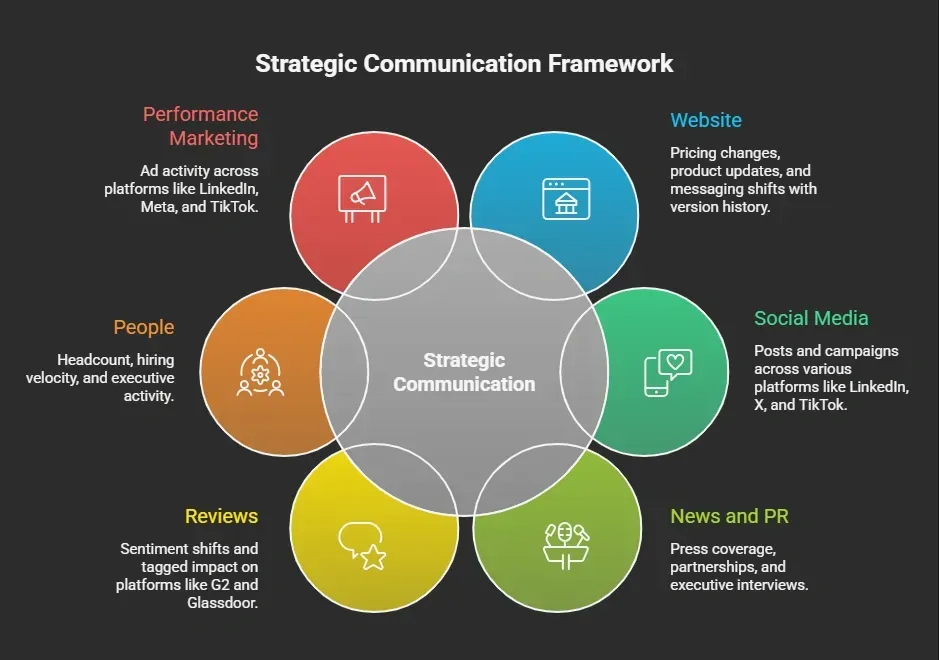
Six signal categories running every day
-
Website - pricing changes, product updates, messaging shifts, with full version history and before-and-after strategic interpretation
-
Social Media - posts and campaigns across LinkedIn, X, Instagram, Facebook, YouTube, TikTok, and Reddit
-
News and PR - press coverage, partnerships, executive interviews, media volume tracked over time
-
Reviews - G2, Glassdoor, Capterra sentiment shifts and tagged impact
-
People - headcount, hiring velocity, job postings by department, and executive activity feed
-
Performance Marketing - ad activity across LinkedIn, Meta, and TikTok
 The daily brief lands every morning before the first meeting. Sales teams get deal-specific competitive context. Marketing gets live campaign and market signals. Product teams read job postings weeks in advance to see where competitors are building next. Strategy teams spot M&A moves and market entry signals before formal announcements.
Four functions from one platform. Zero duplication of research effort across teams. Rocket.new saves up to 80% of the time founders and teams previously spent assembling competitive context manually across separate tools.
Decision Making Across Teams With Shared Context
What separates Rocket.new from every other no-code platform is shared context. Intelligence does not live in a separate tab. It lives inside the project, shared across all functions.
The competitor signal from Monday is present when a product manager opens the platform on Wednesday. The pricing move from last week shows up when marketing is building the landing page. The job postings from last month inform the roadmap strategy this quarter. The platform combines research from every direction into one shared context that every team member works from.
Rocket.new also gives founders and teams full version history and one-click rollback on everything built inside the platform. Ship, test, and iterate without risk - while competitive intelligence from the platform keeps feeding the strategy forward.
Other no-code platform tools hand the rest back to you. Rocket.new holds the whole flow inside one project.
Human Expertise Meets AI App Intelligence on One Platform
The platform combines research and monitoring - but human expertise still drives the decisions. Founders and product teams call what to build next. Sales leaders decide how to position. The AI app layer surfaces the signals; the team acts on them.
The difference is that those calls now happen with full market analysis, shared across teams, days or weeks before the competitor move lands on a prospect call. Founders are building toward their first enterprise deal and scaled teams running strategy across dozens of competitors use it the same way - one platform, continuous intelligence, no blind spots.
How Rocket.new Prevents Competitor Blindsides
Getting blindsided in an enterprise deal is a context problem, not a talent problem.
The information exists. Most founders and teams do not have a platform that surfaces it in time, connects it across teams, and keeps it current without days of manual effort. How Rocket.new prevents competitor blindsides is straightforward: competitive intelligence as a continuous function built inside the same no-code platform that founders and teams use to research, build, and launch products. Rocket.new delivers first-generation, launch-ready outputs without the need for further modification.
Teams that used to spend days assembling background for a competitive call now walk in with context loaded - updated automatically, shared across every role, connected to the build and strategy layers that follow. Rocket.new consolidates all workflows and data within one tool, reducing context switching and delays.
Rocket.new also offers a large library of templates that are free to use, encouraging engagement and accessibility.
Table of contents
- -When Competitive Intelligence Arrives Too Late?
- -The Job Postings Signal Most Founders Keep Missing
- -Market Analysis That Most AI Tools Cannot Deliver
- -When Signals Arrive vs. When They Matter
- -The No Code Platform Gap: Building Without Market Context
- -How Rocket.new Combines Research Across Teams
- -Six signal categories running every day
- -Decision Making Across Teams With Shared Context
- -Human Expertise Meets AI App Intelligence on One Platform
- -How Rocket.new Prevents Competitor Blindsides