
Effective market research helps founders validate demand before investing in development. Combining qualitative and quantitative research uncovers real customer pain points, pricing signals, and market opportunities. Rocket.new bridges the gap between research and execution by turning validated insights into production-ready apps quickly.
What if the biggest risk to your business idea is not failing to build it, but building the wrong thing entirely?
Market research is the process of gathering, analyzing, and interpreting data about your target market, potential customers, and competitors to support better business decisions. Done well, it separates a product people actually want from one that collects virtual dust. According to Founders Forum Group, 42% of startups collapse because they misread market demand, building products nobody needs or wants. The fix is to conduct market research before you build, not after.
This guide walks you through how to do market research step by step, the research methods that work, and how Rocket.new helps you go from validated insight to a shipped product.
Why is Market Research Important Before You Build?
Most failed products share a common root cause. The team building them assumed they already knew what customers wanted.
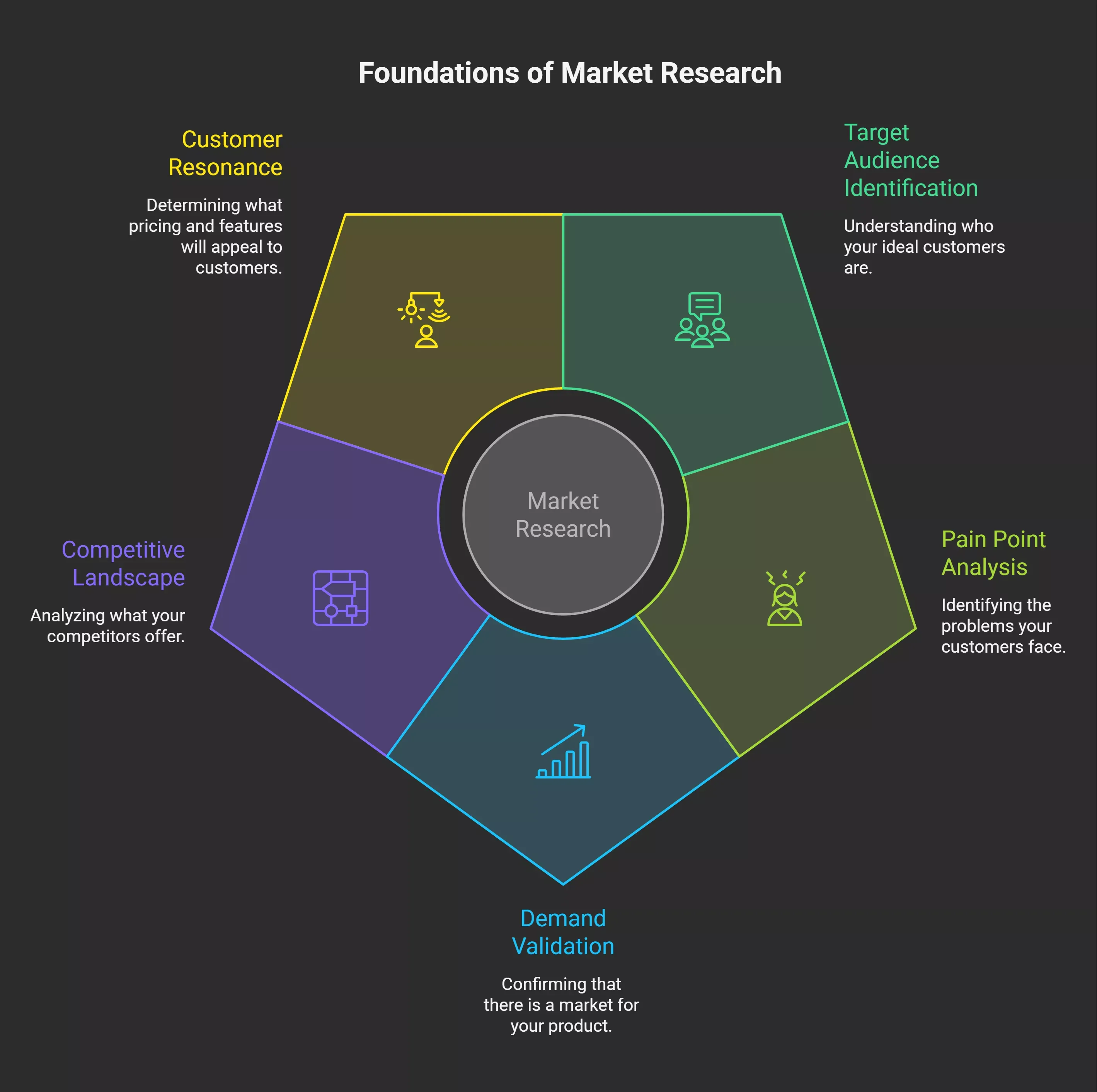
Market research changes that assumption into evidence. When you conduct market research properly, you understand:
- Who your target audience actually is (not who you think they are)
- What pain points are they trying to solve day to day
- Whether your business idea has real demand in the market
- What your competitors offer and where the gaps are
- What pricing, messaging, and features will resonate with your target customers
The global market research industry reached $140 billion in revenue in 2024, with projections reaching $150 billion by the end of 2025. That level of investment reflects how seriously companies of all sizes take the need to understand their markets before making major business decisions.
You do not need an enterprise budget to conduct market research that moves the needle. You need the right structure, the right research methods, and a clear set of research objectives.
The Two Core Types of Market Research
Before getting into the steps, it helps to understand the two main categories: primary and secondary research.
Primary Research
Primary research means gathering new data directly from the source, your potential customers, current users, or target audience. You design the study, run it yourself, and collect data that did not exist before.
Common primary research methods include:
- Online surveys: scalable and fast, strong for quantitative data
- Focus groups: structured small group discussions that surface qualitative research insights
- One-on-one interviews: deep conversations that reveal rich consumer behavior patterns
- Observational research: watching how people actually navigate a problem
Primary research is time-consuming, but it gives you data nobody else has. It answers the "why" behind buying behaviors.
Secondary Research and Secondary Data
Secondary research uses existing data collected by others. This includes:
- Industry reports, market research reports from Statista, IBISWorld, or research firms
- Government census data and population data
- Competitor content, customer reviews, and industry publications
- Academic studies and trade publications
Secondary market research is where most people start. It is faster and cheaper. It answers "what": what is the market size, what are the industry trends, and what is already documented about consumer behavior.
Qualitative vs. Quantitative Research: A Quick Comparison
| Dimension | Qualitative Research | Quantitative Research |
|---|---|---|
| What it measures | Feelings, motivations, opinions | Numbers, patterns, frequency |
| Best methods | Interviews, focus groups | Online surveys, analytics |
| Sample size needed | Small (8-20 participants) | Large (50-1,000+) |
| Output format | Themes and findings | Stats and percentages |
| Core question answered | Why do people behave a certain way | How many and how often |
Smart researchers combine primary and secondary research, and qualitative and quantitative methods. Numbers tell you what is happening. Conversations tell you why.
How to Conduct Market Research: A Step-by-Step Guide
Step 1: Set Clear Research Objectives
Before you gather a single data point, get clear on what you are trying to find out.
Vague objectives produce vague research findings. Specific research objectives produce actionable insights you can use. Ask yourself:
- What business decision does this research support?
- Who is my target market, and what do I actually know about them?
- What do I need to validate about my business idea before committing resources?
- What existing data do I already have?
Write your research objectives in plain language. Example: "We need to understand whether freelance content creators would pay for a social media scheduling tool with built-in performance analytics."
That sentence defines who (freelance content creators), what (scheduling tool with analytics), and the research question (willingness to pay). Now your entire research process has direction.
Step 2: Gather Secondary Research First
Secondary research gives you context before you talk to a single customer. Spend a few hours here first:
- Read industry reports and market research reports about your sector
- Review customer reviews on G2, Capterra, Amazon, or app stores for competing products
- Check government census data for relevant demographic data
- Browse Reddit threads, LinkedIn posts, and forums where your target customers already talk
This phase helps you identify what is already known - and where the gaps are. Those gaps become your primary research priorities.
Step 3: Run Your Primary Research Through Surveys, Interviews, and Focus Groups
Now you gather original data. Match your research methods to your research objectives.
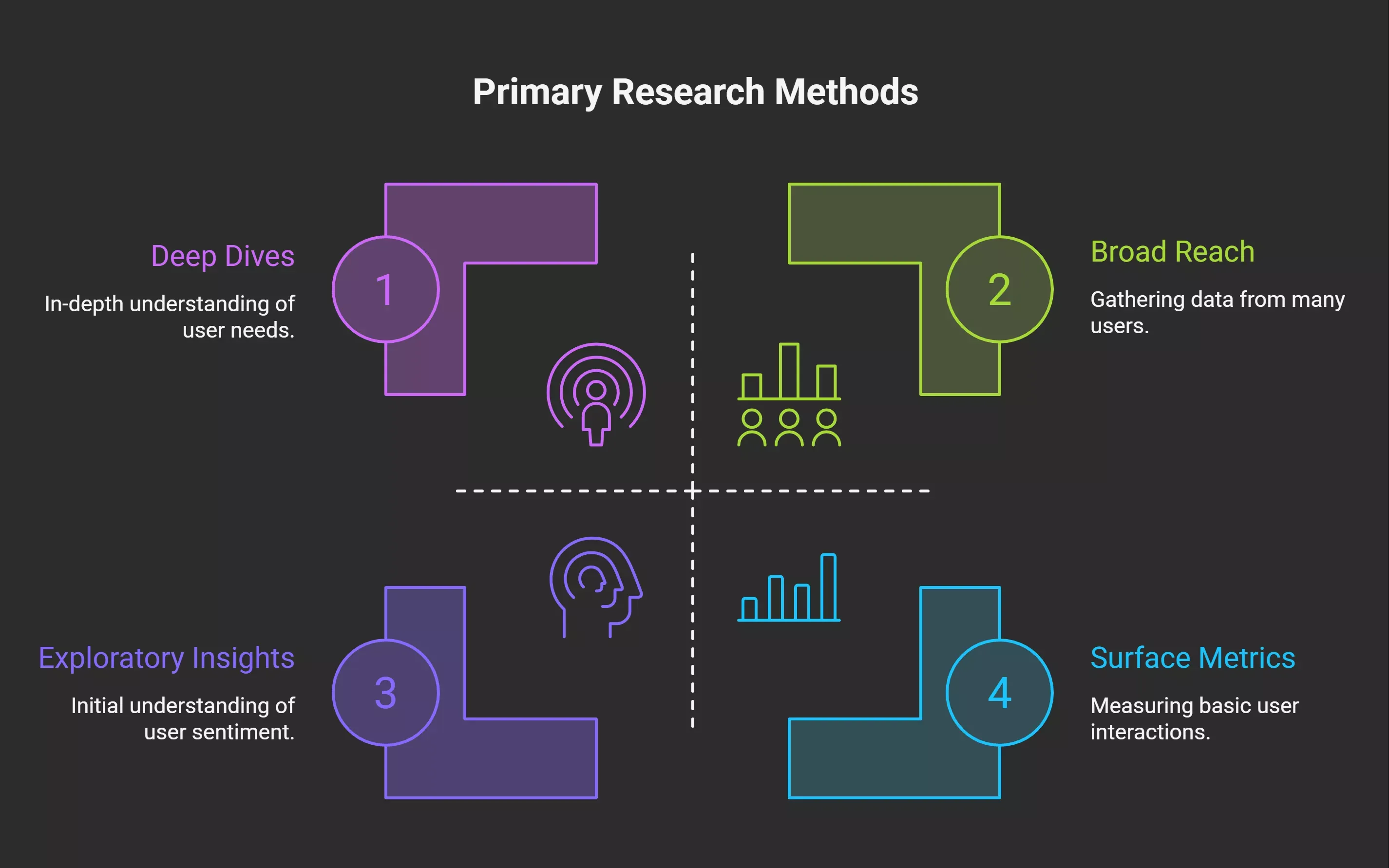
Online surveys work well when you need quantitative data at scale. Keep them short (under 10 minutes), combine closed questions with open-ended questions, and aim for at least 50-100 responses to spot meaningful patterns. Free tools like Google Forms or Typeform get you started at no cost.
Focus groups bring together 6-10 participants from your target market to discuss a topic in depth. They are effective for exploring emotional responses to product concepts, testing messaging, or gauging reactions to a prototype. The group dynamic often surfaces qualitative insights that one-on-one conversations miss.
One-on-one interviews give you the richest qualitative data. Talk to 10-20 potential customers individually. Ask open-ended questions. Listen more than you talk. The goal is to understand their world, their pain points, and how they currently solve the problem you are targeting.
A few interview questions worth asking:
- "Walk me through how you handle [the problem] right now."
- "What is the most frustrating part of your current approach?"
- "What would the ideal solution actually look like for you?"
Step 4: Conduct a Competitive Analysis
Understanding your competitive environment is market research, too.
Map out your biggest competitors. For each one, look at:
- Their product or service offering and pricing range
- Customer reviews - especially the negative ones, which reveal unmet needs
- Their marketing strategies and how they position their brand
- Features customers praise and features they consistently request
Competitor analysis reveals the gaps your product could fill. It also shows you what your target customers already expect from any solution in your space. That context shapes your product, positioning, and pricing.
Step 5: Data Collection and Organization
As you gather data, organize it as you go. Do not wait until all research is complete before sorting.
For quantitative data, spreadsheets work fine. Track survey responses, calculate percentages, and look for statistically significant patterns across different segments.
For qualitative research, tag recurring themes as you review interview notes or focus group transcripts. When the same theme appears across multiple conversations from the same target segment, that is a signal worth acting on.
Look for convergence - where qualitative themes match the quantitative data patterns. That convergence is where your most reliable market research findings live.
Step 6: Data Analysis and Extracting Market Research Findings
Raw data does not give you answers. Data analysis does.
When you analyze data from your market research, look for:
- Which pain points appear most frequently across your interviews and surveys
- Which customer segments show the strongest demand signal
- Where your business idea connects with real, documented needs - and where it does not
- Which assumptions turned out to be wrong
Be honest about what the data shows. Good market research sometimes tells you to pivot the idea, narrow the target market, or change the pricing model. That is not failure. That is the research process working correctly - and far cheaper to learn before you build than after.
Step 7: Apply Research Findings to Your Business Strategy
Market research findings only create value when someone acts on them.
Translate your data into specific product, pricing, and marketing decisions:
- Refine your product scope based on real customer needs, not assumptions
- Adjust your pricing based on willingness-to-pay signals from interviews and surveys
- Shape your messaging using the exact language your target customers use to describe their pain
- Identify which market segment has the strongest demand to target first
- Improve your business plan with data-backed market size estimates and competitive positioning
Step 8: Track Customer Satisfaction After You Launch
Market research does not stop at launch. After shipping, customer satisfaction data becomes your primary ongoing research method.
Track how customers actually use your product. Measure net promoter scores. Run short surveys after key interactions. Monitor reviews and support conversations for recurring themes.
This post-launch data feeds directly back into your research objectives, helping you refine the product and stay ahead of emerging trends in your market.
What the Community is Saying
"Too many founders build amazing products that never take off because they never validated what the market actually wanted. The risk isn't guessing wrong. The risk is not checking at all. Market research gives you the clarity your instincts can't. It shows you who your real customers are, what they care about, and what they will actually pay for. You don't need a massive budget to get real insight. You just need the right approach." - Sellerant on LinkedIn, November 2025
From Validated Business Idea to Shipped Product: The Gap Most Founders Hit
Market research gets you to a decision: what to build, for whom, and how to position it.
That is where most tools leave you. You have a validated business idea, clear target audience profiles, a competitive analysis, and documented customer needs. But you still need to build something.
For most founders, there is a long, expensive bridge between "research done" and "product shipped." Weeks of scoping. Months of development. Constant re-explaining of context to every new tool or developer brought into the process.
This is the gap that Rocket.new was built to close.
Effective Market Research Meets Rocket.new: Validate It, Then Ship It
Rocket.new is the world's first Vibe Solutioning platform, where business research intelligence and product building exist in the same workspace, with shared context. You do not lose your research when you move to the build phase. The platform carries your thinking forward.
Solve: Turn Your Research Findings Into a Clear Strategy
The Solve feature takes any business question or market research prompt and returns a full structured analysis: findings, evidence, and clear recommendations, exportable as PDF or PPT.
Where most tools ask you to analyze data yourself and then manually move that analysis into separate planning documents, Solve keeps it in one place. Your market research findings inform the build from day one - no re-explaining, no lost context.
Build: Ship a Production-Grade Product Without a Development Team
Once your idea is validated, Build generates a production-grade web app or mobile app from a plain-language description.
Web apps come out in Next.js. Mobile apps in Flutter, ready for the App Store and Google Play. Landing pages, SaaS dashboards, internal tools, customer portals, all generated with real design quality, not generic template output that looks like every other AI-built product.
A founder who has completed market research and validated an idea can describe the product to Rocket.new and have a working, deployable build ready to test in minutes.
Rocket.new vs Competitors
| Feature | Rocket.new | Lovable / Bolt / v0 |
|---|---|---|
| Pre-build research intelligence | Yes - Solve feature | No |
| Shared context across research and build | Yes | No |
| Production-grade web (Next.js) and mobile (Flutter) | Yes | Web-only or variable quality |
| Continuous competitive monitoring post-launch | Yes - Intelligence | No |
| Redesign existing websites with slash commands | Yes - 8 commands | No |
| Build from a validated research context | Yes | No |
Competitors like Lovable, Bolt, and v0 build what you tell them to build. Rocket.new helps you figure out what is worth building first, then builds it at production quality.
Intelligence: Stay Ahead of Market Trends After You Launch
Your market does not freeze once you ship. Competitors update their products. Customer preferences shift. New market trends appear. Industry dynamics change.
Rocket.new's Intelligence feature monitors every public platform your competitors operate on and tells you what their signals mean for your business. It is not just a data feed; it is interpreted market intelligence, delivered where you work.
For any business that did the work to understand its market before launch, Intelligence keeps that research current without additional effort.
Gather Data, Validate, and Then Ship
The core problem market research solves is this: most poor product decisions happen because teams build on assumptions instead of evidence. They confuse enthusiasm for demand and speed for progress.
Effective market research - combining primary and secondary research, qualitative and quantitative methods, competitive analysis, and direct customer conversations gives you something more valuable than a better pitch deck. It gives you confidence that you are building something people genuinely want.
So conduct market research before you write a single line of code. Use the data to validate your idea, refine your target audience, and understand your competitive environment. Then ship on Rocket.new, where your validated research becomes the foundation of a production-grade product.
How to do market research is not the hard part anymore. Acting on what you find is.
Visit Rocket.new and sign up to validate your idea with real market data, then turn it into a production-ready product
Table of contents
- -Why is Market Research Important Before You Build?
- -The Two Core Types of Market Research
- -Primary Research
- -Secondary Research and Secondary Data
- -Qualitative vs. Quantitative Research: A Quick Comparison
- -How to Conduct Market Research: A Step-by-Step Guide
- -Step 1: Set Clear Research Objectives
- -Step 2: Gather Secondary Research First
- -Step 3: Run Your Primary Research Through Surveys, Interviews, and Focus Groups
- -Step 4: Conduct a Competitive Analysis
- -Step 5: Data Collection and Organization
- -Step 6: Data Analysis and Extracting Market Research Findings
- -Step 7: Apply Research Findings to Your Business Strategy
- -Step 8: Track Customer Satisfaction After You Launch
- -What the Community is Saying
- -From Validated Business Idea to Shipped Product: The Gap Most Founders Hit
- -Effective Market Research Meets Rocket.new: Validate It, Then Ship It
- -Solve: Turn Your Research Findings Into a Clear Strategy
- -Build: Ship a Production-Grade Product Without a Development Team
- -Intelligence: Stay Ahead of Market Trends After You Launch
- -Gather Data, Validate, and Then Ship