
Discover practical methods to uncover competitor strategies before they go public by tracking hiring activity, partnerships, patents, product updates, and customer feedback to stay ahead in your market and strengthen business decision-making.
What if you could spot your competitor’s next launch early?
That sounds like insider access, but it's not. The signals are public. The tools are available. And the method is something most companies just haven't figured out yet.
Your competitors leave trails everywhere. Job postings, GitHub commits, trademark filings, pricing changes, social media shifts- all of these broadcast what's coming months before any official announcement. Competitive analysis is the practice of reading those trails early enough to act on them.
According to Evalueserve, 90% of Fortune 500 companies already use competitive intelligence to gain an advantage. The question isn't whether it works. The question is whether your team has a system for doing it consistently.
Let's walk through exactly how this works- from identifying the right competitors to building a monitoring setup that gives you a genuine head start.
Why Most Competitor Analysis Programs Fail?
Most companies believe they are tracking competitors effectively. In reality, they are only reacting to announcements after the important work has already happened behind the scenes.
Think about the last time a competitor launched something new. Your team probably discovered it through a press release, a LinkedIn update, or a customer conversation. But by then, the competitor had already spent months building, testing, positioning, and preparing their go-to-market strategy.
That is the real weakness of reactive competitive analysis. Teams respond to the launch instead of understanding the signals that appeared long before the launch ever became public.
The Biggest Problems With Traditional Competitor Analysis
-
Teams rely too heavily on public announcements and media coverage
-
Most monitoring starts after competitors already execute their strategy
-
Important signals stay scattered across multiple platforms and tools
-
Companies collect data but fail to interpret what the signals actually mean
-
Competitive research often becomes inconsistent and reactive instead of continuous
Octopus Competitive Intelligence captured this well in a LinkedIn article on predicting competitor product launches:
"Most companies react to competitor launches 6 months too late - but patent filings, GitHub commits, and trademark applications reveal product roadmaps 18-24 months in advance."- LinkedIn
The signals exist. The gap is in knowing where to look and how to read them on a consistent schedule.
Start by Knowing Who You Are Actually Watching
Before you can track competitor behavior, you need to be clear on who your actual competitors are. This sounds obvious, but most teams focus too narrowly and miss half the competitive landscape.
Direct Competitors
Direct competitors are brands selling the same product or service to the same target audience. If you run a project management SaaS, Asana and Monday.com are your direct competitors. They fight for the same market share, the same target customers, and the same budget.
Tracking direct competitors gives you a sharp view of pricing strategy shifts, feature rollouts, and marketing strategies aimed squarely at your target market.
Indirect Competitors
Indirect competitors solve the same problem differently. In the project management example, Excel or Notion competes for the same spend without being an identical product. Customers regularly choose them over your offering.
Watching indirect competitors often reveals more about market gaps than tracking direct rivals does. They tell you what jobs customers are trying to get done that nobody is fully addressing yet.
Emerging and New Competitors
These are startups quietly building in your space. They might not be on your radar yet, but their job postings, GitHub activity, and investor announcements are public. Missing emerging competitors is one of the most common competitive intelligence blind spots- and one of the most expensive.
Secondary Competitors
Secondary competitors operate in adjacent markets with partial customer overlap. They may not directly compete with your entire product, but they influence the same audience and buying behavior through related solutions and positioning.
| Competitor Type | Definition | Where to Find Them |
|---|---|---|
| Direct competitors | Same product, same target market | Google Search, G2, Capterra, industry reports |
| Indirect competitors | Different product, same problem | Customer feedback, review sites, analyst reports |
| Emerging competitors | New entrants building in your space | LinkedIn, GitHub, Product Hunt, AngelList |
| Secondary competitors | Adjacent market, partial customer overlap | Social media, trade publications, conferences |
The strongest competitor analysis programs do not focus on just one category of competitors. They track the full ecosystem to understand where the market is moving before those shifts become obvious to everyone else.
Build Your Competitive Market Research Foundation
Good competitor analysis doesn't start with tracking signals. It starts with market research that tells you what normal looks like- so you can spot deviations when they appear.
Establish a Baseline
Before you can recognize when a competitor is gearing up for something new, you need baseline data on how they typically operate:
-
How many job postings do they usually run at one time?
-
How frequently do they update their pricing page?
-
What is their typical social media publishing cadence?
-
How often do their GitHub contributors push code on average?
-
What topics do they consistently write about?
Spending two to three weeks just observing and recording this baseline across your key competitors pays off significantly when something shifts.
Where to Gather Your Market Research
The primary data sources for competitor research break into several categories:
-
Job Boards: LinkedIn, Indeed, and company careers pages. Weekly checks for new roles, especially in engineering, product, and sales, reveal where budget is actively moving.
-
GitHub: Open-source repositories, commit histories, and contributor activity from competitor engineering teams.
-
Trademark and Patent Databases: USPTO, Google Patents, and WIPO. Free, publicly searchable, and remarkably revealing about development timelines.
-
Review Sites: G2, Capterra, Trustpilot, and app store reviews. Customer feedback here is a live signal of where competitors are winning and where they are falling short.
-
Pricing Pages: Screenshot and archive these monthly. Pricing strategy changes, especially tier restructures or model switches, almost always signal a product or market shift.
-
Social Media Platforms: LinkedIn for hiring and thought leadership signals. X for real-time messaging shifts. YouTube for product demo changes and launch preparation.
-
Google Ads and Digital Marketing: The Meta Ad Library and Google's Transparency Center show paid advertising strategies and messaging direction in near real time.
The biggest advantage in competitive market research does not come from collecting more data than everyone else. It comes from recognizing meaningful changes faster than everyone else because you already understand what normal behavior looks like across your market.
The Key Signals That Reveal What Your Competitor Is Building
Once your monitoring system is running, you start to see patterns. Here is how to read the most reliable early warning signals in competitive intelligence.
Competitor Behaviour: Hiring Spikes as Product Signals
When a company that never had a mobile team suddenly posts five iOS developer roles, they are building a mobile product. When a B2B SaaS company starts hiring consumer growth specialists, they are preparing to go direct-to-consumer.
Hiring spikes in specific technical areas are one of the clearest early indicators in competitor analysis because they reflect where budget is actually going. Companies do not hire for strategies they are not actively pursuing.
Watch for:
-
Sudden spikes in roles tied to a specific technology (AI, mobile, payments, data infrastructure)
-
New department-level hiring that did not exist before
-
Leadership hires in areas they have never had dedicated leadership
-
Roles in geographies outside their usual target market
GitHub Activity as a Product Development Tracker
Public repositories reveal product direction in extraordinary detail. New repos with names like "enterprise-api," "billing-v2," or "analytics-core" tell you what is being built. Commit message patterns, branching strategies, and contributor additions add context.
Track:
-
New repositories with active commit histories
-
Existing repos with sudden acceleration in commit frequency
-
Technology stack changes switching frameworks often signals a product rewrite
-
Contributors joining from outside the company, which can indicate acquisition activity in progress
-
API development sprints that suggest upcoming third-party integrations
Patent and Trademark Filings
Companies file patents during active product development, not after. A patent filing contains technical specifications, implementation details, and sometimes partnership references. Reading them gives you a view into what is being built months before it ships.
Trademark filings for new brand names typically happen 6 to 12 months before a product launch. A competitor filing "BrandNamePro" or "BrandNameEnterprise" is telling you exactly what tier they plan to target next.
Check the USPTO TESS database and Google Patents quarterly. It takes 15 minutes and the data is entirely public.
Pricing Strategy Shifts
Pricing changes are strategic signals, not just revenue decisions. A competitor adding a new tier, removing a free plan, or switching to annual-only billing all reflect either new customer acquisition goals or preparation for a product expansion into a different market segment.
Archive competitor pricing pages monthly. When something changes, that change is worth digging into.
Customer Feedback on Review Sites
Read their one-star and two-star reviews on G2, Capterra, and Trustpilot. Customer sentiment here tells you exactly what gaps exist in their product. Those gaps are your opportunities. And when a competitor starts closing those gaps, their feature announcements will directly reflect the patterns in those reviews, usually 3 to 6 months later.
The strongest competitive intelligence programs do not rely on one signal alone. They connect hiring patterns, GitHub activity, pricing shifts, patents, and customer feedback together to understand the larger story behind what competitors are preparing long before the official announcement ever happens.
How to Set Up a Continuous Competitive Intelligence System
Tracking signals manually works for a week. Running it consistently over months requires a structured workflow.
Here is how an effective competitive intelligence setup flows:
The key to making this sustainable is regularity. Competitive analysis done once a quarter catches announcements after the fact. Done weekly, it catches signals before the announcement. The goal is signals- not summaries.
Set up Google Alerts for competitor names, their key products, and their leadership team. Most effective competitor research programs spend two to three hours per week on monitoring plus one structured review session per quarter.
Use a SWOT Analysis to Turn Signals into Decisions
Raw signals are only useful if you can turn them into actionable decisions. A SWOT analysis applied specifically to your competitor research helps you prioritize what to act on.
For each key competitor, build a SWOT analysis based on what you have gathered:
-
Strengths: Where are they winning? What is their unique value proposition? What does customer feedback consistently praise about their product or service?
-
Weaknesses: Where are they falling short? What does customer sentiment flag repeatedly in reviews? What gaps does their product leave open in the market?
-
Opportunities: What market gaps are they not addressing? What industry trends are they slow to respond to? What signals suggest they are about to move in a direction that opens space for you?
-
Threats: What signals suggest they are about to launch something that could affect your market share or market position? How fast can they move based on current hiring and development activity?
Running a SWOT analysis quarterly against your top three competitors gives you a living map of the competitive landscape you can use to make decisions, not just discussions.
Track Their Marketing Strategies and Marketing Efforts
What competitors say publicly is also a signal. Their marketing strategies and marketing channels reveal who they are targeting and what problem they believe they are solving.
Customer Acquisition Signals in Their Content
When a competitor suddenly publishes heavily around a new topic area, they are often preparing to launch a product in that direction. Content investment in a new theme is a soft but reliable competitive signal.
Watch for content clusters forming around topics they were not covering six months ago. Keyword research tools like SEMrush can show you which keywords their websites are newly targeting and where they are gaining ground.
Paid Advertising and Google Ads Shifts
Changes to Google Ads and paid advertising messaging are visible through free tools. When their ad copy shifts from "simple and easy" to "enterprise-grade," they are moving upmarket. When they start advertising to a new industry vertical, they are expanding their target audience.
Customer Acquisition Through Social Media
Consistent pattern changes in social media strategy over 60 to 90 days are meaningful. A company that doubles its LinkedIn posting frequency while going quiet on X is repositioning toward a B2B audience. A sudden increase in video content production almost always signals an upcoming product launch campaign.
Marketing signals often reveal strategic direction before product announcements do. When competitors change their messaging, advertising focus, content themes, or social media behavior consistently over time, they are usually preparing for a larger shift in positioning, audience targeting, or product expansion.
Why Most Competitive Intelligence Misses Key Signals
Most competitive intelligence programs fail because they focus on visible announcements instead of the quieter operational signals that appear months earlier during product development and market positioning.
-
Tracking press releases only shows decisions after they are finalized
-
Social media updates reflect messaging, not early strategic movement
-
Hiring patterns often reveal product direction before launches happen
-
GitHub activity exposes active development and technical priorities
-
Pricing changes usually signal positioning shifts or market expansion
-
Patent and trademark filings reveal long-term roadmap intentions
-
Inconsistent monitoring causes teams to miss patterns over time
-
Reactive competitor analysis creates delayed responses instead of strategic preparation
The market reflects how much demand exists for solving this problem. According to Spherical Insights, the global competitive intelligence tools market is projected to grow from $482.36 million in 2024 to $1.85 billion by 2035, at a CAGR of 13.02%. That growth is not happening because the problem is easy. It is happening because most companies have not solved it yet.
The companies that gain a real competitive advantage are usually the ones studying behavior early, connecting multiple signals together, and acting before competitors officially explain what they are building.
Rocket.new: Research, Build, Monitor
Spotting competitor signals early only matters if your team can act on them quickly. Most businesses struggle because research, product planning, and execution happen across disconnected tools and teams.
Rocket.new combines strategic research, AI-powered app building, and continuous competitive intelligence into one workflow. Research the market, decide what to build, launch faster, and monitor competitors continuously from a single platform.
Solve: Competitive Research in Minutes
The Solve pillar helps teams generate structured market research, competitor analysis, PRDs, and strategic recommendations through AI-powered workflows.
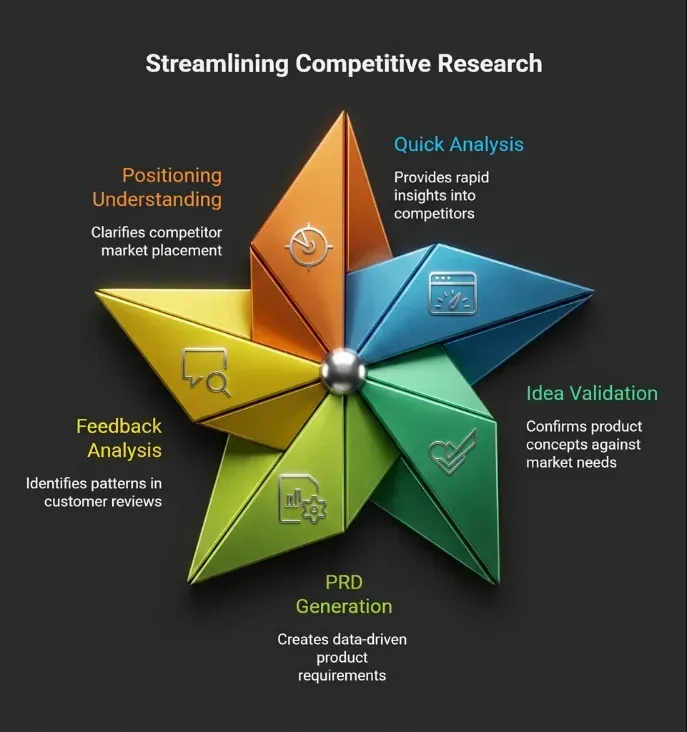
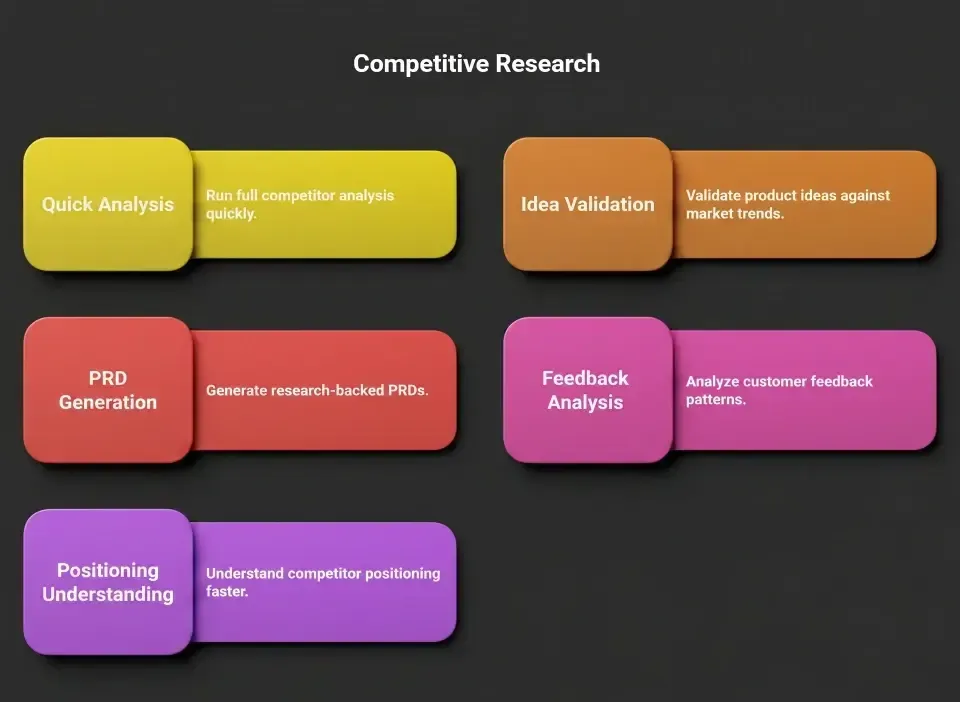 For businesses trying to predict competitor direction, Solve creates the research foundation needed to move earlier and make decisions faster.
Build: Ship Faster Than Traditional Teams
Once research reveals an opportunity, the Build pillar turns natural language prompts into production-ready applications.
Teams can create:
-
Full-stack Next.js web apps
-
Flutter mobile applications
-
Deployable production products
-
Apps ready for App Store, Google Play, or custom domains
Most AI builders focus on prototypes. Rocket.new focuses on helping teams ship real production products quickly after identifying a market opportunity.
Intelligence: Continuous Competitor Monitoring
The Intelligence dashboard continuously tracks competitor activity after setup.
Teams receive:
-
Daily competitor briefs
-
Pricing change alerts
-
Market trend signals
-
Strategic movement updates
-
Monitoring dashboards connected directly to research workflows
Traditional competitive intelligence tools often require dedicated analyst teams and disconnected workflows. Rocket.new connects research, monitoring, and product execution into one continuous system designed for lean teams that need speed.
| Capability | Rocket.new | Traditional CI Tools |
|---|---|---|
| Research and competitive analysis | AI-powered, minutes | Manual, days |
| App building from insights | Yes - production-ready | No |
| Continuous competitor monitoring | Yes, automated | Yes, requires analyst team |
| Research + build + monitor in one | Yes | No - separate tools |
| Team size required | Solo or small team | Dedicated CI staff |
| Time to first actionable insight | Under 5 minutes | Days to weeks |
The biggest advantage in competitive intelligence is not simply seeing signals earlier. It is having the ability to research, decide, build, and respond before competitors realize the market has already shifted.
Knowing What Your Competitor Is Building in Nutshell
Most teams still treat competitor analysis as a reaction instead of a prediction system. By the time a launch becomes public, the strategy, development, and positioning work has already been happening for months. The real advantage comes from tracking early signals like hiring activity, GitHub updates, pricing changes, patents, and marketing shifts before announcements happen.
The signals are already public. What teams often lack is a connected system to research competitors, monitor patterns consistently, and act quickly. Rocket.new brings research, monitoring, and AI-powered building together so businesses can identify market shifts early and respond faster.
Use Rocket.new to research competitors, monitor market signals continuously, and build production-ready responses before competitors officially launch their next move.
Table of contents
- -Why Most Competitor Analysis Programs Fail?
- -The Biggest Problems With Traditional Competitor Analysis
- -Start by Knowing Who You Are Actually Watching
- -Direct Competitors
- -Indirect Competitors
- -Emerging and New Competitors
- -Secondary Competitors
- -Build Your Competitive Market Research Foundation
- -Establish a Baseline
- -Where to Gather Your Market Research
- -The Key Signals That Reveal What Your Competitor Is Building
- -Competitor Behaviour: Hiring Spikes as Product Signals
- -GitHub Activity as a Product Development Tracker
- -Patent and Trademark Filings
- -Pricing Strategy Shifts
- -Customer Feedback on Review Sites
- -How to Set Up a Continuous Competitive Intelligence System
- -Use a SWOT Analysis to Turn Signals into Decisions
- -Track Their Marketing Strategies and Marketing Efforts
- -Customer Acquisition Signals in Their Content
- -Paid Advertising and Google Ads Shifts
- -Customer Acquisition Through Social Media
- -Why Most Competitive Intelligence Misses Key Signals
- -Rocket.new: Research, Build, Monitor
- -Solve: Competitive Research in Minutes
- -Build: Ship Faster Than Traditional Teams
- -Intelligence: Continuous Competitor Monitoring
- -Knowing What Your Competitor Is Building in Nutshell