Lovable and Rocket.new build apps from plain English with zero coding. Lovable wins for quick demos and teams with moderate usage. Rocket.new wins for full-stack builds, native mobile, built-in SEO, and code that scales. Pick Lovable to validate fast. Pick Rocket.new to build for real.
Can you actually ship a startup MVP using an AI app builder without writing a single line of code?
Yes, Two names dominate that conversation right now: Lovable and Rocket.new. Both let you describe your app idea in natural language and get working code back in minutes. Both skip the traditional development grind.
So which one should you pick?
According to Gartner, more than 70% of new applications will be built using low-code or no-code platforms by 2025, up from less than 25% in 2020. A McKinsey report found that teams using AI tools trim early app development cycles by nearly 40%.
Picking the right AI-powered app builder for your MVP matters more than most founders realize.
What is Vibe Coding and Why Do Founders Love It?
Vibe coding is a style of software development where you describe what you want in plain English and an AI writes the app for you. No boilerplate. No syntax headaches. No waiting on a development team for three weeks while your runway burns.
Beyond speed, vibe coding also creates a visual specification that helps non-technical stakeholders clearly articulate what they need, making it easier to align teams before a single line of real code is written.
Here is why vibe coding has taken over early-stage startup thinking:
-
You go from app idea to a live app in hours, not months
-
You do not need coding skills to get working code back
-
Testing ideas costs almost nothing before committing to custom software
-
Both Lovable and Rocket.new deliver 10 to 20 times faster app development cycles than traditional development
That said, vibe coding is a double-edged sword. It provides remarkable speed but can sacrifice long-term maintainability if you are not careful about which platform you choose and how you structure the app from day one.
How Does Lovable App Work?
Lovable is an AI-powered app builder that converts natural language prompts into a working web application without the user writing any code. You type what you want in plain language, and Lovable generates the frontend UI, backend logic, database schema, and login flows automatically.
Lovable focuses on getting a functional web app with a Supabase backend up and running in hours, which makes it ideal for non-technical founders needing to validate a simple SaaS idea or dashboard in one to three days.
Here is how the development process flows:
-
Describe your app idea in simple, conversational plain language
-
Get the first version of your app generated in minutes
-
Use the visual editor to tweak layouts and styles
-
Connect third-party services like Stripe or Supabase
-
Deploy to custom domains with one click
-
Export generated code to GitHub for full code ownership
Lovable works best for UI prototypes, simple landing pages, and early SaaS concepts. It is a great starting point if your app idea is primarily frontend-focused and you need something demoable fast.
Where Lovable Performs Well?
Lovable shines in specific scenarios, particularly when speed to first demo matters more than production architecture.
-
Building landing pages and simple web apps fast
-
Creating basic CRUD apps with user authentication included out of the box
-
Using chat mode to iterate on designs without consuming heavy build credits
-
Getting a functional prototype to stakeholders in under 90 minutes
-
Testing ideas quickly without needing a development team in place
The Lovable app builder gives founders a user-friendly interface and clean React/Tailwind output without touching code. Code edits in build mode cost more credits than chat mode, so switching between modes matters for budget control.
Lovable Works Great, But Only for Simple Use Cases
As your app idea grows more complex, the gaps start to show.
Lovable struggles with:
-
Complex projects needing custom backend logic or advanced features
-
Apps requiring file uploads, database table management, and deep external services wiring
-
Technical debt that accumulates quietly in AI-generated code not built for scale
-
A looping debugging problem where the AI re-breaks fixed issues while consuming paid plan credits
-
Predictable cost planning when your app development needs thousands of iterations
Users of vibe coding platforms frequently face challenges with debugging and maintaining the generated code over time. The architectural decisions baked in by AI app builders can make refactoring into a production-ready application genuinely challenging later. Tech debt builds fast, and untangling AI-generated code is not cheap.
Lovable Pricing: Plan Breakdown
Lovable uses a credit-based pricing model tied to message limits rather than the token systems other platforms use.
| Plan | Price | Credits | Key Features | Best For |
|---|---|---|---|---|
| Free | $0 | 5/day indefinitely | Unlimited public projects | Ongoing experimentation and light iteration with no time limit |
| Pro | $25/month | 250/month | Custom domains, private projects, visual editor, remove Lovable badge | Solo founders iterating on a single concept |
| Business | $50/month | 200/month, unlimited users share the pool | SSO, team collaboration, admin controls, no per-seat fees | Larger teams with moderate per-person usage |
| Enterprise | Custom | Custom | Dedicated support, professional onboarding, custom integrations | Organisations needing tailored support at scale |
Note: Charges can escalate rapidly for projects requiring thousands of iterations. The credit-based model suits moderate usage; for high-volume builds, compare against Rocket.new's token model.
The free plan gives individual developers enough runway to test the platform. The credit system with unlimited users offers better economics for situations where many people need access without per-seat costs. For larger teams with moderate usage, this structure can work in Lovable's favor. For heavy iteration cycles requiring thousands of prompts, Lovable's charges can escalate rapidly.
Rocket.new: The Full-Stack Launch Pad Built for Real Products
Rocket.new is an AI-powered platform built for founders who want production-ready code from the start, not just a polished demo.
By the numbers:
| Metric | Detail |
|---|---|
| Funding | $15 million raised in September 2025 |
| Investors | Salesforce Ventures and Accel |
| Users | 400,000+ across 180 countries |
| Apps built | 500,000+ |
| Serious builders | ~80% are building real applications, not just landing pages |
What makes it different:
Describe your app idea once in plain English, and Rocket builds the entire product in a single pass:
-
Frontend UI
-
Backend logic
-
Database schema
-
User authentication
-
API logic
-
Deployment
No manual intervention needed. No separate prompts for each feature. That is a fundamentally different approach compared to Lovable and most other no-code platforms, where you often wire these pieces together yourself across multiple steps.
*See it in action:** The Built with Rocket gallery is a live showcase of real apps the community has shipped, ranging from early MVPs to polished products. You can filter by category and launch time, and each card links directly to the live app so you can see exactly what is possible before you start building..***
Top Features That Make Rocket.new Stand Out
One-Prompt Full-Stack Generation: A single line or paragraph gets you a complete app with database schema, user authentication, file uploads, and deployment all wired together.
Production-Ready Code: Rocket generates clean, structured, maintainable React code built for real use, not just demos. This is the standout feature most clearly.
Real-Time Previews: As you build, you see your app update in real time, which significantly enhances the development experience and reduces back-and-forth guesswork.
One-Click Deployment: Deploy your live app instantly without jumping between external hosting tools.
Native iOS and Android Mobile Apps: Rocket.new produces native mobile apps from the same build flow as your web app. No other major AI app builder handles this as smoothly.
Built-in SEO via Next.js: Rocket's web apps include SEO from the start. Lovable's single-page app approach does not offer this natively.
Figma-to-Code Conversion: Rocket.new translates Figma designs into responsive working code with results users consistently describe as 100% accurate.
Rich External Services Support: Payments, email, analytics, and other external services connect as part of the initial build.
Multiple AI Models: Rocket.new combines AI models from Anthropic, OpenAI, and Google Gemini with its own proprietary deep learning systems.
Rocket.new Use Cases for Your Startup MVP
Where does Rocket.new win most clearly?
-
Full-stack MVPs with real backend logic and database tables, not just a UI shell
-
Mobile apps for iOS and Android built alongside a web app in a single prompt
-
Complex projects with multi-page flows, custom domains, and role-based access
-
Internal tools and dashboards with proper external services connections and file uploads
-
Production-ready code that a development team can extend cleanly without rebuilding
-
Apps with custom integrations needing detailed instructions embedded from the start
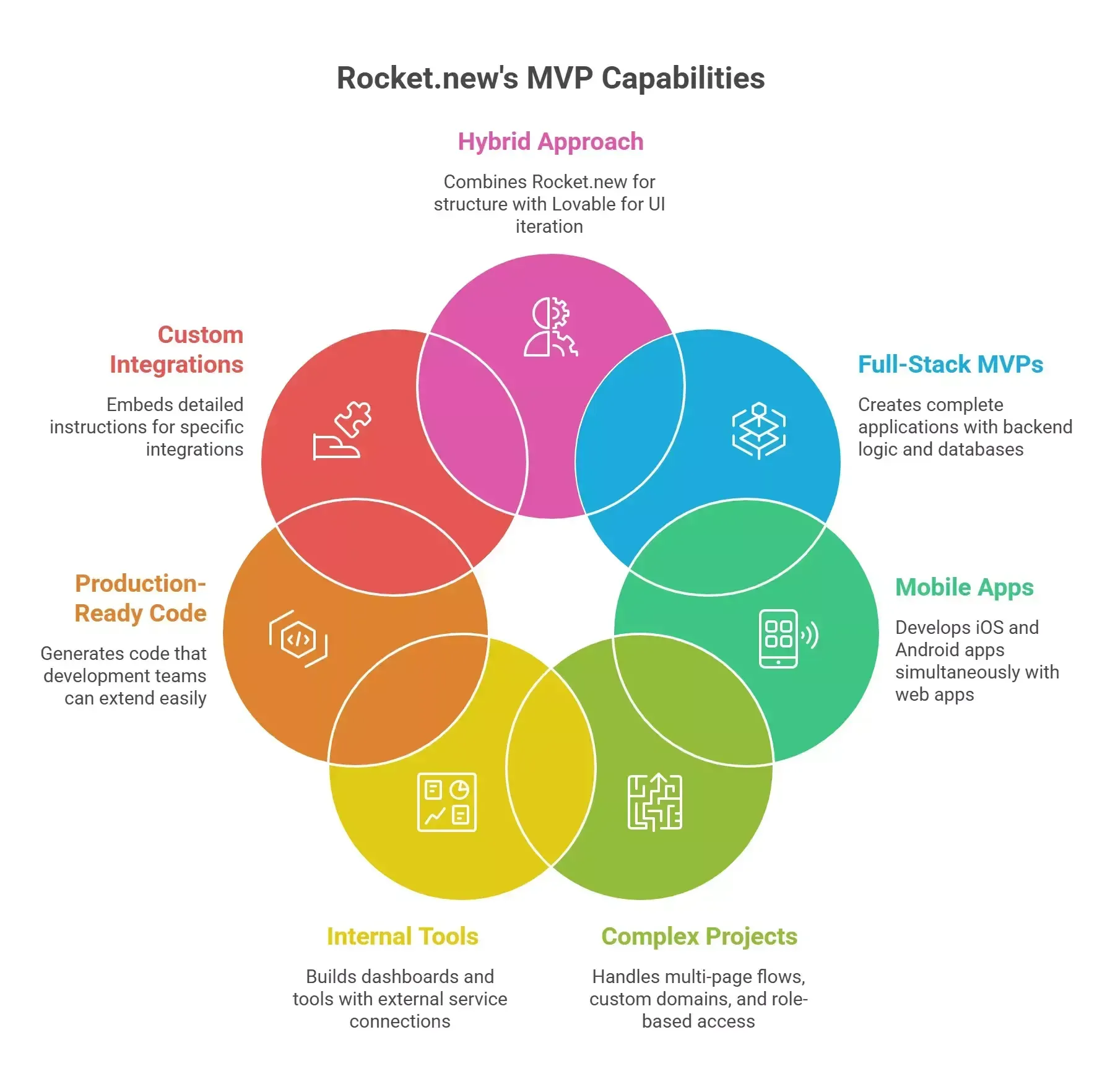
Many developers use a hybrid approach: build the full-stack structure in Rocket.new for production-ready code, then use Lovable for rapid UI iteration on specific screens.
Feature Comparison: Lovable vs. Rocket.new
| Feature | Lovable | Rocket.new |
|---|---|---|
| Natural Language Input | Yes | Yes |
| Web Apps | Yes | Yes |
| Native Mobile Apps | No | Yes |
| Production-Ready Code | Partial | Yes |
| One-Click Deployment | Yes | Yes |
| Custom Domains | Paid plan only | Yes |
| Built-in SEO | No | Yes (Next.js) |
| File Uploads | Limited | Yes |
| User Authentication | Yes | Yes |
| Database Tables | Basic | Advanced |
| Multi-Page Applications | Limited | Yes |
| Visual Editor | Yes | Yes |
| Chat Mode | Yes | Yes |
| Real-Time Previews | No | Yes |
| Code Ownership | GitHub export | Full export |
| Vendor Lock-In Risk | Low | None |
| Free Plan | 5 credits/day, unlimited public projects | Available |
| Starting Paid Plan | $25/month | $25/month |
| Enterprise Plan | Custom pricing | Custom pricing |
| External Services | Via third party | Built in |
| Learning Curve | Low | Moderate |
Pricing Deep Dive: Which Platform Gives Better Value?
Both platforms start paid plans at $25/month. The economics diverge fast at scale.
Lovable pricing:
-
Credit-based model tied to message limits
-
Free plan gives 5 messages per day with unlimited public projects, good for ongoing experimentation
-
Paid plan range: $25 to $100/month, depending on usage
-
Unlimited users per plan, which improves economics for teams with moderate per-person usage
-
Charges can escalate rapidly for projects requiring thousands of iterations
-
Enterprise plan requires custom pricing with dedicated support
Rocket.new pricing:
-
Token-based model with hosting included in the price
-
30 to 50% cheaper at high volume compared to Lovable
-
At the $50/month tier, Rocket.new delivers 10.5 million tokens for power builders, while Lovable offers 200 credits with unlimited users sharing the pool
-
Rocket.new provides 45 to 55% savings over six months on medium-sophistication apps
-
The token model provides more predictable rates for high-volume usage
-
Both platforms require custom enterprise negotiations with dedicated support
Here is where the nuance matters. For teams of 4 to 10 people with moderate usage, Lovable's unlimited-user credits can actually win on economics since there are no per-seat fees. For growing teams of 5 to 15 people doing high-volume building, Rocket.new typically delivers 30 to 50% better value when factoring in total charges. The right answer depends on how intensively your team builds.
Decision Flow: Lovable or Rocket.new?
Not sure which tool fits your situation? Run through these five questions:
-
Do you need a native mobile app? Yes → Rocket.new
-
Is SEO important to your product? Yes → Rocket.new
-
Do you need multi-page flows or a complex backend? Yes → Rocket.new
-
Just building quick prototypes or UI demos? Yes → Lovable works fine
-
Planning to hand off to developers or scale later? Yes → Rocket.new
Technical Debt: The Hidden Cost of Moving Too Fast
Vibe coding feels amazing in week one. The app ships, investors nod, users sign up. Then six months later, adding a single feature takes two weeks and breaks three others.
This happens when AI-generated code is not structured for growth. The architectural decisions made during the build phase can make refactoring genuinely painful later, and in some cases, the cleanup costs more than building it right from the start.
Rocket.new generates clean architecture from the first prompt, which means less rework as you scale and a smoother handoff when a development team steps in.
Code Ownership and Vendor Lock-in
Both platforms let you export your code. The depth of that freedom differs.
| Lovable | Rocket.new | |
|---|---|---|
| Export method | GitHub export | Full code export |
| Stack | React / Tailwind | React / Next.js |
| Vendor lock-in | Low | None |
| Developer handoff | Possible, but architecture can complicate refactoring | Clean, any developer can pick it up immediately |
Rocket.new's Built with Rocket gallery shows exactly how teams have taken that exported code from MVP to a real product.
When to Move Past AI App Builders
Watch for these signs that you have outgrown the tool:
-
Natural language prompts can no longer describe what you need precisely enough
-
You need machine learning, real-time systems, or deeply custom logic
-
You are spending more time fighting the platform than building features
-
Your team is ready for a proper development setup with full control
When that moment comes, Rocket.new makes the transition smoother because the generated code already uses standard frameworks any developer knows.
So, Which One Should You Pick?
Choose Lovable if you:
-
Have a simple, frontend-focused app idea
-
Need quick prototypes for demos or early user feedback
-
Are a solo developer on a tight budget
-
Have a larger team with moderate usage and want to avoid per-seat fees
Choose Rocket.new if you:
-
Want production-ready code and full control from day one
-
Need mobile apps, SEO, or complex backend logic
-
Are building at high volume and want predictable pricing
-
Plan to hand off to developers or scale into a full product
Fast Frontend or Full Product? Here is Your Answer
Lovable is a capable tool for fast frontend demos and early validation. Its unlimited-user plan also makes it genuinely economical for larger teams with moderate usage.
For everything else, including production-ready code, native mobile, built-in SEO, and pricing that does not surprise you at scale, Rocket.new is the stronger platform.
Ready to build? Start with the free plan on either platform to test the water. When you are ready to ship something real, describe your app idea on Rocket.new and see your first version arrive faster than you expect.
Table of contents
- -What is Vibe Coding and Why Do Founders Love It?
- -How Does Lovable App Work?
- -Where Lovable Performs Well?
- -Lovable Works Great, But Only for Simple Use Cases
- -Lovable Pricing: Plan Breakdown
- -Rocket.new: The Full-Stack Launch Pad Built for Real Products
- -By the numbers:
- -What makes it different:
- -Top Features That Make Rocket.new Stand Out
- -Rocket.new Use Cases for Your Startup MVP
- -Feature Comparison: Lovable vs. Rocket.new
- -Pricing Deep Dive: Which Platform Gives Better Value?
- -Decision Flow: Lovable or Rocket.new?
- -Technical Debt: The Hidden Cost of Moving Too Fast
- -Code Ownership and Vendor Lock-in
- -When to Move Past AI App Builders
- -So, Which One Should You Pick?
- -Fast Frontend or Full Product? Here is Your Answer