
Rocket.new transforms competitor G2 reviews into real-time competitive intelligence. It detects patterns in customer complaints across platforms to uncover product weaknesses. Teams use these insights to improve product strategy, sales messaging, and market positioning.
What if your competitors' own customers were telling you exactly where to attack, and your teams were not listening?
Software review sites are now the second most influential source for vendor shortlists, with public review sites being the most consulted information source for 31% of B2B buyers planning a purchase, up from just 13% in 2021.
Every review a competitor's customers leave on G2 Capterra or Trustpilot contains raw competitive intelligence: complaints about software features, frustrations with support quality, pricing objections, and usability gaps. Rocket.new reads those reviews, spots patterns, and tells your teams what they mean.
Why Competitor G2 Reviews Are a Competitive Intelligence Goldmine
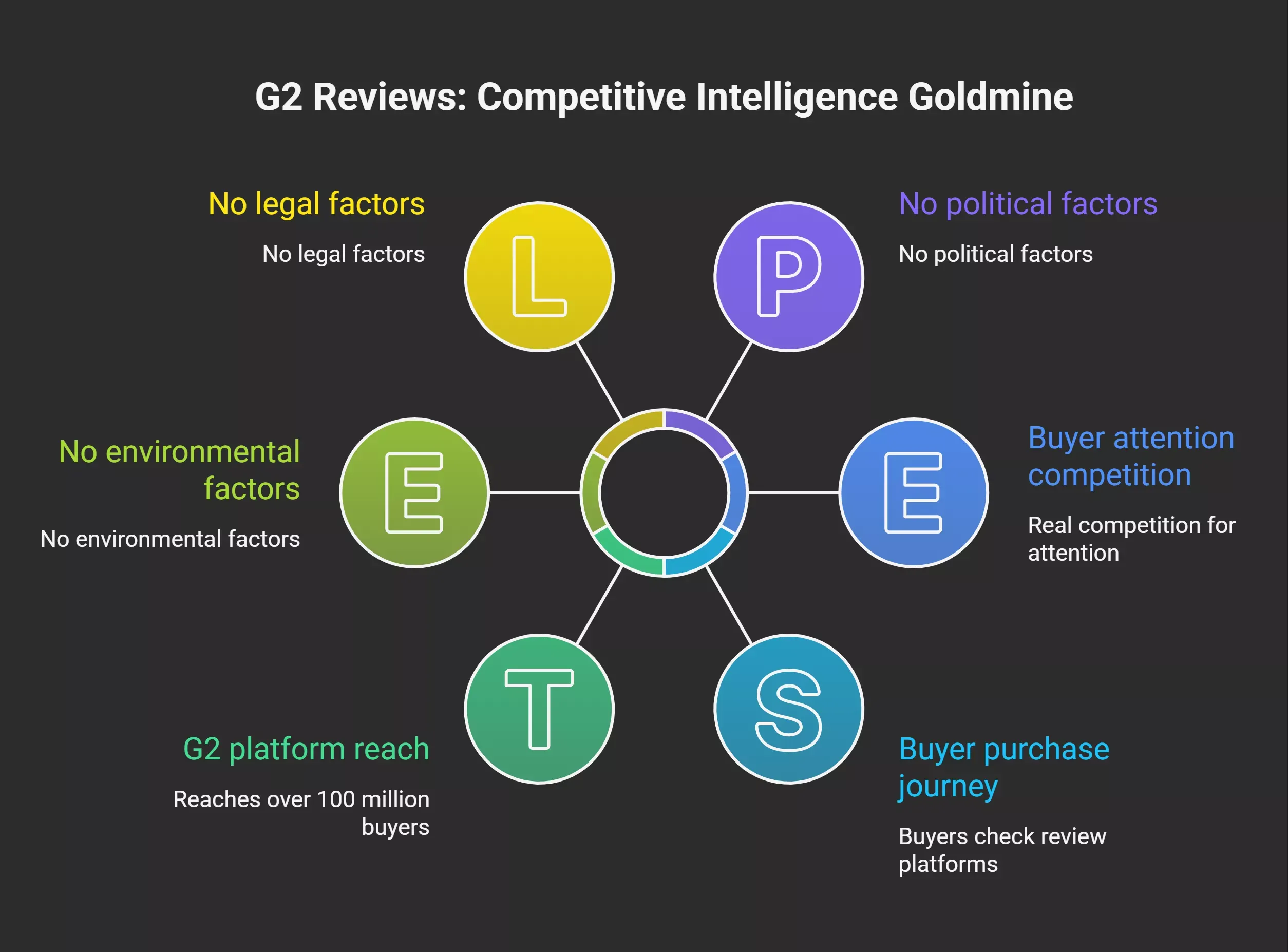
Most teams treat software review sites as a place to collect their own reviews. Fewer use them as competitive intelligence tools for studying competitors. That is a missed opportunity.
- G2 now reaches over 100 million annual software buyers and holds more than 3 million verified reviews across thousands of software categories
- Buyers check review platforms during every stage of the software purchase journey, from awareness through their final decision
- A single detailed negative review on a product profile can dominate the 'most recent' section for weeks, creating a first impression that is hard to counteract, while a negative review on a competitor's profile can serve as competitive intelligence.
- G2's grid reports and category page rankings change quarterly based on review data, often without software vendors noticing
The intelligence is there. The competition for buyer attention on these software review sites is real. The problem?
Most teams are not reading competitor review content systematically, and even fewer teams are turning what they find into product roadmaps, sales playbooks, or product positioning updates.
What Competitor Review Content Reveals
For example, a single G2 review from a frustrated customer contains more competitor insights than a dozen press releases. When you read competitor reviews at scale, patterns emerge in four categories:
- Feature gaps: Customers asking for software features the competitor does not offer. These gaps become your product team's roadmap input, giving you a concrete idea of what to build next.
- Support quality failures: Recurring complaints about slow response times, poor onboarding, or unhelpful documentation. Your sales team can reference these patterns when buyers ask about the competition.
- Pricing friction: Reviewers flagging unexpected price increases, confusing tiers, or poor value relative to cost. This gives product marketing an answer to the question of how to position your solution against competitors on price.
- Usability problems: Real users describing clunky software workflows, steep learning curves, or broken integrations. These point to where your software features and user experience can win.
A 2025 ProductBoard survey found that 68% of product teams collect G2 reviews, but only 19% have a repeatable process for turning review data into strategic decisions. The gap between collecting reviews and acting on them costs teams real revenue and lets competitors fix their weaknesses before you can take advantage.
How Most Teams Monitor Competitor Reviews Today (And Why It Breaks)
Before looking at Rocket.new's approach, it helps to see what the typical review monitoring job looks like, and where it falls apart.
- A product manager opens a competitor's G2 product profile once a quarter and skims recent reviews on the category page
- Someone on the sales team asks in Slack whether anyone has checked what customers say about a rival's new features
- Nobody checks G2 Capterra reviews alongside Trustpilot data because the job takes too long to do manually across multiple review platforms
This approach misses review velocity, sentiment quality trends, and recurring complaint themes. Review content from different review sites never gets combined into a single view.
The result tells a different story than what most teams assume. Your company reacts to competitor weaknesses months after real users have been reporting them. Most teams lose deals because their sales team is working with old reviews and outdated competitor insights.
Manual Approach vs. Continuous Monitoring
| Factor | Manual Quarterly Review | Continuous Monitoring with Intelligence |
|---|---|---|
| Frequency | Every 60 to 90 days | Daily or weekly signals |
| Review platforms covered | Usually one review site | G2 Capterra, Trustpilot, App Store, Google Play |
| Review quality tracked | No sentiment trend data | Sentiment trend chart over time |
| Review count tracked | Rarely measured | Tracked per platform with review volume data |
| Time to insight | Hours of manual research | Automated pattern detection |
| Cross-team value | Trapped in one person's notes | Shared dashboard for all teams |
| Action speed | Weeks between discovery and response | Same-week response possible |
What Rocket.new Intelligence Monitors on Software Review Sites
Rocket.new's Intelligence layer runs continuous competitor monitoring across review sites. Here is what happens inside the Customers tab of each competitor profile.
- Rocket Intelligence aggregates review data from G2, Trustpilot, Google Play, the App Store, and other review platforms into one view
- Each review platform gets its own card showing the current rating, star display, and review count
- A sentiment trend chart plots combined ratings over time, helping teams spot rating drops or recoveries at a glance
- Individual recent reviews are listed in a table showing date, platform, author, review content, and impact classification
- You can toggle specific review platforms on or off to compare sentiment across software review sites or isolate a single platform for deeper analysis
How Rocket Surfaces Competitor Weaknesses from Reviews
The system does not just collect reviews. It identifies signals that indicate where competitors are weakest. Here is the flow:
Rocket Intelligence scores every signal using a formula: Impact multiplied by Urgency multiplied by Differentiation Gap.
For example, a one-star review from an enterprise buyer complaining about data migration failures on a competitor's software platform scores differently than a three-star review mentioning a minor UI annoyance.
The system weights signals so your product teams focus on the weaknesses that deliver the most value for your competitive positioning.
Signals That Indicate Competitor Weaknesses
When monitoring G2 reviews, Rocket watches for specific patterns. For example:
- Sudden rating drops: A competitor's G2 rating falling by half a star in a quarter often correlates with a poorly received software update, pricing change, or support quality decline. A half-star change on G2 measurably affects click-through rates from comparison pages and category page grids.
- Recurring complaints in recent reviews: If the last 20 reviews all mention slow customer support, that is a systemic weakness your sales team can use as specific proof in buyer conversations. Negative reviews about features, support, and pricing each tell your teams something different about where the competition is failing.
- Review volume changes: A drop in new reviews might mean a competitor's review base is aging with old reviews, which hurts their category placement in grid reports and reduces search visibility for buyers researching that category.
- Divergence across review sites: A competitor rated 4.5 on G2 but dropped to 3.2 on Trustpilot tells a different story about enterprise versus SMB customer satisfaction. Company size segments show different quality patterns across review platforms.
- Comparison page mentions: Reviews where customers specifically name your solution or other software alternatives signal direct competition for market share. These mentions on comparison pages affect buyer perception and product positioning.
Turning Competitor Review Weaknesses into Action
Finding weaknesses is only half the job. Rocket.new connects competitive intelligence to execution through its three-product structure. The platform translates identified weaknesses into actionable outputs, including product roadmaps and sales playbooks.
For Product Teams
- When Intelligence surfaces recurring software feature complaints on a competitor's G2 profile, product teams can trigger a Solve task to map the gap. For example, if buyers consistently cite missing API access, that becomes a roadmap item backed by data from real users.
- The Build feature can prioritize developments based on competitor feature gaps identified through G2 review data.
- Product teams track whether a competitor's negative reviews about specific features are increasing or decreasing, signaling whether established competitors are investing in fixes.
For the Sales Team
- Negative review trends give your sales team specific proof of competitor weaknesses to share in competitive deals. For example, three recent reviews citing onboarding failures give a rep a concrete talking point that resonates with buyers.
- When a buyer mentions they are evaluating competing software, your sales team knows which G2 Capterra comparison pages to reference for maximum value.
- Intelligence surfaces the exact review platforms and review sites where a competitor's ratings are weakest, giving the sales team an answer backed by real users instead of guesswork.
For Product Marketing
- Competitor weaknesses map directly to product positioning updates on your own website and product pages. Each weakness creates an idea for differentiated messaging that brings value to the buyer's decision process.
- When G2 Capterra comparison pages update based on review data, product marketing teams can adjust how they position against competitors in Google search results and on your own product profile.
- Review intelligence feeds into competitive positioning documents and battle cards. For example, a competitor's recurring negative reviews about AI features become your product marketing angle for showcasing your software's capabilities.
Reading Grid Reports and Category Data for Competitive Intelligence
G2's grid reports rank software products within each category based on customer satisfaction and market presence. Understanding how these grid reports work gives your company context for what review data means in the competition for buyer attention.
- Grid reports update quarterly. A competitor can move from High Performer to Leader, or drop, based on review volume, review velocity, and rating quality. A High Performer status with a rising review count signals a competitor gaining ground fast.
- Category placement affects search visibility on G2 and Google, changing how many buyers see your competitor's product profile versus yours. Primary category selection determines which comparison pages G2 auto-generates.
- How many categories a competitor lists affects their market presence score in grid reports. Established competitors in the same category compete directly for buyer attention.
- Category strategy matters: being listed in categories where your software features are strongest gives your company better competitive positioning in grid reports.
- Regularly updated competitive analysis documents are essential for product managers to adapt to changing market conditions and competitor actions.
What Review Count and Ratings Tell You About Competitor Strategy
Review count and ratings are not vanity metrics. They directly affect category strategy and buyer perception.
- Competitors with high review counts but declining ratings are losing customers' trust while maintaining visibility. Their strategy may focus on driving new reviews to dilute negative sentiment.
- A competitor whose review count grows rapidly but whose ratings stay flat is collecting volume without improving its software features or customer experience. That pattern signals an opportunity for your teams.
Using Review Intelligence to Inform Strategy and Revenue
Review-based competitive intelligence feeds into strategic decisions across your company. Here are four ways teams use this data, each with a specific example:
- Market research for new software features: For example, when multiple competitors share the same weakness in a category, that gap is white space. Product teams use review data from real users to justify new features backed by market trends and specific proof.
- Product positioning adjustments: If negative reviews cluster around a capability your software handles well, product marketing updates product pages and comparison pages. For example, a competitor losing ratings on onboarding quality becomes your positioning advantage.
- Revenue protection: When Intelligence flags that a competitor's ratings are improving with new reviews praising new features, your teams adjust category strategy before deals slip. Market trends in review sentiment predict competitive shifts before they show up in revenue.
- Market share signals: Review volume and review velocity across review platforms give proxy indicators for market share changes. Software vendors with a declining review base and old reviews tend to be losing ground to competitors with a stronger market presence.
How Review Monitoring Connects to the Broader Intelligence Loop
This guide covers how review data works with other competitive intelligence signals across the platform.
- A competitor's G2 rating drops at the same time they post new engineering job openings. That pattern suggests they know about the problem and are hiring to solve it.
- A competitor changes their own website pricing page the same week negative reviews about pricing surface on G2. Your sales team can use that correlation.
- A competitor's social media spikes with launch announcements while their review sentiment stays flat. That disconnect between marketing and buyer reality is intelligence your teams can act on.
Rocket.new Intelligence ties all signal categories together in one competitor profile, so teams can cross-reference customer reviews with website changes, hiring data, and social activity. For example, a signal spike combined with new reviews and a website update often indicates a coordinated launch that your company should respond to with strategic decisions of its own.
Cross-Signal Patterns That Reveal Competitor Strategy
When you combine review data with other Intelligence signals, strategy patterns become visible.
- Customers leaving negative reviews about features while the competitor is hiring senior engineers suggests the competitor has recognized the gap. Your strategy should accelerate shipping the equivalent features before customers see improvement in competitor ratings.
- Customers praising a competitor's new features while their review count jumps tells you the competition shipped something that resonates. Your product teams need to adjust strategy accordingly.
- When customers on G2 mention your product by name as an alternative, that signal reaches your sales team directly through Intelligence, helping reps prepare for competitive conversations with buyers.
What People Are Saying About Review-Based Competitive Intelligence
"With Klue's Auto Insights, we're delivering the specific intel reps need to handle objections in real deals, right when they need it. The Win/Loss Stories and What Prospects Are Saying auto insights have become our gut check." - Mara Konrad, Competitive Intelligence Lead at Greenhouse Software, via Klue
Konrad's experience reflects a broader market trend. Competitive intelligence tools are moving from quarterly market research projects to continuous feedback loops. The teams that monitor competitor reviews weekly catch weakness signals that quarterly teams miss entirely. When your competitors' customers are telling you what is broken, ignoring that data leaves revenue on the table.
How Rocket.new Handles Competitive Intelligence from G2 Reviews
Rocket.new analyzes competitor reviews on G2 by integrating them into a real-time competitive intelligence loop. The platform uses continuous monitoring and AI-powered sentiment analysis to identify common pros and cons in competitor reviews, flagging the patterns that matter while filtering noise.
Here is what Rocket.new brings to this job:
- Vibe solutioning platform: Solve for market research, Build for execution, and Intelligence for monitoring, all sharing context
- 25,000+ templates library, free to use: Pre-built templates for competitive analysis dashboards, battle cards, and other tools your product teams need
- Saves up to 80% tokens: Rocket's architecture cuts token usage, reducing cost for competitive intelligence workflows
- Supports Flutter (mobile) and Next.js (web): Build competitive dashboards, internal software tools, or customer-facing product pages in either stack
- Collaboration features built in: Product teams, sales teams, and marketing share the same Intelligence dashboard
- Three products, one platform: Solve, Build, and Intelligence: Research a competitor's weakness, build your response, and keep monitoring without leaving one system
Use Cases for G2 Review Intelligence on Rocket.new
A thorough competitive analysis provides a holistic overview of the competitor landscape, which can be used to improve and optimize products.
- Competitor weakness tracker: Set up Intelligence to monitor your top competitors across G2 and other review sites. When a competitor's rating drops or new complaint patterns appear in recent reviews, Rocket flags it. Your product marketing team turns the findings into updated competitive positioning the same week.
- Sales battle card automation: Intelligence feeds competitor review themes into your workspace. Use Solve to generate a structured competitive teardown mapping competitor positioning and weaknesses, then Build an internal tool that surfaces the right battle card language to your sales team based on which competitor a buyer mentions.
- Product roadmap from competitor failures: When G2 reviews consistently cite software features your competitor lacks, product teams use that intelligence as market validation. For example, the Build feature can prioritize developments based on competitor feature gaps identified through review data from real users.
- Category page performance monitor: Track how competitor review velocity and ratings affect their position in G2 grid reports. When a competitor slips in category placement due to declining review quality, your company pushes for new reviews to capture the market presence advantage.
Wrapping Up: From Competitor Reviews to Competitive Advantage
How does Rocket.new read a competitor's G2 reviews and tell you what they reveal about weaknesses?
It monitors review platforms continuously, tracks sentiment over time, flags complaint patterns, and connects that competitive intelligence to your product, sales, and marketing workflows. The teams that win know exactly where the competition is failing, as confirmed by what real users report, and respond faster than anyone else in the market.
Start turning competitor reviews into a winning strategy with Rocket.new today!
Table of contents
- -Why Competitor G2 Reviews Are a Competitive Intelligence Goldmine
- -What Competitor Review Content Reveals
- -How Most Teams Monitor Competitor Reviews Today (And Why It Breaks)
- -Manual Approach vs. Continuous Monitoring
- -What Rocket.new Intelligence Monitors on Software Review Sites
- -How Rocket Surfaces Competitor Weaknesses from Reviews
- -Signals That Indicate Competitor Weaknesses
- -Turning Competitor Review Weaknesses into Action
- -For Product Teams
- -For the Sales Team
- -For Product Marketing
- -Reading Grid Reports and Category Data for Competitive Intelligence
- -What Review Count and Ratings Tell You About Competitor Strategy
- -Using Review Intelligence to Inform Strategy and Revenue
- -How Review Monitoring Connects to the Broader Intelligence Loop
- -Cross-Signal Patterns That Reveal Competitor Strategy
- -What People Are Saying About Review-Based Competitive Intelligence
- -How Rocket.new Handles Competitive Intelligence from G2 Reviews
- -Use Cases for G2 Review Intelligence on Rocket.new
- -Wrapping Up: From Competitor Reviews to Competitive Advantage