
Rocket.new continuously scans competitor websites, reviews, hiring activity, ads, and social signals in one AI-powered intelligence workflow. Instead of tracking isolated updates, it correlates patterns across platforms to reveal strategic moves, market shifts, and emerging threats faster. Teams can move directly from competitor insights into building and shipping responses using Solve, Build, and Intelligence in one system.
Why Most Companies Miss Competitor Patterns
What happens when a competitor changes pricing on Monday, posts new job postings on Tuesday, and updates landing pages on Friday?
Most companies catch each update in isolation using separate tools and miss the connection. The competitive intelligence market hit $0.87 billion in 2026 because businesses realize scattered signals from multiple platforms cost real money.
-
Most companies use four or more apps to track competitors, and none share context
-
Pricing changes and product updates show up in one dashboard, hiring activity in another
-
The team that spots competitor movement rarely cross-references it
-
By the time someone builds a background for the call, the market has shifted
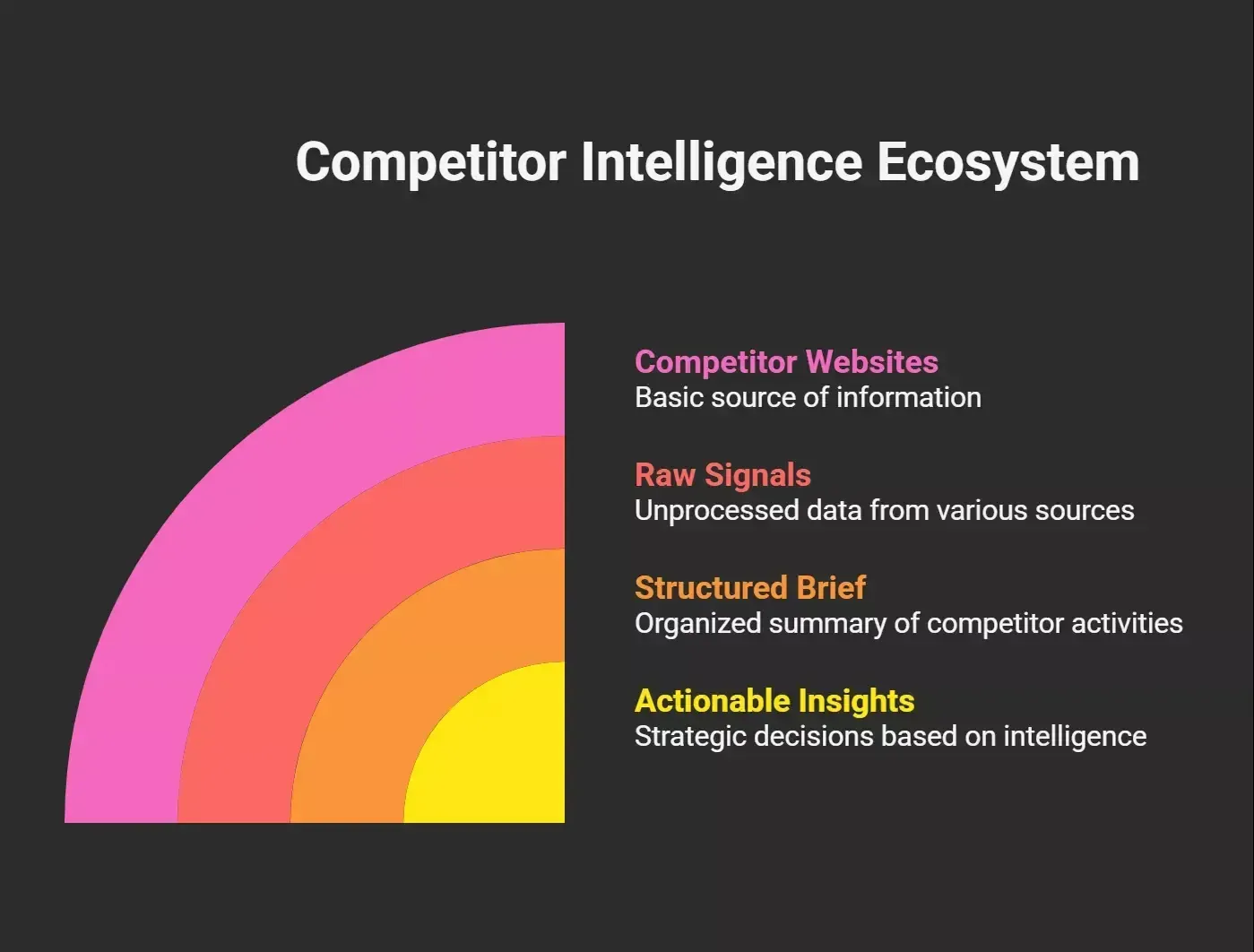 The default workflow: Open a competitor tracking app, copy information into a spreadsheet, repeat for the next source. That messy process is the default for most businesses entering a conversation about product strategy. At that point, the data is stale.
Scattered Signals and What They Miss
Competitor analysis falls apart when signals live in different places across a market. A pricing change on a competitor's websites might match hiring activity on LinkedIn, new features heading to their web apps, and reviews on G2.
Over time, they form a pattern about competitor movement that most companies miss.
-
Job postings for specific roles (three mobile apps engineers in two weeks) show where a company plans to build
-
LinkedIn activity from founders reveals market direction faster, giving users speed advantages in product strategy
-
G2 reviews and comments carry customer emotion that, combined with product updates, form a signal cluster heading toward one direction
-
Pricing changes combined with updated landing pages and comments on social posts show a market repositioning play
| Signal Type | Source | Alone | In a Cluster |
|---|---|---|---|
| Pricing changes | Websites, pages | Revenue pressure | Market repositioning |
| Job postings | LinkedIn, career pages | Headcount growth | New product direction |
| Product updates | Changelogs, app stores | Feature releases | Strategic pivot |
| Reviews, comments | G2, Reddit | Customer sentiment | Competitive vulnerability |
| Hiring activity | Job boards, LinkedIn | Scalability investment | New capability |
Signals get scored by Impact, Urgency, and Differentiation Gap. This is where competitor tracking becomes competitive intelligence. Contextual synthesis connects market announcements to historical records, finding patterns that no longer hide when you run them through one system.
What People are Saying
"In competitive intelligence, people who advocate for more data simply have no clue what real intelligence looks like." - Dr. Ben Gilad, President, Academy of Competitive Intelligence
-
That observation lands hard for any team drowning in dashboards, yet unable to write a clear competitor comparison
-
The industry has long treated more information as the answer, when the real problem is understanding what combined market signals mean across multiple platforms faster in any industry
How Rocket.new Reads 15 Competitor Sources in One AI Platform
Rocket.new Intelligence connects competitive signals with product building workflows. This AI app reads websites, social posts, job boards, reviews, pages, features listings, and news updates. Scattered signals become structured understanding that helps businesses make faster market decisions.
Step 1: Continuous Scanning Across All Sources
Intelligence scans external sources on your behalf and delivers signals, meaning meaningful changes, new developments, and emerging patterns, directly to a persistent dashboard. The underlying monitoring runs continuously; the frequency setting only controls how often Rocket summarizes and delivers findings to you.
For every competitor you add, it monitors all of these simultaneously: websites including pricing pages, feature lists, landing pages, and product updates; social and news including press releases, product announcements, and social media activity; reviews including customer sentiment on review platforms and app stores; advertising including changes in competitor ad copy, positioning, and campaign strategy; and job postings, people movements, and press.
Step 2: Signal Strength Evaluation
Not every detected change is equal. Every signal in your Intelligence dashboard includes a strength indicator: Critical, High, Medium, or Low.
-
Rocket determines that strength by evaluating four factors simultaneously. Scope of change: How much of the source changed?
-
A full pricing page restructure ranks higher than a single price adjustment. Strategic relevance: Does the change affect positioning, pricing, or capabilities?
-
Strategic moves rank higher than operational updates. Deviation from pattern: Is this change unusual for this source?
-
A competitor that never changes pricing suddenly restructuring their tiers is a high-strength signal. Cross-source correlation: Did related changes happen across multiple sources?
A pricing change plus a new blog post plus updated ad copy about the same topic amplify the signal.
That last factor, cross-source correlation, is the core of how Rocket reads meaning from multiple inputs at once. It does not treat each data point in isolation; it looks for signals that reinforce each other across sources.
Step 3: Pattern Recognition Across Competitors and Time
Individual signals are data points. Patterns are insights. This is where reading multiple competitors simultaneously becomes powerful. Rocket recognizes three types of combined patterns.
Escalation is when small signals from one competitor build toward a bigger move. A competitor publishes a blog post about AI, then posts five new AI/ML engineering roles, then adds an "AI" badge to their enterprise tier. Each signal alone is low or medium strength, but together they form a high-confidence prediction of a major AI feature push.
Convergence is when multiple competitors make similar moves at the same time. When several competitors adjust pricing within a short window, it usually signals a market-wide repricing driven by shared cost pressures or a collective bet on higher willingness to pay.
Divergence is when one competitor breaks from the group. If three of your four main competitors are raising prices and the fourth drops theirs, the outlier signal is often the most important one. It may indicate a different strategic bet, a struggle for market share, or a new funding round enabling aggressive growth pricing.
Step 4: Noise Filtering
Before any of this reaches your dashboard, Rocket filters out the irrelevant. Cosmetic updates like button color changes, routine weekly blog posts, minor copy edits, seasonal promotions, and junior staff hires are classified as noise because they rarely signal strategic shifts. Rocket continuously filters out noise so you only see what matters.
What makes Rocket.new different is shared context. Market research, planning, building workflows, and launch tracking stay inside one project.
A competitor movement in Intelligence flows into Solve for competitor analysis, then into Build, where your team quickly ships web apps, mobile apps, or internal tools with an understanding of company requirements.
Key features:
-
Vibe solutioning: Solve, Build, and Intelligence on one system
-
25,000+ templates free to use for mobile apps, internal tools, dashboards, and more
-
Supports Flutter for mobile apps and Next.js for web apps
-
Collaboration is built in, so your team can start building faster
-
3 Products, one system: Solve, Build, and Intelligence
Use Cases
Use cases connecting competitor tracking to this AI app:
-
A founder spots a company's pricing and hiring activity, runs Solve for market research, and uses Build to quickly ship updated pages before the competitor's idea lands
-
A product strategy team catches a signal cluster from reviews and job postings, then starts a vibe solutioning workflow to build and code the response on Flutter with the scalability the project needs
-
A company sets up brief tracking of competitor movement across websites, so founders and their team maintain an understanding of which code changes go live and where to start building their next idea
Turning Competitor Patterns into Your Next Build
Rocket reads across many competitors at once by running continuous automated scans across every source type for every competitor in your list.
It knows what the combined pattern means by correlating signals across sources and across competitors, amplifying signals that reinforce each other, surfacing escalation sequences, flagging market-wide convergence, and spotlighting outliers who diverge.
The Intelligence dashboard's trend view is specifically designed to surface these patterns, and checking it weekly reveals correlations that individual signals do not.
The question of how Rocket.new reads 15 competitor platforms at once and knows what the combined pattern means comes down to this: One AI app that watches, interprets, and connects market signals so your team can build the right thing. You start each conversation with an understanding of what competitors did, write your prompt, and ship code from the same vibe workflow.
Track competitor signals, uncover hidden market patterns, and ship your response faster with Rocket.new Intelligence.
Table of contents
- -Why Most Companies Miss Competitor Patterns
- -Scattered Signals and What They Miss
- -What People are Saying
- -How Rocket.new Reads 15 Competitor Sources in One AI Platform
- -Step 1: Continuous Scanning Across All Sources
- -Step 2: Signal Strength Evaluation
- -Step 3: Pattern Recognition Across Competitors and Time
- -Step 4: Noise Filtering
- -Use Cases
- -Turning Competitor Patterns into Your Next Build