
Rocket.new connects competitive intelligence, product strategy, and product building into one shared AI platform for every business function. Sales, marketing, product, and strategy teams work from the same live competitor signals instead of disconnected dashboards and stale reports. The result is faster execution, better alignment, smarter product decisions, and continuous competitive advantage.
Why Do Most Businesses Still Operate on Scattered Data?
What happens when the selling group, the marketing group, the product team, and strategy leads all track competitors using separate tools? They end up with four versions of the same reality, none of them complete.
-
76% year-over-year increase in AI adoption within competitive intelligence groups, according to Crayon's 2025 State of CI report
-
60% of those groups now use AI daily for CI work
-
The average business still rates itself 3.8 out of 10 for competitive readiness
That gap between tool adoption and readiness tells a clear story. Most businesses buy separate tools for data collection, research, and competitor tracking, then spend hours piecing together what it all means. Information sits in different dashboards, gets interpreted differently by each department, and nobody shares the same version of what a competitor did last week.
The Real Cost of Using Separate Tools for Tracking Competitors
Why Fragmented Approaches Slow Down Building
Most teams treat competitor tracking as something that happens in pockets. The selling team watches pricing changes. Marketers track such content gaps. The product team reads feature announcements. Strategy reviews quarterly reports. Each group pulls from its own set of tools, and none of those tools talk to each other.
-
A change on the competitor's pricing page means one thing to sellers and something else to the team building the product
-
Job postings and hiring signals tell a story about where a competitor operates next, but that information rarely reaches the people doing the actual building
-
Static reports go stale within weeks, and most businesses do not refresh them fast enough
So what happens? Groups duplicate work. They spend hours on manual effort pulling the same competitor information into dashboards. When they sit in a room together, they argue about whose version is correct. The company loses time it could spend building.
What Gets Lost Without Shared Context
When findings live in scattered systems, context disappears between handoffs. A strategic insight from market research never reaches the sales process. The product team starts building without knowing what the competitor just shipped.
-
Most tools store data in isolation, so each team builds its own mental model
-
No one sees the full arc of what a competitor is doing across hiring, pricing, product launches, and messaging at the same time
-
The thinking behind a decision in one department stays invisible to every other department
How Findings Reach Sellers Across the Business
Turning Competitor Signals into Better Conversations
The sales team lives in conversations. They need specific, current information about what a competitor charges, what features they promote, and what weaknesses buyers mention. Most companies cobble this together from memory, outdated battlecards, and quick web searches.
-
Sellers spend 8 to 12 hours per month on individual competitor work, according to Arise GTM's 2026 CI automation study
-
Businesses that use conversational tools for competitive tracking report an 82% lift in win rates, per Crayon's 2025 report
-
A structured pre-call intelligence brief covering competitive positioning and recommended messaging cuts prep time and sharpens the pitch
So when sellers have access to ongoing CI, they stop guessing. They see what the competitor changed last Tuesday and what messaging shifted on their homepage. That data flows directly into deal prep. Building proposals with current findings wins more business.
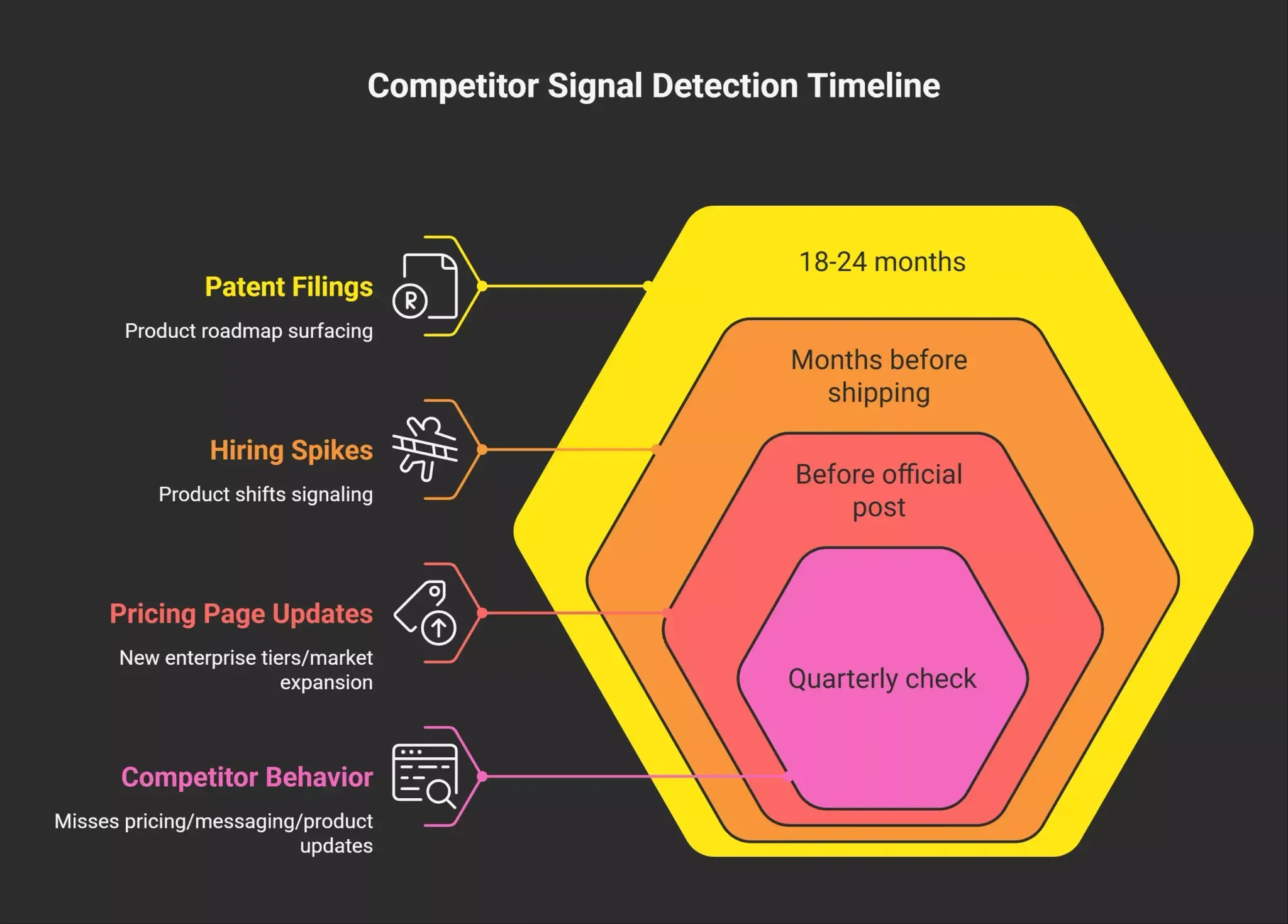
What Sellers Actually Need
-
Real-time pricing changes from every competitor, not quarterly summaries
-
Hiring signals that reveal which market segments a competitor plans to enter
-
Competitor features mapped against what the business is building
-
Findings that connect to the rest of the organization, not siloed dashboards
How Competitive Intelligence Shapes Building Campaigns
From Guesswork to Data-Backed Building of Campaigns
Marketers track competitor ad spend, content gaps, and messaging shifts. When this work sits in a separate platform from the product roadmap, campaigns end up misaligned with what the business actually needs.
-
Marketers can launch more targeted campaigns by tracking competitor ad spend and content gaps in real time
-
Competitor messaging shifts reveal positioning changes that should reshape your own go-to-market approach
-
When the product team ships a new feature, the business needs to know immediately how it stacks against what competitors offer
Most businesses solve this by scheduling weekly sync meetings. By the time the campaign group hears about a competitor's move through a meeting, the window to respond has already narrowed.
What Campaign Groups Get from Shared Context
-
Content gaps identified through competitor monitoring, not manual scanning
-
Brand guidelines that reflect actual market positioning, not assumptions
-
Campaign timing informed by competitor product launches and pricing changes
-
Data and messaging that matches what sellers hear from buyers
How the Product Team Uses Competitive Intelligence While Building Apps
Building What Users Want, Not What a Brief Assumed
The product team makes the most expensive decisions in any business: what to build next. For most businesses, that decision still relies on internal conviction more than external data.
-
Product managers receive structured insights on market gaps and customer pain points, which leads to faster decision-making about what is worth building
-
Continuous competitive intelligence after launch lets the product team adjust what they are building based on what competitors ship
-
The connection between what the initial review showed before building and what actually happened after launch stays visible inside the platform
Vibe coding made code generation faster. A product team can go from idea to building a prototype in hours. But faster execution does not fix the problem of building the wrong thing. The idea of what is worth building still comes from disconnected processes.
What the Product Team Needs While Building
-
Competitor feature timelines mapped against their own building roadmap
-
User data combined with external signals that inform what they are building next
-
Findings that feed directly into the product-building process, not a separate document
-
Continuous learning after launch, not a one-time phase
How Strategy Gets Powered by Continuous Data and Insights
Connecting Evidence to Decisions at the Leadership Level
Strategy leads synthesize everything: where the market is heading, how each competitor operates, what pricing changes signal about industry direction, and where the next opportunity sits. The team typically works from static reports that are outdated by the time they reach a slide deck.
-
AI-powered tools now generate product strategy documents that include pricing approaches, market positioning, and go-to-market recommendations
-
AI-powered platforms continuously monitor competitors' digital footprints, helping teams see live views instead of quarterly snapshots
-
Organizations can save up to 80% of the time typically spent on manual analysis by using automated approaches
What Strategy Does a Unified System Need
-
A single platform where competitor tracking, product direction, and market research converge
-
Insights connected to execution, not isolated in a strategy document
When strategy works from the same source as everyone else, decisions align faster. The gap between "we decided" and "we shipped" shrinks because the data stays connected to what users are building.
How Shared Context Changes Everything
From Scattered Systems to One System
| Capability | Scattered Approach | Shared Context Approach |
|---|---|---|
| Pricing tracking | Sellers check manually | Automated alerts reach all users simultaneously |
| Competitor hiring signals | Strategy reads job postings quarterly | The system tracks hiring and connects it to building decisions |
| Feature launch response | Product hears about it in a meeting | Flags the change, links it to your building roadmap |
| Workflows and processes | Each department builds its own | One AI platform connects solving, building, and tracking |
| Campaign alignment | Guessing at positioning | Messaging reflects real-time competitor movement |
| Context and findings | Separate logins, separate dashboards | Unified workspace where findings feed into building directly |
When users work from a shared context, they experience less confusion, stronger direction, and better alignment. The time between spotting a market shift and acting on it drops from weeks to hours.
The Flow from Data to Execution
This loop is what separates a unified system from a collection of tools. Findings feed execution. Execution produces new signals. Those signals feed back into the platform. Nothing resets. Nothing gets lost.
What the Community is Saying
The frustration with disconnected data and scattered tools is not new. More people are naming it directly.
"Your AI project isn't stalled because of the model. It's stalled because nobody agreed on the data foundation." - Gabriel Laliberte on LinkedIn
-
This matches what most groups experience: the tools work individually, but without a shared data foundation, every group builds on different assumptions.
-
A unified data architecture is essential for organizations to transform fragmented data into a single, continuous narrative of business performance, enabling better decision-making and operational efficiency.
How Rocket.new Delivers Competitive Intelligence Across Every Function from One Source
Rocket.new is the world's first vibe solutioning platform, built around a specific idea: solving, building, and competitor tracking with intelligence belong in one system. Most platforms start with the build. Rocket starts at the question, "Is this idea worth building?" and stays with you through launch, competitor monitoring, and continuous learning.
The AI platform connects context and decisions in one place. When sellers pull competitor pricing, they see the same signals your product team uses to prioritize what they are building. When your strategy leads review market shifts, those insights link directly to the campaigns being run. One shared context, compounding over time.
-
Vibe solutioning platform: Rocket connects research directly to execution, which is what vibe solutioning means. The thinking and the building happen in the same place
-
25,000+ templates library, free to use: Start from a template that matches your use case, and Rocket adapts it to your context, brand, stack, and goals
-
Supports Flutter for mobile apps and Next.js for web apps: Build production-ready web apps, mobile apps, and internal tools inside one AI platform
-
Collaboration features built in: Unlimited members across all plans, with real-time collaboration on projects, building, and dashboards
-
Three products, one platform: Solve, Build, and Intelligence: Solve handles market research and product strategy. Build turns decisions into production-ready apps. The tracking layer monitors every platform a competitor operates on
Where Rocket Fits for Each Use Case
-
Solo founders use Solve to validate an idea, jump to Build for building a working prototype, and activate tracking to watch competitors. Users across 180 countries, from solo founders to enterprise groups, rely on Rocket for building everything from dashboards to customer-facing apps
-
Product teams use Solve to create documented PRDs backed by real findings, Build to start building features, and the tracking layer to monitor competitor releases and pricing changes
-
GTM leaders pull real-time competitive data from Rocket to handle objections and prepare for calls with current findings, not stale battlecards. Rocket replaces separate tools for the business
-
Enterprise users access the AI platform for organization-wide competitive intelligence, helping teams across departments work from one shared context while building their next product
Rocket is backed by Salesforce Ventures, Accel, and Together Fund. Over 1.5 million users across 180 countries have used the platform. The full arc of vibe solutioning covers everything from the first question about what to build, through building it, through understanding how what you built performs. Salesforce Ventures and Together Fund both backed the business because of this approach to connecting findings with execution.
Rocket offers three tiers: $25/month for Build, $250/month for Solve plus Build, and $350/month for the complete Solve, Build, and tracking package. Every plan includes unlimited members.
How Rocket Works
-
You describe the problem or the idea you want to solve
-
Rocket analyzes the competitive space and returns a clear recommendation about what is worth building
-
You start building from that recommendation inside the same AI platform, with all context already loaded
-
After launch, the tracking layer watches competitor websites, pricing changes, hiring signals, and market movements continuously
-
Daily briefs synthesize what changed, connecting individual signals into a single picture for all users
This is the first vibe solutioning platform where solving, product building, and intelligence share a shared context. Nothing resets between sessions. Solve feeds Build, and the tracking sharpens every decision.
The Shift from Vibe Coding to Vibe Solutioning
Why Code Generation Alone Does Not Solve Real Problems
Vibe coding made building faster. AI coding assistants turned the ability to write code from a specialized skill into something any company can access. The CI tools market is projected to reach $1.85 billion by 2035, growing at 13% annually, because most businesses now recognize that building is only one part of the problem.
-
Most tools that focus on vibe coding optimize for speed, but the actual bottleneck is knowing what is worth building
-
Vibe coding platforms start with code generation. Rocket starts with the idea and carries context through the entire lifecycle of building a product
This is where Rocket stands apart as the first vibe solution platform. Vibe solutioning connects the thinking and the execution. The idea shapes what you solve. What you solve shapes what you start building. Vibe coding only covers one step. Vibe solutioning covers the full arc.
Vibe Coding vs. Vibe Solutioning
-
Vibe coding answers "how do I build this?" with faster code generation
-
Vibe solutioning answers "what should I build, and how do I stay competitive after launch?"
-
Rocket covers the full arc: solving, building, in one system
The distinction matters for any company building web apps, mobile apps, or internal tools. Users across 180 countries use Rocket because it solves real problems at every stage of building.
Turning Findings into a Competitive Advantage
What Happens When Execution Matches Research
When users work from a shared context, decisions compound. Product strategy does not sit in a PDF nobody reopens. It lives inside the same place where the team gets the product built, where sellers pull deal prep, and where strategy reviews evidence on market shifts.
-
Users of dedicated CI platforms reported a 79% increase in effectiveness, per Crayon's 2025 report
-
Businesses with dedicated CI programs outperform stock market averages, according to Valona's Global report
Rocket offers something most tools do not: the connection between knowing and doing. Solving the feed building. Building feeds new data and insights. Everything stays connected.
This is what continuous competitive intelligence looks like when it works. Not a dashboard you check once a month, but a living system that gives users current insights and signals to act on. For any company building apps or internal tools, this is how outcomes improve.
Findings That Compound, Not Findings That Expire
How does Rocket.new's intelligence serve sales, marketing, product, and strategy from a single shared source?
By keeping every signal, every decision, and every build connected inside one platform. For most teams, this replaces the patchwork of separate tools, static reports, and disconnected research that slows real problems from getting solved.
Rocket makes CI a living input into everything a business does, not a one-time exercise that expires before anyone acts on it. Stop working from scattered competitor data and start building with shared intelligence inside Rocket.new.
Table of contents
- -Why Do Most Businesses Still Operate on Scattered Data?
- -The Real Cost of Using Separate Tools for Tracking Competitors
- -Why Fragmented Approaches Slow Down Building
- -What Gets Lost Without Shared Context
- -How Findings Reach Sellers Across the Business
- -Turning Competitor Signals into Better Conversations
- -What Sellers Actually Need
- -How Competitive Intelligence Shapes Building Campaigns
- -From Guesswork to Data-Backed Building of Campaigns
- -What Campaign Groups Get from Shared Context
- -How the Product Team Uses Competitive Intelligence While Building Apps
- -Building What Users Want, Not What a Brief Assumed
- -What the Product Team Needs While Building
- -How Strategy Gets Powered by Continuous Data and Insights
- -Connecting Evidence to Decisions at the Leadership Level
- -What Strategy Does a Unified System Need
- -How Shared Context Changes Everything
- -From Scattered Systems to One System
- -The Flow from Data to Execution
- -What the Community is Saying
- -How Rocket.new Delivers Competitive Intelligence Across Every Function from One Source
- -Where Rocket Fits for Each Use Case
- -How Rocket Works
- -The Shift from Vibe Coding to Vibe Solutioning
- -Why Code Generation Alone Does Not Solve Real Problems
- -Vibe Coding vs. Vibe Solutioning
- -Turning Findings into a Competitive Advantage
- -What Happens When Execution Matches Research
- -Findings That Compound, Not Findings That Expire