
Rocket.new helps businesses detect competitor intent before official announcements by analyzing hiring patterns, pricing changes, product updates, and customer sentiment. Instead of reactive competitor analysis, teams get predictive intelligence powered by connected market signals and AI-driven pattern recognition. With continuous monitoring across multiple public sources, Rocket.new turns scattered competitive data into actionable product and growth decisions.
Why Most Companies Miss What Competitors Are Building
What if competitors told you their plans six months before any press release?
They already do. The global competitive intelligence tools market is projected to grow from $482.36 million in 2024 to $1.85 billion by 2035, indicating a rising demand for AI-driven insights in product development. Most companies watch the wrong thing. That growth reflects a clear shift: businesses that track competitors through raw signals move faster than those waiting for announcements.
The Problem With Reactive Competitor Analysis
Most companies run competitor analysis the same way:
-
Wait for a competitor to launch an update or press release
-
Scramble to adjust
-
Lose six months of market advantage
The difference between reactive and proactive competitive intelligence comes down to what you watch. Reactive teams read announcements. Proactive teams read patterns in hiring activity, job postings, and what customers say on review sites. Competitive research done right spots intent, not just output.
Signals That Reveal Intent Before Public Moves
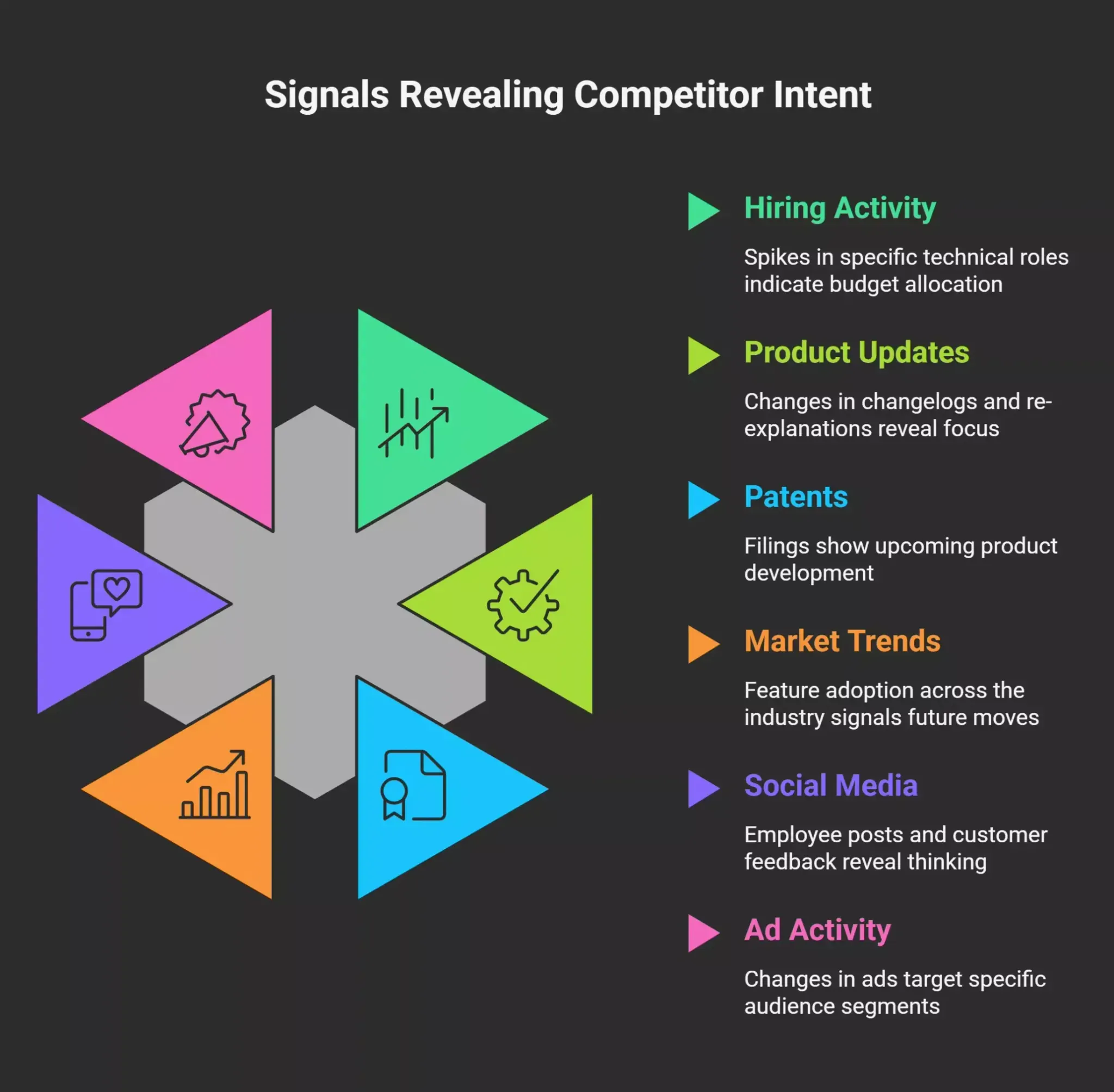
The strongest competitive analysis programs track the full system of competitors, including direct, indirect, and emerging players operating in the same space. Identifying these signals early lets your team make strategic decisions weeks ahead.
Hiring Activity as Early Indicators
-
Hiring spikes in specific technical areas show where the budget is going. Ten machine learning roles, while public messaging still says "analytics," tell you the roadmap.
-
Monitoring open positions by department reveals where competitors invest resources, indicating potential market entries.
Product Updates and Market Trends
-
Product updates on changelogs, re-explained through the lens of hiring patterns, reveal what competitors focus on next.
-
Companies file patents during active development, and a filing shows what is being built months before it ships.
-
Market trends in feature adoption across your industry signal where competitors will move.
Social Media and What Customers Are Saying
-
Social media posts from employees leak thinking about product direction.
-
Customer feedback on G2 or Capterra shows where competitors lose ground and where pricing changes follow.
-
Ad activity and messaging changes across multiple platforms reveal which audience segments competitors target before full campaign rollout.
How Raw Signals Become Strategic Context
Scattered signals on their own tell you little. A single new feature on a changelog is noise. A hiring surge combined with a shift in social media messaging and pricing changes is a pattern.
| Signal Type | What It Shows | Where to Find It |
|---|---|---|
| Hiring activity | Budget allocation and product direction | LinkedIn, Indeed, careers pages |
| Product updates | Active development priorities | Changelogs, GitHub, app stores |
| Pricing changes | New segment targeting | Competitor pricing pages |
| Social media | Messaging shifts and audience targeting | X, LinkedIn, multiple platforms |
| Patent filings | Long-term roadmap intent | USPTO, Google Patents |
Businesses that build context from scattered signals across multiple platforms can track competitors at the intent level. Without connected thinking, competitive intel stays shallow, and companies end up reacting to the wrong thing.
What Happens When a New Competitor Enters the Market
When a new entrant shows up in your category, most companies notice too late. The signs were there: job postings in your industry, sales team hires in your geography, social media testing new messaging. Continuous competitor monitoring catches these market entries early.
A SWOT analysis run against the new entrant, using real pricing and hiring details, gives your team background for the call on whether to adjust your roadmap.
How Competitor Links Support Your Strategy
Analyzing the links to a competitor's website shows which publications and industry sites reference them. That feeds your own link-building strategy by identifying high authority domains in your market. If competitors earn links from specific publications, those become targets for your growth efforts.
Turning Competitive Analysis Into Advertising
Competitor analysis feeds advertising directly. When you track competitors and map their messaging, you see the gaps. Monitor their Google Alerts footprint, analyze what customers complain about, and build your ads against those pain points. The businesses that win speak to problems competitors have not yet solved for their customers.
What People Are Saying
"Most companies react to competitor launches 6 months too late, but patent filings, GitHub commits, and trademark applications reveal product roadmaps 18-24 months in advance." - Octopus Competitive Intelligence on LinkedIn
That timeline gap is where market advantage lives. Companies that invest in identifying competitive signals early gain months of lead time.
How Rocket.new Reads Competitor Intent Before Positioning Catches Up
Rocket.new connects market research, product execution, and intelligence on one platform. Instead of scattered spreadsheets and disconnected tools, businesses use Rocket to solve, build, and monitor in a single workspace. AI can strengthen product development by analyzing market trends and identifying gaps, and Rocket puts that integration to work.
Rocket identifies intent by linking real data from behavioral shifts rather than waiting for press releases. The platform monitors signals and assigns confidence scores based on impact, urgency, and differentiation gap, so your team can act on market data. Rocket builds a persistent memory by continuously monitoring data over months, letting the AI move to predictive roadmapping.
Rocket.new features for competitive analysis:
-
Vibe solutioning platform connecting research, building, and intelligence
-
25k+ templates library, free to use
-
Supports Flutter for mobile and Next.js for web
-
Collaboration features built in
-
Three products, one platform: Solve, Build, and Intelligence
Decorative background aside, the call to action section of any intelligence program should answer one question: Are you acting on market intelligence, or waiting for competitors to tell you?
Rocket does the heavy lifting of continuous competitor monitoring and turns raw signals into ai powered briefs.
Use Cases
-
Track industry trends for product decisions: Rocket watches competitors across social media, product launches, and pricing, then delivers daily briefs for strategic decisions and growth planning.
-
Run market research before building: Solve analyzes your competitive landscape and produces structured reports with customer success patterns using tools your team already knows.
-
Monitor after launch: Intelligence tracks product launches, hiring activity, and customer feedback so businesses stay ahead of market shifts.
-
Prepare your sales for customers: Intelligence gives context on competitor moves, so every conversation starts informed.
Reading What Competitors Build Before They Say It
How does Rocket.new identify a competitor's intent before their public positioning catches up with what they are actually building? It comes down to systems thinking. Connect scattered signals, build context over time, and let patterns guide your analysis.
Businesses that treat competitive intelligence as a process, not a one-time research project, spot what competitors are building while those competitors are still figuring out how to announce it. Rocket.new gives that process a home where research, tools, and execution share one platform.
Start using Rocket.new to turn competitor signals into predictive market intelligence before the market catches up.
Table of contents
- -Why Most Companies Miss What Competitors Are Building
- -The Problem With Reactive Competitor Analysis
- -Signals That Reveal Intent Before Public Moves
- -Hiring Activity as Early Indicators
- -Product Updates and Market Trends
- -Social Media and What Customers Are Saying
- -How Raw Signals Become Strategic Context
- -What Happens When a New Competitor Enters the Market
- -How Competitor Links Support Your Strategy
- -Turning Competitive Analysis Into Advertising
- -What People Are Saying
- -How Rocket.new Reads Competitor Intent Before Positioning Catches Up
- -Use Cases
- -Reading What Competitors Build Before They Say It