
Rocket.new structures outputs into intuitive, organized formats that make it easier for stakeholders to scan, understand, and act on information, improving alignment, speeding decisions, and enhancing cross-team collaboration overall efficiency.
How can a tool guide stakeholders straight to the answer without reading pages?
It uses a smart feature structure to organize information so every part of the output stays clear, connected, and easy to follow. Instead of long documents filled with scattered ideas, you get a structured path that leads directly to the right value. This makes decision-making faster and reduces confusion across teams.
This is where structured thinking, supported by the Solve approach inside Rocket.new, changes how teams work. Instead of digging through layers of content, stakeholders can move through connected ideas and reach answers with clarity and speed.
This blog will help you understand how structured outputs make navigation faster, clearer, and more practical for any stakeholder.
Why Structure Matters More Than Long Documents?
So, let’s start with a simple idea.
Most teams rely on documents packed with ideas, research, and plans. But when the structure is weak, people have to read everything just to understand one point.
That slows down the process and creates confusion.
Key points
- Traditional documents mix too many ideas without clear structure
- Stakeholders spend more time reading than finding answers
- A strong feature structure organizes information into connected features and values
- Each attribute holds a clear value, which improves clarity
- Nodes and paths connect ideas, making navigation easier
- In computational linguistics, this is represented using an attribute value matrix
- This matrix helps show how features relate in a clean and logical way
- Instead of reading full reports, teams can follow feature names and paths
- Each path leads directly to a specific value, giving clear direction
When information is structured this way, teams stop searching and start understanding faster. The shift is simple but powerful. From reading everything to finding exactly what matters.
Understanding Feature Structures in Simple Terms
Well, let’s break it down.
A feature structure is just a way of organizing information using attributes and values. Think of it like a smart table. Each row is an attribute. Each column shows the value.
Here is a simple example:
| Attribute | Value |
|---|---|
| Problem | Low conversions |
| Cause | Weak onboarding |
| Solution | Improve UX |
| Result | Higher retention |
This is an attribute value matrix in its simplest form. Now scale this idea.
Instead of one table, you get connected structures. These are represented as a directed graph. Each node is a feature. Each path connects ideas. This is how representing feature structures works in real systems.
From Linguistics to Business Thinking
Next, let’s connect this to phrase-structure grammars. In language, they define how sentences are built. A noun phrase has its own structure, made of smaller parts with their own feature values.
- Phrase structure grammars show how parts combine to form meaning
- A noun phrase contains smaller components, each with clear feature values
- Business problems work the same way, broken into structured parts
- Each component has its own feature structure
- Connecting these structures creates a complete system
- Typed feature structures add rules using a type system
- A type hierarchy organizes how features relate
- Appropriateness conditions keep everything valid and consistent
- This removes redundant specifications and avoids confusion
When this structured thinking is applied to business, everything becomes clearer, more connected, and easier to manage.
How Rocket.new Uses Structured Thinking?
Now let’s bring it back to Rocket.new.
The platform works as a vibe solutioning platform that helps teams move from ideas to building with clarity. Inside it, solve creates outputs using structured logic instead of long documents.
- From ideas to structure: The system builds a general feature structure for each problem and then refines it into more specific subtypes.
- Clarity in every instance: Each instance follows a clear plan where every attribute has a defined value and each feature name stays consistent.
- Logic over randomness: The structure follows a type hierarchy and uses type inference to guide decisions, keeping outputs reliable.
- Consistency through identity: It maintains token identity, so two feature structures can be compared easily when they are token identical.
- Shared understanding: When two structures share the same value in the same place, it becomes structure sharing, which improves clarity across teams.
This approach keeps everything connected, predictable, and easy to navigate, making structured thinking practical for real team workflows.
How Solve Builds Clarity Step by Step?
Then comes the process. Solve starts with a rough idea. It does not wait for perfect research.
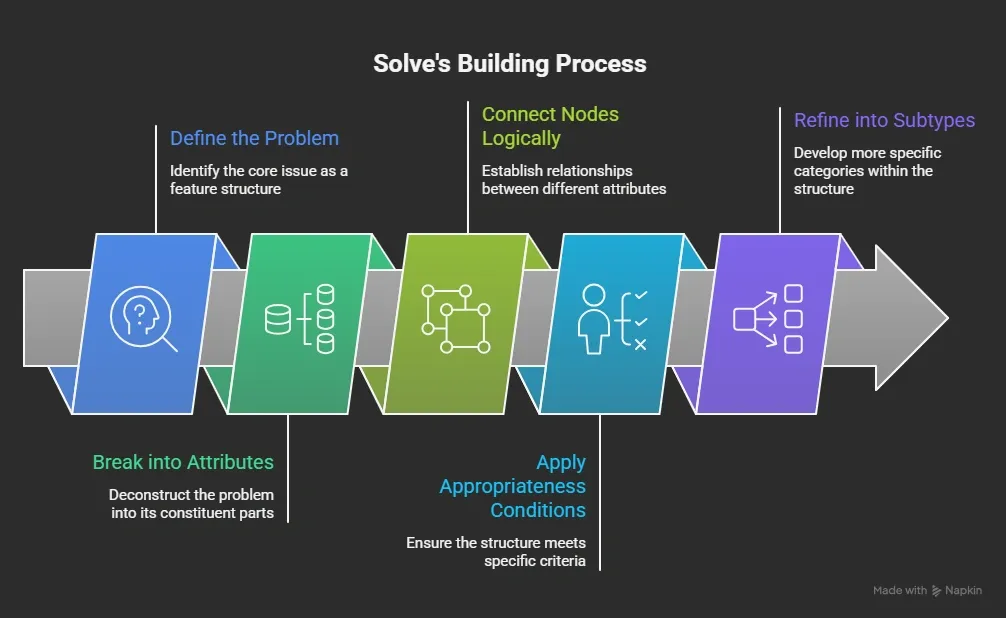
This process keeps things simple.
Each step adds clarity. Each step builds confidence. Instead of endless thinking, teams move forward with a clear plan.
Why Stakeholders Love This Approach
After that, let’s look at the real impact. Stakeholders do not want to read long documents. They want answers.
With structured outputs, they can:
- Jump to the right feature
- Follow paths quickly
- Understand the value without reading everything
This creates a big difference. The structure makes navigation easy. The system keeps everything connected. The platform supports faster decisions.
A Practical Example
Let’s take another example. A team is building an app. Instead of writing a long plan, they create a feature structure.
- Feature: User onboarding
- Attribute: Steps
- Value: 3 screens
- Attribute: Goal
- Value: Reduce drop-off
Now connect this with other features like pricing, retention, and feedback. Each node leads to another. Each path adds meaning. This represents feature structures in action.
Rocket.new Insight
Here’s something directly from X by Rocket.new:
“Describe any business situation. Get a complete, structured solution.” X(Twitter)
This shows exactly what your blog is talking about.
Less reading. More structure. Clear outputs. Teams are moving toward systems where you describe a problem and instantly get a structured answer with direction.
How Rocket.new's Solve Works?
Let’s look at how it works based on the official docs from Rocket.new. Inside solve, the process is simple and structured:
- You input a problem
- The system builds a structured output
- Each part is connected using feature names and values
- The output follows a consistent structure
This process begins with a most general feature structure. Then, it gradually refines into more specific structures, giving better clarity and direction.
It supports building through:
- Structured nodes
- Connected paths
- Clear attribute value mapping
Every part of the output is represented clearly, so teams can navigate through information without confusion and move forward with confidence.
Key Features of Rocket.new Solve
Now, let’s look at what makes solve inside Rocket.new so practical for teams working with structured outputs.
- Structured Outputs: Every output follows a feature structure. No random text. Just clear logic.
- Connected Thinking: Each feature is connected. Each node leads to another. This creates sense.
- Fast Building: Teams can begin quickly. No need for heavy research first.
- Clear Navigation: Stakeholders can find answers without reading everything.
- Consistent System: The platform uses a stable type system and type hierarchy.
These features keep everything aligned, making it easier for teams to move from ideas to execution with clarity and direction.
Why Solve Feature Structures Change the Way Teams Work
Teams often rely on long documents packed with research and ideas, but finding answers inside them is slow and frustrating. Stakeholders spend more time searching than deciding, which reduces clarity and delays progress. This creates confusion across teams and weakens direction. Structured outputs using feature structures solve this by connecting every feature, attribute, and value clearly, making navigation simple and focused.
Teams shift from overthinking to building with confidence, staying aligned at every step. It becomes easier to move from ideas to action without getting lost in content.
Try this directly on Rocket.new to experience how structured outputs guide you straight to answers.
Table of contents
- -Why Structure Matters More Than Long Documents?
- -Understanding Feature Structures in Simple Terms
- -From Linguistics to Business Thinking
- -How Rocket.new Uses Structured Thinking?
- -How Solve Builds Clarity Step by Step?
- -Why Stakeholders Love This Approach
- -A Practical Example
- -Rocket.new Insight
- -How Rocket.new's Solve Works?
- -Key Features of Rocket.new Solve
- -Why Solve Feature Structures Change the Way Teams Work