
Competitive intelligence for sales teams means knowing what your rivals changed before your prospect does. Sales teams using Rocket.new access to continuous competitor signals, pricing shifts, and hiring patterns before every call starts. Set up monitoring once, and the intelligence arrives where you already work, not in a tab nobody opens.
What Happens When a Competitor Moves Budget
What should your marketing teams do when a competitor doubles their ad budget overnight?
Rocket.new picks up that shift, cross-references it with hiring data, pricing changes, and website updates, then delivers a structured brief explaining what the move means for your business with its Intelligence feature.
EMARKETER reports that total US media ad spending reached $422 billion in 2025. Competitors are redistributing those dollars constantly, and most businesses miss the shift until the new campaign is already live.
Why Ad Spend Shifts Carry Real Competitor Signals
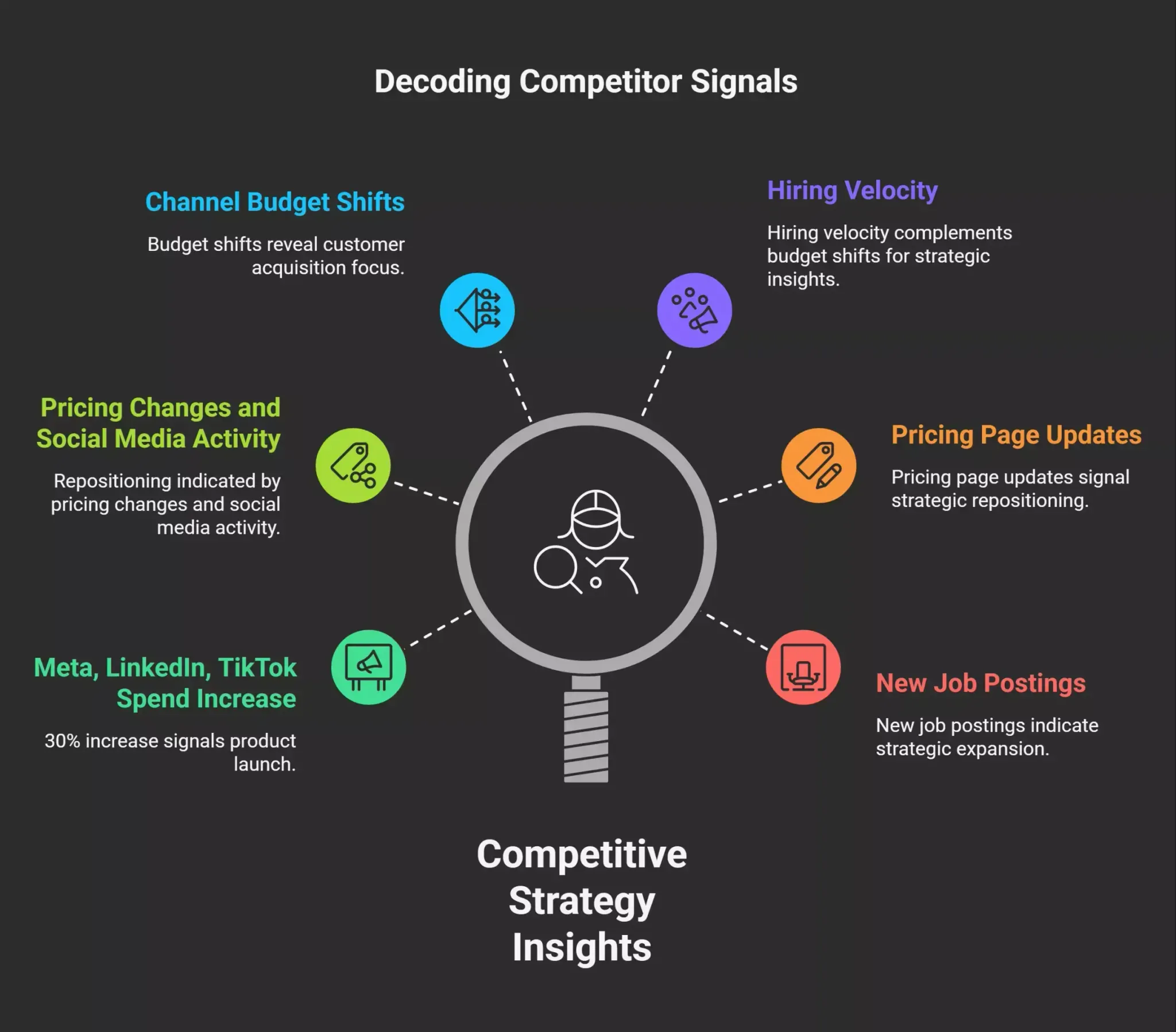
Budget Changes Reveal Strategy Before Press Releases
-
A competitor increasing spend on Meta, LinkedIn, and TikTok by 30% in one week is not testing creatives. That is a product launch signal.
-
Pricing changes on a competitor's website, paired with new social media activity across LinkedIn, Instagram, and Facebook, point to repositioning.
-
When companies pull budget from one channel and push it to another, the shift tells you where they expect their next customers.
Most businesses track competitors through periodic checks or fragmented alerts. A budget shift on one channel, viewed alone, looks like noise. Connected to hiring velocity, a pricing page update, and new job postings, it becomes a clear signal your product teams can act on.
What Separates a Signal From Noise
-
Raw data says a competitor spent $40,000 more on Instagram this month.
-
A useful competitive signal says that an increase arrived alongside a new feature announcement, a messaging shift, and enterprise-focused hiring.
-
Rocket.new connects those dots and delivers them in a daily brief your team can use.
How Rocket.new Intelligence Tracks Five Categories
Five Surfaces, Every Competitor, Every Day
Rocket.new's intelligence feature monitors five signal categories across every competitor, every day:
| Signal Category | What Gets Tracked | Why It Matters |
|---|---|---|
| News | Press coverage, partnerships, announcements | Shows where competitors want attention |
| Website | Pricing page updates, product page content | Reveals positioning shifts and pricing changes |
| Customer | Reviews on G2 Glassdoor Capterra, customer feedback | Exposes gaps and satisfaction trends |
| People | Open roles, hiring patterns, key hires | Indicates where companies are investing |
| Social | Ad activity across LinkedIn, Meta, and TikTok, organic posts | Tracks real-time campaign signals and ad spend |
Businesses that monitor too many competitors face overload. Businesses that monitor too few miss the shifts that matter. Rocket.new intelligence balances this by connecting signals across all five surfaces and flagging only patterns that require a response.
How Most Businesses Handle Competitor Tracking Today
The Gap Between Data and Action
-
Most businesses check competitors quarterly. Competitors move weekly.
-
Standalone tools like Crayon or Klue (Crayon and Klue are the most cited competitive intelligence tools) focus on website changes and battlecard creation. They track pricing changes and product launches across multiple platforms, but connecting ad data with hiring signals and customer feedback takes manual research.
-
Research cited by Pendo shows 75% of software companies say data drives product decisions, while only 30% of product managers feel satisfied with their data access.
-
Businesses that want structured signals ready for roadmap sessions face a gap that most tools do not close.
What Makes Rocket.new Different
-
Tools like Crayon track competitors across specific surfaces. Rocket.new connects signals across all five categories and explains the pattern.
-
Those tools charge $15,000 to $40,000 per year. Rocket.new wraps intelligence into a broader platform alongside Solve and Build.
-
Most businesses need updates that arrive ready to act on, not raw feeds requiring an analyst.
How Rocket.new Converts Ad Spend Shifts Into Actionable Signals
Detection and Synthesis
-
Rocket.new continuously aggregates real-time data across ad networks, tracking campaigns, and creative adjustments across multiple platforms.
-
The system triggers alerts when competitor spend crosses a set threshold on a particular channel.
-
Rocket.new's intelligence maps ad changes against website updates, hiring patterns, and pricing shifts. This separates a routine ad test from a strategic pivot.
-
Within 90 minutes of a significant shift, Rocket.new delivers a structured report. The AI-driven layer connects the ad shift to a likely strategy: product launch, enterprise push, or geographic expansion.
What the Daily Brief Contains
-
What changed: ad spend on which channels, by how much
-
What else moved: a pricing update, a new feature on the product page, competitor activity on social media
-
What it means: a structured reading connecting the ad shift to competitor strategy
-
What to do: recommended responses for your team
Rocket.new analyzes ad spend changes contextually. A 20% budget increase during a seasonal cycle gets flagged differently than the same increase paired with a new landing page and new hiring across multiple platforms.
How Product Teams and Sales Reps Use These Signals
From Signals to Decisions
-
Product teams that use structured competitive signals before roadmap sessions avoid building based on internal assumptions. Customer feedback becomes useful for planning when teams read it as a whole, not as individual data points.
-
A structured brief combining these signals with customer feedback and usage data replaces opinion with evidence. Businesses running structured decision-making see fewer misaligned roadmaps.
-
Before an enterprise sales call, a team already has the competitive context for the meeting. The daily brief with every competitor's pricing changes, social media activity, and new feature launches makes prep automatic.
Practical Scenarios
-
A competitor increases social media spend by 40% on X Instagram, Facebook, YouTube, and TikTok while posting enterprise content on LinkedIn. Rocket.new's intelligence reads that as an enterprise push and flags the window before the competitor's positioning goes fully public.
-
Companies in your space are starting to hire aggressively for performance marketing roles. The system tracks hiring to indicate where competitors are investing.
-
A competitor drops a pricing tier and adds a free plan. Rocket.new connects this change with new product launch content across multiple platforms. Product teams receive the analysis, and sales teams get the daily brief.
What People Are Saying
"I remember spending a week going through all the existing platforms and features, reading comments, happy stories, frustration, and friction. And then preparing the Google sheet to map it all. Fast forward 10 years, today, at Rocket, we launched something that will short-circuit the same amount of work to an hour." - Hardik Sojitra on LinkedIn
Photo of Hardik Sojitra, who is part of the growth team at Rocket.new where he spends most of his time figuring out why people stay or leave. Curious by default, an active blood donor, and a big cricket fan. Decorative background for the call to action section.
The observation aligns with what most businesses find: continuous competitive tracking at scale, done manually, breaks down. Companies that skip it react after competitors reach new customers.
How Rocket.new Handles Competitor Ad Spend Signals
Rocket.new translates competitor advertising budget changes into actionable signals by tracking multi-channel ad data, isolating shifts from noise, and combining them with hiring, pricing, and product signals. The platform uses an AI-driven agent layer that delivers a structured reading of each shift.
Rocket.new identifies patterns by cross-referencing ad changes across five public signal surfaces, and interprets them as connected intelligence, not individual alerts.
-
Vibe Solutioning platform: Describe a competitive situation, and Rocket.new produces a structured analysis with recommendations. No template to fill out, no search query to write.
-
25,000+ templates, free to use: Build competitive response pages or product comparison tools directly from the template library.
-
Supports Flutter (mobile) and Next.js (web): If your response to a competitor move requires a new feature page or product launch page, build it on the same platform without starting over.
-
Collaboration built in: Share the daily brief, tag team members, and assign recommended actions, all inside the workspace.
-
3 Products, One Platform: Solve, Build, and Intelligence: Rocket.new's Intelligence catches the signal. Solve analyzes the competitive situation and produces a structured recommendation. Build ships the response page or feature. Nothing leaves the platform.
-
One platform, four intelligence functions: Sales intelligence, marketing intelligence, product intelligence, and strategic intelligence, served from one source with zero duplication of monitoring effort across your team.
Use Cases
-
A competitor increases ad spend on LinkedIn, X, Facebook, and YouTube. Rocket.new detects the shift, connects it to a landing page update, and your team responds with a counter-campaign before the competitor's campaign peaks.
-
Product teams notice competitor reviews on G2 mentioning a new feature your product lacks. Rocket.new flagged the product launch weeks earlier through social media signals and news activity. Solve delivers a structured comparison.
-
Businesses running market research use Rocket.new for competitive monitoring without switching between multiple platforms. One dashboard, all five categories, every competitor, daily updates.
-
Companies preparing for a product launch scan what competitors are spending on, so the launch messaging reflects current positioning across social media channels.
Turning Signals Into Business Decisions
How does Rocket.new turn, a shift in a competitor's advertising spend, a signal your marketing team can act on?
It watches ad signals across channels, connects spend changes with hiring, pricing changes, and product data, processes them through its intelligence layer, and delivers a daily brief that your team uses the same day. Most businesses react to competitors after the fact.
Businesses that catch signals early hold their position because they respond while competitors are still setting up campaigns. Companies that treat competitor intelligence as a continuous process make sharper decisions on pricing changes, new feature priorities, and product launch timing.
Sign up now and start tracking competitor ad spend signals with Rocket.new today.
Table of contents
- -What Happens When a Competitor Moves Budget
- -Why Ad Spend Shifts Carry Real Competitor Signals
- -Budget Changes Reveal Strategy Before Press Releases
- -What Separates a Signal From Noise
- -How Rocket.new Intelligence Tracks Five Categories
- -Five Surfaces, Every Competitor, Every Day
- -How Most Businesses Handle Competitor Tracking Today
- -The Gap Between Data and Action
- -What Makes Rocket.new Different
- -How Rocket.new Converts Ad Spend Shifts Into Actionable Signals
- -Detection and Synthesis
- -What the Daily Brief Contains
- -How Product Teams and Sales Reps Use These Signals
- -From Signals to Decisions
- -Practical Scenarios
- -What People Are Saying
- -How Rocket.new Handles Competitor Ad Spend Signals
- -Use Cases
- -Turning Signals Into Business Decisions