
Rocket.new gathers fragmented competitor signals from multiple sources and converts them into a unified weekly strategic interpretation, helping businesses monitor trends, risks, positioning, and emerging opportunities with greater speed and clarity.
Why does competitor intelligence still fail to drive action?
Most product teams already track competitors, but the process is fragmented: screenshots, Slack messages, bookmarked pages, and scattered notes. The issue is not missing data, but missing interpretation. Companies are overwhelmed with competitor signals and struggling to turn them into strategic clarity, driving rapid growth in competitive intelligence.
The global competitive intelligence tools market was valued at $0.71 billion in 2025 and is projected to reach $4.03 billion by 2034 at a CAGR of 21.17%, according to Fortune Business Insights.
Rocket.new closes that gap by pulling 15 distinct competitor data sources across six signal categories and synthesizing them into one clear, strategic interpretation every single week.
The Problem Most Competitive Intelligence Programs Share
Data collection and interpretation are not the same job. Most platforms treat them as one.
You get a dashboard of signals. A pricing page has changed. A competitor posted on LinkedIn. Three new reviews appeared on G2. Each one lands in a feed, gets skimmed, and the week moves on without a single clear decision coming out of it.
Oliver Guirdham, CEO of The Business Research Company, described this challenge clearly in a recent LinkedIn piece:
"In this environment, having access to information is no longer a competitive advantage. Knowing what to trust, what to ignore, and what to act on is what really matters."- LinkedIn
This is where traditional consulting firms, standalone alerting tools, and manual research all fall short. They surface information. Rocket.new produces direction.
What "15 Competitor Data Sources" Actually Includes
Rocket.new Intelligence monitors every public platform a competitor operates on. The 15 data sources span six signal categories:
| # | Data Source | Signal Category |
|---|---|---|
| 1 | Competitor websites - pricing, features, messaging shifts | Website |
| 2 | LinkedIn posts and activity | Social Media |
| 3 | X (Twitter) | Social Media |
| 4 | Social Media | |
| 5 | Social Media | |
| 6 | YouTube | Social Media |
| 7 | TikTok | Social Media |
| 8 | Social Media | |
| 9 | Press coverage and media mentions | News and Web Presence |
| 10 | Blog posts and partnership announcements | News and Web Presence |
| 11 | G2 reviews and sentiment shifts | Reviews and Reputation |
| 12 | Glassdoor reviews and ratings | Reviews and Reputation |
| 13 | Capterra and other review platforms | Reviews and Reputation |
| 14 | Job postings and hiring velocity | People |
| 15 | Meta's ad libraries, LinkedIn Ads, and SimilarWeb's API | Performance Marketing |
None of these sources are optional. Rocket monitors all of them simultaneously, with proprietary web crawlers and SimilarWeb's API tracking traffic trends and user behavior patterns in the background. You set up competitors once - and the platform does the rest.
How Rocket.new Synthesizes Competitor Data Week After Week
The synthesis happens through the daily brief. Every day, Rocket AI produces a structured brief for every competitor you track. It covers three things: what moved and what it means, patterns worth watching, and a direct recommendation for your business.
Here is what the data collection and synthesis flow looks like:
The key word in that flow is "clustering." Rocket Intelligence does not read signals in isolation. It reads them as a group.
A competitor updating their pricing page in isolation is noise. That same update alongside enterprise-focused social posts, defensive G2 responses flagging security, and three new enterprise sales job postings is one clear strategic signal: this competitor is moving upmarket.
This is what continuous competitive intelligence actually looks like when it works. Not a feed. A strategic interpretation of what the market is doing - delivered before your first meeting of the day.
Catching Market Positioning Shifts Early
Most companies realize a competitor has changed direction only after the public announcement goes live. By then, the strategy has already been in motion for months. The signals were always there — just scattered across different channels and difficult to connect.
Rocket’s competitor move tracking identifies these patterns before they become headlines by analyzing signals across multiple competitor touchpoints in real time.
Early Signals Rocket Detects
-
Hiring Trends: Sudden hiring for enterprise sales, partnerships, or executive roles often signals expansion into a new market segment.
-
Pricing Changes: Adjustments like removing per-seat caps or introducing enterprise plans can indicate a shift toward larger customers.
-
Messaging Evolution: Changes in website copy, social media positioning, and campaign language reveal who competitors are targeting next.
-
Product & Feature Direction: Frequent updates around integrations, compliance, or scalability often point toward enterprise positioning.
-
Go-To-Market Expansion: Increased activity around webinars, partnerships, procurement content, or industry events signals strategic market movement.
Why This Matters?
Individually, these signals may look insignificant. Together, they reveal a competitor’s future direction weeks or even months before any official announcement. That early visibility gives product, strategy, and leadership teams valuable preparation time to respond proactively instead of reacting late.
Traditional competitor analysis once required expensive consulting firms and slow quarterly research cycles. Rocket transforms that process into a continuous, automated workflow running directly inside your existing platform.
What Product Teams Get From This Every Week?
Product teams are the most underserved group in most competitive intelligence setups. Sales gets battlecards. Marketing gets ad creative benchmarks. Product teams get a link to a shared doc that nobody updates.
Rocket Intelligence serves four functions simultaneously from one source:
-
Sales intelligence: Deal-specific competitive briefs, known pricing models, pricing strategies for direct comparisons going into calls - including background for the call in a format the team can actually use.
-
Marketing intelligence: Campaign differentiation based on current competitor ad activity, traffic trends, and positioning shifts.
-
Product intelligence: What competitors shipped in the last 90 days, and what job postings signal they are building next.
-
Strategic intelligence: M&A signals, market entry moves, and enterprise positioning changes detected months before formal announcements.
All four use the same data. None requires a separate setup. Product teams specifically benefit from the job postings signal - hiring concentration reveals where competitors are investing before any product announcement confirms it. Twelve new AI engineering roles are not just a hiring decision. It is a product strategy signal hiding in plain sight.
Rocket.new: Strategy, Intelligence & Product Building
Rocket.new is a Vibe Solutioning platform, the first platform where competitive intelligence, product strategy, and application building happen in the same place.
Solve: Strategic Analysis on Demand
Solve is Rocket's decision intelligence layer. Describe any business question in plain text, and Rocket AI runs queries across 150+ sources in parallel, returning a full structured brief in 60 to 90 minutes.
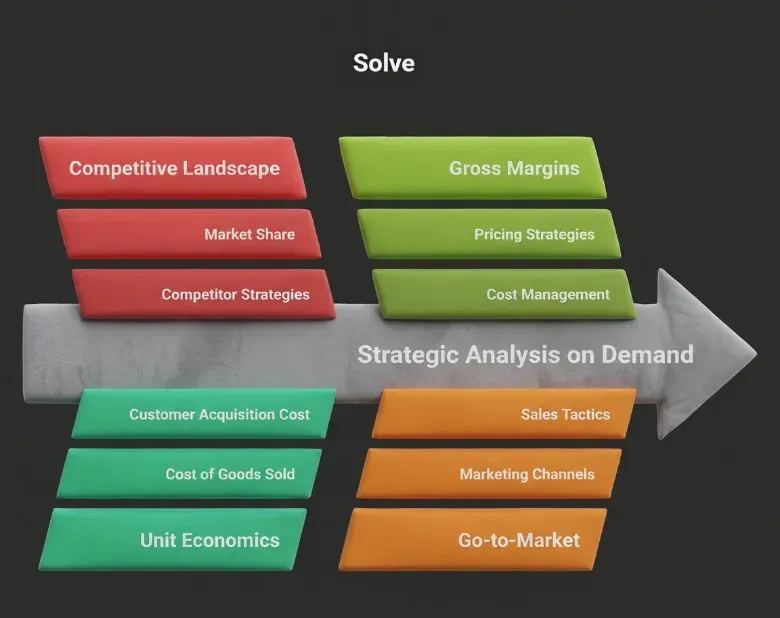 Export in PDF format or generate a full presentation deck with one click.
The output does not disappear after the export. It stays in the project as the foundation for what gets built next.
Build AI App Development Inside the Same Platform
Build is the AI app development layer. From text prompts, Rocket generates production grade web apps in Next.js and Flutter mobile apps with full design systems.
This is not vibe coding in the traditional sense, it is product building informed by the intelligence already inside the project. Every web app and mobile app launch starts from a foundation of research and competitive context, not a blank prompt.
Intelligence Continuous Competitive Monitoring
Intelligence is the third pillar. Set up once per workspace, it runs automatically across all 15 data sources with no ongoing manual effort.
Rocket 1.0 connects research, product strategy, and competitive intelligence inside a shared context architecture so the pricing move caught on Monday is already present when a PM writes a product requirement document on Wednesday.
Rocket raised funding from Salesforce Ventures, Together Fund, and Accel to build this category. Rocket AI is the engine across all three pillars, with Salesforce Ventures and Together Fund backing the thesis that strategy and building belong in the same place.
1.5 million users across 180 countries have tried Rocket since launch.
Why Standalone CI Tools Fall Short
Tools like Crayon, Klue, and Kompyte do the monitoring part reasonably well. The gap is interpretation and connection.
The Problem
-
They send alerts
-
You still do the analysis
-
The analysis still sits in a separate document from your product strategy and build workflow
With Rocket's subscription plans, Intelligence lives inside the full platform alongside Solve and Build.
What Rocket Changes
-
No separate logins
-
No context lost between what you learned and what you build
-
One source
-
Four functions
-
Zero duplication
Rocket.new combines competitive intelligence, strategic analysis, and AI-powered product building into one connected workflow turning insights into execution without losing context between research, strategy, and development.
How Rocket.new Synthesizes Competitor Data
Most teams are not short on competitor data. They are short on time to interpret it and short on a system that connects those insights to the work that follows. Data without synthesis becomes noise, and in fast-moving markets, noise is expensive.
Rocket.new treats interpretation as the actual deliverable, not a secondary feature. By analyzing 15 competitor data sources across six signal categories, Rocket generates one structured strategic brief every day. Sales, marketing, product, and strategy teams all operate from the same competitive intelligence without building separate monitoring systems or disconnected workflows.
Want competitor intelligence that directly connects to product strategy and execution? Explore how Rocket.new turns market signals into actionable decisions inside one unified platform.
Table of contents
- -The Problem Most Competitive Intelligence Programs Share
- -What "15 Competitor Data Sources" Actually Includes
- -How Rocket.new Synthesizes Competitor Data Week After Week
- -Catching Market Positioning Shifts Early
- -Early Signals Rocket Detects
- -Why This Matters?
- -What Product Teams Get From This Every Week?
- -Rocket.new: Strategy, Intelligence & Product Building
- -Solve: Strategic Analysis on Demand
- -Build AI App Development Inside the Same Platform
- -Intelligence Continuous Competitive Monitoring
- -Why Standalone CI Tools Fall Short
- -The Problem
- -What Rocket Changes
- -How Rocket.new Synthesizes Competitor Data