
Rocket.new vs Base44 Pricing Comparison: Which Gives better Value in 2026? Rocket.new offers better value with zero real entry cost, code ownership, and predictable credit-based pricing. Base44 is simpler to start but becomes expensive due to dual-credit usage and limited flexibility. Choose Rocket.new for scalable, production-ready apps; choose Base44 for simple, structured builds.
Which vibe coding platform actually earns its price?
The answer depends on what you are building, how fast you need it to live, and whether you walk away owning the code.
Vibe coding crossed from niche to mainstream in 2025, and the appeal is clear: describe a full app and watch it get built, with Rocket.new reaching 1.5 million users in 180 countries just months after launching. Both Rocket.new and Base44 promise to turn natural language into working applications. Their pricing structures, credit mechanics, and actual outputs differ in ways that matter at every stage of a project.
This is a direct comparison. If you are evaluating these two platforms for a real build, you will have a clear answer by the end. Every claim is grounded in documented pricing, verified user reviews, and published feature specifications.
What Vibe Coding Actually Costs
Vibe coding is the practice of describing software in plain language and letting AI handle the build.
No writing code from scratch. You type what you want, and the AI-powered platform generates a working application from your description.
Pricing in this space behaves differently from most SaaS tools. Most AI app builder platforms use credits, tokens, or message limits as their cost unit. Those units burn faster than new users expect, especially on platforms that charge separately for building and for running the app.
The sticker price rarely reflects the actual cost over time.
Understanding how each pricing model behaves under real usage is what separates a good plan from a billing surprise.
What Rocket.new is
Rocket.new is an AI-powered app builder that turns natural language prompts into full-stack web and mobile apps.
You describe your app, and it generates the frontend, backend logic, and deployment setup. It supports Flutter for mobile and Next.js for web, and includes a 25,000+ template library to reduce credit usage and speed up builds.
Rocket.new raised $15 million in September 2025, reinforcing its position as a production-grade vibe coding platform.
What Base44 is
Base44 is an AI builder and no-code platform acquired by Wix for $80 million in mid-2025.
It generates applications from natural language and bundles database, authentication, and hosting into one managed system. Users don't need to configure infrastructure, as everything is handled internally.
Base44 is designed for non-technical users and founders who want a fast, simple path from idea to deployment, though this simplicity can create limitations at scale.
Where These Two Platforms Diverge
Both Rocket.new and Base44 are positioned as AI-first app builders, but they cater to different user needs and preferences in app development.
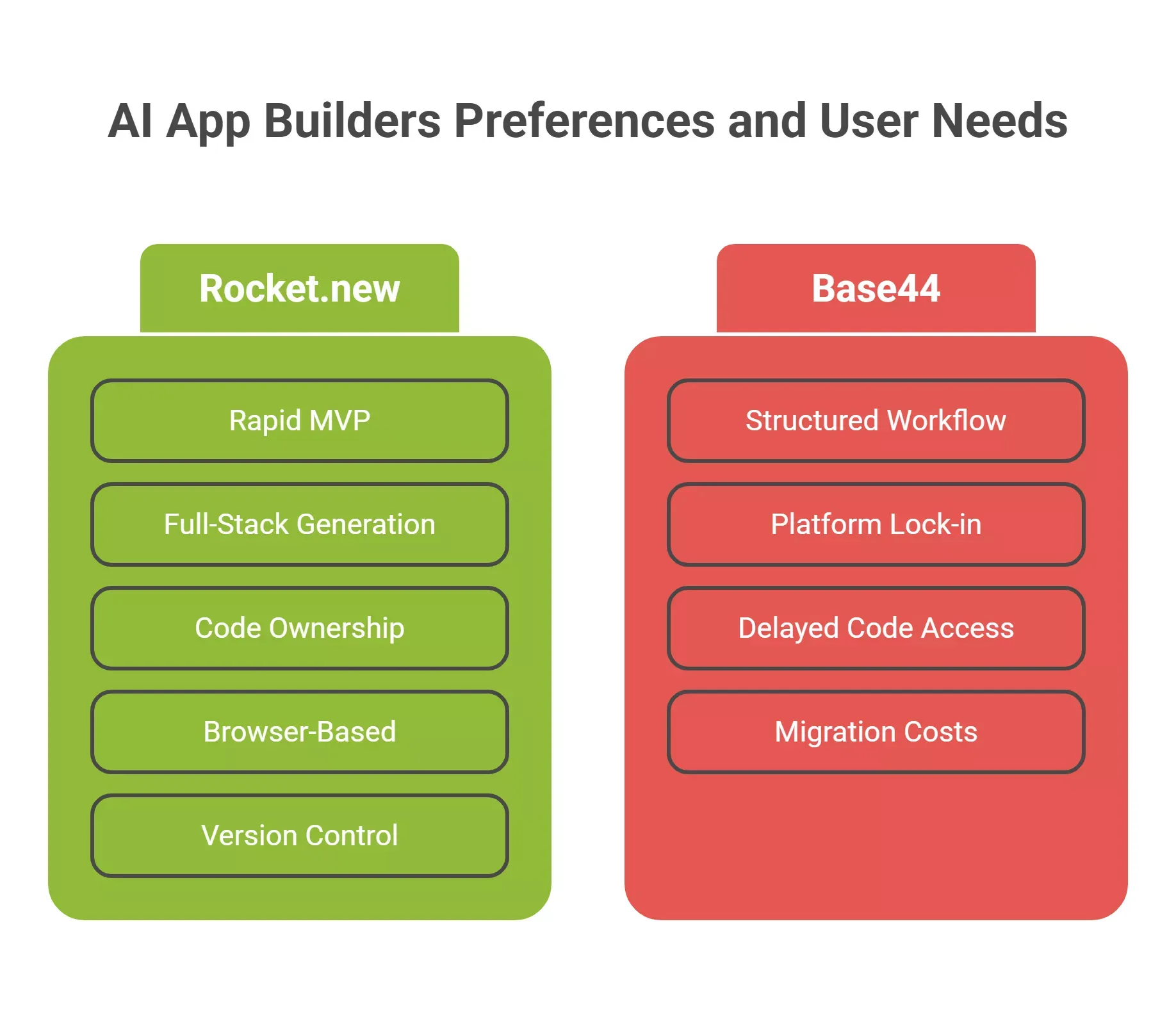
Prompt-Based App Generation and Speed
Rocket.new:
Primarily focused on serious developers or entrepreneurs, or anyone who wants to build a real, production-ready application. Generates a full-stack working project structure from a single prompt.
Minimal setup, no friction, fast iteration from the first build. Optimized for rapid MVPs, rapid experimentation, and quick execution. Rocket.new is designed for speed and rapid app generation, focusing on quick MVP creation. Rocket.new is ideal for indie hackers who prioritize speed. Performs well at scaffolding UI, endpoints, and basic data flows.
Base44:
Uses a structured, AI-guided workflow before generating. Encourages thinking in terms of flows, architecture, and system design. Better suited for founders and AI-first product teams that value deliberate building. Adds guided steps that slow the initial build but add product depth.
Speed and execution go to Rocket.new. Structured building goes to Base44.
Full-Stack Generation: What Each Platform Produces
Rocket.new:
Build web and mobile apps with frontend UI, backend infrastructure, API endpoints, and a deployment pipeline in one pass. Generated code exports cleanly to GitHub with full code ownership. Allows users to generate full-stack applications from natural language prompts without traditional coding. Output is structured enough to be handed directly to a developer for extension.
Base44:
Generates full-stack web apps with built-in database, auth, and hosting in one pass. Code export is limited to lower plan tiers. Backend and database infrastructure remain locked to the Base44 platform. Requires users to accept vendor lock-in since its database and backend cannot be exported.
Rocket.new focuses on rapid AI-powered app generation with strong speed and execution emphasis. It generates portable code and builds production-ready apps. Base44 produces platform-dependent output.
Browser-Based Development: One Key Difference
Both platforms share: fully browser-based with no local setup required, and no toolchain configuration, dependency management, or environment mismatch.
Where they split on code visibility:
Rocket.new:
Full code access and direct code edits are available on all paid plans. GitHub sync is included in the entry paid plan. Gives developers early control and flexibility from day one.
Base44:
Code access and editing are locked behind the Builder plan at $40 per month. Lower tiers restrict visibility and flexibility. Developer control is delayed until you upgrade.
Rocket.new gives you code control from the start. Base44 makes you pay more to unlock it.
Version Control and Long-Term Code Ownership
Rocket.new:
GitHub sync is available on all paid plans from day one. Full version control, easy handoff, and scalability built in. Pull into VS Code or any environment, make changes, push back freely. Supports flexible long-term growth and migration without extra cost.
Base44:
Version control is only unlocked on the Builder plan at $40 per month. No external access to code on lower tiers. Code remains tied to the platform until you upgrade. Migration requires upgrading first, then exporting, and adding avoidable costs.
Rocket.new keeps your growth options open from the first paid month. Base44 delays ownership and adds migration cost the longer you stay on a lower tier.
Feature Comparison: Gaps That Affect Your Buying Decision
Mobile Apps: A Category Boundary, Not a Feature Gap
Rocket.new:
Builds landing pages, web apps, and mobile apps from a single platform. Uses Flutter for native mobile output and Next.js for web apps. About 45 percent of Rocket.new users build mobile apps, per TechCrunch. Choosing Rocket.new from the start avoids switching tools mid-project for mobile support.
Base44:
Does not build native mobile apps for iOS or Android. Generates responsive web apps that display on mobile browsers only. A responsive web app and a native mobile app are different products with different distribution profiles.
Rocket.new is particularly effective for entrepreneurs needing to launch MVPs quickly, which can be scaled easily, while Base44 is more focused on structured app development. This is not a feature gap. Only one platform builds mobile apps at all. If your project needs an installable mobile app, Base44 is not a viable option regardless of pricing tier.
Internal Tools and Back-Office Apps
Rocket.new:
Builds admin panels and back-office applications from a single natural language prompt. Output deploys to custom domains and is ready for developer extension. Real code output gives development teams room to grow and customize over time. Strong choice for internal business apps that need to scale beyond initial setup.
Base44:
Generates solid internal tools, including dashboards, admin panels, and client portals with login flows. Internal tools stay inside the Base44 platform with limited extension options. Works well for a basic client portal or admin panel that will not need customization. Any extension beyond the platform's integrations requires staying on-platform or rebuilding elsewhere.
For simple internal tools, Base44 delivers. For internal tools a team may extend or hand off, Rocket.new provides more flexibility.
Custom Domains: Where Base44 Creates a Pricing Barrier
Rocket.new:
Custom domains are included on all paid plans starting at $25 per month. No tier upgrade required to ship a production-ready app with a real domain.
Base44:
Custom domains are locked behind the Builder plan at $40 per month. Starter plan at $16 per month only gives a Base44 subdomain. True entry price for a production-ready app with a custom domain is $40, not $16.
Rocket.new's real entry price for a production app is $25. Base44's is $40.
User Authentication and Data Storage
Rocket.new:
Handles user authentication through Supabase integration. Auth is portable and follows standard patterns that a developer can extend or replace. Connects to a standard PostgreSQL database you control directly. Supabase-based setup gives full data portability and ownership.
Base44:
Bundles user authentication into every plan, including the free plan. No external provider needed, making it faster to start for non-technical users. Auth is tied to Base44's infrastructure and cannot be moved independently. Auto-generates a database schema and manages it internally.
Base44 is faster to set up for auth. Rocket.new gives you portable, developer-friendly auth and data you fully own.
Deployment Capabilities
Rocket.new:
Deployment goes through GitHub sync to any host, including Netlify, Firebase, or your own server. All deployment options available on all paid plans with no upgrade required. Gives teams direct control over where and how their app is hosted with a simplified deployment workflow. Built-in preview and managed deployment options make it suitable for MVP launches.
Base44:
Deployment options depend on the plan tier. Lower tiers deploy to Base44-managed hosting on a Base44 subdomain only. Custom deployment requires the Builder plan at $40 per month. Simpler approach but less flexible for teams with specific hosting requirements.
Rocket.new includes built-in preview and managed deployment options, making it suitable for MVP launches. It gives deployment flexibility from the entry plan. Base44 restricts hosting options until you pay more.
Enterprise Integrations and AI Agents
Rocket.new:
Connects to enterprise integrations through its API layer including Claude, OpenAI, Gemini, Stripe, and Twilio. Build AI agents and AI features directly inside generated applications without writing code manually. Native support for scalable AI systems, automated pipelines, and LLM-driven features. Integration costs scale with your build activity, not with end-user interactions.
Base44:
Offers 20 pre-built integrations covering CRM, ecommerce, and email. Enterprise integrations available on the Pro plan and above only. Integration credit system charges end-users each time an AI feature or external service triggers inside the live app. Dual billing for runtime AI agents creates unpredictable costs as user traffic grows.
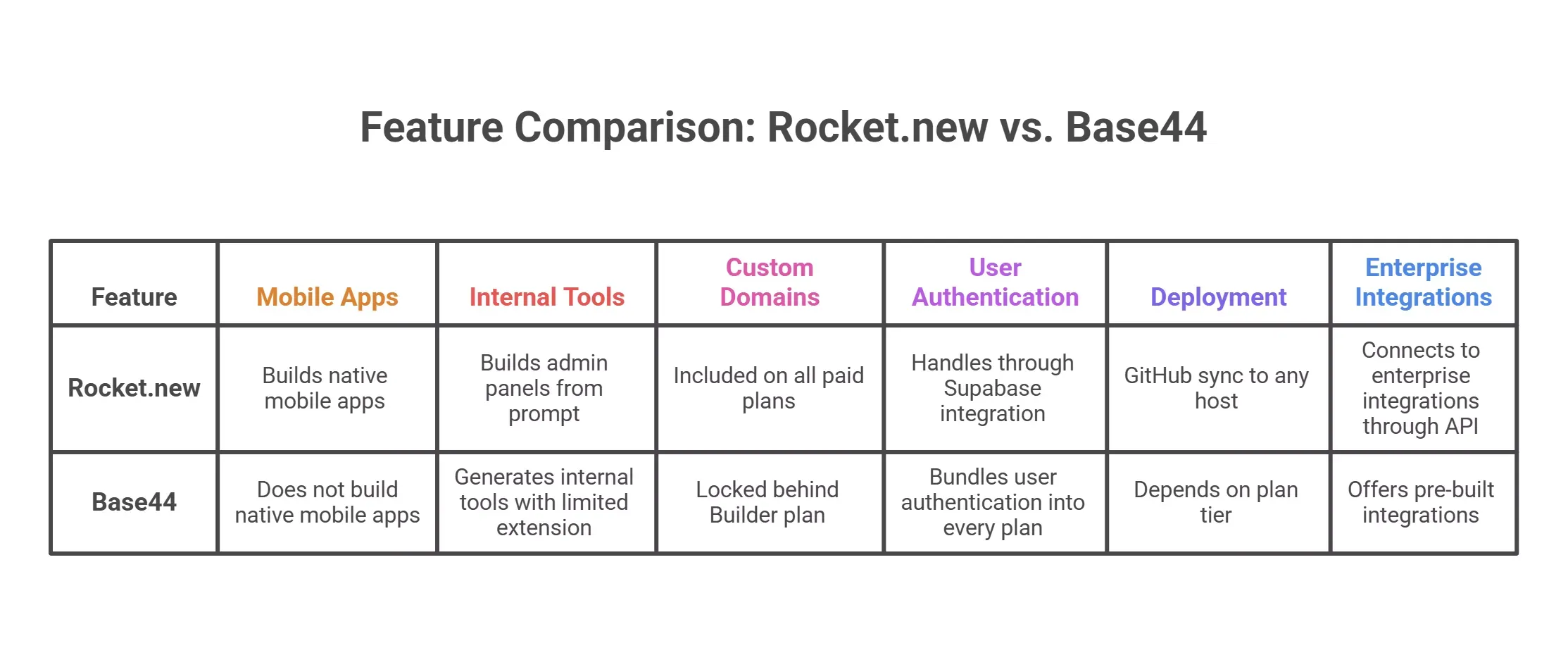
Rocket.new generates structured project files automatically and allows edits within its environment, optimized for fast iteration. It offers broader integration options at lower plan tiers with no runtime billing surprise. Base44's integration credit model makes costs harder to predict at scale.
Pricing Plans: Every Tier and Its Actual Implications
**Rocket.new Pricing (all plans billed monthly; no annual discount listed)**
| Plan | Monthly Price | Credits/Month | Key Features | Best For |
|---|---|---|---|---|
| Free | $0 | 20 credits | Basic app generation, limited project scope | Exploration and testing |
| Pro | $25/mo | 100 credits | Custom domain, GitHub sync, private projects | Solo creators, landing pages, portfolios, lightweight apps |
| Rocket | $50/mo | 250 credits | All Pro features, consultant-grade solutions, competitive intelligence | Frequent individual and team use |
| Booster | $250/mo | 1,500 credits | All Rocket features, highest credit allocation | Power users and fast-moving teams |
Credits never expire and additional credits can be purchased on any plan.
**Base44 Pricing (annual billing shown)**
| Plan | Annual Price | Message Credits | Integration Credits | Key Features | Best For |
|---|---|---|---|---|---|
| Free | $0 | 25/mo (5/day cap) | 100/mo | Core features, auth, database | Initial exploration only |
| Starter | $16/mo | 100/mo | 2,000/mo | Unlimited apps, in-app code edits | Personal projects and early-stage ideas |
| Builder | $40/mo | 250/mo | 10,000/mo | Custom domain, GitHub sync, backend functions, free domain for 1 year | First tier suitable for shipping a real product |
| Pro | $80/mo | 500/mo | 20,000/mo | All Builder features, AI model selection, and early beta access | Growing apps with active users |
| Elite | $160/mo | 1,200/mo | 50,000/mo | All Pro features, premium support | High-volume teams needing priority support |
Side-by-Side Plan Comparison
| Feature | Rocket.new Pro ($25/mo) | Base44 Starter ($16/mo) | Base44 Builder ($40/mo) |
|---|---|---|---|
| Custom domain | Yes | No | Yes |
| GitHub sync | Yes | No | Yes |
| Code export | Yes | No | Yes |
| Credits never expire | Yes | No | No |
| Mobile app support | Yes | No | No |
| Backend lock-in | No | Yes | Yes |
| Runtime billing on user activity | No | Yes | Yes |
Rocket.new's Pro plan at $25 per month already includes everything Base44 requires the $40 Builder plan to unlock. Base44's credits expire monthly with no rollover, and integration credits burn with every user interaction inside your live app, regardless of which plan you are on.
The Dual-Credit Problem
Rocket.new uses a credit-based pricing model. Credits measure AI processing during app generation and code updates. Credit consumption scales with your build activity. What your users do inside the app does not affect your plan.
Base44 runs two separate credit buckets. Message credits are spent on prompts you send while building. Integration credits are consumed by your end-users every time they trigger a database call, LLM action, or external service inside your app.
So your costs scale with two independent variables: how much you build, and how much your users use what you built.
Trustpilot reviews for Base44 document users hitting credit limits on the first day of signup, forcing plan upgrades during product launches when real user traffic hits for the first time. That is not a user error. That is how the pricing models are designed.
Rocket.new's credit model does not have this problem. Your billing reflects what you build, not what your users do.
What Builders Are Actually Saying
Rocket.new community feedback consistently highlights the speed of output and the quality of the generated code for rapid prototyping. Builders describe the vibe coding experience as fast and the output as structured enough to hand off to a developer without a full rewrite.
Base44 user sentiment splits clearly. Early adopters praise the all-in-one simplicity. Getting a working application deployed without configuring Supabase, auth, or hosting separately is genuinely convenient.
One Trustpilot reviewer captured that arc directly:
"Base44 was my first real taste into the world of vibe coding. It was amazing seeing what I could build with minimal technical knowledge. The credit system keeps catching me off guard, though." - Source
That describes the experience accurately. Entry is smooth. Scale creates friction. The AI-powered simplicity that draws users in is the same mechanism that makes costs unpredictable at volume.
Alternatives Beyond These Two Platforms
Knowing the broader field before you commit to any billing cycle saves rebuild pain later.
Emergent is an advanced AI-powered full-stack vibe-coding platform that enables both non-coders and experienced developers to build production-ready applications using natural language prompts. It includes multi-agent coordination, GitHub sync, Supabase integration, and large context windows for deep project analysis. Emergent suits teams that need more architectural depth than Base44 provides while keeping a natural language workflow intact.
Bolt.new is an AI-powered builder for web and mobile apps using natural language prompts. It is a strong alternative for code-first builders who want editable code from the free plan without a plan upgrade. Bolt integrates with Figma and GitHub. Pricing starts at $18 per month.
Lovable is an AI-powered web development vibe coding platform designed for non-coders who want to build apps without requiring coding knowledge. It focuses on frontend design and produces React and Tailwind components backed by Supabase. Strong for landing pages. Pricing runs higher than Base44 at equivalent usage volumes.
CodeConductor.ai is a no-code tools platform with persistent memory and enterprise integrations built for scalable AI systems at organizational scale. It targets teams building complex automation workflows with AI agents rather than teams looking for quick app generation. More structured applications, less rapid iteration.
Vitara.ai builds full-stack web and mobile apps from plain language prompts with full code ownership and no backend lock-in. It is a solid AI builder option for teams that want vibe coding speed without giving up control over where the app lives and how it scales.
Vercel v0 targets frontend-focused builders who want production-ready web UI and clean design templates. It generates React and Tailwind components from prompts but does not handle full-stack generation or backend services internally. Best suited for landing pages and UI scaffolding within an existing technical workflow.
Glide builds structured applications, including internal tools, admin panels, and AI-powered apps from spreadsheets and business data without code. It targets small business owners who already live in spreadsheets and want to convert that data into a working app quickly. Less of a natural language vibe coding platform, more of a data-to-interface builder.
Final Verdict: Which Gives Better Value
Rocket.new is the stronger choice for most builders because the features Base44 locks behind higher tiers come standard with Rocket.new from day one.
Where Rocket.new Wins
Pricing transparency from the start: Base44 is cheaper on paper at $16 per month, but that plan includes no custom domain and no code export. The first Base44 tier that supports a production-ready app costs $40 per month. Rocket.new delivers the same features at $25 per month, making it the lower real entry price for a shippable product.
Predictable costs as you grow: Base44's dual-credit model adds unpredictability since integration credits burn with every user interaction inside your live app, not just your build activity. Rocket.new's pricing revolves around credit consumption tied to what you build, keeping costs transparent as your app grows. Credits never expire on any paid plan, meaning unused allocation carries forward and is never wasted at month's end.
Full mobile support: Base44 does not build native mobile apps for iOS or Android. Rocket.new supports Flutter for mobile and Next.js for web from the same platform. If your project needs an installable mobile app, Base44 is simply not an option regardless of tier.
Code ownership without a tier jump: Rocket.new includes GitHub sync, code export, and custom domains on all paid plans. Base44 requires the Builder plan at $40 per month to unlock those same features. Rocket.new gives you portable, production-ready code from day one.
Where Base44 Holds Its Ground
All-in-one simplicity: Base44 is a well-structured platform that appeals to small teams wanting to build, host, and launch full-stack applications without managing infrastructure. Auth, database, and hosting are all bundled, so there is no external configuration needed to get started.
Unlimited app building on all tiers: Base44 allows users to build an unlimited number of apps on all tiers including the free plan. That is a genuine advantage for teams exploring multiple ideas simultaneously without worrying about project caps.
Structured workflow for deliberate builders: Base44 is beginner-friendly and recognized for its structured AI-guided workflow. It suits founders and AI-first product teams that value controlled architecture over raw speed. Base44 emphasizes structured logic from the beginning, which can make long-term code evolution smoother for teams that stay within its ecosystem.
Known limitations to weigh: Users of Base44 express concerns regarding scalability limits and ecosystem dependency, particularly for complex applications. Scaling still depends on ecosystem constraints and export flexibility, which can create friction as projects grow.
The Bottom Line
Rocket.new is the stronger platform for builders who need production-ready web and mobile apps, predictable costs, and full code ownership from the start. Base44 works well for simple web-based projects where infrastructure simplicity matters more than portability.
Choose Rocket.new when you need full-stack web and mobile applications, real code ownership, and costs that scale with what you build.
Choose Base44 when you are building a simple web-based project, do not need code portability, and are comfortable managing credit limits at scale.
Table of contents
- -What Vibe Coding Actually Costs
- -What Rocket.new is
- -What Base44 is
- -Where These Two Platforms Diverge
- -Prompt-Based App Generation and Speed
- -Full-Stack Generation: What Each Platform Produces
- -Browser-Based Development: One Key Difference
- -Where they split on code visibility:
- -Version Control and Long-Term Code Ownership
- -Feature Comparison: Gaps That Affect Your Buying Decision
- -Mobile Apps: A Category Boundary, Not a Feature Gap
- -Internal Tools and Back-Office Apps
- -Custom Domains: Where Base44 Creates a Pricing Barrier
- -User Authentication and Data Storage
- -Deployment Capabilities
- -Enterprise Integrations and AI Agents
- -Pricing Plans: Every Tier and Its Actual Implications
- -Side-by-Side Plan Comparison
- -The Dual-Credit Problem
- -What Builders Are Actually Saying
- -Alternatives Beyond These Two Platforms
- -Final Verdict: Which Gives Better Value
- -Where Rocket.new Wins
- -Where Base44 Holds Its Ground
- -The Bottom Line