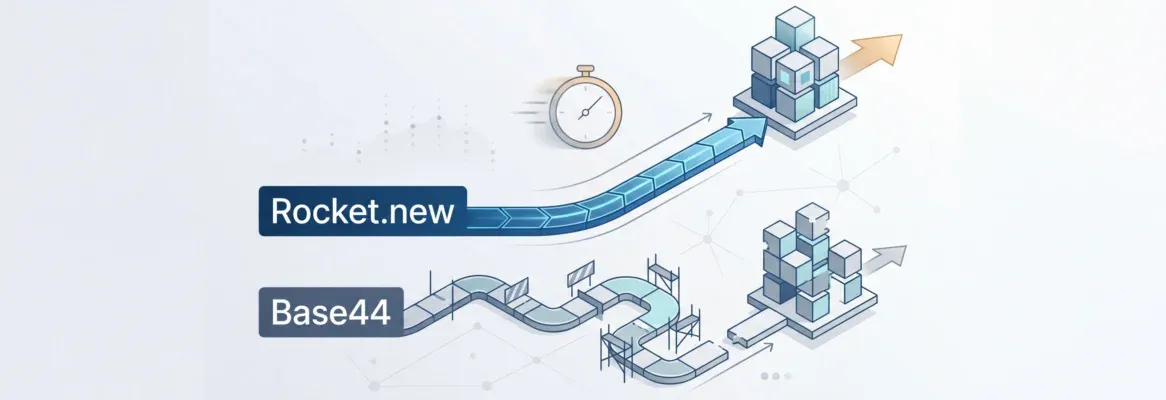
Rocket.new builds production-ready web and mobile apps faster with full-stack generation, code export, and scalability. Base44 works for simple web apps, but Rocket.new wins for speed, flexibility, and long-term growth.
Which AI App Builder Creates Apps Faster?
Which AI app builder creates production-ready apps faster?
Rocket.new does. It generates a working app from a single natural language prompt in minutes. The platform covers web apps and mobile apps with full backend logic already built in. No writing code required.
According to Gartner's forecast via Index.dev, 70% of new applications will use no-code or low-code tools by 2025. Here is what both platforms offer and which one wins.
- Rocket.new covers web and mobile apps from a single prompt.
- Base44 is web-only with a very limited free plan.
- The right AI app builder gets you from idea to working app in hours.
What These Two Platforms Are
Rocket.new and Base44 are both AI app builders. Both take natural language prompts and skip writing code.
But they go in different directions.
- Rocket.new is a vibe coding platform with full-stack app generation for web and mobile apps.
- Base44 is a web-first structured builder owned by Wix after an $80 million acquisition in mid-2025.
Both target non-technical users. The key difference is how much they actually deliver.
How AI App Builders Work
In simple terms, an AI app builder takes what you type and turns it into a real, working app. In contrast, traditional development often requires extensive coding, environment setup, and configuration, which can slow everything down, especially in the early stages. AI app builders flip that experience.
- Instead of starting with code, you start with an idea.
- You describe your app in natural language
- The platform generates the UI, backend logic, authentication, and database for you.
Many modern tools even support full-stack development in one place, handling everything from frontend screens to backend APIs and data storage.
This also makes AI app builders far more accessible for beginners. You don’t need deep programming knowledge to get started, which lowers the barrier to entry significantly. At the same time, most platforms still allow flexibility; you can tweak the generated code, connect API keys, or extend functionality when needed.
When is Traditional Development Necessary?
However, there’s a trade-off. While AI app builders dramatically speed up development, they can sometimes limit deep customization compared to traditional coding. For highly complex applications or edge-case requirements, traditional development methods may still be necessary to achieve full control and functionality.
That said, the shift is clear. The low-code and no-code market is growing rapidly, signaling a major move away from purely traditional development toward faster, AI-assisted approaches.
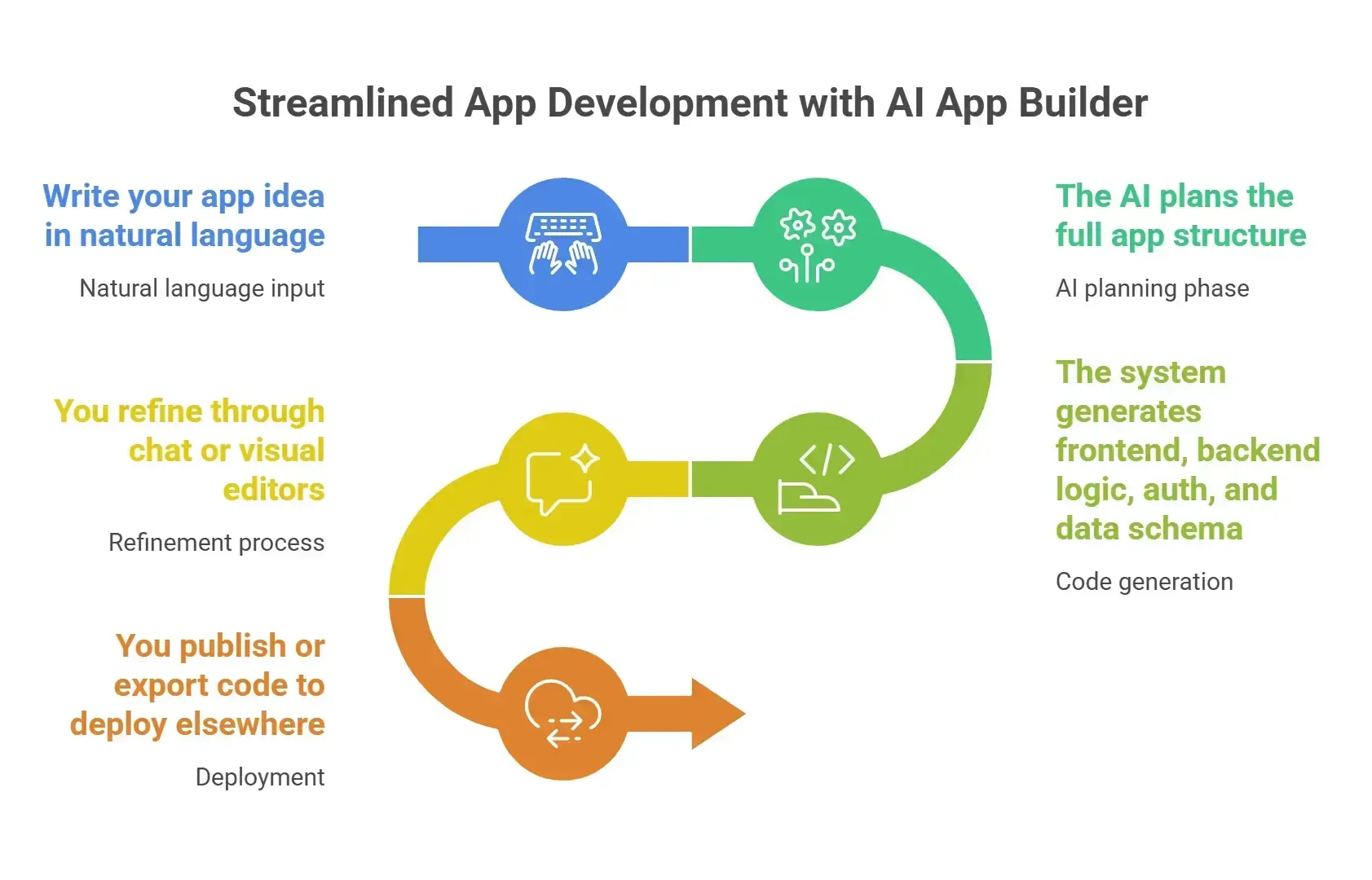
Standard App Generation Flow:
- Write your app idea in natural language.
- The AI plans the full app structure.
- The system generates frontend, backend logic, auth, and data schema.
- You refine through chat or visual editors.
- You publish or export code to deploy elsewhere.
This compresses weeks of app development into hours.
Vibe Coding: What Does it Actually Mean?
Vibe coding is building apps by describing intent rather than writing code line by line.
You describe what the app should do. The platform turns that into a working app with full-stack logic already in place.
Rocket.new leads this movement. It raised $15 million from Salesforce Ventures and Accel in September 2025, becoming one of India's fastest-growing vibe coding platform startups.
Key points:
- No writing code from scratch.
- AI today handles the full code generation stack.
- Vibe coding cuts app development timelines fast.
Rocket.new: The Vibe Coding Platform Built for Efficiency
When speed matters, Rocket.new is the standout AI app builder.
It converts natural language prompts into full-stack apps. Front-end, backend logic, auth, and database generated in one pass. Rocket.new works for startups, non-technical founders, developers, and agencies.
Why Rocket.new leads the field
Rocket covers both web apps and native mobile apps from one platform. You do not need two separate tools or two separate projects. The platform gives you the full underlying code and a complete code export from the start. No lock-in of any kind.
Top Features of Rocket.new
Core strengths:
- 25,000+ templates library: Free to use, start building in seconds.
- Flutter for native mobile apps: Generate iOS and Android apps from a prompt.
- Next.js for web apps: Production-ready web output from a description.
- Full-stack generation: Frontend, backend logic, database, and auth together.
- Code export: You own the generated code on every plan.
- Up to 80% token savings: Lower token consumption than most comparable tools.
- Collaboration tools: Build with your whole team.
- Version control: GitHub sync for proper code workflows.
- App store publishing: Push mobile apps to iOS and Android stores.
- Minimal setup: Describe the idea and go.
Rocket.new Use Cases
Here is where Rocket.new fits naturally:
- Startups doing rapid app generation: Validate ideas before custom development.
- Internal tools quickly: Build dashboards and admin panels without a dev team.
- Mobile applications for clients: Deliver native mobile apps and web apps together.
- Scalable AI systems: Supports AI-powered features from day one.
- Complex apps with layered roles: Handles multi-level backend logic and access control.
Base44: The Structured Web Builder
Base44 is a no-code platform that builds full-stack applications from natural language prompts. It includes built-in auth, database, and hosting. Wix's backing gives it real infrastructure support after the June 2025 acquisition.
Where Base44 Works Well
- Simple web apps and quick web-based MVPs.
- Non-technical teams want a guided prompt to the app experience.
- Internal tools and basic CRUD apps with low traffic.
- Projects with no native mobile requirement.
Where Base44 Falls Short
- No native mobile app support.
- Free plan capped at just 25 messages per month.
- Code export is gated to paid plans only.
- A security vulnerability in the auth was found in July 2025 (patched in 24 hours).
- Performance slowdowns at 200 or more concurrent users.
- Not suited for complex apps needing granular control.
Rocket.new vs Base44: Feature Comparison
| Feature | Rocket.new | Base44 |
|---|---|---|
| Web Apps | Yes (Next.js) | Yes |
| Native Mobile Apps | Yes (Flutter) | No |
| App Store Publishing | Yes | No |
| Full Stack Coverage | Yes | Yes (web only) |
| Natural Language Prompts | Yes | Yes |
| Code Export | All plans | Paid plans only |
| Free Plan | Yes | Yes (25 messages/month) |
| Paid Plans Start At | $25/month | $16/month |
| Templates Library | 25,000+ | Limited |
| Collaboration Tools | Yes | Limited |
| Token Savings | Up to 80% | Not stated |
| Version Control | GitHub sync | Builder plan only |
| Custom Domains | Yes | Builder plan only |
| Vibe Coding Platform | Full | Partial |
Efficiency: Who Gets to a Working App Quickly
Rocket.new wins on efficiency.
The platform handles every app layer in one generation pass, meaning your frontend, backend logic, auth, and database come together without jumping between tools or waiting on separate build steps. Everything moves forward at once, which makes the entire app development process feel seamless from the first prompt.
Efficiency comparison:
- Rocket.new produces full-stack output in one pass with minimal setup, so you spend less time configuring and more time building.
- Base44 works well for straightforward web apps, though complex projects benefit from more structured prompting to get the output just right.
- Rocket.new paid plans include token rollover, so any unused capacity carries forward and keeps your workflow running without interruption.
Mobile Apps: Where the Real Gap Shows
Rocket.new supports native mobile apps using Flutter. You can build mobile apps for iOS and Android from the same prompt. App store publishing is built into the workflow.
Base44 does not build native mobile apps. Web only.
Build mobile app details:
- Mobile apps are built alongside your web app in one project.
- Flutter-based native apps are ready for app store submission.
- Developers publish through Xcode or Android Studio.
App Generation Flow: Visual Overview
Here is how both platforms move from idea to a working app:
Backend Logic and Full Stack Apps
Both platforms handle backend logic. The depth differs.
- Rocket.new gives more flexibility for complex apps with layered logic.
- Base44 keeps backend logic inside its own ecosystem.
Rocket.new Backend Logic
Rocket.new generates full-stack apps with API routes, user auth, database, and server-side logic from a single prompt.
Backend highlights:
- Everything is fully wired from the first generation.
- Works with Supabase, Stripe, and Firebase.
- Backend logic adjusts through natural language prompts in chat.
Base44 Backend Logic
Base44 includes built-in backend logic with a generated database and user management. No external database is needed.
It is solid for web-focused full-stack applications. But the backend logic stays inside Base44's platform.
Backend points for Base44:
- Auth and database are built in from the start.
- Accessing and exporting full backend code requires paid plans.
- Works for standard CRUD apps but struggles with complex apps needing custom logic.
Internal Tools: Build What Your Team Needs
Both platforms work well for internal tools. Teams use them to build dashboards, trackers, and admin panels fast.
Rocket.new handles internal tools quickly with flexible backend logic and clean code export. You are not tied to one hosting environment.
Internal tools points:
- Rocket.new lets developers take exported code and host it anywhere they choose.
- Base44 is good for simple internal tools with straightforward data logic.
- As tools grow in complexity, Rocket.new gives developers far more room to work.
Code Export: Who Lets You Own Your App?
Code export determines long-term growth. Rocket.new gives you more flexibility.
- Rocket.new: Full code export on all plans. You always own the underlying code.
- Base44: Code export is gated to paid plans. Free users cannot access the generated code.
This key difference matters when your app needs custom hosting.
Free Plan and Paid Plans: The Full Picture
Both platforms offer a free plan. But the experience is very different.
Rocket.new Pricing
- Free plan: App generation with token-based limits.
- Personal: $25/month with 5M tokens and rollover.
- Rocket Plan: $50/month with 10.5M tokens for agencies.
- Paid plans include token rollover, so unused capacity carries forward.
Base44 Pricing
- Free plan: 25 messages and 500 credits per month.
- Starter: $16/month with unlimited app creation.
- Builder: $40 to $50/month with custom domains and GitHub access.
- Pro: $80 to $100/month for advanced features.
- Elite: $160 to $200/month for max credits and priority support.
- Paid plans use two separate credit systems: one for building, one for live user actions.
Base44's dual credit system adds budget complexity. Rocket.new's token consumption is simpler month over month.
Rapid App Generation: How the Platforms Compare
Key points when sizing up rapid app generation:
- Rocket.new delivers web apps and native mobile apps from one prompt.
- Base44 delivers web apps only.
- Code Rocket is known for clean, fast output that ships on the first pass.
- Token consumption is up to 80% lower on Rocket versus comparable ai tools.
- Both support no-code workflows. Rocket adds code export and code generation on top.
Scalability and Long-Term Growth
Both platforms launch you fast. But scaling is a different story.
- Rocket.new gives you full generated code to take anywhere.
- Base44 keeps growth inside its ecosystem.
Rocket.new on Scaling
Rocket.new supports long-term growth by giving you the full code from day one.
Scalability points:
- Code export lets you move to custom hosting anytime.
- Supports scalable ai systems through ai powered architecture.
- Clear deployment flexibility paths to grow beyond the platform.
Base44 on Scaling
Base44 supports growth within its ecosystem. Reports show performance slowdowns for apps approaching 200 or more concurrent users.
Scalability points:
- Works fine for lightweight apps and small-scale tools.
- Higher-paid plans increase limits for more active apps.
- Moving outside Base44 for custom hosting is not easy.
Community Feedback: What Real Builders Say
The Rocket.new community response has been strong and consistent.
A builder working on a more complex project noted:
"Rocket is working on an extremely complicated website with several APIs, databases and payment interfaces. Support has been amazing in helping me overcome major obstacles that seemed insurmountable." - Trustpilot
Community highlights:
- Trustpilot users rate Rocket.new above all other no-code tools they have tried.
- Developers praise its ability to generate a working app on the first prompt.
- Users with zero technical knowledge report shipping live apps within hours.
Who Should Use Rocket.new?
Rocket.new is the right choice for teams that prioritize both efficiency and long-term scalability. While many AI app builders focus only on quick outputs, Rocket.new balances rapid development with structured growth.
It is ideal for:
- Startups that need fast app generation across web and mobile apps, without sacrificing future scalability as their product evolves.
- Non-technical founders who want an accessible entry point into app development, while still having the flexibility to expand features over time.
- Agencies delivering web and native mobile apps for clients, especially when projects require integrations with third-party services and APIs.
- Developers who want AI-powered scaffolding with full customization control and code export, ensuring they are not limited as applications grow in complexity.
- Teams that rely on collaboration tools to build together and iterate quickly in a structured environment.
- Builders targeting app store publishing who need both speed and the ability to scale features for real users.
Who Should Use Base44?
Base44 is better suited for simpler, more structured use cases where efficiency is less critical than guided development.
It works best for:
- Builders creating simple web apps with no mobile requirements.
- Non-technical users who prefer a highly structured and guided setup, even if it limits flexibility.
- Internal tools and CRUD applications with low user traffic and limited scalability needs.
- Projects where the learning curve of Base44’s framework is acceptable.
However, when evaluating long-term needs:
- Customization options can be limited as your application grows
- Scalability for complex features may become a challenge
- Integration flexibility with modern APIs may not meet advanced requirements
If your project requires native mobile apps, deeper customization, scalable architecture, or flexible deployment, Rocket.new is the stronger choice.
The Final Call: Speed, Range, and Ownership
So what does the full picture tell us?
When evaluating Rocket.new vs. Base 44, which AI builder creates production-ready apps faster, Rocket.new leads on every dimension that matters for serious app development.
Base44 keeps things simple for web apps and is a decent starting point for non-technical teams with web-only needs.
Rocket.new is built for builders who want more. With a 25,000+ templates library, Flutter for mobile, Next.js for web, collaboration tools, and full code export, it is a stronger platform.
If you are ready to turn ideas into production-ready apps, start building on Rocket.new today.
Table of contents
- -What These Two Platforms Are
- -How AI App Builders Work
- -When is Traditional Development Necessary?
- -Standard App Generation Flow:
- -Vibe Coding: What Does it Actually Mean?
- -Rocket.new: The Vibe Coding Platform Built for Efficiency
- -Top Features of Rocket.new
- -Rocket.new Use Cases
- -Base44: The Structured Web Builder
- -Where Base44 Works Well
- -Where Base44 Falls Short
- -Rocket.new vs Base44: Feature Comparison
- -Efficiency: Who Gets to a Working App Quickly
- -Mobile Apps: Where the Real Gap Shows
- -App Generation Flow: Visual Overview
- -Backend Logic and Full Stack Apps
- -Rocket.new Backend Logic
- -Base44 Backend Logic
- -Internal Tools: Build What Your Team Needs
- -Code Export: Who Lets You Own Your App?
- -Free Plan and Paid Plans: The Full Picture
- -Rocket.new Pricing
- -Base44 Pricing
- -Rapid App Generation: How the Platforms Compare
- -Scalability and Long-Term Growth
- -Rocket.new on Scaling
- -Base44 on Scaling
- -Community Feedback: What Real Builders Say
- -Who Should Use Rocket.new?
- -Who Should Use Base44?
- -The Final Call: Speed, Range, and Ownership