
Rocket.new wins for complex backend logic with Next.js/Flutter output, four backend options, and an Advisor Agent that resolves error loops. Lovable wins on UI speed for simple prototypes. Choose Rocket.new for production apps; choose Lovable for fast frontend demos.
Quick verdict
- For complex backend logic: Rocket.new generates Next.js (web) or Flutter (mobile) with four backend options (Supabase, Airtable, Strapi, Directus) and an Advisor Agent that resolves error loops automatically.
- For rapid UI prototyping: Lovable delivers industry-leading frontend speed but is limited to Supabase as its only backend and struggles with complex server-side logic.
- For research + build + competitive intelligence in one platform: Rocket.new is the only tool here that combines Solve (market research), Build (app generation), and Intelligence (competitor monitoring) under one credit balance.
If you've spent any time in developer communities lately, you already know the vibe coding conversation is everywhere, on Reddit, LinkedIn, and in every Slack channel where builders hang out. And at the center of that conversation, one question keeps coming up: when it comes to Rocket.new vs Lovable for complex backend logic, which wins?
The short answer is that it depends on what you're building.
The longer answer is what this guide is for.
Both platforms represent the best of what AI-assisted coding can offer today: the ability to go from idea to live app without writing thousands of lines of code manually. But they make very different bets on what matters most. Understanding those differences could save you weeks of frustration and wasted credits.
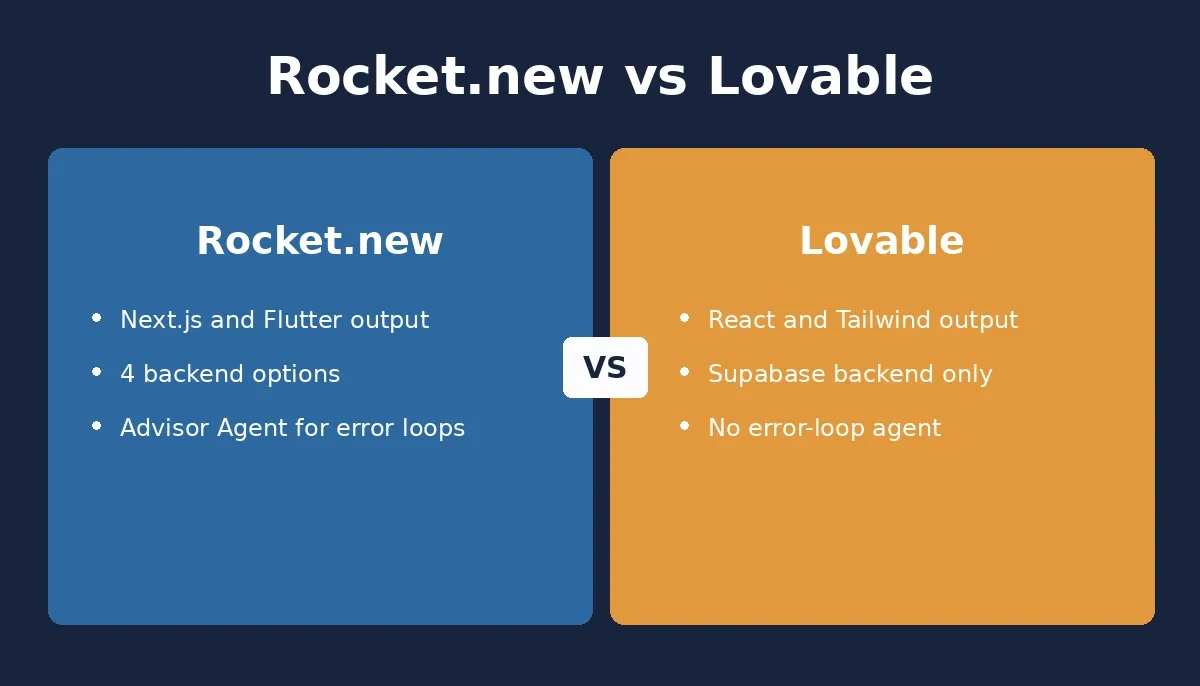
Rocket.new vs Lovable: key differences at a glance
What is Vibe Coding and Why Does it Matter?
Imagine describing your app idea in plain English and watching it come to life, no syntax, no Stack Overflow rabbit holes, no waiting on a developer who's already juggling three other projects. That's vibe coding, and it's quietly reshaping how software gets built.
Instead of writing code line by line, you tell the AI what you want, and it does the heavy lifting. Founders, product managers, and designers who once sat at the back of the dev queue can now spin up a working web app or dashboard in hours. The barrier to building isn't gone, but it's lower than it's ever been.
The numbers back this up. Over 76% of developers are already using or planning to use AI tools in their workflow. Vibe coding has moved from a curious experiment to a standard part of modern software development, especially for building full-stack apps with AI.
Here's the catch, though: not all vibe coding platforms are created equal. When your project is simple, most of them get the job done. But the moment your backend logic gets complex, the differences between platforms stop being subtle. They become expensive, time-consuming, and impossible to ignore.
Understanding Backend Logic: And Why it's the Real Test
Simple apps are easy. A landing page, a contact form, a basic dashboard- any decent AI tool can handle these. The real test comes when your app needs to do something genuinely complex on the server side.
Complex backend logic includes:
- Multi-step workflows: Order processing, payment flows, approval chains
- Custom validation: Rules that go beyond basic field checks
- Advanced error handling: Async operations, retries, graceful failure states
- Real-time features: Live notifications, collaborative tools, WebSocket connections
- Role-based access control: Different user types with different permissions
- Third-party integrations: APIs that require edge case handling and transaction management
This is where the question of which platform handles complex business logic better stops being theoretical and starts costing real money. Let's look at both platforms through that lens.
How each platform routes a prompt through to output
Rocket.new: Full-Stack Generation Without the Friction
Rocket.new is a fully integrated vibe solutioning platform built around three pillars: Solve (market research and PRDs), Build (the AI app generator), and Intelligence (competitor monitoring). For this comparison, the focus is on Build, but it's worth knowing that Rocket.new is the only platform in this category that ships all three capabilities under one credit balance.
Within Build, Rocket.new takes users from a raw idea to a live, production-ready web or mobile app through a simple loop: describe, build, refine, ship. Specifically, Build generates production-ready Next.js for web apps and Flutter for mobile apps, structured deployable codebases with routing, authentication, and data layers wired in from the start.
Key Features of Rocket.new Build
- Natural language prompts to full-stack output: Describe your app, get a working Next.js or Flutter codebase
- Four backend options: Supabase, Airtable, Strapi, and Directus, giving genuine choice over your data layer
- Advisor Agent: A built-in senior architect sub-agent that diagnoses root causes, resolves error loops, and makes architectural decisions so the coding agent never gets stuck
- 26+ production connectors: Stripe, OpenAI, Anthropic, Gemini, Razorpay, HubSpot, Twilio, Resend, Mixpanel, GitHub, Figma, and more, wired from a single prompt
- Mobile apps and web apps: Next.js for web, Flutter for Android and iOS, deployable to the App Store and Google Play
- Custom domains: Publish with branded domains out of the box
- Code export and GitHub sync: Full ownership with two-way sync to your existing repo
- Dashboards, internal tools, and SaaS apps: All supported from a single platform
- Solve and Intelligence: Research markets before you build, monitor competitors after you ship
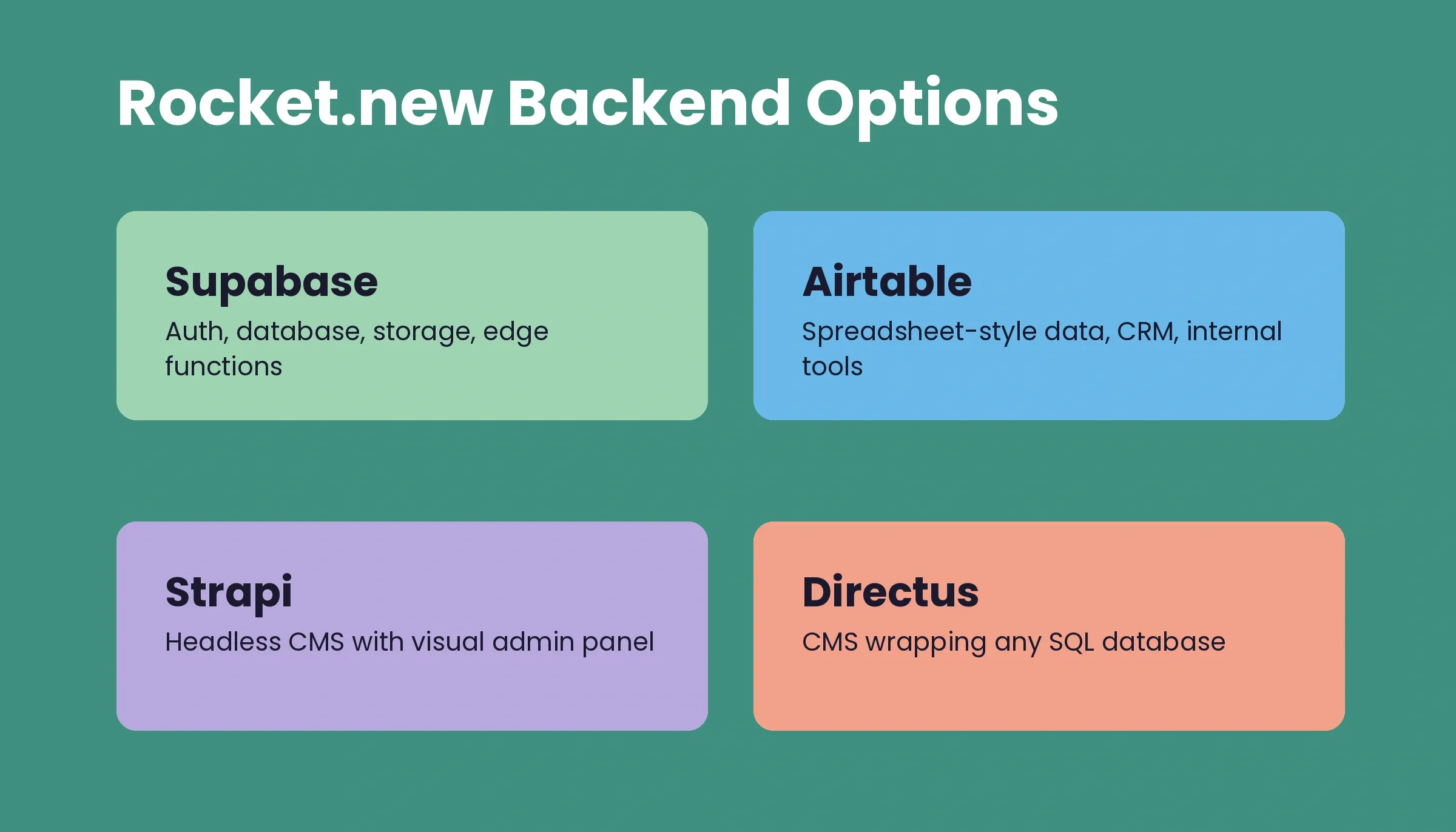
Rocket.new supports four backend integrations, each suited to different use cases
What Sets Rocket.new Apart for Backend Logic
The real differentiator is backend breadth combined with workflow orchestration. While both Rocket.new and Lovable support Supabase, Rocket.new also supports Airtable, Strapi, and Directus, giving teams the right data layer for each use case rather than forcing everything through one provider.
The Advisor Agent is the other critical differentiator. When a build hits a complex error or architectural decision, the Advisor Agent steps in automatically to diagnose root causes and resolve loops.
It runs on the most capable model available (Claude Opus), operates in read-only mode, and returns structured analysis: root causes, a recommendation, numbered implementation steps, and a trade-off table. This is the specific failure mode that makes complex backend logic painful in most AI builders, and Rocket.new has a dedicated sub-agent to address it.
One builder's side-by-side test using the same prompt across both platforms found: "one gave me a pretty shell, the other gave me a working product with backend, logic, and UI." - Nelly on X
One honest caveat: Rocket.new's credit consumption can be hard to forecast on large initial builds, and some users report needing multiple iterations before a complex feature lands correctly. These are real friction points worth factoring into your planning.
When to Choose Rocket.new
- You need production-ready Next.js or Flutter code, not a prototype
- Your app involves complex backend logic, multi-step flows, or advanced integrations
- You want four backend options rather than being locked into one provider
- You need the Advisor Agent to handle error loops without manual intervention
- You want Solve (research) and Intelligence (competitor monitoring) alongside your build workflow
Lovable AI: The UI-First Rapid Prototyper
Lovable AI is an AI-powered app development platform that helps users create complete web applications from natural language prompts. Lovable is designed to turn text prompts into complete, deployable applications without requiring coding knowledge, and it's very good at exactly that.
Lovable generates a React and Tailwind CSS frontend with Supabase handling all backend services, including a PostgreSQL database, authentication, and file storage. For rapid prototyping, client presentations, and visual design iteration, it is genuinely hard to beat.
Key Features of Lovable
- Speed: Industry-leading UI generation from natural language
- Supabase integration: Automatic PostgreSQL database and authentication setup
- Visual interface: Modify designs, content, and logic without touching code
- One-click deployment: Get a live app in minutes
- Team collaboration: Built-in multi-user support
- Chat-based interface: Extremely fast setup of standard backend features like user login and data storage
If your app is frontend-heavy and your backend needs are standard CRUD, Lovable is a strong choice. For AI-powered rapid prototyping, it consistently delivers polished results faster than most alternatives.
Where Lovable vs Complex Backend Logic Gets Difficult
Lovable's backend is Supabase, full stop. There is no Airtable, no Strapi, no Directus. If your data model or CMS requirements don't fit Supabase's structure, you are working around the platform rather than with it.
Beyond the single-provider constraint, Lovable is optimized for rapid prototyping and visual iteration but requires more manual intervention for complex backend logic. Many users run into a frustrating looping problem: the AI gets stuck trying to fix a bug, cycles through old errors, and burns through paid credits without resolving the issue. Unlike Rocket.new's Advisor Agent, Lovable has no dedicated architectural sub-agent to break out of these loops.
There's also a documented security concern: a 2025 audit found that 10.3% of Lovable-generated apps had critical row-level security flaws in their Supabase configurations, not edge cases, but apps handling real user data with exploitable access gaps.
When to Choose Lovable
- You need a rapid prototype or MVP with minimal backend complexity
- UI speed and visual polish are the top priority
- You're doing client presentations or design iteration
- Your project involves standard CRUD operations and simple data flows backed by Supabase
- You want a no-code-friendly experience with strong team collaboration
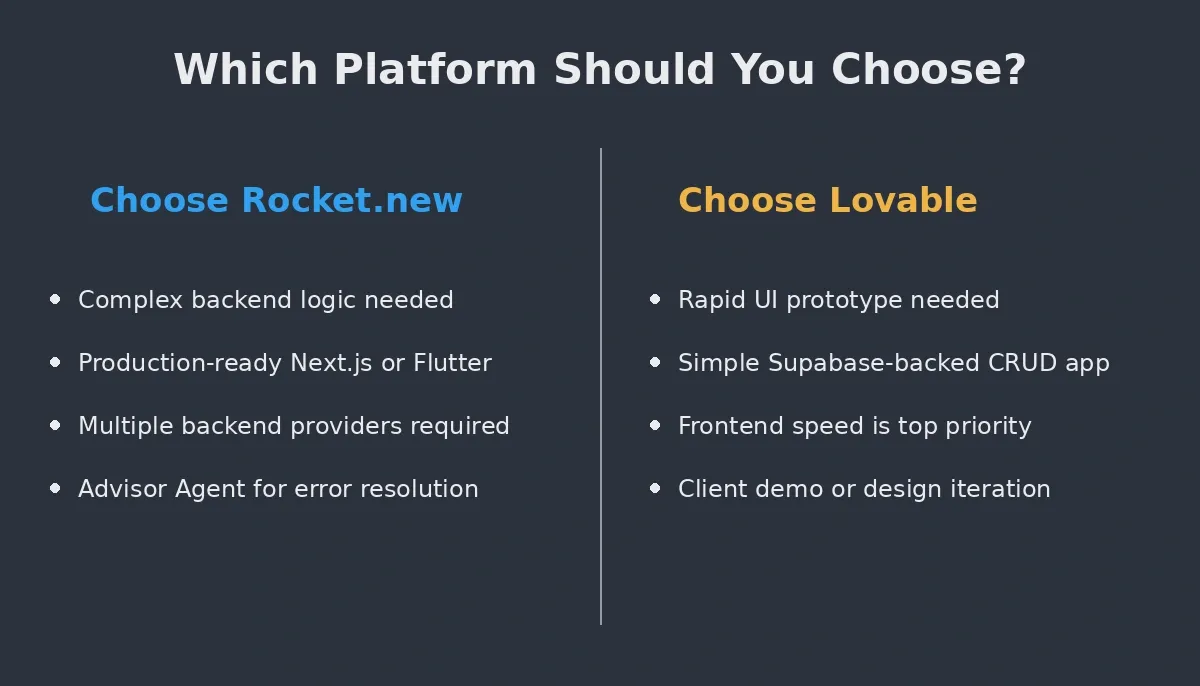
Use this as a quick decision guide before committing to either platform
Rocket.new vs Lovable: Side-by-Side
The table below uses sourced specifics rather than subjective characterizations, so every row can be verified against official documentation.
| Feature | Rocket.new | Lovable AI |
|---|---|---|
| Backend Options | Supabase, Airtable, Strapi, Directus (4 options) | Supabase only |
| Output Stack | Next.js (web), Flutter (mobile) | React + Tailwind CSS (web only) |
| Backend Logic Depth | Advanced; Advisor Agent resolves error loops automatically | Basic; struggles beyond standard CRUD, no error-loop agent |
| UI Generation Speed | Excellent | Industry-leading |
| Production Ready Code | Yes, architecture built to scale | Better for prototypes; can produce unmaintainable code at scale |
| Real-time Features | Supported natively via Supabase edge functions | Requires external solutions |
| Connectors | 26+ (Stripe, OpenAI, Twilio, HubSpot, Razorpay, and more) | Good API support, manual setup needed |
| Custom Domains | Yes | Yes |
| Mobile Apps | Yes (Flutter, App Store and Google Play) | Limited |
| Code Export / GitHub Sync | Full ownership, two-way GitHub sync | Full repo export |
| Error Loop Resolution | Advisor Agent (Claude Opus, read-only analysis) | Manual intervention required |
| Security Defaults | Stronger architecture; RLS configured from chat | 10.3% of apps had critical RLS flaws (2025 audit) |
| Platform Scope | Solve + Build + Intelligence (one credit balance) | Build only |
| Pricing (entry paid) | $25/mo (Pro, 100 credits/mo) | $25/mo (Pro) |
| Best For | Full-stack, production-ready applications with complex backend logic | Rapid prototyping, MVP, UI-focused builds |
Pricing Overview
Lovable runs on a credit-based consumption model:
- Free plan: 5 daily credits (30/month cap)
- Pro plan: $25/month, higher limits, credit rollover
- Business plan: $50/month
- Complex requests consume significantly more credits than simple UI tweaks
- Debugging AI-introduced bugs can drain credits fast, with no guaranteed resolution
Rocket.new uses a credit-based model across four tiers, with annual billing saving 20%:
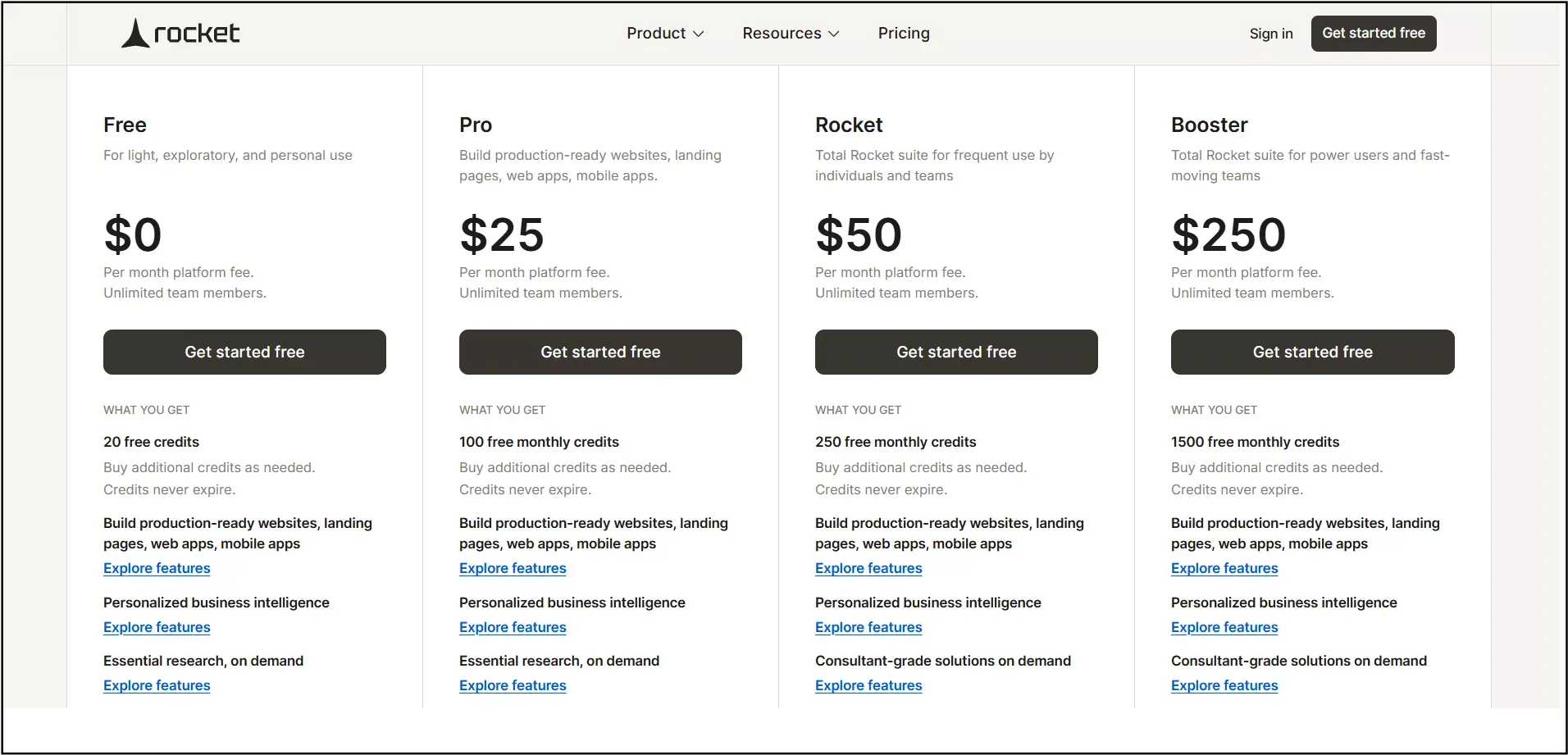
Rocket.new's four pricing tiers, all sharing one credit balance across Solve, Build, and Intelligence
| Plan | Price | Credits/month | Includes |
|---|---|---|---|
| Free | $0 | 20 (one-time) | Build + Light Solve |
| Pro | $25/mo | 100 | Build + Light Solve |
| Rocket | $50/mo | 250 | Build + Full Solve + Intelligence |
| Booster | $250/mo | 1,500 | Build + Full Solve + Intelligence + premium support |
All paid plans include unlimited team members. Credits can be topped up on any plan at any time.
Rule of thumb: For simple MVPs, both platforms' $25/mo Pro plans are comparable on credit budget. Projects with complex backend logic should budget for the Rocket plan ($50/mo, 250 credits) or higher, since complex builds consume more credits per iteration and benefit from Solve research and Intelligence monitoring.
For a detailed breakdown of how credits work across all three pillars, see the Rocket.new pricing guide.
The Security and Code Quality Reality
AI-assisted coding introduces quality risks that are easy to underestimate. A December 2025 study on AI code quality found that AI co-authored code contains roughly 1.7x more major issues than human-written code, including 75% more misconfigurations and 2.74x more security vulnerabilities. AI-generated code can sometimes miss nuance in complex enterprise applications, making human review non-negotiable for business-critical logic.
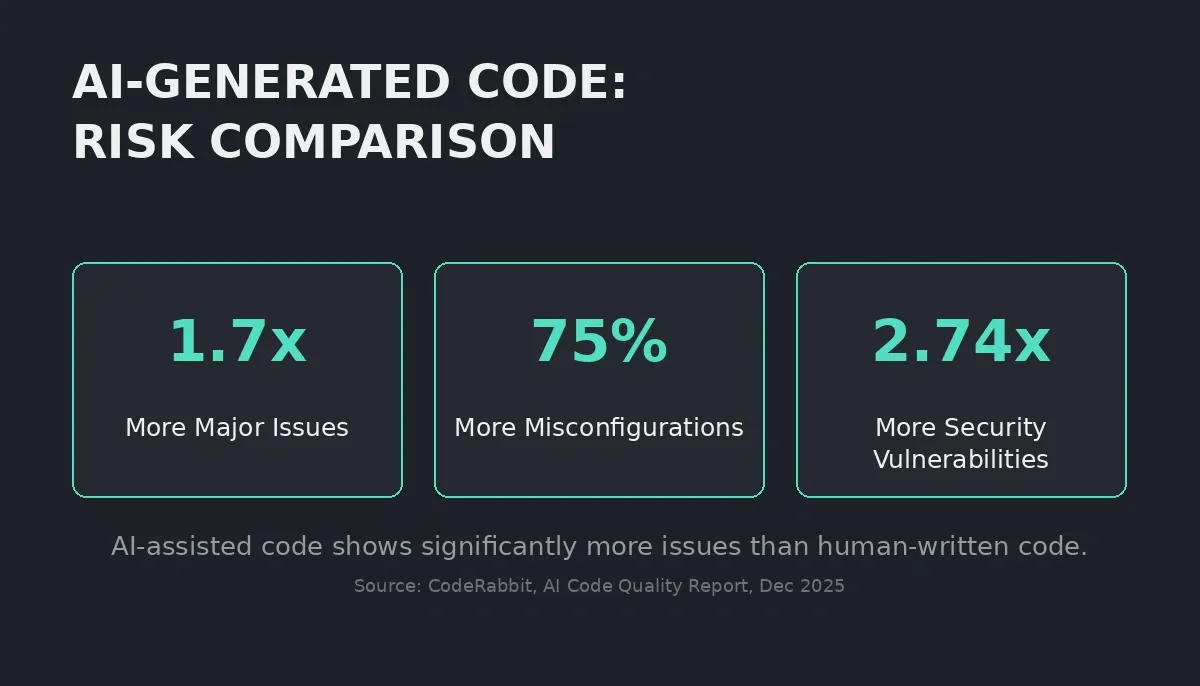
Key risk metrics from a December 2025 study on AI co-authored code quality
Whatever platform you use, these practices apply:
- Run tests with automated suites before deploying AI-generated code
- Scan for security vulnerabilities as a standard step
- Keep human review in the loop for business-critical and security-sensitive logic
- Use staged deployment to catch problems before they reach production
Rocket.new's docs include a dedicated security checklist for Build apps covering API key protection, authentication configuration, row-level security, and user data handling. For teams building apps that handle sensitive data, the web application security best practices guide is also worth reviewing before launch.
Alternatives Worth Knowing
If neither platform fits your needs precisely, the ecosystem has strong options.
Emergent stands out as an advanced AI-powered full-stack vibe-coding platform that enables both non-coders and experienced developers to build production-ready applications using natural language prompts. Emergent automates frontend, backend, database, hosting, authentication, and deployment in a single browser-based workspace, making it a compelling option for teams that need enterprise-grade scalability.
Cursor is an AI-first code editor built to make software development faster, smarter, and more collaborative. Cursor helps developers write, refactor, debug, and understand complex codebases through intelligent chat, autocomplete, and inline editing. Best for experienced developers who want AI assistance without giving up control.
Windsurf is an AI-powered development environment with a built-in AI assistant that understands context across entire projects. Good for developers who want deep AI integration in a traditional IDE workflow.
Firebase is Google's comprehensive backend-as-a-service platform designed to help developers build, deploy, and scale applications faster. Firebase's Real-Time Database and Firestore automatically sync data between users and devices. A strong standalone backend option for teams building custom frontends.
For a deeper look at how Rocket.new compares across the full competitive landscape, the Rocket.new vs Lovable comparison page and the AI app builder guide cover additional use cases and scenarios.
The Future of AI-Powered App Development
The future of app development is simple: AI handles the repetitive work, humans handle the judgment calls. Boilerplate, scaffolding, and routine logic go to the AI. Architecture, security, and critical decisions stay with the developer.
Human oversight isn't disappearing; it's just shifting upstream. The platforms that get this balance right will define what software development looks like next. Rocket.new's three-pillar structure (Solve, Build, Intelligence) reflects this shift: research before you build, build with production architecture, monitor after you ship.
For teams ready to move beyond single-purpose tools, the Rocket.new Build overview explains how all three pillars connect in practice.
Key Takeaways
- Vibe coding is now a standard part of modern software development; both Rocket.new and Lovable AI are leading examples of what's possible
- Rocket.new is the stronger choice for complex backend logic, full-stack projects, and production-ready applications that need to scale, generating Next.js and Flutter with four backend options and an Advisor Agent
- Lovable AI excels at rapid prototyping, UI generation speed, and frontend-heavy MVPs, but is limited to Supabase as its only backend and requires more manual intervention as complexity grows
- The backend differentiator is not that Rocket.new uses a different engine; it's that Rocket.new offers four backend options vs. Lovable's one, plus workflow orchestration and an architectural agent on top
- Many users find value in combining both: Lovable for early UI iteration, Rocket.new for backend depth and production readiness
- Security and code quality require active human oversight, regardless of which AI-powered platform you use
- The right tool depends on one core question: are you testing an idea, or building something built to last?
If you're ready to move beyond prototypes and build something that actually scales, Rocket.new is where serious builders start.
If you're serious about building apps that hold up under real-world conditions, Rocket.new delivers the backend depth, production architecture, and integration support that complex projects demand. Sign up for Rocket.new and ship your first production-ready app today.
Table of contents
- -What is Vibe Coding and Why Does it Matter?
- -Understanding Backend Logic: And Why it's the Real Test
- -Rocket.new: Full-Stack Generation Without the Friction
- -Key Features of Rocket.new Build
- -What Sets Rocket.new Apart for Backend Logic
- -When to Choose Rocket.new
- -Lovable AI: The UI-First Rapid Prototyper
- -Key Features of Lovable
- -Where Lovable vs Complex Backend Logic Gets Difficult
- -When to Choose Lovable
- -Rocket.new vs Lovable: Side-by-Side
- -Pricing Overview
- -The Security and Code Quality Reality
- -Alternatives Worth Knowing
- -The Future of AI-Powered App Development
- -Key Takeaways