
Rocket.new and Lovable are both AI app builders for non-technical founders, but they serve different goals. Lovable is fast for visual prototypes and investor demos. Rocket.new generates complete, production-ready applications from a single prompt, handling backend logic, scalability, and deployment from day one. If you are building something real users will pay for, Rocket.new starts where Lovable stops.
You have an app idea. You do not write code. So, which AI app builder do you pick?
If you have been researching your options, you have probably landed on the same two names: Rocket.new and Lovable. Both promise to let non-technical users build real web apps using natural language prompts. Both are getting a lot of attention in the startup founder community. But they are not the same product, and picking the wrong one can cost you serious time.
A large-scale 2025 AI productivity survey of 1,750 tech workers found that 78% of founders report AI has exceeded their expectations, with half saying it saves them over 6 hours per week, the highest of any role surveyed. Substack, Lenny's Newsletter, December 2025.
The question is not whether AI app builders matter. They clearly do. The question is which one gets you to real users, real revenue, and real scale.
What Are AI App Builders and Why Do AI App Builders Matter?
AI app builders are platforms that let non-technical users create functional web apps, mobile apps, or internal tools using plain language, without writing code. You describe what you want, the platform generates the code, and you get a working app.
Here is what a modern AI app builder typically handles:
-
Frontend layout and UI generation from natural language prompts
-
Backend logic, database connections, and API setup
-
Authentication, payments, and third-party integrations
-
One-click deployment to production environments
-
Version history and code export for when a developer needs to take over
Why do AI app builders matter right now?
Because the alternative is hiring a developer, spending $15,000 to $80,000, and waiting months to validate an app idea that might not work. These platforms compress that timeline into hours, not weeks.
How Do AI App Builders Help You Go from Idea to Working App Faster?
The use of AI in app development can accelerate the process, enabling teams to go from idea to working app in a matter of hours instead of weeks.
But the shift AI brings to app development is not just speed. It is the scope. These platforms handle backend logic, code generation, and deployment, so you focus entirely on functionality and design rather than infrastructure.
Teams that used to need a full-stack engineer, a designer, and a DevOps person can now ship a working app with one non-technical founder and a clear prompt. Here is who benefits most:
-
Startup founders can ship production-ready apps in days instead of months
-
Small teams can build and test multiple product directions without a developer on payroll
-
Non-technical users can own the full stack, from idea to deployed product, with no dependencies
-
Operators and consultants can build internal tools for their own workflows without waiting on IT
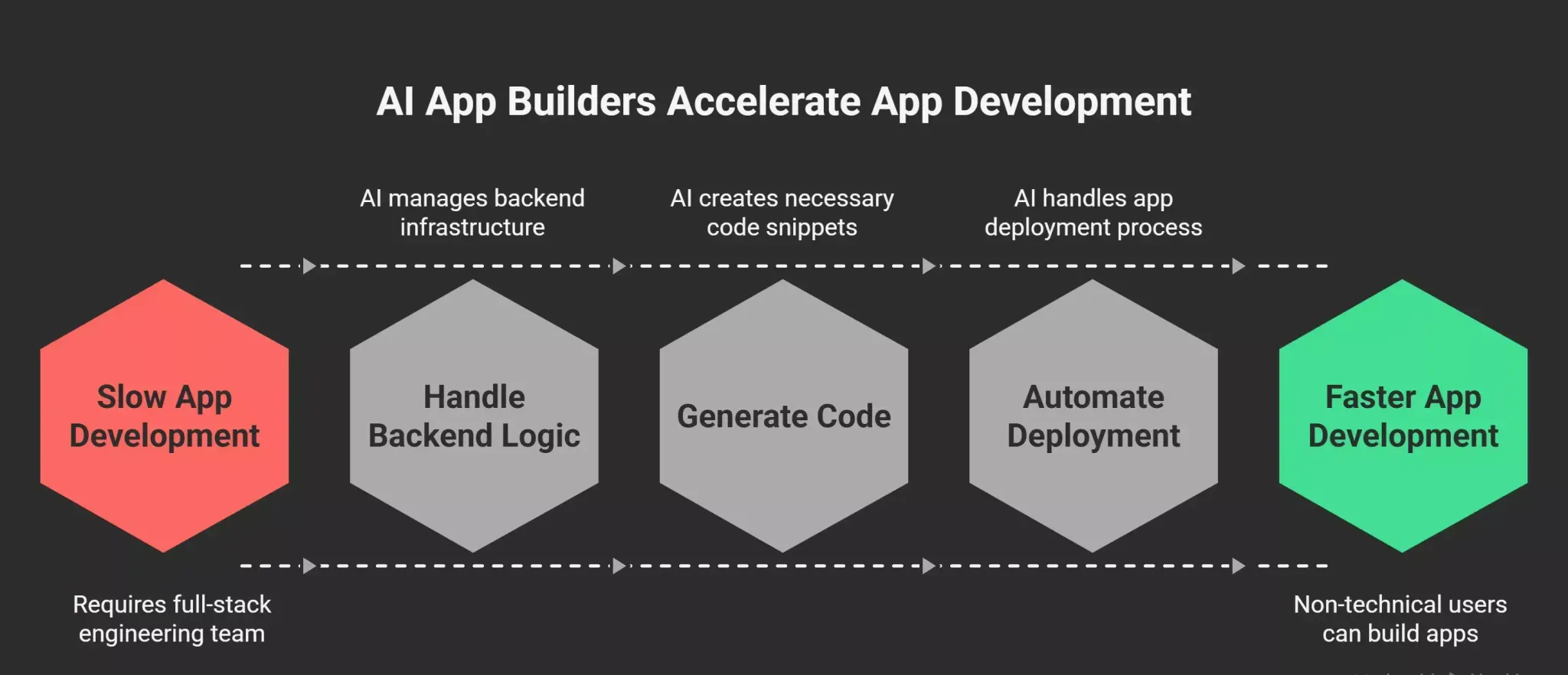 Many AI app builders are great at prototyping but struggle with production-ready code, which is essential for applications that need to function reliably at scale.
What are the Key Differences Between Rocket.new and Lovable?
Goal-to-Platform Mapping
| Your goal | Best platform | Why it works |
|---|---|---|
| Validate an idea quickly with a visual demo | Lovable | Rapid UI prototyping is great for investor presentations |
| Ship a production app that real users can pay for | Rocket.new | Production-ready code with backend logic from the first generation |
| Build web apps and landing pages fast | Either | Both platforms handle web apps and landing pages well |
| Build mobile apps or internal tools | Rocket.new | Broader use case support, including mobile apps and internal dashboards |
| Research the market before building anything | Rocket.new | Solve feature evaluates market problems before app development begins |
| Quick demos and rapid prototyping | Lovable | Built for iterative UI design and quick visual output |
| Build SaaS products for long-term scalability | Rocket.new | Structured for maintainability, avoids the technical debt trap |
Feature Breakdown
| Feature | Rocket.new | Lovable |
|---|---|---|
| App creation approach | Full app from one comprehensive prompt | Iterative prompting over multiple cycles |
| Production-ready output | First generation | After refactoring cycles |
| Backend logic | Built in from the start | Via Supabase integration |
| Mobile apps | Supported | Limited |
| Internal tools | Supported | Limited |
| Code export and code ownership | Full code ownership | Available |
| GitHub sync and GitHub integration | Supported | Supported |
| Visual editor | Available | Strong |
| Strategic planning before building | Solve feature | Not available |
| Pricing from | Free / $25/mo Build plan | Free tier available |
Tip: Focus on what happens after the demo. A polished-looking prototype that cannot handle real users, real data, or real payments is not a product. It is a slide. If you are building something that needs to scale, start with a platform that produces output structured for that goal.
Steps to pick the right platform:
-
Define your goal: investor demo or real users paying you money?
-
Check your use case: is it web app-only, or do you need mobile apps or internal tools too?
-
Consider your timeline: one complete build or rapid prototyping with many iterations?
-
Think about code ownership: will a developer need to take over eventually?
-
Evaluate long-term scalability: can the platform grow with your business without switching tools?
Step-by-Step: How to Start App Development with Rocket.new
Here is exactly how a non-technical founder ships a production-ready SaaS product using Rocket.new, starting from zero.
-
Run Solve first. Before touching the builder, use Rocket's Solve feature. Type your business problem in plain language. Solve evaluates the market, identifies the real problem worth solving, and gives you a structured direction. This step alone saves founders from building the wrong thing.
-
Write your comprehensive prompt. Describe your full app idea in detail: what it does, who it is for, what key features it needs, and how it should behave. Rocket generates the complete full-stack application from this single prompt.
-
Review the first-generation output. Rocket produces production-ready code from the start. The AI-generated code includes a clean, secure, and scalable architecture with built-in error handling. Review it in the visual editor or code view.
-
Connect your integrations. Add Stripe for payments, Supabase for your database, GitHub for version history and code sync, or any of Rocket's 25+ connectors directly from the App Studio.
-
Test in staging, then deploy. Rocket gives you separate staging and production environments. Test with real users before going live. One-click deployment handles the rest.
-
Iterate with natural language prompts. Any changes go through the chat interface. Type what you want updated in plain language. No code required.
The full flow takes hours, not weeks. You move from idea to deployed working app in the same session.
Who Uses These AI App Builders? Real Examples by User Type
| User type | What they want to build | How the right AI app builder helps |
|---|---|---|
| Startup founders | SaaS products with subscriptions and user accounts | Rocket.new ships production-grade applications with auth, payments, and backend logic from the first build |
| Freelancers and creatives | Client portals, booking apps, landing pages | Lovable handles rapid prototyping for quick demos; Rocket.new handles the ones that go live |
| Small business owners | Booking systems, inventory tools, customer portals | Full-stack generation with no developer needed means complete ownership from day one |
| Coaches and consultants | Client dashboards, course platforms, internal tools | Natural language prompts handle the full app idea without writing code or managing a team |
| Operators and teams | Internal dashboards, workflow automation, and reporting tools | Rocket.new builds production-ready internal tools with role-based access and team collaboration |
Across all user types, the shared outcome is the same: a working app that serves real users, without a developer on retainer.
What Real Users Say About These AI App Builders
The clearest signal on which platform suits which founder comes from people already using them.
"Rocket.new is surprisingly smooth for creating internal tools. The AI agent setup saves me hours of boilerplate work, and the vibe coding interface is pretty addictive."- Reddit user, r/vibecoding
"I built PostRight using Rocket, and the experience exceeded my expectations. The platform enabled me to build a professional SaaS with zero SEO errors and 96% site health straight out of the build, no developer required."- Verified reviewer, Trustpilot
"I tested Rocket vs Lovable using the same prompt; one gave me a pretty shell, the other gave me a working product with backend, logic, and UI." - Community user, Source
Community discussions on Reddit's r/vibecoding and the Rocket Discord show the same pattern: founders reach for Lovable for early demos, then move to Rocket when they need production-ready output that real users can depend on.
Why Rocket.new is Built for Founders Who Are Building Real Businesses
Most app builders start after the hardest decision has already been made. Rocket starts before it. 1.5 million people have tried Rocket across 180 countries.
Key features of Rocket:
-
Solve evaluates market problems and gives you strategic direction before a single line of app code is written
-
Build generates complete, full-stack applications, including frontend, backend logic, and deployment from one comprehensive prompt
-
Intelligence monitors your competitive landscape continuously, so you know when the market shifts
-
Visual editor lets you tweak layouts, colors, and components in real-time after the app is generated
-
Version history and separate staging and production environments give you full control over releases
-
GitHub integration and code export mean you own the code and can hand it off to a developer whenever you need
-
25+ connectors, including Stripe, Supabase, Figma, Resend, Twilio, Google Analytics, and AI providers like Anthropic, OpenAI, and Gemini
-
SEO, WCAG, and GDPR compliant builds out of the box
-
Unlimited team members on every paid plan with role-based access management
How Rocket.new applies to real business use cases:
-
Founders building SaaS products get production-grade applications with authentication and payment logic from the first generation, not after three rounds of refactoring
-
Teams building internal tools get maintainable code they can hand to a developer without a rebuild
-
Non-technical founders building mobile apps get full-stack output that goes beyond what most AI app builders support
-
Operators validating market problems before building use Solve to make sure the app idea is worth the app development time
Pricing starts free with 20 credits. The Build plan runs $25 per month with unlimited team members. The Solve plus Build plan runs $250 per month and adds strategic intelligence. Credits never expire. No per-seat pricing.
So, Which Platform Should You Choose?
Here is the straight answer. If you need a high-fidelity prototype for a pitch or an investor meeting, Lovable handles that job quickly. Lovable focuses on speed and visual design, and that is a real advantage for early-stage validation and quick demos.
But if you are building something that needs to serve real users, process real data, handle payments, and grow over time, the choice is different. Production apps need maintainable code, strong backend logic, and an architecture that does not fall apart when you try to scale.
For non-technical founders building real businesses, the Rocket vs lovable, which is better for non-technical founders building real businesses question comes down to one thing: are you building for a deck, or building for real users?
Rocket.new generates complete full-stack applications from a single prompt, starts with strategic validation through Solve, and produces production-ready output that does not require a rebuild when your business grows. Try it free at Rocket. No credit card required.
Start now, build your first app.
Table of contents
- -What Are AI App Builders and Why Do AI App Builders Matter?
- -How Do AI App Builders Help You Go from Idea to Working App Faster?
- -What are the Key Differences Between Rocket.new and Lovable?
- -Goal-to-Platform Mapping
- -Feature Breakdown
- -Step-by-Step: How to Start App Development with Rocket.new
- -Who Uses These AI App Builders? Real Examples by User Type
- -What Real Users Say About These AI App Builders
- -Why Rocket.new is Built for Founders Who Are Building Real Businesses
- -So, Which Platform Should You Choose?