
Comparing Rocket.new vs Lovable for SaaS apps? Rocket.new wins on scalability with cleaner AI generated code, included hosting, and production-grade backend support. Lovable excels at rapid prototyping and visual polish. See the full breakdown of pricing, code quality, features, and which platform grows with your SaaS.
If you are comparing Rocket.new vs Lovable for SaaS apps, which scales better?
Here is the short answer, Rocket.new wins on scalability. It is built for production-grade software from day one, not just rapid prototyping. The right choice between Rocket.new and Lovable depends on what you are building and how you like to budget, but if long-term growth is the goal, Rocket.new is designed for exactly that.
The low-code and AI platform market is projected to hit $65 billion by 2027. Both Rocket.new and Lovable are riding that wave. The real question is not which one looks better. Which one still performs when you have 10,000 paying customers depending on it every day?
What is Rocket.new?
Rocket.new is a vibe solutioning platform. You describe your idea using natural language prompts, and the platform handles the rest: frontend, backend logic, database schema, authentication, and deployment.
It is intended for developing production-grade applications with complex backend requirements, supports code generation in multiple programming languages, and gives experienced developers direct access to customize and extend their projects. Since launch, it has reached 400,000 users in 180 countries, with over 10,000 paid subscribers.
Key Features of Rocket.new
Rocket.new comes packed with key features built around the idea that launching is just the beginning.
-
Prompt-to-App Creation: Describe your app using natural language and Rocket.new generates the full stack, including frontend, backend, database, auth, and APIs
-
Figma Import: Convert design files into live, editable layouts instantly
-
AI-Powered Backend: Handles backend logic, data models, and workflows automatically
-
Custom Domain Support: Publish with your own branded domain, included in the subscription
-
Code Export: Full code access for experienced developers to customize later
-
One Click Deployment: Go live without dealing with server management or infrastructure
-
AI Agents: Specialized AI agents handle different parts of the build process
-
Multi-Page Generation: Build complex, multi-page apps from a single browser-based workspace
-
Internal Tools Support: Generate admin dashboards, analytics panels, and team tools
-
Instant Generation: Go from idea to working app in minutes
-
Multi-Language Support: Generate code across multiple programming languages and frameworks
What Is Lovable?
Lovable is an AI-powered app development platform that helps users create complete web applications from natural language prompts. Originally built on the open-source GPT Engineer project, it has grown into a major player in vibe coding. The platform raised $330 million at a $6.6 billion valuation with over 25 million projects created.
Lovable automatically generates frontend, backend, and database logic from natural language prompts without requiring manual coding. It provides a visual interface where users can modify designs, content, and logic, offers built-in hosting and deployment, and is especially friendly for non-technical users who want to move fast.
Key Features of Lovable
-
Full-stack generation from natural language prompts
-
Visual editor with a select tool for design control
-
Built-in hosting and one-click deployment
-
Supabase-based database schema and backend
-
GitHub sync and code export
-
Real-time collaboration features for up to 20 users (launched February 2026)
-
Custom domains on paid plans
-
Free plan with 5 messages per day
Quick Comparison: Rocket.new vs Lovable
| Feature | Rocket.new | Lovable |
|---|---|---|
| Full Stack Generation | Yes | Yes |
| Natural Language Prompts | Yes | Yes |
| Mobile App Support | Web + Mobile | Web-focused |
| Figma Import | Yes | No |
| Multi-Page Generation | Strong | More limited |
| Internal Tools | Supported | Limited |
| Built-in Hosting | Included in subscription | Separate cloud charges |
| Backend Complexity | Complex schemas supported | Supabase-based |
| Code Access | Full direct access | GitHub sync |
| Visual Editor | Yes | Yes |
| Starting Price | $25/month | $25/month |
| Free Plan | Yes | Yes (5 credits/day) |
| Vibe Coding | Core feature | Core feature |
| Multiple Programming Languages | Yes | React/TypeScript focused |
Ready to build a SaaS that scales? Try Rocket.new for free and go from idea to production-ready app without the rewrite trap.
Development Speed: Both Are Fast, But for Different Reasons
Both platforms deliver 10 to 20x faster creation cycles than traditional development. That is not a marketing claim. Real users building real web apps consistently confirm it. The difference shows not on launch day but in the weeks and months that follow.
| Rocket.new | Lovable | |
|---|---|---|
| Speed vs Traditional Dev | 10 to 20x faster | 10 to 20x faster |
| Best For | Quick launches with production-ready foundations | Rapid prototyping and UI creation |
| Minimal Setup | Yes | Yes |
| Full-Stack in Minutes | Yes | Yes |
| Long-Term Viability | Strong | Hits limits at scale |
Lovable excels at rapid prototyping and UI creation. It can build a deployable full-stack app in minutes, making it ideal for quickly validating ideas. Rocket.new is designed to help users rapidly create and launch applications with minimal setup. Users report that it is optimized to get projects off the ground quickly, especially when speed and simplicity are top priorities.
But unlike most AI tools that focus only on Day One, Rocket.new is also built for what comes after: maintaining, scaling, and growing the app without a costly rewrite.
Vibe Coding: How Each Platform Approaches it
Vibe coding is the practice of describing what you want in plain language and letting AI build it. Both platforms are built around this concept, but they apply it differently.
With Rocket.new, vibe coding goes beyond mockups. The platform uses specialized AI agents that understand app logic and generate working systems from prompts. It is not just generating code snippets. It is building full-stack projects with backend logic, authentication, and data models included from the start.
Lovable's approach to vibe coding is more conversational. You chat with the AI, describe what you want, and it generates the app for you. It works well for non-technical users who want something visual quickly.
The core difference: Rocket.new's vibe coding approach is built for production. Lovable's is optimized for speed and often regarded as the best for rapid validation and MVP creation.
Code Quality: Where Long-Term SaaS Lives or Dies
For any SaaS product that plans to grow, code quality is the most important factor to evaluate.
Rocket.new generates structured, maintainable AI-generated code that reduces technical debt over time. Experienced developers stepping into the codebase find it clean enough to extend without having to rebuild. It explicitly aims to solve "Day Two" problems such as maintenance and scaling, and is designed to avoid the rewrite trap that plagues most rapid AI builders.
Lovable produces clean code for initial builds, and its AI improves over time by learning from user refinements. However, the code generated by Lovable can become inflexible as complexity grows, making updates time-consuming and scaling harder.
| Rocket.new | Lovable | |
|---|---|---|
| Code Maintainability | High, structured for long-term use | Good initially, gets rigid at scale |
| Technical Debt | Low | Increases with complexity |
| Day Two Problems | Explicitly addressed | Not a core focus |
| Code Access | Full direct access and code editor | Visual editor, limited granular control |
| Multiple Languages | Yes | React and TypeScript focused |
| Complex Business Logic | Handled well | Requires workarounds |
| Code Snippets | Yes | Yes |
When generating code for complete app setups, Rocket.new covers frontend, backend, data layer, and API connections from a single prompt. For generating code snippets across specific components, both platforms perform well.
When complex business logic or custom backend work is involved, Rocket.new's built-in code editor and full code access give development teams significantly more flexibility.
Backend Logic and Database Power
For any SaaS product, the backend is everything. User management, billing, data storage, API integrations. If the backend fails, the app fails.
Rocket.new is designed to handle complex database schemas, API integrations, and robust backend logic from a single prompt. It gives you backend control that goes deeper than most AI tools in this category.
Lovable provides built-in hosting and deployment, automatically managing scalability and backend setup. It uses Supabase for its backend, which handles standard use cases well. But it can hit limits as your data layer grows more complex, and connecting third-party services often requires additional custom code.
Rocket.new supports connections with outside services, including payments, email, analytics, and AI models. That makes it easier to extend functionality as your SaaS product grows.
Full Stack Development: Who Does It Better?
For full-stack projects, Rocket.new has a clear edge.
Rocket.new allows users to build full, production-ready apps from natural language prompts. It handles frontend, backend, database, authentication, APIs, and deployment in a single browser-based workspace. That all-in-one approach means you are not stitching together multiple AI tools to get a complete product.
Lovable also handles full-stack generation, but it is primarily focused on web apps and responsive designs, making it less ideal for native mobile scaling. For SaaS products targeting both web and mobile, that gap matters.
Rocket.new supports multi-page generation and has better capabilities for creating native mobile applications, including paths toward native development and app stores. If your SaaS strategy includes mobile, Rocket.new covers more ground.
Internal Tools: A Quiet Advantage
Internal tools are a massive use case that often gets overlooked when comparing AI coding tools.
Rocket.new covers internal tools as a core use case. It can generate admin dashboards, data management panels, and workflow tools directly from prompts. As your SaaS grows, so does the need for these systems: user management dashboards, analytics panels, and customer support interfaces.
Lovable is less focused on internal tools. It is more geared toward customer-facing web apps and prototypes. If your SaaS operation needs admin and team tools alongside the main product, Rocket.new handles both in one development environment.
AI Agents and AI Assistance
Rocket.new uses specialized AI agents that handle different aspects of the build process. These agents are not just generating code. They are explaining the logic behind design decisions and building systems that fit together as a working product.
This goes beyond simple code generation. It works more like having an AI assistant that understands what you are building and why, rather than just producing code snippets on demand.
Lovable's AI assistance is chat-based and conversational. You describe what you want, and it builds it. That approach works well for straightforward projects and non-technical users.
For complex SaaS apps with many moving parts, Rocket.new's use of specialized AI agents and its structured development environment provide a more reliable foundation.
Deployment, Hosting, and Custom Domains
Both Rocket.new and Lovable allow users to export code to GitHub and deploy to various providers.
Rocket.new includes hosting and deployment in its subscription model, making costs more predictable. No server management surprises. No unexpected bills from traffic spikes. Custom domains are included in the subscription.
Lovable charges separately for cloud hosting and usage outside subscription credits. Custom domains are available on paid plans. Lovable eliminates traditional coding bottlenecks and promises instant app creation with a click-to-deploy workflow, which is genuinely fast for simpler projects.
For SaaS products with paying customers generating real traffic, Rocket.new's all-in hosting model keeps costs under control.
Landing Pages and Marketing Sites
Not every SaaS project starts with a full app. Sometimes you need landing pages to test demand first.
Lovable builds polished landing pages quickly and is a strong choice for marketing sites and early validation. Rocket.new can also build landing pages, but the majority of its users have built more complex, production-ready products. Both platforms cover this use case, but Lovable's visual polish shines especially for simple landing pages.
Pricing: Where the Numbers Matter
Both Rocket.new and Lovable start at $25/month, but their cost structures diverge significantly as your SaaS scales.
Plan Comparison
| Rocket.new | Lovable | |
|---|---|---|
| Free Plan | Yes, core features included | Yes, 5 messages/day, 30/month |
| Free Plan Includes | Natural language prompts, visual editor, instant generation | Unlimited public projects |
| Starter Plan | $25/month | $25/month |
| Team Plan | $50/month | $50/month |
| Users Per Plan | Token-based | Unlimited users |
| Hosting Included | Yes | No, charged separately |
| Custom Domains | Included in subscription | Available on paid plans |
| Enterprise | Custom negotiation with dedicated support | Custom negotiation with dedicated support |
Cost at Scale
| Rocket.new | Lovable | |
|---|---|---|
| Pricing Model | Token-based | Credit/message-based |
| High Volume Cost | 30 to 50% cheaper than Lovable | Higher at scale |
| Hosting Costs | Included in subscription | Charged separately |
| Six-Month Savings | 45 to 55% cheaper in typical usage | Higher total spend |
| Best For | High-volume creators and scaling teams | Larger teams with moderate per-person usage |
| Predictability | High, all-in token model | Variable, cloud charges add up |
| Team of 4 to 10 | $50/month tier recommended | $50/month tier recommended |
For teams of 4 to 10, the $50/month tier is where things get interesting for both services. Rocket.new delivers significantly more interaction volume for the same spend, with hosting and deployment included in the token subscription.
Lovable's unlimited users per plan can work well for larger teams with moderate individual usage, but cloud hosting charges, which aren't covered by subscription credits, add up fast for apps with real traffic. Both platforms require custom enterprise negotiations with dedicated support for larger organizations.
Scalability, Speed, and Collaboration Features
Scalability: The Real Difference
Rocket.new is generally better suited for long-term scaling as a SaaS business grows. Its architecture supports production-ready applications from the start, and the AI-generated code is structured for growth from day one.
Rocket.new advantages:
-
Intended for developing production-grade applications with complex backend requirements
-
Designed to avoid the rewrite trap that plagues rapid AI builders
-
Handles generating code for complete apps, including server-side code and deployment from a single prompt
-
AI-generated code stays clean and extendable as user volumes grow
Lovable limitations at scale:
-
Can reach limits in customization and scalability as app traction increases
-
Backend generation requires more iteration and prompt refinement for complex requirements
-
Many users transition from Lovable to Rocket.new or traditional environments when scaling to high user volumes, costing time, money, and momentum
Collaboration and Version Control
| Rocket.new | Lovable | |
|---|---|---|
| Team Collaboration | Task-based, shared project ownership | Real-time collaboration, up to 20 users (Feb 2026) |
| Individual Developers | Full code access, code editing, and deployment built in | Quick prototypes, polished visual results |
| Version Control | Seamless GitHub integration | Seamless GitHub integration |
| Code Export | Clean, developer-friendly, ready for handoff | Works well for simpler projects, may need refactoring |
| Code Ownership | Full ownership | Full ownership |
| Long-Term Export Quality | Structured for ongoing software development | Can require refactoring as complexity grows |
Both platforms offer seamless GitHub integration and full code ownership. The meaningful difference is in export quality at scale. Rocket.new's codebase is structured for ongoing software development and immediate developer handoff. Lovable's exports work well for simpler projects but often need refactoring as the product grows.
Who Should Use Which Platform?
The right tool depends on your stage, your team, and your goals.
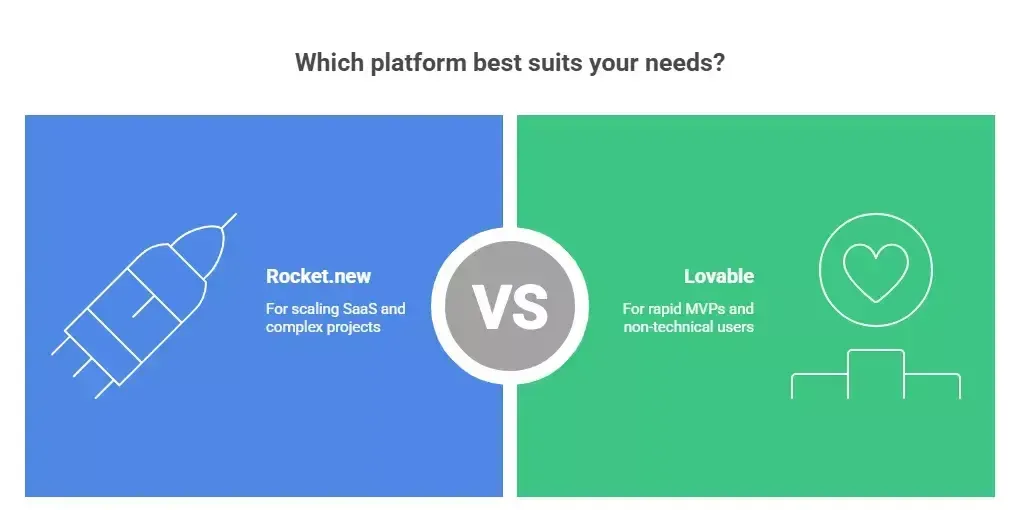
Choose Rocket.new if you are:
-
Building a SaaS product that needs to scale past the MVP stage
-
An experienced developer who wants full code access alongside AI assistance
-
Working on full-stack projects with complex backend requirements
-
Building for web and mobile using a single development environment
-
Looking for predictable pricing with hosting included
-
Running AI-assisted coding workflows with your existing team
-
Generating internal tools alongside a customer-facing product
Choose Lovable if you are:
-
Validating a new idea quickly with a polished MVP
-
A non-technical user who wants to build web apps without manual coding
-
Prioritizing UI design and visual polish above backend complexity
-
Part of a larger team that benefits from unlimited users per plan
-
Building standard web apps where Supabase handles your backend needs
Migration Patterns: What Real Users Do
Users report a consistent pattern. Teams start with Lovable for speed and visual quality. They validate ideas with real users. Then, as their SaaS grows, they need more control and migrate to Rocket.new or traditional environments.
Both platforms support code export to GitHub, so migration is possible. But it comes with refactoring costs and lost time. If scaling is the goal from the start, building on Rocket.new avoids that transition entirely. It is designed for quick launches and early experimentation, but it is also built to carry the app forward.
Which Scales Better?
For SaaS apps that need to grow, Rocket.new is the stronger foundation.
Lovable is a great tool for speed and visual quality. It excels at rapid prototyping, produces polished web apps quickly, and works well for non-technical users validating ideas. The free plan is accessible, and the platform continues to improve.
But Rocket.new is built for what comes after launch. The AI-generated code is cleaner and more maintainable. The backend capabilities go deeper. The pricing model is more predictable at scale. And it is one of the few AI tools that explicitly addresses the Day Two problems that most platforms ignore.
For SaaS founders who want speed now and scalability later, Rocket.new is the right tool.
Table of contents
- -What is Rocket.new?
- -Key Features of Rocket.new
- -What Is Lovable?
- -Key Features of Lovable
- -Quick Comparison: Rocket.new vs Lovable
- -Development Speed: Both Are Fast, But for Different Reasons
- -Vibe Coding: How Each Platform Approaches it
- -Code Quality: Where Long-Term SaaS Lives or Dies
- -Backend Logic and Database Power
- -Full Stack Development: Who Does It Better?
- -Internal Tools: A Quiet Advantage
- -AI Agents and AI Assistance
- -Deployment, Hosting, and Custom Domains
- -Landing Pages and Marketing Sites
- -Pricing: Where the Numbers Matter
- -Plan Comparison
- -Cost at Scale
- -Scalability, Speed, and Collaboration Features
- -Scalability: The Real Difference
- -Collaboration and Version Control
- -Who Should Use Which Platform?
- -Migration Patterns: What Real Users Do
- -Which Scales Better?