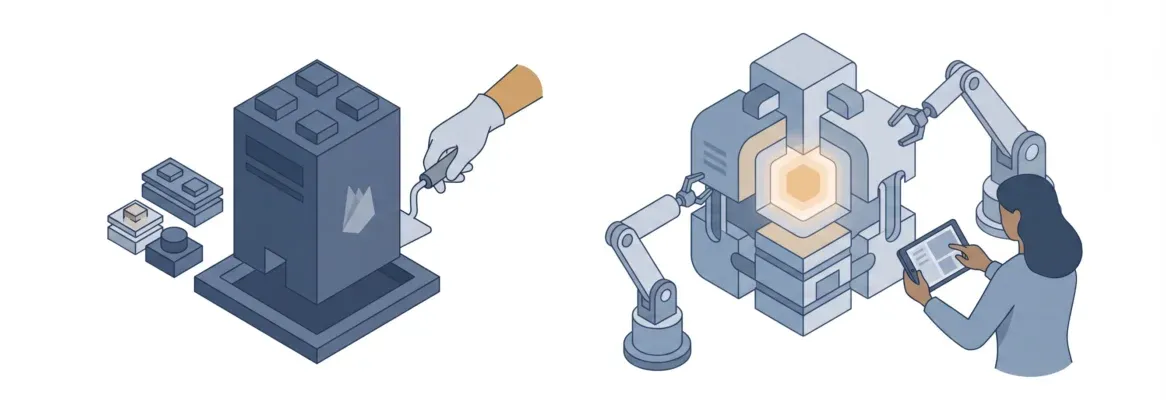
Rocket.new vs Lovable: Which Gives You Cleaner, More Maintainable Code?
Rocket.new vs Lovable: Rocket delivers production-ready, scalable code, while Lovable is best for rapid prototyping and design. For long-term, maintainable apps, Rocket.new is the stronger choice, just describe your idea and start building.
What happens when AI writes your code?
You have an app idea. You type it in plain language. A few minutes later, you have a working app. That is the promise of modern AI app builders, and honestly, it mostly delivers.
But here is the question nobody asks until it is too late: what does the code actually look like under the hood?
According to recent projections, the global low-code/no-code market is on track to hit $65 billion by 2027. More teams than ever are using AI assistance to skip months of traditional app development. So picking the right AI app builder is not just a convenience choice. It is a decision that affects whether your app scales or falls apart six months from launch.
This comparison looks at Rocket.new vs Lovable through one specific lens: code quality and long-term maintainability.
What are AI App Builders?
AI app builders are platforms that let you describe software in natural language and receive functional, deployable applications in return.
Instead of hiring a dev team or spending months writing code from scratch, you:
-
Describe your app idea using natural language prompts
-
Watch the platform generate full-stack code automatically
-
Customize, iterate, and deploy without deep coding knowledge
What they typically generate:
-
Web apps and landing pages
-
Internal tools and dashboards
-
Mobile apps and customer portals
-
Backend logic, database schema, and user authentication
-
Production-ready apps with full code export
Who uses them:
-
Non-technical founders validating ideas
-
Developers accelerating app generation
-
Teams are building internal tools fast
-
Designers moving from mockup to live product
The key outcome: you go from idea to working software in hours, not months. Some platforms allow teams to launch in minutes.
How Do AI App Builders Affect Code Quality Long-Term?
Code quality determines whether your app is a liability or an asset.
Great code is readable, structured, and easy to change. Bad code works until it does not, and when it breaks, it breaks badly.
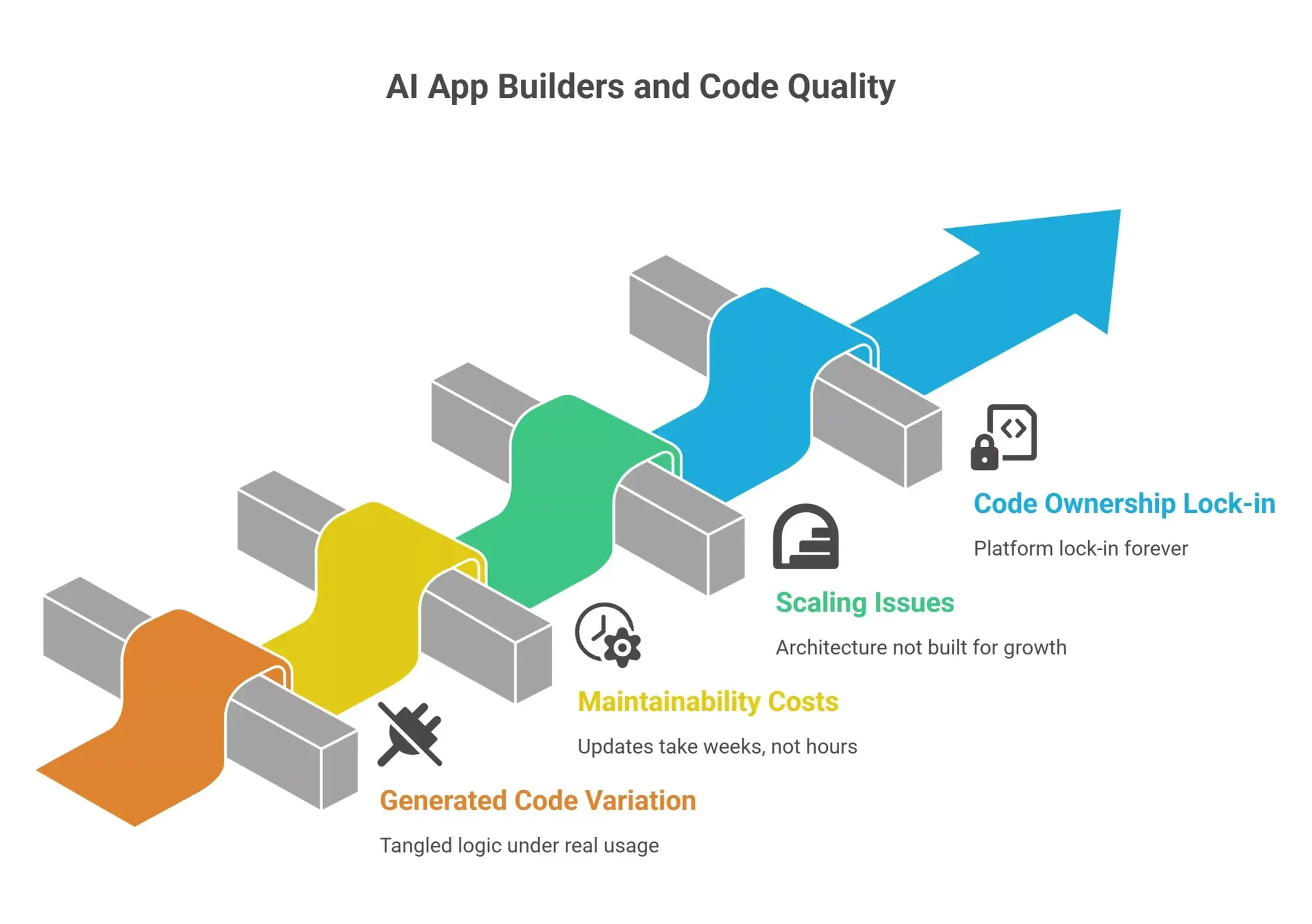 Here is why this matters specifically with AI app builders:
-
Generated code varies wildly. Some platforms output clean, production-ready code. Others produce tangled logic that works for demos but collapses under real usage.
-
Maintainable code saves money. When your team can read and modify the codebase, updates take hours, not weeks.
-
Code structure affects scaling. An app serving 100 users needs a different architecture than one serving 100,000. Good app builders account for this from the start.
-
Code ownership matters. If you cannot export and own your code, you are locked into the platform forever.
Maintaining code quality is one of the biggest concerns for teams using AI app builders. The generated code must be clean and organized to support future updates and scalability. That is exactly where Rocket.new and Lovable take very different paths.
How Does Rocket.new Approach Code Quality?
Rocket.new is designed for building real applications with production-grade architecture from the first generation.
The platform treats the entire application as a single, connected system. This is not just a technical detail. It changes everything about how bugs get caught, how features get added, and how the codebase holds up over time.
Key features that affect code quality:
-
System-wide architecture: Rocket.new treats debugging as a system-wide operation. When one part of the app changes, the platform understands how it connects to everything else. This leads to fewer bugs when scaling applications.
-
Technical debt prevention: Much of Rocket.new's architecture is designed to minimize technical debt by treating the entire application as a single, connected system rather than a collection of patched prompts.
-
Production-ready code from day one: Rocket.new is specifically marketed for building applications that require a solid architectural foundation for long-term maintenance.
-
Backend logic built in: AI app builders like Rocket.new automate backend logic, data modeling, and authentication directly from user prompts. The result is not just a pretty front-end. It is a complete, working system.
-
Figma import: Convert existing designs into live layouts without breaking the code structure underneath.
-
Code export: Full code ownership from the start, so your team can extend, modify, and deploy on your own infrastructure.
-
Multiple programming languages: The platform supports different technical requirements without forcing a single approach.
-
GitHub integration: Sync your codebase directly, making collaborative development and version control straightforward.
Rocket.new focuses on long-term production scalability. The app you build today is architected to still make sense a year from now.
How Does Lovable Approach Code Quality?
Lovable takes a different path. It is optimized for rapid prototyping and visual design, allowing for quick demos and UI iterations.
The platform generates clean, standard React and TypeScript code that is excellent for Minimum Viable Products (MVPs). For getting an idea in front of users fast, it is genuinely impressive.
Where Lovable excels:
-
Visual editor: Lovable features a strong visual editor for real-time customization, making it easy to tweak designs without touching code.
-
Quick MVPs: Lovable generates clean code that works well for early-stage validation and client presentations.
-
Pre-built templates: Good for getting started fast without a blank canvas.
-
Visual design iteration: The integration of visual editors in AI app builders enhances the user experience by enabling real-time design adjustments.
-
Natural language prompts: Like other top AI app builders, Lovable lets you describe features conversationally and watch them appear.
-
GitHub sync: Connect your repository and keep code changes tracked.
-
Custom domains: Deploy your app to a domain you own.
Where code quality becomes a concern:
This is the honest part. Lovable's iterative, chat-based approach can make the codebase difficult to update as the project grows. Each prompt adds to the app, but the system does not always understand how the new addition connects to the full picture.
As project complexity increases, the code generated by Lovable can become inflexible and harder to manage, often requiring refactoring before it is ready for production. What starts as a clean MVP can turn into a codebase that needs significant rework to scale.
That is not a knock on Lovable for its intended purpose. It is simply what happens when a tool optimized for speed encounters the demands of production apps.
Rocket.new vs Lovable: Side-by-Side Code Quality Comparison
| Factor | Rocket.new | Lovable |
|---|---|---|
| Code architecture | System-wide, connected architecture | Chat-based, iterative additions |
| Technical debt | Minimized by design | Can accumulate with complexity |
| Production readiness | Built for production from day one | Strong for MVPs, may need refactoring |
| Backend logic | Full backend logic automation | Backend support, less system-aware |
| Debugging approach | System-wide operation | Localized, per-prompt fixes |
| Code export | Full code ownership | Code export available |
| GitHub integration | Yes | Yes, via GitHub sync |
| Visual design | Figma import to live layouts | Strong visual editor |
| Best for | Production apps, scaling teams | Rapid prototyping, MVPs |
| Scalability | Architected for scale | May require refactoring to scale |
How to Choose Between Rocket.new and Lovable for Your Project
The right choice depends on what you are building and where you plan to take it.
Goal-to-platform mapping:
| Your Goal | Best Platform | Why It Works |
|---|---|---|
| Build a production app from day one | Rocket.new | System-wide architecture, production-ready code |
| Validate an idea with a quick MVP | Lovable | Fast visual iteration, clean React output |
| Build internal tools your team will use daily | Rocket.new | Solid backend logic, maintainable code |
| Create landing pages for a campaign | Either | Both handle simple web apps well |
| Build complex web apps that scale | Rocket.new | Designed for complexity and long-term maintenance |
| Show a client a quick interactive prototype | Lovable | Visual editor makes client presentations fast |
| Build full-stack projects with a dev team | Rocket.new | GitHub integration, multiple programming languages |
| Launch a native mobile app | Rocket.new | Supports native mobile apps with proper architecture |
Steps to pick the right platform:
-
Define whether you are validating an idea or building for production
-
Assess how much backend logic your app needs
-
Consider how often your team will update the codebase
-
Check whether code export and code ownership matter to you
-
Decide if long-term scalability is a priority from the start
Quick tip: Focus on architecture, not just the interface. The visual design is easy to change. What matters is whether the underlying code structure matches where your app is going.
Step-by-Step: How to Start Building With Rocket.new
Here is exactly how to go from idea to production-ready app using Rocket.new, using a specific example: an internal sales dashboard for a growing team.
Step 1: Describe your app in plain language
Go to Rocket.new and select the Build feature and type your app idea using natural language prompts. For example: "Build an internal sales dashboard with user authentication, database tables for leads, and a reporting view by region." Rocket.new reads the full request as a system, not line by line.
Step 2: Let Rocket.new generate the full stack
The platform automates backend logic, data modeling, and authentication directly from your prompt. You get a complete full-stack project, not just a front-end screen with placeholder data.
Step 3: Review the architecture
Before customizing anything, look at the code structure. Rocket.new generates production-ready code organized for maintainability. You can see how the database schema connects to the front-end and where the backend logic lives.
Step 4: Customize using natural language or Figma import
Adjust the visual design using natural language or import a Figma file to convert it into a live layout. The design changes without breaking the underlying code quality.
Step 5: Connect your GitHub repository
Use GitHub integration to sync the codebase. Your team can now collaborate, run pull requests, and track changes using standard software development workflows.
Step 6: Deploy to production
With custom domains and full code ownership, deploy directly to your infrastructure. The app is production-ready from this first build, not a prototype that needs rebuilding.
The full flow takes minutes for simple web apps and hours for more complex apps. Either way, you end with code you own, understand, and can maintain.
Who Uses These AI App Builders? Real Examples by User Type
| User Type | What They Want to Build | How AI App Builders Help |
|---|---|---|
| Startup Founder | A full-stack SaaS product with user authentication | Rocket.new generates production-ready code and backend logic without a dev team |
| Freelance Developer | Client web apps and landing pages fast | Both platforms reduce writing code time and speed up delivery |
| Product Manager | Internal tools for tracking team workflows | Rocket.new builds maintainable internal tools with clean code structure |
| Designer | Interactive prototypes and visual design iterations | Lovable's visual editor allows rapid design changes without coding knowledge |
| Non-Technical Entrepreneur | A mobile app or customer portal to launch a business | AI app builders make mobile app development accessible without software development experience |
Across all user types, the common outcome is the same: faster app development with less friction, and more time spent on the product rather than the code.
What is the Best-of-Both-Worlds Approach?
Some teams smartly combine both platforms.
A common best-of-both-worlds approach involves building the initial full-stack structure with Rocket.new and then using Lovable for rapid UI refinement. You get the solid, production-ready architecture from Rocket.new, and the fast visual design iteration from Lovable.
This works especially well for:
-
Teams that need to show polished prototypes quickly while maintaining production-grade code underneath
-
Projects where the backend logic and database schema are complex, but the front-end needs to change frequently
-
Situations where non-technical stakeholders want to see visual progress without the engineering team rebuilding from scratch
That said, if you are building from scratch and want production apps that scale, starting with Rocket.new gives you the cleanest path. You avoid the refactoring step entirely.
What Real Users Say About Code Quality in AI App Builders
Teams that have used both platforms consistently report the same pattern: Lovable is great to start fast, but Rocket.new holds up better as the project grows.
"Is Lovable all hype? That’s one of the questions that I have been thinking about lately. They hit $100M ARR in just 8 months, clearly they are onto something! Everyone is excited but things break when they try to go beyond the demo, build logic, connect data or just do something that the AI didn’t expect. And suddenly the same prototype becomes an impractical idea." - LinkedIn
The community consensus on forums like Reddit and communities around vibe coding and AI tools reflects this split clearly. Lovable wins the speed comparison for the early stages. Rocket.new wins the code quality and production readiness comparison for everything after that.
How Does Rocket.new Connect to the Future of App Development?
Rocket.new is not just an AI app builder. It is described as the world's first Vibe Solutioning platform, meaning it covers the full arc from research and decision to building and operating.
The Build feature specifically focuses on production-grade app generation. But what makes it different from other AI app builders is the shared context. Every app you build in Rocket.new benefits from the accumulated intelligence of your project. The research you did before building, the decisions you made, and the architecture you started with. It all compounds.
Rocket.new features that directly affect code quality:
-
System-wide architecture that treats your app as one connected whole
-
Automated backend logic and data modeling from natural language prompts
-
Figma import for design-to-code without breaking the code structure
-
GitHub integration for team collaboration and version control
-
Full code export so you maintain complete code ownership
-
Support for multiple programming languages and full-stack projects
-
Production-ready code from the first generation, not after refactoring
-
Native mobile apps with proper architecture for app stores
How this applies to real projects:
-
Building web apps that serve real users at scale without rebuilding
-
Creating internal tools that your team will use and update for years
-
Launching production apps with backend logic that handles real data
-
Moving from an app idea to a deployed product without accumulating technical debt
Rocket.new vs Lovable: Which Gives You Cleaner, More Maintainable Code?
The answer depends on what you are building. But if code quality and long-term maintenance are your priority, Rocket.new is the clearer choice.
Lovable is excellent for rapid prototyping, visual design work, and early-stage MVPs. The code it generates is clean and standard, which makes it a great starting point for simple web apps and design validation. For teams that want to leverage AI to move fast and show something working, it delivers.
Rocket.new is built for production. The code it generates follows proper architectural patterns, minimizes technical debt, and holds up as the app grows. For production apps that serve real users, handle real data, and need to be maintained and extended over time, Rocket.new gives you a foundation worth building on.
Head to Build with Rocket, type your app idea in plain language, and see what production-ready code actually looks like from day one.
Table of contents
- -What are AI App Builders?
- -How Do AI App Builders Affect Code Quality Long-Term?
- -How Does Rocket.new Approach Code Quality?
- -How Does Lovable Approach Code Quality?
- -Rocket.new vs Lovable: Side-by-Side Code Quality Comparison
- -How to Choose Between Rocket.new and Lovable for Your Project
- -Step-by-Step: How to Start Building With Rocket.new
- -Step 1: Describe your app in plain language
- -Step 2: Let Rocket.new generate the full stack
- -Step 3: Review the architecture
- -Step 4: Customize using natural language or Figma import
- -Step 5: Connect your GitHub repository
- -Step 6: Deploy to production
- -Who Uses These AI App Builders? Real Examples by User Type
- -What is the Best-of-Both-Worlds Approach?
- -What Real Users Say About Code Quality in AI App Builders
- -How Does Rocket.new Connect to the Future of App Development?
- -Rocket.new vs Lovable: Which Gives You Cleaner, More Maintainable Code?