
Rocket.new and Lovable are both strong vibe coding platforms, but they serve different stages of development. Lovable is fast and visual, making it ideal for early prototypes and simple web apps. Rocket.new builds the entire stack as one connected system, which means fewer bugs from the start and smarter fixes when something does break. If you are prototyping, start with Lovable. If you are building for production, Rocket.new is the more reliable long-term choice.
When it comes to Rocket.new vs lovable, which handles debugging better, the answer comes down to architecture. Rocket.new operates as a system-level AI that understands your entire app, while Lovable is fast for prototyping, but users frequently report getting stuck in frustrating debugging loops as projects grow.
The no-code and low-code market is projected to cross $65 billion by 2027, and over 76% of developers are already using or planning to use AI tools in their workflow. So, which platform actually helps you ship clean code without burning hours on bugs? Let's break it down.
What Is Vibe Coding and Why Does Debugging Matter?
Vibe coding is a software development practice that makes app building more accessible, especially for people with limited programming experience. Instead of writing code manually, you describe what you want using natural language prompts, and the AI generates working code.
Vibe coding tools let you build production-ready apps using plain language, with no manual coding needed, lowering the barrier to app development for non-developers.
But building fast is only half the challenge. The real test is what happens when something breaks.
-
Does the platform catch errors on its own?
-
Can it fix bugs without creating new ones?
-
Does the debugging process drain your credits?
These questions determine whether a platform is suited only for rapid prototyping or for long-term, production-ready applications.
A Quick Overview: Rocket.new and Lovable
What is Rocket.new?
Rocket.new is a fully integrated vibe-coding platform that takes users from a raw idea to a live, production-ready web or mobile app with minimal setup. It generates complete, working software, not mockups or wireframes, following a simple four-step loop: describe, build, refine, ship, and iterate with AI support.
Rocket.new raised $15 million in a seed round led by Salesforce Ventures, with Accel and Together Fund. It has crossed 400,000 users in 180 countries, including users from Meta, PayPal, KPMG, and PwC.
What is Lovable?
Lovable is an AI-powered web development vibe coding platform designed specifically for non-coders. It transforms plain English ideas into fully functional web apps with a "click-to-deploy" workflow, handling user authentication, roles, and database operations out-of-the-box.
Lovable secured $330M in Series B funding at a $6.6B valuation in December 2025 and has grown to nearly 8 million users.
How Rocket.new Handles Debugging
Rocket.new takes a fundamentally different approach to debugging because of how it builds in the first place.
How the build prevents bugs from the start:
-
Generates complete full-stack code covering frontend, backend, database structure, authentication, and deployment as a single connected system with an AI-assisted development process
-
Because every layer is built together, there are far fewer places for errors to hide
-
The AI maintains context across UI, backend logic, data relationships, and integrations throughout the entire build
-
When something breaks, the fix addresses the actual source of the problem rather than patching the surface while leaving the root cause intact
Why system-level context matters:
-
The platform does not treat your app as a collection of isolated files
-
It understands how a change in one part of your app ripples through everything else
-
This is what separates Rocket.new's debugging experience from most other vibe coding tools
The structured approach from the Rocket.new debugging guide:
Before spending a single token, users are guided through simple checks first (debugging guide):
-
Refresh the page
-
Undo the last change
-
Look for typos in names and labels
-
Confirm your settings and connections are correct
Most surface-level issues resolve at this stage without any further effort.
Quick slash commands for common issues:
-
/Fix Navigation Issues for broken links or pages failing to load
-
/Fix Layout Issues for spacing and alignment problems
-
/Fix Theme Switching when light and dark mode behave unexpectedly
-
/Fix Supabase Authentication Issues for login and signup failures
-
/Organize Code to clean up tangled or hard-to-follow files
For bugs that resist quick commands, the docs recommend a structured description:
-
What you expected to happen
-
What actually occurred
-
Any error message you saw
-
Where in the app the problem appear
-
What you already tried before writing the message
Scoping fixes to avoid unintended changes:
-
Use the @filename syntax to narrow any fix to a single file
-
For example: @pages/login.jsx fix the submit button behavior
-
This tells the AI to work only within that file, preventing changes from spreading through the rest of the codebase
-
This small discipline is precisely what stops one fix from quietly breaking something else
What real users experience:
One Medium reviewer described moving to Rocket.new after getting exhausted by other tools, noting that tokens were being consumed fixing errors before a complete application could even be built
"After switching, the application was generated in under 15 minutes, with an error that appeared being resolved instantly"- Read the full story here on Medium
The result is a debugging workflow that is methodical, contained, and far less likely to spiral into the kind of expensive loops that drain credits and slow down real projects.
That kind of experience captures what the platform is designed to deliver: less time managing errors, more time building what actually matters.
How Lovable Handles Debugging
Well, Lovable has a different approach for debugging.
Built-in debugging tools:
-
"Try to Fix" button appears when the AI detects a logic error, saving users from manual troubleshooting
-
Agent Mode searches the codebase, reads files, inspects logs, and searches the web for solutions
-
Chat Mode provides a collaborative interface for planning, debugging, and iterative development
Where Lovable struggles:
-
Fixing one bug often breaks existing features, leading to spaghetti code and maintenance challenges
-
Projects that grow too complex frequently develop hidden technical debt or repetitive bugs
-
Users report getting stuck in debugging cycles where credits are consumed fixing the same issue repeatedly
-
Struggles with purely visual issues because it assumes a fix worked based on code logic alone, not what is actually visible on screen
The complexity wall:
-
Works well for UI-heavy prototypes and simple SaaS MVPs where the app is small and contained
-
Once the app grows past a few screens with deeper backend logic, the debugging experience deteriorates
-
AI often delivers half-fixes that still require manual corrections afterward
-
Small prompts rarely solve the full problem, leading to repeated attempts that burn through credits fast
The credit problem:
-
Every debugging attempt counts against your monthly credit allocation
-
Heavy debugging sessions can drain an entire month's credits with no pay-as-you-go safety net
-
Users describe the experience as unpredictable, with no clear sense of how much a fix will cost before attempting it
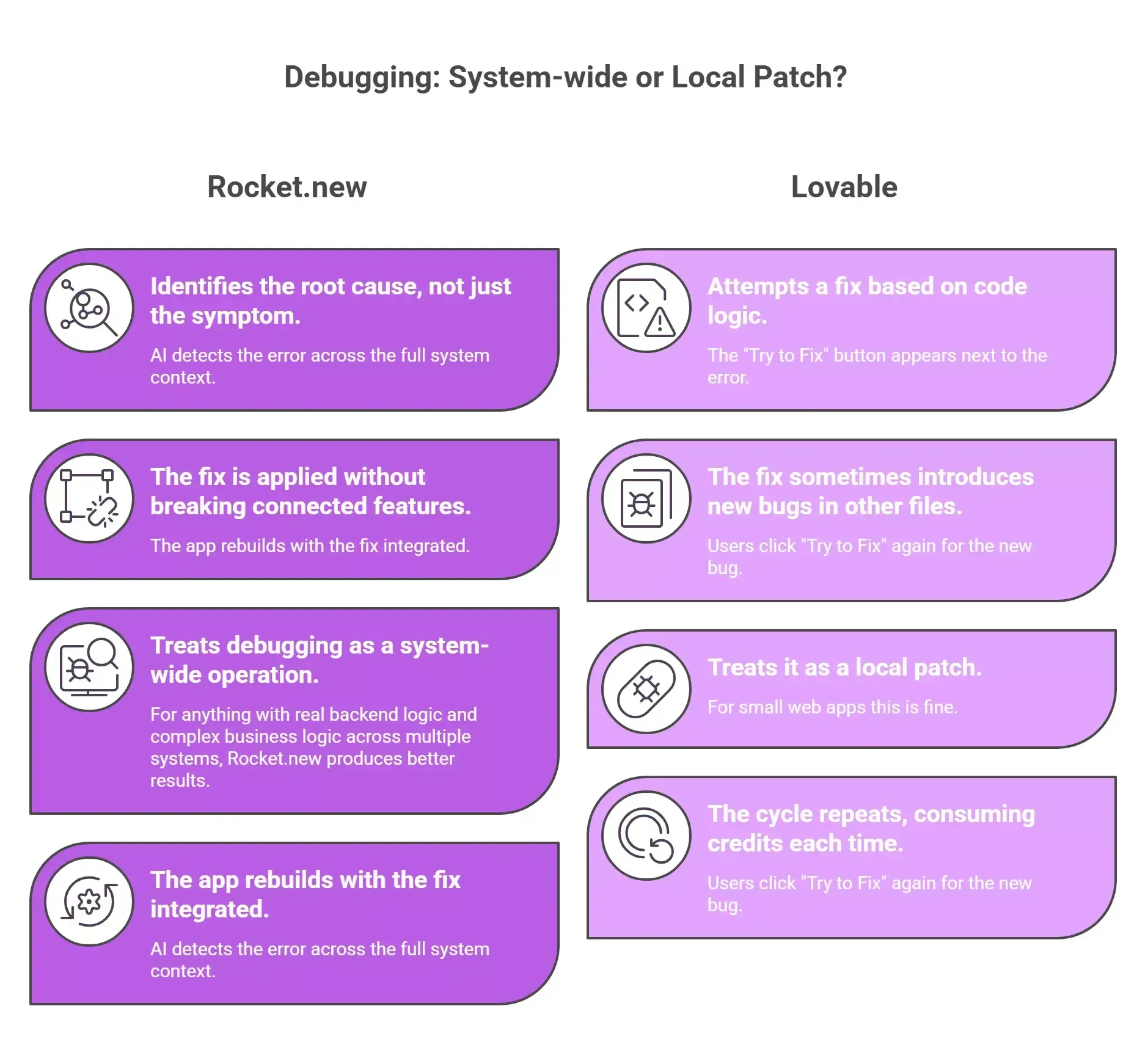
Debugging Workflows: What Actually Happens
Rocket.new's flow when a bug appears:
-
AI detects the error across the full system context
-
It identifies the root cause, not just the symptom
-
The fix is applied without breaking connected features
-
The app rebuilds with the fix integrated
Lovable's flow when a bug appears:
-
The "Try to Fix" button appears next to the error
-
AI attempts a fix based on code logic
-
The fix sometimes introduces new bugs in other files
-
Users click "Try to Fix" again for the new bug
-
The cycle repeats, consuming credits each time
Rocket.new treats debugging as a system-wide operation. Lovable treats it as a local patch. For small web apps this is fine. For anything with real backend logic and complex business logic across multiple systems, Rocket.new produces better results.
Comparison table:
| Feature | Rocket.new | Lovable |
|---|---|---|
| Debugging Approach | System-level AI with full context across all layers | Per-error "Try to Fix" button targeting individual issues |
| Bug Cascading | Minimal, all parts built together as one system | Common, fixing one bug often breaks other features |
| Root Cause Analysis | Yes, identifies and fixes the source of the problem | No, patches the symptom based on code logic alone |
| Visual Issue Detection | Handled through full system context | Struggles, assumes fix worked based on code logic alone |
| Credit/Token Drain During Debugging | Low, designed to get things right on the first pass | High, every attempt counts against monthly credit allocation |
| Quick Fix Commands | Yes, slash commands like /Fix Navigation Issues, /Fix Layout Issues, /Fix Supabase Authentication Issues | No dedicated slash commands |
| Scoped Fixes | Yes, using @filename syntax to limit changes to one file | No built-in scoping, changes can spread to unexpected files |
| Structured Debugging Guide | Yes, step-by-step approach with templates and commands | No formal debugging guide |
| Agent Mode | Specialized AI agents per stage of development | Yes, searches codebase, reads files, and inspects logs |
| Chat Mode | Collaborative building and refinement throughout | Yes, for planning, debugging, and iterative development |
| Full Stack Context | Yes, frontend, backend, database, auth built as one | Yes, but cross-layer debugging is harder to manage |
| Version History | Supported natively | Supported via GitHub sync |
| Custom Domains | Unlimited on paid plans | Available on Pro plan and above |
| Mobile App Support | Yes, web and mobile | Web only |
| Best For | Production-grade apps that need reliable debugging at scale | Rapid prototyping and visual MVPs at early stage |
Key Features of Rocket.new
Here are the key features that make Rocket.new a strong platform for full-stack development:
-
Prompt-to-App Creation: Describe your app using natural language prompts, and the platform builds UI, backend logic, and data handling in one go.
-
Full Stack Code Generation: Frontend, backend, database, authentication, APIs, and deployment handled together.
-
Supports multiple programming languages: Rocket.new supports multiple programming languages for web and mobile app development.
-
Figma Import: Convert design files into live, editable layouts with 100% accurate results.
-
Dedicated AI Workers: Specialized AI agents handle building, designing, quality checks, and deployment separately, reducing the chance of errors slipping through.
-
Multiple Framework Support: Choose from React, Next.js, or Flutter based on your coding knowledge level.
-
Custom Domains: Unlimited custom domains on paid plans for landing pages and live apps.
-
Version History: Track changes and roll back when needed.
-
One-Click Deployment: Deploy directly from the browser.
-
Team Collaboration: Real-time pair programming and team workspaces.
Use cases where the platform shines: startup MVPs, internal tools, mobile apps, SaaS products, landing pages, and full-stack projects where developers want AI-assisted coding without losing control over the code.
AI Tools Worth Knowing
Both Rocket.new and Lovable leverage AI-driven agents for automating debugging but differ in error handling. Other tools in the space include:
-
Bolt: An AI-powered builder for non-coders and full-stack developers creating web apps and mobile apps using natural language prompts.
-
Cursor: An AI-first code editor for software development that helps developers write, refactor, debug, and understand complex codebases through intelligent chat and autocomplete.
-
Windsurf: An AI-powered development environment that integrates with popular IDEs and version control systems for team collaboration and coding productivity.
-
Emergent: An advanced AI-powered full-stack vibe-coding platform with a multi-agent orchestration system handling design, coding, backend logic, and deployment. Emergent's AI operates at a system level, maintaining context across UI, backend logic, data relationships, and integrations. Emergent stands out by being built for long-term products, not just fast launches, and provides full system control without exposing technical complexity.
-
Firebase: Google's backend-as-a-service platform providing authentication, databases, hosting, analytics, and cloud functions that eliminate the need for server management.
Choosing the Right Tool
Choosing the right no-code tool depends on your technical level, project scope, and budget. Most no-code tools offer a free tier so you can test before committing to a paid plan.
Need a quick visual prototype?
Lovable is well-suited for early-stage validation.
Need a production-ready app?
Rocket.new handles end-to-end development, debugging, and deployment.
If you are an experienced developer wanting more control, Cursor or Windsurf give you control over your existing codebase. If you want to scale products over time: Rocket.new is built for long-term stability.
A common effective workflow is to build the initial MVP with Lovable for speed, then transition to Rocket.new for long term production stability. Start with Lovable for visual iteration and early feedback, then move to Rocket.new when you need backend control, better debugging, and production-ready code.
Pricing Breakdown
Rocket.new Pricing
| Plan | Monthly Price | Annual Price | Includes |
|---|---|---|---|
| Free | $0 | $0 | Limited tokens to test the platform |
| Starter | $25/month | $25/month | Standard token allocation for solo builders |
| Personal | $50/month | $40/month | Higher token allocation for active projects |
| Booster | $100/month | $80/month | Maximum tokens for heavy usage and teams |
The plan price is token-based, meaning debugging does not consume extra credits on top of your usage. You always know what you are spending.
Lovable Pricing
| Plan | Monthly Price | Includes |
|---|---|---|
| Free | $0/month | 5 daily credits |
| Pro | $25/month | 100 monthly credits |
| Business | $50/month | 100 monthly credits plus SSO and templates |
| Enterprise | Custom pricing | Custom credit allocation with dedicated support |
The credit-based model means every debugging attempt counts against your monthly allocation. Heavy debugging sessions can drain your credits fast, with no pay-as-you-go safety net to fall back on.
Key Takeaways
-
Debugging reliability: Rocket.new's system-level AI catches errors before they cascade. Lovable's per-error approach often creates new bugs.
-
Credit efficiency: Rocket.new tokens are not drained by debugging loops. Lovable's credit system gets expensive during complex fixes.
-
Scalability: Rocket.new is built for the full lifecycle. Lovable is best for early prototypes.
-
Mobile support: Rocket.new handles both web and mobile. Lovable is web only.
-
Code ownership: Both platforms let you export your code, but Rocket.new's full-stack output is more complete.
Use Rocket.new if you want an AI-driven app going from idea to production without debugging headaches, need mobile and web, or are building to scale. Use Lovable if you need a fast visual prototype for validation and are comfortable moving to another platform later for production.
Table of contents
- -What Is Vibe Coding and Why Does Debugging Matter?
- -A Quick Overview: Rocket.new and Lovable
- -What is Rocket.new?
- -What is Lovable?
- -How Rocket.new Handles Debugging
- -How the build prevents bugs from the start:
- -Why system-level context matters:
- -The structured approach from the Rocket.new debugging guide:
- -Quick slash commands for common issues:
- -For bugs that resist quick commands, the docs recommend a structured description:
- -Scoping fixes to avoid unintended changes:
- -What real users experience:
- -How Lovable Handles Debugging
- -Built-in debugging tools:
- -Where Lovable struggles:
- -The complexity wall:
- -The credit problem:
- -Debugging Workflows: What Actually Happens
- -Comparison table:
- -Key Features of Rocket.new
- -AI Tools Worth Knowing
- -Choosing the Right Tool
- -Pricing Breakdown
- -Rocket.new Pricing
- -Lovable Pricing
- -Key Takeaways