Rocket.new is best for non-technical founders who want to build and launch apps fast without coding. Replit is ideal for developers who prefer full control with AI-assisted coding. For MVP speed, mobile apps, and ease of use, Rocket.new is the stronger choice.
What actually separates the AI tools that help you ship from the ones that slow you down?
That is the question every founder, solopreneur, and product team faces when picking an AI app builder. According to Gartner, more than 70% of new apps are expected to rely on AI-driven or low-code platforms by 2025. So the right platform choice carries real weight.
This blog answers Rocket.new vs Replit: Which tool is better for building startups and MVPs with a direct, side-by-side breakdown.
What Are AI App Builders and Why Do They Matter?
AI app builders are platforms that turn a description of an app idea into a working, deployable product. Instead of writing code from scratch, users describe what they want in natural language, and the platform handles the rest.
-
They cut traditional development cycles from weeks to hours.
-
AI app builders remove barriers for non-technical founders without a developer on the team.
-
They let you test an app idea before hiring developers or committing to infrastructure.
-
The best AI app builders handle full-stack output: frontend, backend, authentication, and databases.
-
They make app creation accessible across all skill levels.
Whether you are building internal tools, dashboards, or mobile apps and web apps, these platforms shift focus from syntax to strategy.
What is Replit?
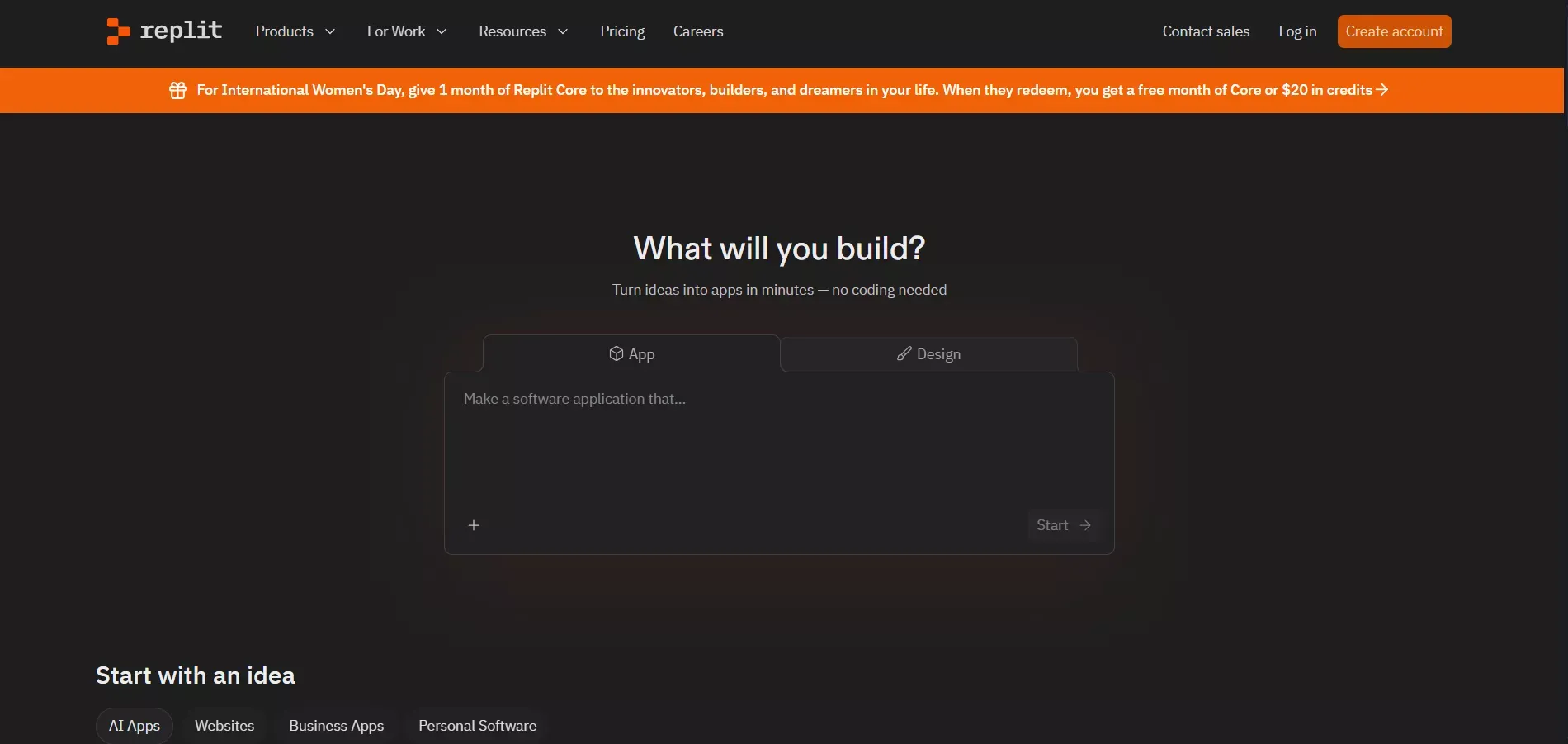
Replit is a browser-based IDE and a complete development environment where developers write, run, and deploy code from a cloud IDE without local setup.
-
Replit AI, including the Replit Agent and Ghostwriter, provides AI assistance for code generation, debugging tools, and test runs.
-
It supports over 50 programming languages, covering multi-language projects across the stack.
-
Real time collaboration lets multiple developers work in the same workspace.
-
Deployment tools and version control are built into one platform.
-
The free tier allows basic access; paid plans are needed for private projects and serious development work.
-
Replit is a browser-based IDE, not an app generator. Developers still write and manage code directly.
Replit amplifies what developers can do. It does not replace the need to code.
What is Rocket.new?
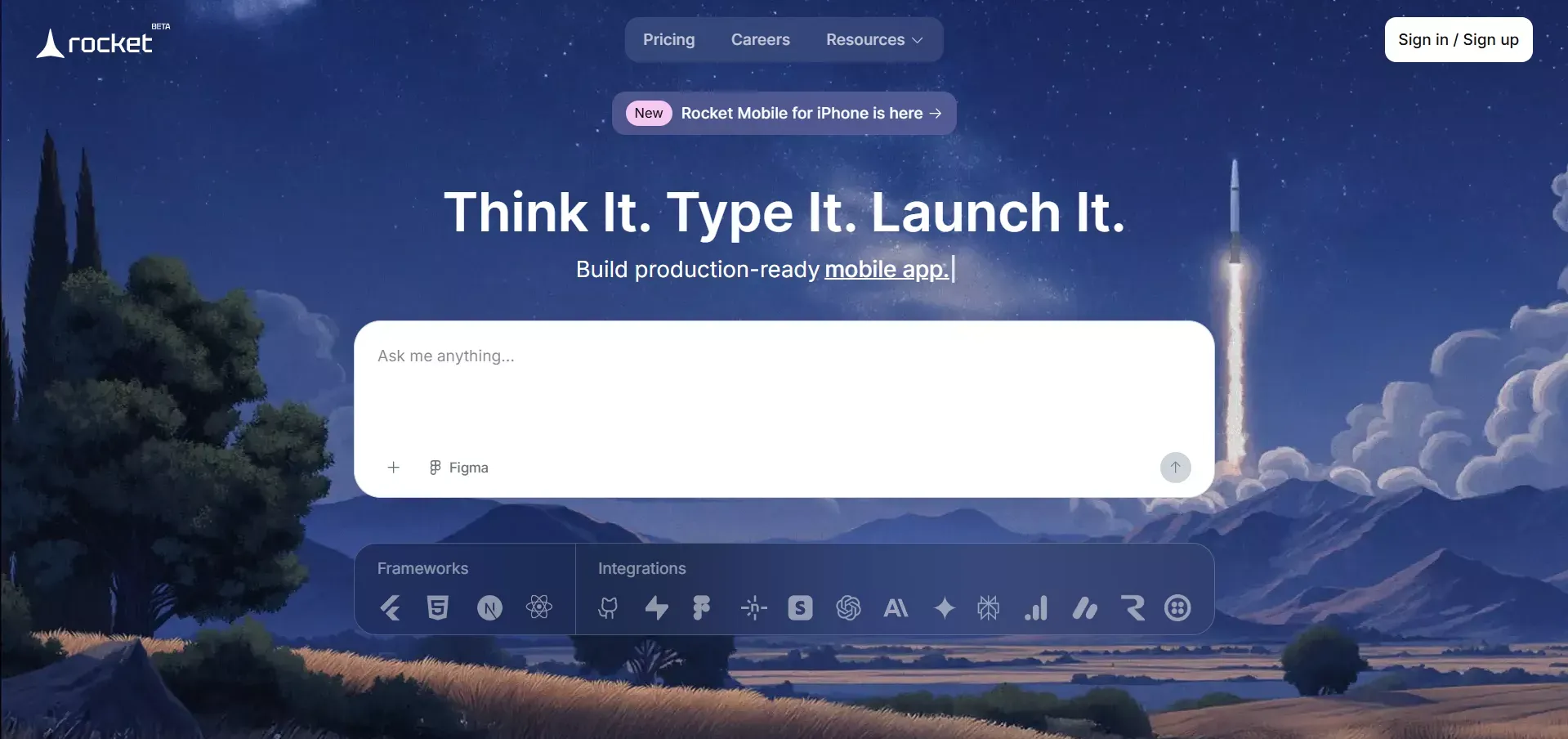
Rocket.new is an AI-powered vibe solutioning platform built to turn ideas into production-ready applications fast. It is not a code editor. It is an AI app generator that takes natural language prompts and builds full-stack web apps and mobile apps from them.
-
Rocket generates complete apps from a single prompt, including UI, logic, backend, and database setup with its AI capabilities.
-
Template library for landing pages and webities with 25,000+ templates for different use cases.
-
It supports Flutter for mobile apps and Next.js for web apps, delivering production-ready code across platforms.
-
Rocket.new converts Figma designs into live, editable apps with reported 100% accuracy.
-
A visual builder alongside a code view makes it accessible at all skill levels.
-
The free tier includes 2 million total tokens and Figma-to-code support for up to 2 screens.
-
Code export is built in, giving teams full control as apps scale.
-
29+ integrations cover payments, databases, AI, and email for functional app output beyond visual design.
Rocket.new raised $15 million led by Salesforce Ventures, crossed 400,000 users in 180 countries, and hit $4.5M ARR within months of launching. That pace says something concrete about what happens when a platform removes friction from app creation.
Replit vs Rocket.new: Feature Comparison
| Feature | Rocket.new | Replit |
|---|---|---|
| Primary use | AI app generator | Cloud IDE with AI assistance |
| Mobile apps | Flutter-based, from prompts | No native mobile output |
| Web apps | Next.js, one-click deploy | Full-stack, developer-written |
| Natural language prompts | Core feature, full app from one prompt | AI assistant, not full generation |
| Code export | Full export across frameworks | Full codebase access always |
| Internal tools | AI-generated, no coding required | Requires coding with AI support |
| Free tier | 1M tokens, Figma-to-code (2 screens) | 1 public app, daily credit cap |
| Paid plans | Token-based, transparent | Effort-based billing is prone to overages |
| Best for | Non-technical founders, product teams | Developers wanting code-level control |
How Replit Pricing Works and Where it Breaks Down
Replit switched from fixed checkpoint pricing to effort-based billing in mid-2025. Each AI task now costs based on compute consumed, not a flat rate.
-
The Core plan is $25 per month and includes $25 in monthly usage credits.
-
When credits run out, Replit moves automatically to pay-as-you-go billing with no hard cap.
-
Some users have reported charges of up to $350 in a single day from complex builds.
-
The free tier locks all projects as public, which is not workable for any real startup app idea.
-
Replit has changed its pricing structure multiple times since 2025, making budget forecasting difficult for product teams.
-
Paid plans on Core do not roll over unused credits; they expire monthly.
For startups managing a budget, unpredictable costs are a real barrier. One Replit Core subscriber described the experience:
"The $25/month in credits disappear very quickly, not because of heavy work on my end, but because the platform often fails to follow instructions properly. This means repeating tasks, re-running code, and burning through credits on inefficiencies rather than actual progress." - SoftwareAdvice user review, 2025
Rocket.new vs Replit: The Mobile App Gap
This is one of the clearest gaps between the two platforms. Replit produces web apps from developer-written code but has no native mobile apps output.
Rocket.new builds mobile apps using Flutter alongside web apps from the same prompt.
-
A single app idea produces both web apps and mobile apps without separate frameworks.
-
Teams avoid hiring developers specifically for mobile development.
-
Mobile app output on Rocket is production-ready and exportable from day one.
-
The free plan already supports mobile app generation.
For startups that need mobile apps, vs Rocket.new has a clear answer. Replit does not reach mobile.
Building Internal Tools: Where Replit vs Rocket.new Diverges Most
Building internal tools is a high-value use case for startups. Most product teams need dashboards, reporting views, or admin panels fast, and hiring developers for each one is slow and expensive.
On Replit, building internal tools means writing code with AI assistance. A developer manages every step.
On Rocket.new, building internal tools starts with a natural language description. The ai generates the full tool, including interface, logic, and data connections. Non-developers on product teams can ship real apps without touching code.
One Reddit user shared their experience with Rocket.new:
"Rocket.new is surprisingly smooth for creating internal tools. The AI agent setup saves me hours of boilerplate work and the vibe coding interface is pretty addictive."- Reddit user
AI Assistance vs AI Generation: The Core Difference
The phrase "AI-powered" covers two different things. That distinction matters for startup builders.
Replit AI assists. It suggests code, debugs apps, and helps refactor. But developers still direct each step and assemble the pieces. For experienced developers, that control is valuable. For product teams without deep technical skill levels, it creates a bottleneck.
Rocket AI generates. Describe your app idea once in natural language, and Rocket produces a working functional app with onboarding flows, CRUD logic, database schemas, and a styled interface.
1flowchart LR
2 A[App Idea] --> B{Platform Choice}
3 B -->|Replit| C[Write Code with AI Assist]
4 B -->|Rocket.new| D[Describe in Natural Language]
5 C --> E[Developer Reviews and Assembles]
6 D --> F[AI Generates Full App]
7 E --> G[Deploy After Manual Iteration]
8 F --> H[Deploy in Minutes]
9 G --> I[Real Users]
10 H --> I
That workflow gap changes how fast real apps reach real users and which skill levels can participate.
Rapid Prototyping for MVPs: What Fast Actually Means
The goal of an MVP is not a cheap version of your final product. It is the simplest thing that tests your core idea with real users. Speed defines whether you iterate in time to matter.
Replit requires a developer in the loop at every step. The AI assistance is useful, but it does not remove the need for coding expertise.
Rocket.new removes that dependency entirely for rapid prototyping.
-
Non-technical founders validate an app idea without hiring developers.
-
Product teams ship working apps from a brief, not a sprint.
-
Build timelines shrink from days to hours.
-
The output is production-ready code with full code export, so prototypes do not get thrown away after validation.
AI app builders that do full generation, not just AI assistance, are a game-changer for MVPs. They collapse the time between idea and testable product in a way that traditional development simply cannot match.
How Do Rocket.new and Replit handle the underlying code?
Replit exposes the codebase directly, giving developers full visibility and control over every line. Rocket.new abstracts the code during generation and then gives you a clean export when you need it.
The AI capabilities in Replit amplify developer productivity, while Rocket.new replaces much of the manual coding process.
If understanding and modifying the codebase at every step is important to your workflow, Replit suits that approach well. If getting a working, exportable app fast is the priority, Rocket.new is the stronger fit.
How Rocket.new Handles the Full Build for Startups
Rocket.new is an ai powered app builder built around one core problem: the gap between having an app idea and shipping working apps to real users. It narrows that gap by combining natural language prompts with full-stack AI generation, visual editing, and deployment tools in one platform.
Here is what makes Rocket stand out as an ai powered builder:
-
Vibe-solutioning platform built for turning ideas into real apps without a development team.
-
25,000+ templates library, free to use, cutting token usage by up to 80% per build.
-
Supports Flutter (mobile) and Next.js (web) for production-ready applications across platforms.
-
Collaboration features built in, so product teams can work together without extra tooling.
-
Figma-to-code conversion for turning design files directly into live, editable web apps.
-
Custom domains and one-click deploy included.
-
Full code export with full-stack support so teams keep full control as products grow.
Specific use cases where Rocket.new deliveries:
-
Startup MVP launches where non-technical founders need working apps to show investors or test with early real users.
-
Internal tools built from natural language, skipping the developer sprint entirely.
-
Mobile app prototyping where Replit simply does not reach.
-
Landing pages and dashboards built from prompts, refined with the visual builder.
AI app builders are ideal for creating minimum viable products quickly and efficiently, and Rocket.new is purpose-built for this use case.
The goal of an MVP is not to build a cheap version of your final product; it is to build the simplest possible thing that tests your core business idea. Rocket.new is designed to get you there fast, so you can validate before making a larger investment.
Who is Each Platform Actually For?
Not every builder needs the same thing. Here is a direct breakdown of platform fits.
Choose Rocket.new if you:
-
A non-technical founder validating an app idea fast?
-
Lead product teams that need working apps without waiting on developers.
-
Need both mobile apps and web apps from one platform.
-
Want to build internal tools without writing code.
-
Need rapid prototyping with production-ready output.
-
Are you looking for the best Replit alternatives that work without managing a development environment?
Choose Replit if you:
-
A developer who wants a complete development environment with deep coding control.
-
Work across multi-language projects using Replit's 50+ programming language support.
-
Build custom backend systems where specific code-level logic cannot be abstracted.
-
Need real-time collaboration in a cloud IDE with version control built in.
The Right Tool Depends on One Question
The right tool is determined by one question: do you need to code, or do you need to ship? Replit is for teams that need to code. Rocket.new is for teams that need to ship. Both vs. Rocket.new and Replit vs comparisons ultimately come down to that distinction.
Rocket.new handles the full development workflow through AI generation, covers both web and mobile platforms, and gives non-developers a direct path from app idea to real users without the overhead of traditional development.
Which Platform Wins for Startup and MVP Builders?
For founders and product teams moving from idea to functional app quickly, Rocket.new vs Replit, which tool is better for building startups and MVPs has a clear answer.
Rocket.new covers more ground from a single prompt, supports mobile apps alongside web apps, delivers predictable pricing, and removes the developer dependency at the early stage.
Replit is a strong platform for developers who want code-level control. For early-stage startup speed and non-technical founders, Rocket.new is the stronger fit.
FAQ Section
Can Rocket.new replace Replit for serious development work?
Rocket.new produces production-ready applications with full code export, so teams move from AI-generated output into any development workflow without losing work. For MVPs, internal tools, and early-stage products, Rocket.new covers the full build.
For long-term custom backend systems managed by experienced developers, Replit's code-first approach may hold up well. Both tools have a strong role depending on where your team is in the build process.
Is Replit's free tier actually usable for startup apps?
Replit's free tier locks all projects as public and limits you to one published app with a daily credit cap. The free plan runs out quickly on any real build. Paid plans start at $25 per month but carry effort-based billing that can produce unexpected charges when complex AI generation sessions consume more credits than planned.
Rocket.new's pricing is structured around AI generation credits and deployment capabilities, making costs more predictable for launch-focused teams.
Does Rocket.new support mobile apps as well as web apps?
Yes. Rocket.new builds mobile apps using Flutter and web apps using Next.js from the same natural language prompts.
It is one of the only AI app builders that covers both platforms from a single workflow, with no separate tools or development skill sets required. You describe what you want once, and Rocket.new handles the rest across platforms.
What makes Rocket.new a better fit than Replit for non-technical founders?
Rocket.new turns a plain-language description of an app idea into a complete, deployable app without code writing, review, or debugging.
Replit is a cloud IDE where AI assistance speeds up coding, but coding is still required at every step. For non-developers testing ideas fast, Rocket.new removes the developer dependency entirely, which is the single biggest difference between the two platforms.
How quickly can I go from an idea to a testable product with Rocket.new?
Rocket.new is purpose-built for speed-focused use cases where getting a functional app in front of real users matters more than spending weeks on the codebase. The platform handles UI/UX design, market-aligned structure, and deployment in one workflow. The best MVP builder is not the one with the longest feature list; it is the one that lets you turn your idea into a testable product with the least amount of friction, and that is exactly where Rocket.new shines.
Can I take the code Rocket.new generates and continue building in my own environment?
Yes. Rocket.new supports full code export, so you can take the generated application into any IDE or development environment and continue building from there. Rocket.new supports modern frameworks and gives you complete control as your app scales. Migration is practical in this direction: generated code imports cleanly into any standard development setup.
Does Rocket.new handle complex workflows like market research or UI/UX design?
Yes. Rocket.new includes features for advanced AI automation that manage complex workflows, including market research and UI/UX design, as part of the app generation process. Rather than assembling a stack of separate tools, you get these capabilities built directly into the platform's generation workflow.
How does Rocket.new comparison in terms of community and support resources?
Replit has a larger community and more established resources built up over years of developer use. Rocket.new's community is growing as the platform matures, and the team is actively investing in documentation, support, and ecosystem resources. For teams that need strong AI-driven output with a modern, intuitive workflow, Rocket.new is a compelling choice even as its community continues to expand.
What should I look for when evaluating any AI app builder?
The first thing to test is how easy the platform is to use and how quick the workflow really is. A great builder should feel intuitive, more like a design canvas than a heavy-duty engineering tool. Choosing the right tool early will save you significant time and rework down the road. Using a specialized AI app builder gives you a meaningful advantage compared to traditional development, especially when you are just starting and need to move fast.
Rocket.new vs Replit: Which Tool is Better for Building Startups and MVPs?
Table of contents
- -What Are AI App Builders and Why Do They Matter?
- -What is Replit?
- -What is Rocket.new?
- -Replit vs Rocket.new: Feature Comparison
- -How Replit Pricing Works and Where it Breaks Down
- -Rocket.new vs Replit: The Mobile App Gap
- -Building Internal Tools: Where Replit vs Rocket.new Diverges Most
- -AI Assistance vs AI Generation: The Core Difference
- -Rapid Prototyping for MVPs: What Fast Actually Means
- -How Do Rocket.new and Replit handle the underlying code?
- -How Rocket.new Handles the Full Build for Startups
- -Who is Each Platform Actually For?
- -The Right Tool Depends on One Question
- -Which Platform Wins for Startup and MVP Builders?
- -FAQ Section