The micro SaaS market is wide open for focused, niche-specific products in 2026. This guide covers the best SaaS ideas worth building, how to validate them before writing a line of code, and how Rocket.new gets you from idea to paying customers faster than any other platform. Start at the five-criteria filter, pick one idea, and build.
Why 2026 is Actually Good News for Micro SaaS Builders
What if your next product does not need a hundred features, a sales team, or a five-year runway to make real money?
The global SaaS market hit $315.68 billion in 2025 and is on its way to $1.13 trillion by 2032, growing at roughly 20% per year (source). That sounds like a market flooded with competition. And at the enterprise level, it is. But the long tail of specific, niche problems that big platforms ignore?
That is still wide open for Indie hackers and solo founders who know how to spot the right Micro SaaS idea. This is the Rocket.new edition: A practical guide to the best SaaS ideas in 2026, how to validate them, and the fastest way to go from idea to paying customers.
Understanding the Micro SaaS Opportunity and Market Size
What Does the Market Size Actually Look Like for Micro SaaS?
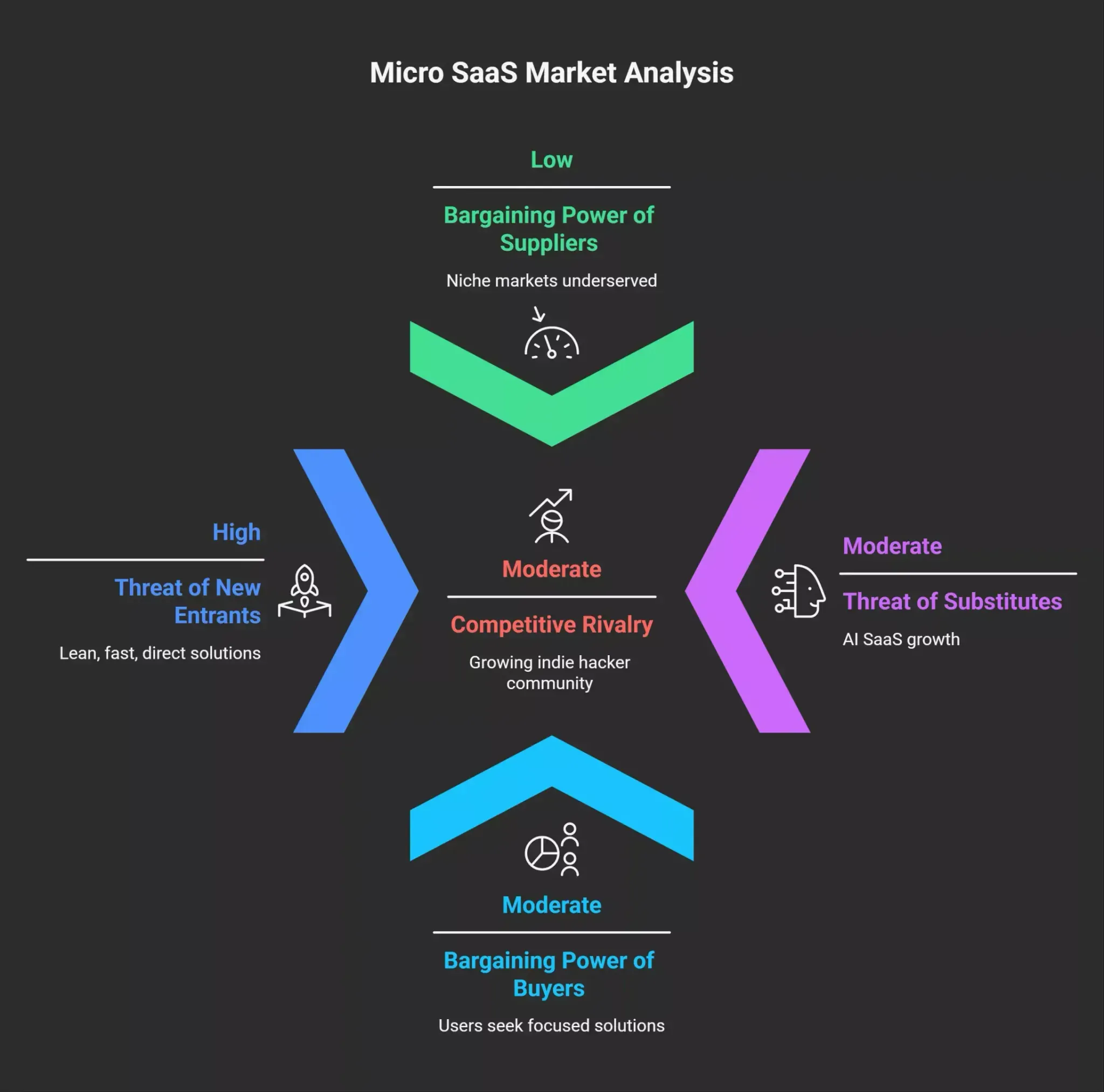
Micro SaaS is not a trend. It is a structural outcome of how software markets work. The large, horizontal SaaS platforms keep getting bigger, more bloated, and more expensive to justify. Existing solutions built for enterprise pricing cannot afford to serve niche markets well.
The median SaaS growth rate compressed to 12% in 2025, down from 30% in 2021 (source). For massive platforms, that is a painful shift. For indie hackers building micro SaaS tools? It is a signal that the horizontal giants are losing grip - and focused, vertical products are capturing what they leave behind.
The AI SaaS market alone is projected to grow at a 38.28% CAGR, from $71.54 billion in 2023 to $775.44 billion by 2031 (source). Solo founders and small teams who build AI-native micro SaaS products now are entering a market that is still in its early innings.
Why Indie Hackers Have a Genuine Edge
Enterprise solutions are designed to justify enterprise pricing. That means sales calls, long onboarding, complex tech stacks, and features that 80% of users will never touch.
Micro SaaS runs a different playbook. Solo founders can build lean, fast, and directly for the people with the problem. A $29/month plan does not need a sales team. A focused web app with 200 paying users can generate solid monthly recurring revenue for a solo developer working part-time. No management platform overhead. No enterprise pricing war to win.
That is why the indie hackers community is growing. Real users, real problems, faster feedback, and a cleaner path from idea to revenue.
Five Criteria for a Good Micro SaaS Idea in 2026
Not every idea clears the bar. Before you pick a tech stack or write a line of code, run every micro SaaS idea through five criteria:
-
Recurring pain: Does this problem come up regularly for users? Daily or weekly is the sweet spot.
-
Willingness to pay: Are people already paying for similar tools, even imperfect ones?
-
Significant gap: Is there a significant gap in existing solutions for a specific niche?
-
Solo-buildable: Can one developer or non-technical founder build and launch a first version?
-
Clear distribution path: Where do target users gather? Reddit? A niche forum? Social media? If you cannot reach them without paid ads, the idea needs a different angle.
Run every micro SaaS idea through this filter before committing to a build. Most ideas fail here, and that is useful information before you spend three months on the wrong thing.
7 Real Micro SaaS Ideas Worth Building in 2026
These are not abstract suggestions. Each micro SaaS idea here is based on real gaps in the current SaaS market, patterns from indie hacker communities, and problems that real users are actively complaining about.
AI Meeting Notes for Remote Teams
Remote teams still have a persistent meeting problem: notes are inconsistent, action items get buried, and follow-ups never actually happen. Tools like Otter and Fireflies exist, but the workflow between meeting notes, action items, CRM, and email sequences remains broken for small teams who cannot justify enterprise solutions.
A focused micro SaaS that generates clean AI meeting notes with tagged action items and syncs them to Notion databases or Slack fills a gap that no current tool addresses for teams under ten people. Transcription accuracy for key decisions, plus a simple dashboard for action item tracking, is the full product. That is buildable by one developer.
Chrome Extension for E-commerce Price Monitoring
Shopify sellers and e-commerce store owners spend significant manual work hours tracking competitor pricing, pulling website screenshots of rival listings, and validating data that should be automatic. A Chrome extension that runs scheduled price checks, fires alerts when competitors change pricing, and exports data to spreadsheets is a genuine time-saver.
The e-commerce market is growing rapidly, and small store owners are precisely the segment that cannot afford enterprise solutions. A $19/month tool saving two hours per week is an easy purchase decision.
Landing Page Analytics for Solo Founders
Google Analytics is free and overwhelming. Most landing page builders include basic analytics, but nothing that helps solo founders understand what is actually working. A lightweight landing page analytics app - built specifically for indie hackers, with a generous free tier and no enterprise pricing wall- solves a real, recurring pain.
A/B testing, scroll depth, and drop-off tracking presented in a simple dashboard, without requiring Google Analytics expertise to read, is a micro SaaS idea with a clear and reachable audience.
Niche Client Management Platform for Freelancers
Freelancers, photographers, coaches, consultants, fitness trainers: All manage clients with a patchwork of tools: one app for intake forms, another for deposit collection, another for scheduling, and spreadsheets holding everything together. A management platform built for one specific niche handles all of this in one workflow.
Existing tools like HoneyBook are priced for full-time freelance businesses. A simpler, niche-specific micro SaaS built just for yoga coaches or video editors wins on price and focus. The five criteria all line up here.
Developer Tools for API Access Monitoring
Developers building web apps that depend on third-party APIs face ongoing anxiety: keys expire, endpoints change format, and error handling for breaking changes is entirely manual. A developer tool that monitors API access health, logs response changes, and fires Slack alerts when something breaks is genuinely needed.
Most existing solutions are either too heavy: full observability platforms built for large engineering teams or too limited. A focused micro SaaS that sits in the middle, with a simple tech stack setup and affordable pricing, serves solo developers and small agencies well.
YouTube Video Analytics for Content Creators
Solo creators on YouTube use Google Analytics and YouTube Studio, but neither gives them the context they actually need: which video topics drove subscriber growth, what upload cadence works best for their specific channel, or how watch time correlates with thumbnails. Podcasters face the same problem.
A micro SaaS video analytics tool that pulls data through API access and surfaces insights in a clean, focused dashboard has a large market of creators with a clear willingness to pay. Existing solutions are either too broad or locked behind enterprise pricing.
AI Form Builder for Small Businesses
Small businesses - medical offices, law practices, insurance agencies, fitness studios - still use paper intake forms or generic form builder tools that treat every industry the same. An AI-powered form builder that adapts logic based on earlier answers, automates deposit collection, and feeds data into a lightweight CRM covers a real workflow gap.
The existing solutions are either static forms with no logic or full enterprise platforms with enterprise pricing to match. The gap in between is where this micro SaaS idea lives.
Micro SaaS Ideas at a Glance
| Micro SaaS Idea | Build Difficulty | Target Users | Revenue Potential |
|---|---|---|---|
| AI Meeting Notes | Medium | Remote teams, agencies | $5K-$30K MRR |
| Chrome Extension - E-commerce | Low-Medium | Shopify sellers | $3K-$20K MRR |
| Landing Page Analytics | Low | Solo founders, indie hackers | $2K-$15K MRR |
| Client Management Platform | Medium | Freelancers, coaches | $5K-$25K MRR |
| Developer Tools - API Monitoring | Medium | Solo developers, small teams | $3K-$20K MRR |
| YouTube Video Analytics | Medium | Creators, podcasters | $5K-$30K MRR |
| AI Form Builder | Medium-High | Small businesses, agencies | $5K-$40K MRR |
What the Community is Saying: SaaS Ideas in 2026
54% of SaaS products built by indie hackers generate zero revenue (source). The difference is almost never technical quality. It is almost always whether the idea solved a real, recurring, painful problem for a specific niche, or whether the founder built something they thought was cool.
A post from r/SaaS from January 2026 captures exactly how founders who succeed tend to think before they start building:
"I'm planning to build a SaaS product in 2026, and I want to be very intentional about what problem I choose to solve. I'm not interested in building another 'nice-to-have' productivity tool... I want to work on something that solves a real, painful, and recurring problem - something people would actually pay for and depend on." - (Source: u/Electronic-Disk-140, r/SaaS, January 2026)
That mindset is exactly what separates profitable micro SaaS products from the ones that never convert.
SaaS Ideas Case Study: Indie Hackers Who Got It Right
Two Indie Hackers stories show what happens when a founder stops trying to build for everyone.
Henry Poydar built a portfolio of micro SaaS products after a first successful exit. Most of them gained no traction. One did. He doubled down, iterated based on what real users actually needed, and pivoted the product until it fit. The result: Steady, a business generating over $83,000 per month. The whole journey started with a single micro SaaS idea that found the right niche. (source)
Rob Hallam spent 2.5 years and five failed products before building SuperX - an analytics tool for creators on X. He launched in July 2025, hit $1K MRR on day one, and reached $23K MRR with around 650 paying customers six months later. One product, one niche, one specific pain. (source)
Both founders followed the same pattern: specific problem, specific niche, fast launch, real users, iterate based on what those users do.
Launch Your Micro SaaS Startup Idea with Rocket.new
Most tools help you build once you know what you want to build. Rocket.new is built for the full journey.
Rocket.new is the world's first Vibe Solutioning platform, with 1.5 million users across 180 countries. It brings market research, full-stack app development, and competitive tracking into one system with one shared context, so indie hackers and solo founders do not have to context-switch between a research tool, a no-code builder, a separate analytics platform, and a tool to track competitors.
Here is what makes Rocket.new different from other platforms:
Research Before You Build
Rocket.new lets you validate your micro SaaS idea against real market data before you write a line of code. Identify the significant gap, check market size, and confirm whether existing solutions actually cover the niche: All inside the same workflow.
Full-Stack Building Without a Heavy Tech Stack
Whether you are building a web app, a management platform, or a form builder, Rocket.new handles the full-stack side - backend, authentication, payment processors, API access, and more, without requiring a developer background. No code experience is enough to ship a working product.
Fast Path to Real Users
Rocket.new is designed for speed. Get your first version live, drive traffic from the communities where your users already gather, and iterate based on what real users do - not what you assumed they would do.
Competitive Tracking Built In
After you launch, Rocket.new keeps watching. You can track what competitors do next, catch changes in their positioning, and decide how to respond: All without leaving the platform. It is the only tool where the thinking, the building, and the tracking happen in one place.
Compare that to Bubble, which gives you no-code tools but no research or analytics layer. Or Bolt, which is fast for prototypes but leaves backend, distribution, and competitive analysis entirely on you. Or building on a fully custom code stack, which gives you complete control but kills the speed that solo founders depend on to start building and launch before the idea window closes.
Ready to Build Your SaaS Ideas Into a Real Startup?
The SaaS ideas in this list are not theoretical. They target specific niches where existing solutions over-charge or under-deliver, where real users are already complaining in communities, and where a solo founder with the right tools can reach paying customers within weeks.
Micro SaaS works when you pick the right niche, validate before you build, and get in front of real users fast. The gap between a SaaS idea and a profitable product is smaller than it has ever been and tools like Rocket.new close it even further.
Pick one. Run it through the five criteria. Then sign up with Rocket.new, research it, build it, and launch it before someone else does.
Table of contents
- -Why 2026 is Actually Good News for Micro SaaS Builders
- -Understanding the Micro SaaS Opportunity and Market Size
- -What Does the Market Size Actually Look Like for Micro SaaS?
- -Why Indie Hackers Have a Genuine Edge
- -Five Criteria for a Good Micro SaaS Idea in 2026
- -7 Real Micro SaaS Ideas Worth Building in 2026
- -AI Meeting Notes for Remote Teams
- -Chrome Extension for E-commerce Price Monitoring
- -Landing Page Analytics for Solo Founders
- -Niche Client Management Platform for Freelancers
- -Developer Tools for API Access Monitoring
- -YouTube Video Analytics for Content Creators
- -AI Form Builder for Small Businesses
- -Micro SaaS Ideas at a Glance
- -What the Community is Saying: SaaS Ideas in 2026
- -SaaS Ideas Case Study: Indie Hackers Who Got It Right
- -Launch Your Micro SaaS Startup Idea with Rocket.new
- -Research Before You Build
- -Full-Stack Building Without a Heavy Tech Stack
- -Fast Path to Real Users
- -Competitive Tracking Built In
- -Ready to Build Your SaaS Ideas Into a Real Startup?