
Solve on Rocket.new is not a search tool or a chatbot. It is a research engine that takes any business question written in natural language and returns a structured, evidence-backed report covering market sizing, competitive teardowns, pricing strategy, and recommendations ready to act on. Unlike Perplexity AI or ChatGPT, Solve connects those research findings directly to building the actual product, inside one platform.
How is Solve on Rocket.new different from Perplexity ChatGPT or any other AI tool that claims to do business research?
Here is a situation most founders and operators know well. You open an AI tool, type a business question, and get back a confident-sounding paragraph. It reads like an answer. But when you try to act on it, you realize you still do not know whether the market is real, what the competition actually charges, or what to build first.
That is not a research problem. That is a tool problem.
Solve was built to close that gap. It does not summarize. It does not retrieve links. It runs a multi-layered research process using multiple AI agents, synthesizes findings from live data across the web, and delivers a structured report with an executive summary, supporting evidence, and clear recommendations.
Then, because Rocket.new is a complete platform, those research findings connect directly to building the product. No copy-pasting. No context-switching. No starting over.
What is Solve on Rocket.new?
AI app development tools are increasingly designed to allow users to create applications using natural language prompts, enabling non-technical users to participate in the development process.
Rocket.new takes this a step further by pairing that natural language interface with a full strategic research layer, so you are not just building faster but building the right thing from the start.
Solve is Rocket's research engine. Type any business question in natural language prompts, and it returns a structured, multi-source report built from live data.
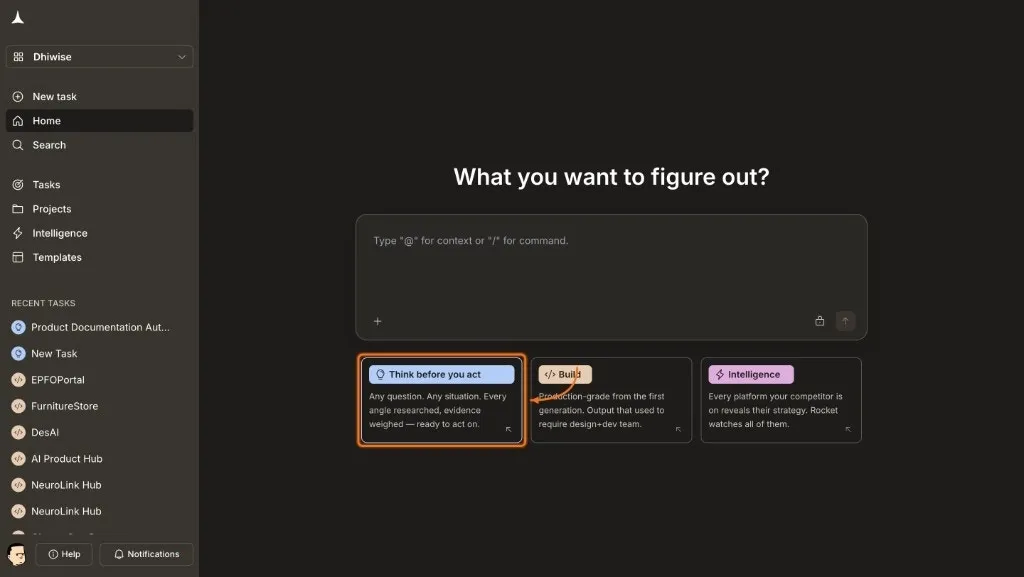
What makes Solve different from every other AI tool in this category is the output format and what happens after. A Solve report includes:
-
Executive summary with key findings and a clear recommendation
-
Detailed analysis sections with supporting evidence
-
Market sizing and opportunity assessment
-
Competitive teardowns with feature comparisons and positioning analysis
-
Pricing strategy benchmarks and scenario models
-
Product direction insights tied to user needs
-
Follow-up questions suggested automatically so you can go deeper without re-framing
And the research findings from Solve flow directly into Build on Rocket.new, so the market analysis that confirms your idea shapes the product you actually build. That is what Rocket calls vibe solutioning: thinking rigorously before building, and building from that thinking, all in one place.
How Does Solve Compare to Perplexity AI and ChatGPT?
This is the question worth answering carefully because the tools are not really competing for the same job, even though they sound similar on the surface.
| What you get | Search or Perplexity AI | ChatGPT | Solve on Rocket.new |
|---|---|---|---|
| Output type | Links or cited summary | Paragraph answer from AI models | Structured multi-source report |
| Live data | Yes, unstructured | Limited, depending on the paid plan | Yes, synthesized across streams |
| Research effort | You do the work | Shallow, single-pass | Done for you, in depth |
| Follow-up | New search required | Some memory, no project context | Builds on full conversation and project context |
| Connects to the building | No | No | Yes, directly inside Rocket.new |
| Multiple AI agents | No | No | Yes, parallel streams per query |
| Decision-ready output | No | No | Yes |
Many AI app development platforms are evolving to integrate multiple functionalities, allowing users to manage the entire app lifecycle from ideation to deployment within a single environment.
Perplexity AI is an excellent AI-powered search engine for real-time research and cited answers. Perplexity vs Solve is not really a head-to-head, because Perplexity AI was built to answer factual questions fast, not to produce structured business deliverables. Perplexity AI is your go-to tool for staying up to date on a topic or pulling academic research quickly.
ChatGPT is a capable general-purpose AI assistant. It handles creative writing, data analysis, code generation, and natural conversations well. The deep research mode in ChatGPT runs multi-step web research and produces a detailed report from web sources. But the final report is informational. It does not tell you what decision to make, and it has no path to building anything.
Both Perplexity AI and ChatGPT give you conversational answers. Solve gives you a structured, evidence-backed deliverable ready to present, act on, or build from.
👉Start free at Rocket.new and type your first business question.
How Does the Solve Research Process Actually Work?
Most people assume AI tools work by sending one big query to a large language model and getting one response back. Solve works differently. Here is the actual research process from question to finished report:
Step 1: You ask in plain language. Type any business question. Pick from suggested categories like Strategy, Product, GTM, Sales, or Competition, or write your own. Solve classifies it into one of nine intelligence types automatically.
Step 2: Solve clarifies if needed. For questions with an ambiguous scope, Solve asks clarifying questions before it starts. This sharpens the research objective and avoids broad, shallow results.
Step 3: The research objective is set. Solve defines the central goal anchoring every subsequent research stream.
Step 4: Query decomposition. Solve breaks your question into its component dimensions. Each one becomes an independent research query. You can watch these appear in chat as research begins.
Step 5: Parallel agent research. Each query runs as a separate stream powered by its own agent. The multiple ai agents run simultaneously, not in sequence. Each agent shows what it researched, which ai tools it used, what it found, and how it assessed the findings.
Step 6: Synthesis into a structured report. Findings from all streams merge into a final report with an executive summary, detailed analysis, supporting evidence, and actionable recommendations.
No other AI assistant or AI-powered search engine runs this kind of coordinated multi-agent research process. Perplexity vs this workflow is the difference between one person looking something up and a team of analysts running parallel tracks.
What Can Solve Actually Research? Real Use Cases by Goal
| Goal | What You Ask Solve | What You Get Back |
|---|---|---|
| Validate a startup idea | "Is there a gap in the B2B invoicing market for freelancers?" | Market sizing, competitor map, pricing benchmarks, and recommendation |
| Prepare for a sales meeting | "What are the technology priorities for mid-market logistics companies?" | Account intelligence brief ready to use |
| Plan a product roadmap | "What features do users of project management tools request most?" | Product direction analysis with priority signals |
| Enter a new market | "What does market entry into Southeast Asia look like for a SaaS analytics tool?" | Market analysis, regulatory signals, go-to-market strategy |
| Assess an investment | "Build a business case for acquiring a niche HR software company." | Due diligence framework with financial and market data |
| Track competitive gaps | "What are Stripe's pricing model weaknesses compared to emerging fintech players?" | Competitive teardown with positioning map |
For every one of these goals, the research findings sit inside Rocket.new's shared context, ready to inform the Build session that follows. That is the part that no other AI app, AI research assistant, or AI-powered search engine in this space provides.
Is Perplexity the Best AI Research Tool?
Perplexity AI is genuinely strong for what it was designed to do. It is one of the best AI tools for real-time research, quick competitive lookups, and staying up to date on fast-moving topics. Perplexity Pro adds access to advanced models and a deep research mode that runs deeper multi-step web research across many sources. For academic research, checking facts, or tracking industry news, Perplexity AI is a solid go-to tool.
But perplexity AI does not produce decision-ready strategic deliverables. It does not run a coordinated multi-agent research process. It does not connect to building a product. Perplexity vs Solve is ultimately a comparison between an answer engine and a strategy engine.
For business research tied to a real decision and a product outcome, Solve is built specifically for that job.
Which is Better for Research: Perplexity or ChatGPT?
Both Perplexity AI and ChatGPT are strong AI tools, but they are optimized for different research modes.
Perplexity AI is faster for real-time research with citations. It pulls live web data and presents it with sources, making it easier to verify factual accuracy. The perplexity pro tier and perplexity's comet browser extend this further for users doing heavy web research.
ChatGPT is better for reasoning through complex topics, long-form content, and tasks that require the AI models to apply judgment rather than just retrieve. Its deep research feature produces a more narrative, detailed report, but does not offer the structured, section-by-section format that Solve delivers.
The key difference is the output format and the next step. Perplexity AI and ChatGPT both stop at the information. Solve produces a structured report and opens a direct path to building.
How Does Solve Connect Research to Building?
This is the design decision that separates Rocket.new from every other AI app or web app in this space.
When you complete a Solve task, the research findings become part of your project's shared context. When you start a Build session in the same project, the AI agents already know what the market analysis said, what the competitive gaps are, and what the go-to-market strategy recommends. You do not re-explain. You do not copy findings into a Google Doc and paste them into a brief. The whole process is connected.
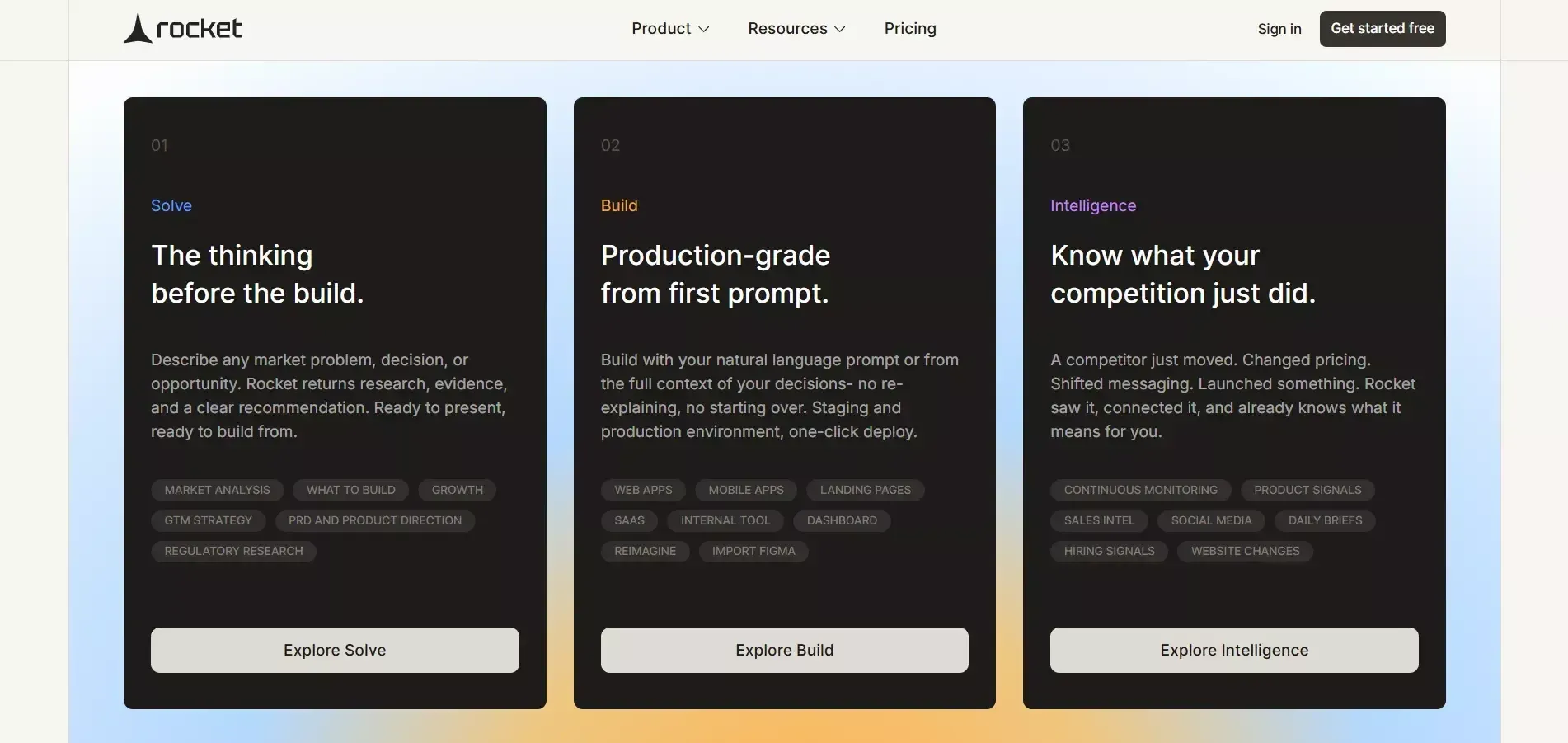
Rocket.new generates actual code and backend setups from this context, not wireframes or demos. AI tool integration in development platforms often includes features like API management, version control, and cloud storage, which facilitate a smoother development process for users. The research that confirmed your idea shapes the product that gets built and shipped.
That is what makes Rocket.new different from a general-purpose AI assistant, a Perplexity AI search session, or any AI tool that handles one part of the arc and leaves the rest to you.
What Does Rocket.new Pricing Looks Like for Solve?
Many AI tools in the market offer a free tier, allowing users to experiment with their features before committing to a paid plan. Also, the subscription-based pricing models are common in the AI-powered application development industry, with plans typically starting around $20 to $25 per month for basic access.
Rocket.new offers a free tier with 20 one-time credits to try the platform with no credit card required. Solve is included in paid plans:
| Plan | Monthly Price | Credits Included | What It Covers |
|---|---|---|---|
| Free | $0 | 20 one-time credits | Build capabilities only |
| Build | $25/month | 100 monthly credits | Production-ready app building |
| Solve + Build | $250/month | 1,000 monthly credits | Full research and building |
| Solve + Build + Intelligence | $350/month | 1,500 monthly credits | Research, building, and continuous competitor monitoring |
Credits never expire. All plans include unlimited team members. The free plan gives you access to all Build capabilities. Solve is available from the $250 paid plan tier.
Perplexity Pro is around $20 per month and strong for search-focused work. ChatGPT's paid plan is similarly priced for general-purpose AI assistant use. Neither includes app development, persistent project context, or the multi-agent research process that Solve runs.
What Real Users Say About Solve on Rocket.new
Real feedback from Trustpilot and LinkedIn gives a clear picture of how people experience the platform.
A Trustpoint reviewer, after testing many other builders, became the one they stuck with, and they highlighted the Discord community as particularly responsive.
"Rocket.new is a modern, fast, and easy-to-use builder."- Ulle, Trustpoint
"Using Rocket.new to build a complex, multi-feature application with real data models, authentication flows, and business logic, and said it delivered far beyond what he expected."- Andrew T. Reilley III, writing on Trustpilot in January 2026
On LinkedIn, the response to the Rocket 1.0 launch drew pointed observations from builders and operators.
One commenter on Vishal Virani's launch post noted that the stat that stuck with them was that 60 to 70 percent of people using vibe coding tools do not know what they are actually building, and framed Solve as the answer to that missing product category, citing consulting-grade problem analysis, continuous competitor intelligence, and a build layer that starts from actual research rather than a blank prompt. -LinkedIn
Kartik Gupta, Investor at Salesforce Ventures, said Rocket.new is purpose-built to solve the problem of iteration, maintenance, and deployment at enterprise scale.
For ongoing community discussion, the Rocket Discord, where builders share how they use Solve and Build together day to day.
Rocket.new Key Features Worth Knowing
The platform emphasizes creating working apps rather than just generating code, allowing users to manage their tech stack, handle version control, and test the entire codebase seamlessly.
-
Solve runs parallel AI agents per query, not one single large language model pass
-
Research findings carry forward into the Build with persistent project context
-
Solve handles nine intelligence types, including market analysis, competitive teardowns, pricing strategy, investment analysis, and product direction
-
Reports are structured with executive summaries, evidence sections, and recommendations, ready to present or export
-
Intelligence (available on the top-tier plan) runs continuous competitor monitoring and delivers daily briefs and pricing change alerts
-
Perplexity's Comet browser and ChatGPT's deep research produce detailed reports. Solve produces structured reports with an explicit next step built in
-
The free tier gives 20 one-time credits with no credit card required
-
Over 1.5 million people across 180 countries have tried Rocket
Start With the Question, Not the Code
The most expensive mistake in building a product is not poor execution. It is a good execution of the wrong thing. That is exactly the problem that Rocket.new handles uniquely with Solve, making it different from Perplexity, ChatGPT, or any other AI tool that claims to do business research.
Solve is built to answer the strategic question before a line of code gets written, and then build from that answer inside the same system.
Perplexity AI and ChatGPT are excellent AI tools. They are not wrong choices for search and general reasoning. But for business research that leads to a decision and a product, they hand the hardest work back to you. Solve keeps it.
Type your first business question at Rocket.new and see what your research actually leads to.
Table of contents
- -What is Solve on Rocket.new?
- -How Does Solve Compare to Perplexity AI and ChatGPT?
- -How Does the Solve Research Process Actually Work?
- -What Can Solve Actually Research? Real Use Cases by Goal
- -Is Perplexity the Best AI Research Tool?
- -Which is Better for Research: Perplexity or ChatGPT?
- -How Does Solve Connect Research to Building?
- -What Does Rocket.new Pricing Looks Like for Solve?
- -What Real Users Say About Solve on Rocket.new
- -Rocket.new Key Features Worth Knowing
- -Start With the Question, Not the Code