
Solve on Rocket.new goes beyond AI summaries by delivering structured, actionable reports instead of plain text answers. It uses parallel agents and live data to generate strategy, competitive insights, and clear next steps. Teams move from idea to execution faster with connected workflows and built-in context.
What actually happens when you ask an AI tool a business question?
You get a paragraph, nod, and spend hours doing the real work yourself. Solve on Rocket.new does something different. It takes your question and returns structured output: market data, strategy, competitive gaps, and a direction your team can act on.
According to a 2026 report, 63% of people using AI tools are non-developers, and many hit the same wall: AI gives them words, not a plan.
The Gap Between a Blank Prompt and Real Progress
When you type a question into ChatGPT, Perplexity, or any standard AI tool, the system creates a summary from its training data. That output sits in a chat window. You copy it, cross-reference it, and reformat it for your team's work meeting. The thinking still falls on you. In a world where vibe coding lets users create entire apps from a single sentence, the thinking behind what to build still happens in scattered docs and group chats.
-
Most tools return a paragraph answer with no structure, no evidence trail, and no connection to your next step
-
The context resets with every session, so teams end up stuck, waiting for someone to manually connect the findings to a strategy
This is the gap. AI tools can retrieve information, but most tools stop there. For enterprise teams running sprint planning or founders testing an idea, that gap costs days.
What is Solve on Rocket.new
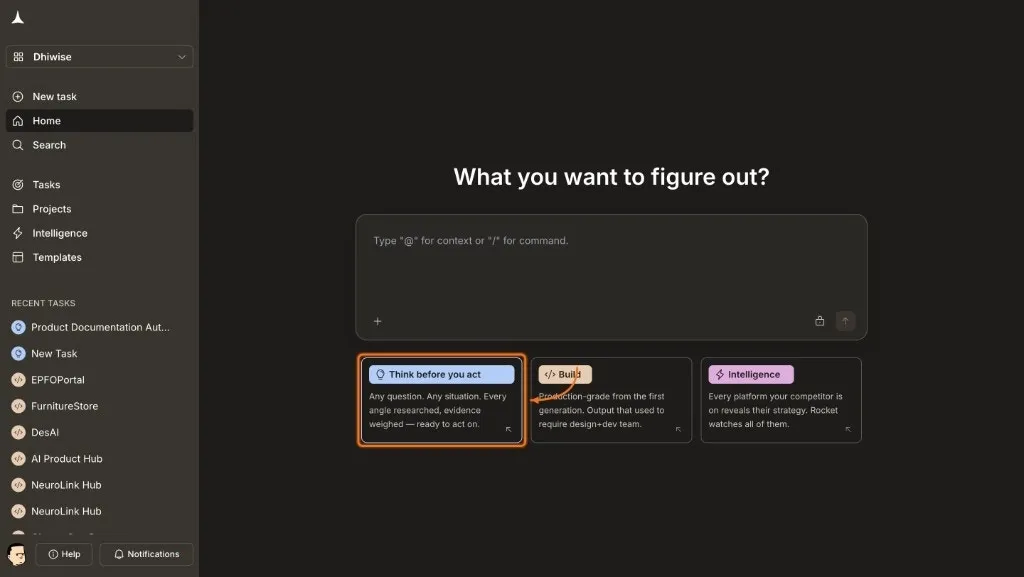
Solve is Rocket's engine for turning questions into action. It sits inside the same platform where teams build web apps and mobile apps, create project plans, and write code. The concept is simple: turn a question into a structured, evidence-backed report, not a chat reply.
-
You type a business question in natural language: "Should we enter the European market for our SaaS product?" or "What pricing model fits a B2B analytics tool?"
-
Solve breaks that question into smaller research queries, each running through parallel agents that search live data simultaneously
-
The output is a structured report with an executive summary, supporting evidence, competitive insights, and specific recommendations
This is not a chatbot conversation. Solve on Rocket.new transforms a simple prompt into structured output, including strategy, flows, and code suggestions, all in one place.
| Feature | Search Engine | AI Chatbot | Solve on Rocket.new |
|---|---|---|---|
| Output format | Ten links | Paragraph summary | Structured report with recommendations |
| Live data | Yes, unstructured | No | Yes, synthesized across sources |
| Research effort | You do the work | Shallow, one-pass | Done for you, multi-stream |
| Context memory | None | Limited per session | Full project and cross-task context |
| Next step | You figure it out | You figure it out | Clear direction, ready for execution |
How the Process Moves from Idea to Structured Output
The process inside Solve follows a fixed pipeline, and every step builds on the previous one.
-
You ask a question, and Solve checks whether it needs clarity before starting
-
The question splits into parts, and each part runs as its own stream with its own agent
-
All findings merge into a single report: data, analysis, confidence scores, and a path to move forward
This is vibe solutioning in practice. The platform does the thinking work that used to take a strategy consultant weeks. Solve can conduct market analysis using live data to map dynamics and risks before a project begins.
It generates output comparable to McKinsey-grade work: pricing models, unit economics, SWOT analyses, and competitive intelligence. Teams building a new product or testing a concept get the knowledge they need before writing code.
Why Summaries Leave Teams Stuck (and How Solve Fixes It)
The problem with AI summaries is not the text quality. The problem is what happens after you read it. Users get stuck.
-
A summary gives you information without direction. You still need to figure out which market to enter, how to price, or whether your idea makes sense against competitors
-
Edge cases and logic gaps get ignored because a chatbot answers the question you asked, not the questions you should have asked
-
When teams building a project switch between separate tools, the context breaks every time
Traditional AI question-answering methods often result in scattered steps and delays. Solve on Rocket.new fixes this by treating the output as the first step in execution. The findings carry directly into Rocket's building mode, where the same context informs code, design, and feature decisions.
-
Findings from the Solve layer automatically carry over to the Build layer, so teams do not re-explain business goals or market constraints when they move from idea to product
-
Solve tracks competitor pricing, hiring patterns, and news to ground recommendations in live market data
-
Teams move from question to decision in hours instead of weeks, thanks to connected workflows and structured output
A vibe solutioning platform helps teams move from idea to execution, reducing delays and improving workflow efficiency. Vibe coding made building fast. Solve makes sure you are building the right thing.
What the Community is Saying
The conversation around vibe coding, structured output, and the gap between thinking and building has picked up speed. The world of AI tools keeps growing, and this blog captures an interesting shift.
"This is taking them from idea space, and opinion space, and from taste directly into product. Vibe coding is the new product management." - Naval Ravikant on X
Naval's point lines up with what Rocket built. The gap was never about generating code faster. It was between having an idea and having enough clarity and confidence to act on it. Solve gives you the progress, the structure, and the insights in one place, so teams stop waiting and start building.
How Rocket.new Turns Research into Execution for Any Team
Rocket.new connects the full arc of product development: validate the idea, build the app, monitor the market. Solve on Rocket.new sits at the start of this workflow, giving teams the confidence they need before building or writing code.
-
Vibe solutioning platform that connects thinking, building, and competitive intelligence
-
25k+ templates library, free to use, for rapid prototyping and setup
-
Saves up to 80% tokens compared to starting from a blank prompt
-
Supports Flutter for mobile apps and Next.js for web apps, so teams create and ship on one platform
-
Collaboration features are built in, so every project has a shared context across users
-
3 Products, one platform: Solve, Build, and Intelligence
Here is how specific teams connect Solve to their workflow:
-
A startup founder tests whether a B2B analytics tool idea has market demand. Solve returns a competitive teardown and a validation path. The founder moves directly into building the app with full context
-
An enterprise team preparing background for the call uses Solve to pull competitive data and positioning. Teams create one report instead of juggling six tabs
-
A product team running sprint planning uses Solve to test a new feature direction against user data and feed findings into a build task. No code gets written until the idea has evidence behind it
-
Developers prototyping an app use Solve to check market fit before committing code, saving time on building the wrong thing. More users adopt this workflow as teams move from idea to production faster
From Questions to Confidence: Picking the Right Tool
What is Solve on Rocket.new and how is it different from asking AI a question and getting a summary back comes down to structure. Chatbots give you text. Solve gives you a plan backed by live data and recommendations your team can move forward on today.
The call to action section of any project should start with confidence, not guesswork, and Solve gives you that confidence before you create a single line of code.
Table of contents
- -The Gap Between a Blank Prompt and Real Progress
- -What is Solve on Rocket.new
- -How the Process Moves from Idea to Structured Output
- -Why Summaries Leave Teams Stuck (and How Solve Fixes It)
- -What the Community is Saying
- -How Rocket.new Turns Research into Execution for Any Team
- -From Questions to Confidence: Picking the Right Tool