
An overview of how Solve on Rocket.new analyzes customer interview transcripts, extracts key insights, and converts them into structured, scoped feature briefs that engineering teams can immediately understand, prioritize, and build from.
How do you turn messy interviews into something buildable?
You need a system that can take raw conversation data, structure it clearly, and turn it into outputs your team can act on. That’s where AI powered platforms like Rocket.new Solve step in. They help convert unstructured discussions into something usable without slowing things down.
According to McKinsey, companies using AI in product development can reduce development time by up to 30%. That kind of speed matters when teams are trying to move fast and stay ahead.
So, let’s break down how this process works, why teams struggle, and how Solve on Rocket.new changes the flow from raw interviews to real product decisions.
Customer Interviews Are Messy
Customer interviews are incredibly valuable. They give direct access to what customers think, feel, and need. But at the same time, they can feel chaotic and hard to manage.
You sit through long interview calls. You collect vast amounts of data. You take notes and try to understand what users are saying. Then comes the hard part, making sense of it all.
This is exactly where most product teams start to struggle.
Where Things Break Down
-
Raw interview transcripts are hard to manage
-
Key themes get lost in long conversations
-
Pain points are scattered across different notes
-
Teams struggle to write a clear problem statement
-
Engineers don’t get clear direction from the insights
So even after putting in all that effort, teams often fail to build what customers actually need. And that’s where the real frustration begins.
Why Traditional Tools Don’t Help Enough?
Most teams rely on many tools, each solving just one small part of the process. On paper, it looks organized. In reality, it creates more gaps than it solves.
Where It Falls Apart
-
Broken workflows
-
Repeated tasks
-
Lost context
-
Slower speed
-
Poor analysis
Even with AI tools, the experience often feels disconnected.
You still have to piece everything together, and without structure, the outputs from large language models can feel random. Instead of clarity, teams end up dealing with more confusion.
Now here’s where things get interesting.
Solve is part of the Rocket.new platform, designed to handle research, analysis, and output in one connected system.
What It Does
-
Processes customer interviews and research data
-
Uses AI and shared context to run structured analysis
-
Generates summaries, insights, and clear outputs
-
Helps teams create direction before building
How It Works
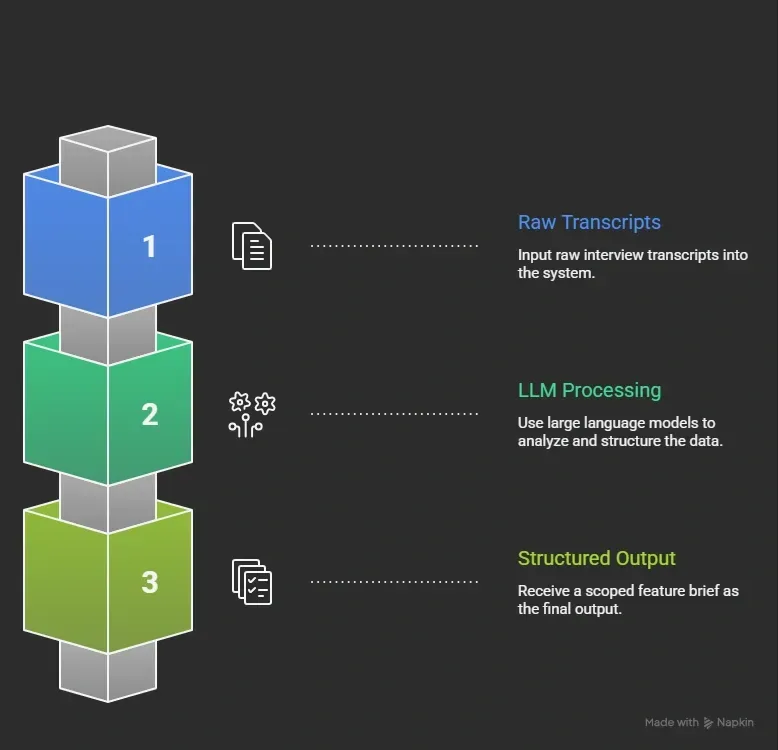 Simple idea. But instead of scattered tools and confusion, your team gets clarity and something they can actually build from.
How the Process Works?
Let’s break it down in a simple way. This is where raw interview data starts turning into something your team can actually use.
Step 1: Input the Interview Data
You upload customer interview transcripts or notes.
This can include:
-
Call recordings turned into text
-
Written interview summaries
-
Any relevant background for the call
The system gets access to all this data in one place.
Step 2: AI Analysis Begins
Now the AI powered system starts its analysis. It uses natural language understanding to read through conversations and understand context.
It looks for:
-
Pain points
-
Friction points
-
Key themes
-
Repeated answers
-
User behavior patterns
This is where large language models shine. They process vast amounts of data quickly and consistently.
Step 3: Extract Insights and Build Structure
Next, the system works to extract insights. Instead of dumping random outputs, it organizes everything into structured sections.
This includes:
-
Problem statement
-
User needs
-
Key insights
-
Supporting quotes
Now the team can actually understand what customers are saying.
Step 4: Turn Insights into a Feature Brief
Solve takes those insights and turns them into something actionable. A scoped feature brief.
This includes:
-
Clear feature ideas
-
Defined outcomes
-
Business context
-
Suggested strategy
So instead of raw notes, your team gets something they can build from.
Step by step, the process moves from messy conversations to structured outputs. And in the end, your team gets clarity, direction, and something real to work with.
How the workflow looks?
Let’s take a simple example.
| Stage | Before Solve | After Solve |
|---|---|---|
| Interview Data | Long transcripts | Structured summary |
| Analysis | Manual and slow | AI powered analysis |
| Insights | Scattered notes | Clear insights |
| Output | Vague ideas | Feature-ready brief |
| Team Work | Confusing tasks | Focused tasks |
That’s a huge shift in how teams manage their workflows.
Real Value for Product Teams
So what does this actually mean for your team?
It shifts how product managers and founders approach their work, making the whole process more clear and focused.
-
Less time spent on analysis, more time to focus on strategy
-
Better decisions based on real insights, not guesswork
-
Fewer tools to manage, everything in one platform
-
Clear understanding of what users actually need
When the noise is reduced, teams can move faster and build with confidence. And that’s where real progress starts to happen.
Rocket.new Insight
Here’s something interesting directly from X:
“Get a clear recommendation. A structured brief… ready to hand to a developer.” post on X
This perfectly reflects the shift happening right now.
Teams don’t just want raw data or long interview transcripts. They want clear outputs they can actually build from. That’s the real value. Turning conversations into structured briefs that move directly into a
Understanding Rocket Solve in Action
Solve works as a research engine that connects data, analysis, and output into one system.
Key Features
-
AI powered analysis of customer interviews
-
Structured summaries with context
-
Ability to create feature briefs automatically
-
Support for multiple workflows
-
Built-in knowledge handling
How It Works
-
You input data
-
The system processes it using AI
-
It generates structured outputs
-
The team uses those outputs to build
It keeps things simple while helping teams move from raw data to clear direction without switching between tools.
Connecting Research to Real Product Decisions
Now let’s zoom out a bit.
Today, companies compete on speed and understanding. The faster a team can understand customers, the faster they can build the right features.
What Changes
-
Faster understanding of customer needs
-
Better connection between research and product decisions
-
Less gap between thinking and execution
-
Stronger ability to scale research
Solve helps bridge the gap between raw conversations and real product outcomes, making it easier for teams to act with clarity.
Why This Approach Matters Going Forward
Product development is changing, and AI is becoming part of everyday workflows. But not all tools actually help teams move forward.
What Stands Out
-
Focus on the full process, not just one task
-
Better handling of data and analysis together
-
Outputs that support real building decisions
-
Consistent workflows across teams
When tools support real tasks and decisions, teams can move faster, stay focused, and build with more confidence.
From Interviews to Action
Teams run customer interviews but still struggle to turn them into clear outcomes. There’s too much data, too many tools, and not enough clarity. Insights get scattered, analysis takes time, and the team often ends up with unclear direction. This slows down decisions and makes it harder to build what users actually need.
Solve on Rocket.new Converts Customer Interview Transcripts into structured feature briefs by connecting data, analysis, and output into one process. When everything is aligned, teams move faster with better speed and focus. They get stronger insights, clearer strategy, and outcomes that lead to better products and real growth.
Try Solve on Rocket.new to convert customer interview transcripts into structured outputs your team can act on quickly.
Table of contents
- -Customer Interviews Are Messy
- -Where Things Break Down
- -Why Traditional Tools Don’t Help Enough?
- -Where It Falls Apart
- -Now here’s where things get interesting.
- -What It Does
- -How It Works
- -How the Process Works?
- -Step 1: Input the Interview Data
- -Step 2: AI Analysis Begins
- -Step 3: Extract Insights and Build Structure
- -Step 4: Turn Insights into a Feature Brief
- -How the workflow looks?
- -Real Value for Product Teams
- -Rocket.new Insight
- -Understanding Rocket Solve in Action
- -Key Features
- -How It Works
- -Connecting Research to Real Product Decisions
- -What Changes
- -Why This Approach Matters Going Forward
- -What Stands Out
- -From Interviews to Action