
Solve on Rocket.new breaks down every business question into structured dimensions before pulling any data. It uses parallel AI agents and shared project memory to deliver connected, decision-ready insights. This “vibe solutioning” approach ensures teams solve the right problem before building anything.
What if the reason your AI keeps missing the mark has nothing to do with the data it finds?
Solve on Rocket.new maps for every dimension of a business question before a single source gets pulled. Over 80% of AI projects fail, and the failure usually traces back to answering the wrong problem with increasing confidence.
What Happens When AI Skips the Thinking
Most people type a prompt into an AI tool and expect good answers. The system runs a search, pulls data, and starts building a response. That sounds fine until you examine what comes back.
Most Products Guess at the Wrong Problem
-
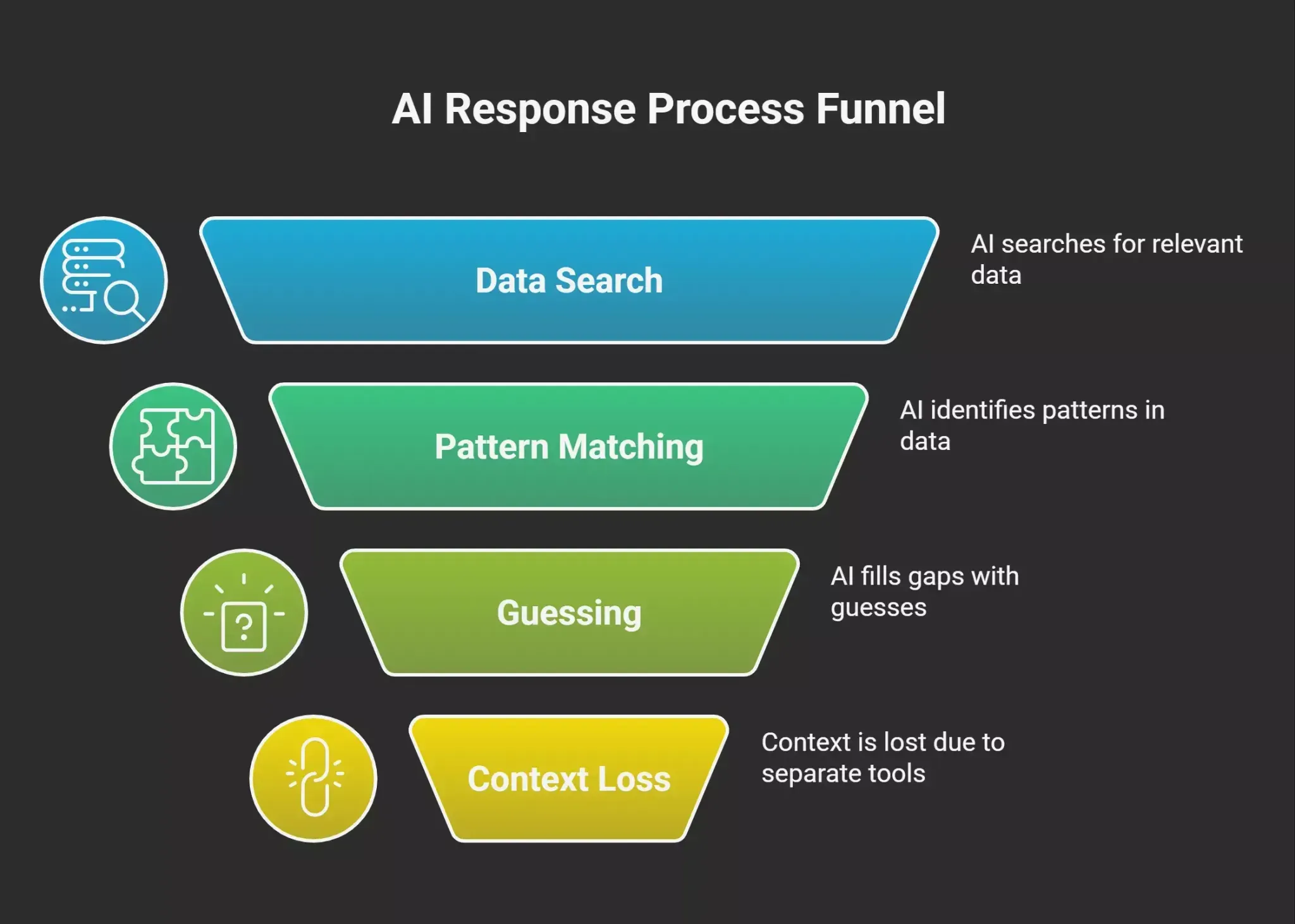
AI language models do not hold real knowledge. They give responses based on patterns from training data, which can lead to guesses that sound right but miss the point.
-
Training data rewards pattern-matching over clarity. Current models fill gaps with guesses instead of admitting they do not know.
-
Most products fail not because teams cannot build them, but because the underlying question is weak or the goal is unclear.
The wrong problem gets answered when teams guess instead of asking what the right one looks like. A team can write code, ship features that do not matter, and track metrics for months while building something nobody needs.
How Separate Tools Create Context Loss
-
When competitive analysis happens in separate tools and handoffs happen, context loss compounds.
-
Strategy docs live in one place. Code lives in another. Competitive data sits in a third tool. Teams re-explain the same thing every time they switch, and that friction adds up.
-
Separate tools give you something worse than wasted time: they give you answers and code that do not connect.
Simply, teams spread across separate tools lose the thread between "what we learned" and "what we build." Vibe coding solved how fast code gets written, but never addressed this gap. Vibe solutioning exists because that gap kept delivering the wrong result.
Vibe solutioning is a process that answers 'what and why' before 'how', shifting the focus from code generation to strategic decision-making in product development.
How the Platform Maps a Question Before Pulling a Single Source
The answer sits in two steps that happen inside Rocket.new before any external source gets touched. Solve employs a research-first approach powered by query decomposition and autonomous AI agents rather than searching for information like a search engine.
Query Decomposition as the First Major Step
-
When you type a business question, the platform reads the prompt and breaks it apart.
-
It identifies every dimension: market dynamics, financial implications, competitive positioning, and user needs.
-
Each dimension becomes a focused track. A single prompt turns into a structured thinking blueprint that accounts for what matters before anything gets pulled.
-
For complex requests, it asks clarifying questions to confirm intent.
This is the first major step in vibe solutioning: responding to a question by mapping its full shape, not by guessing which query might return a useful link.
Parallel Agent Research Across Dimensions
-
After decomposition, separate AI agents investigate each dimension, covering market analysis, competitor positioning, customer pain points, and financial logic.
-
These agents share project memory, so the research findings from one track inform the others as they run.
-
Within 60 to 90 minutes, it runs thousands of queries across 150+ sources and delivers a structured recommendation.
The concept matters here, and it matters a lot: this is the difference between answering questions and figuring out what the question actually requires. Most AI tools return links. Rocket returns a decision with evidence, scored by certainty and cross-referenced.
For example, a business question about entering a new market does not give you a pile of links. It produces a board-ready post with competitive gaps named, validation paths scored, and a 90-day plan.
Why Shared Context and Project Memory Change the Output
What the platform delivers stays inside the project. Everything that follows already knows what was found.
From Strategy Docs to Build, Nothing Resets
-
Add strategy docs, financial models, and customer research to your Rocket project once. Every task after that can reference all of it.
-
Project memory persists across sessions. A team member who joins weeks later starts from the full accumulated picture.
-
When you open a Build task, the code already reflects the research findings. No re-explaining. No context loss between planning and building.
-
Shared context compounds over time. The tenth task knows what the first nine established.
Vibe solutioning separates from vibe coding here. A code-first method starts from a blank single prompt. This approach starts from everything your team already knows, and it makes sense when you see how much rework it eliminates.
| Workflow Step | Separate Tools Approach | Rocket Vibe Solutioning |
|---|---|---|
| Ask the key question | Manual lookup across tabs | Query decomposition works all dimensions in parallel |
| Link research to a build plan | Copy, paste, re-explain in a new product | Findings flow directly into Build with shared context |
| Maintain project memory | Meeting notes that go stale | Persistent memory compounds with every task |
| Build code from findings | Re-explain the idea in a code tool | Build reads from full project logic |
| Create a deliverable for stakeholders | Write a deck from scratch | Export as PDF or write a post, a presentation, or a report from the same system |
What People Are Saying
The friction between thinking and building has been a topic across product communities since vibe coding went mainstream.
"The real bottleneck in product development is not building faster, but choosing better. Rocket just launched Rocket 1.0, its first Vibe Solutioning platform, built to address exactly that problem, what to build before AI writes the code." - Rohan Paul on X
That post became one of the most-shared posts on the topic. The post landed because vibe coding made building cheap, and the cost of building the wrong thing became obvious.
Vibe Solutioning vs Vibe Coding: Where the Friction Sits
Vibe coding solved how to build, but never answered what to build or why.
-
A code-first tool takes a single prompt and turns it into code. Fast, but the output depends entirely on whether the human asked the right question.
-
Vibe solutioning decomposes that prompt, works every angle, and creates a structured answer before any code gets written.
-
The friction in code-first work is not speed. The friction is confidence: teams ship code without knowing if the reasoning behind it holds up.
-
This approach removes that friction.
When teams keep their decisions and code in a single platform, the logic that shapes the product stays connected to the code that builds it.
How Rocket.new Handles Every Dimension of a Question
Rocket.new is a vibe solutioning platform that ties solving, building, and competitive intelligence into one system. The idea clicks when you see how each part feeds the next.
The platform takes any question and returns a structured recommendation. Teams type a natural language prompt, and Rocket produces answers ready to present, answers ready to act on, and answers ready to build from. The output it produces is accurate and scored by confidence. That decorative background noise of generic AI answers vanishes when a vibe solutioning platform does the actual thinking for a human team, responding with structured point-by-point analysis rather than guesswork.
-
Vibe solutioning platform: Build and Intelligence share one shared context.
-
25k+ templates library, free to use: Production-ready starting points for web apps, internal builds, and SaaS products.
-
Saves up to 80% tokens: Helps create more complete output with fewer iterations than code tool workflows.
-
Supports Flutter and Next.js: Build native mobile apps or web applications on modern frameworks from one platform.
-
Collaboration features built in: Shared workspaces and audit logs for teams.
-
3 Products, One Platform: Solve, Build, and Intelligence: Create what matters, build it, and, and track what your competition does next.
Use Cases That Matter
-
A product team types a single prompt about entering a new market. The platform maps the competitive picture, validates the idea, and returns a 90-day plan with every decision ready to build from.
-
A VP of Sales needs background for the call tomorrow. One line typed generates a deal-specific brief, not a generic battle card.
-
A founder wants to know if an idea holds up before code. The platform returns an honest, structured analysis post with findings scored by confidence.
-
An agency needs a call to action section, documentation, and a prototype. Rocket handles all of it, and what they build reflects the findings, not a guess.
Answers That Account for the Full Picture
Why does Solve on Rocket.new understand every dimension of a question before any research actually begins?
It comes down to one thing. When a platform maps a problem before building anything, what happens is that the answers connect to the world the human is building in.
That matters. That is what less time spent guessing and more time spent building looks like. How did vibe solutioning happen? Because vibe coding left the harder problem untouched. You can edit findings, fix what needs fixing, and build from what Rocket gives you.
Start using Rocket.new to turn complex questions into clear, build-ready decisions in minutes.
Table of contents
- -What Happens When AI Skips the Thinking
- -Most Products Guess at the Wrong Problem
- -How Separate Tools Create Context Loss
- -How the Platform Maps a Question Before Pulling a Single Source
- -Query Decomposition as the First Major Step
- -Parallel Agent Research Across Dimensions
- -Why Shared Context and Project Memory Change the Output
- -From Strategy Docs to Build, Nothing Resets
- -What People Are Saying
- -Vibe Solutioning vs Vibe Coding: Where the Friction Sits
- -How Rocket.new Handles Every Dimension of a Question
- -Use Cases That Matter
- -Answers That Account for the Full Picture