
TAM SAM SOM is the market sizing framework that separates funded startups from failed ones. TAM is your ceiling, SAM is your focus, SOM is your year-one plan. This guide walks through real calculations, common mistakes, and how Rocket.new replaces the traditional validation stack.
TAM SAM SOM example calculations are the market sizing framework that separates funded startups from those that never leave the pitch stage. This guide walks through what each layer means, how to calculate total addressable market, serviceable addressable market, and serviceable obtainable market with a real no-code industry example, and how Rocket's Solve, Intelligence, and Build pillars replace the traditional validation stack in 2026.
TAM (Total Addressable Market) is the maximum revenue opportunity if you capture 100% of the market. SAM (Serviceable Addressable Market) is the portion your product can actually serve today. SOM (Serviceable Obtainable Market) is the realistic slice of SAM you can capture in the near term given your resources, competition, and go-to-market plan.
What Is TAM, SAM, SOM, and Why Does It Matter?
TAM SAM SOM is a market sizing framework that breaks your target market into three progressively focused layers. Think of it as a funnel, wide at the top, narrow at the bottom.
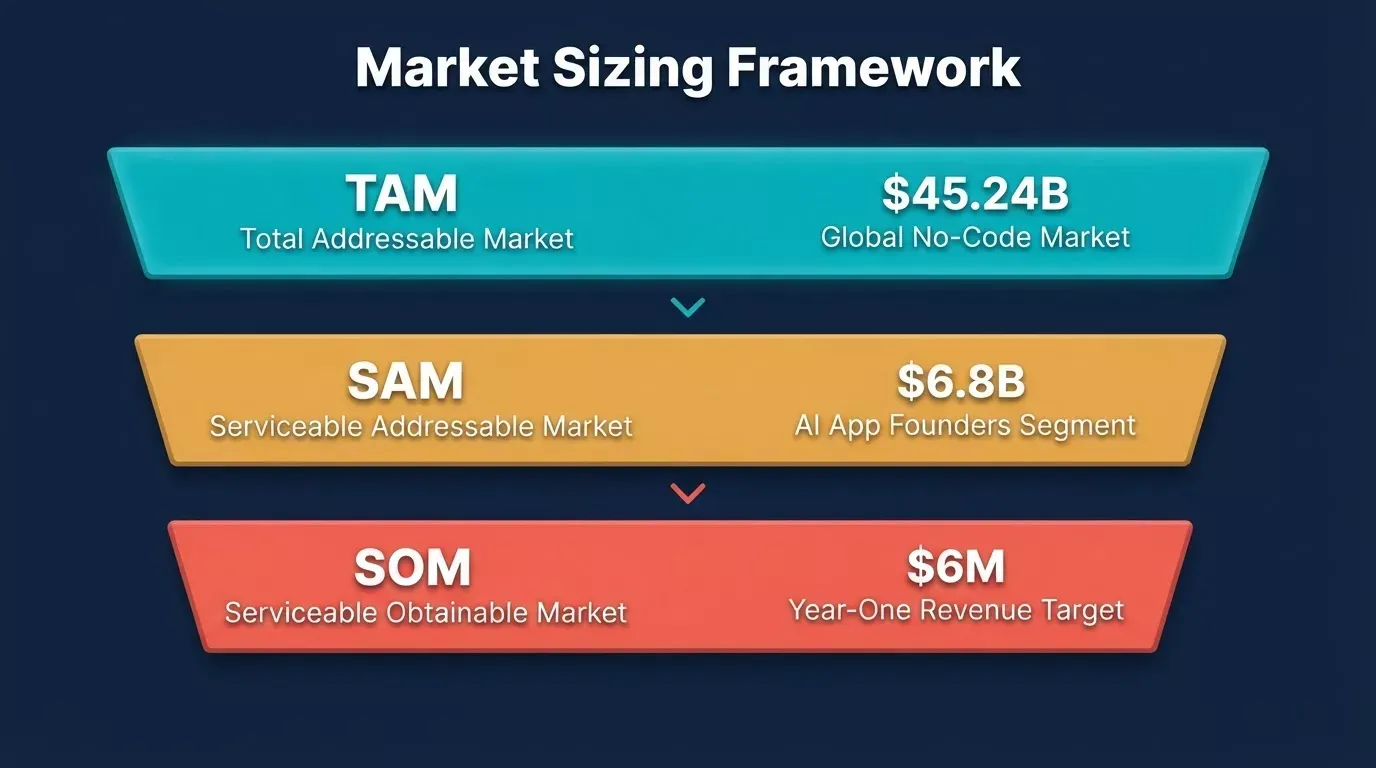
The TAM SAM SOM funnel: from total market ceiling to your realistic year-one revenue target.
Each layer builds on the previous one. You cannot calculate SAM without TAM. You cannot calculate SOM without SAM. The three numbers tell three different stories: your ceiling, your focus, and your plan.
| Layer | Stands For | What It Measures | Primary Use |
|---|---|---|---|
| TAM | Total Addressable Market | Full revenue if you had 100% market share | Investor signaling |
| SAM | Serviceable Addressable Market | Portion of TAM your product can realistically serve | Product and sales strategy |
| SOM | Serviceable Obtainable Market | Slice of SAM you can capture near-term | Operations and forecasting |
What Is Total Addressable Market (TAM)?
TAM represents the complete revenue opportunity available in a given market, assuming no competition and no constraints. It is the theoretical maximum: if every possible potential customer bought your product, what would total revenue look like?
Total addressable market TAM is the number investors use to gauge whether an opportunity is worth pursuing. A small TAM signals limited upside. A large, well-defined TAM tells investors the market is worth their attention.
How to Calculate TAM
There are two main approaches to calculating TAM:
Top-down approach: Start with broad market data from industry reports or financial reports from publicly traded companies, then narrow down to your product category.
Formula: TAM = Total market size x Relevant percentage
Example: The global SaaS market is valued at $300 billion. If your product serves the project management subset (approximately 5%), your total addressable market is $15 billion.
Bottom-up approach: Start from the number of potential customers and multiply by the average revenue per customer.
Formula: TAM = Number of potential customers x Average annual revenue per customer
Example: There are 10 million small businesses in the US that need project management software. If each pays $120/year, TAM = $1.2 billion.
The bottom-up approach is generally more credible to investors because it shows you have done thorough market research, not just pulled a number from an industry report.
What is Serviceable Addressable Market (SAM)?
SAM narrows the total addressable market TAM down to the portion your business can actually serve. This is where geography, product capabilities, customer segments, and pricing come into play.
Serviceable addressable market is the portion of TAM that matches what you actually sell, in the markets you actually operate in, to the potential customers who can use your product. SAM is where your actual business strategy lives.
How to Calculate SAM
Take your TAM and apply filters relevant to your product and go-to-market strategy.
Formula: SAM = TAM x (Percentage of market you can realistically serve)
Continuing the example above:
- TAM: $1.2 billion (all US small businesses needing project management software)
- Your product only serves tech companies with 1-50 employees: roughly 2.5 million companies, not 10 million
- SAM = 2.5 million x $120/year = $300 million
It is the portion of the market you are designing your product, marketing strategies, and sales efforts around. Running a proper competitive intelligence analysis at this stage helps you understand which gaps competitors leave open in your SAM.
What is the Serviceable Obtainable Market (SOM)?
SOM, or the serviceable obtainable market, is the slice of SAM you can realistically capture given your current resources, production capacity, distribution channels, competition, and marketing and sales efforts.
This is the number investors scrutinize most carefully during early-stage funding. It reflects your actual plan, not a dream.
How to Calculate SOM
New startups typically realistically capture 1-5% of SAM in years one through three. Established players can realistically capture 5-15%.
Formula: SOM = SAM x Your realistic market share percentage
Continuing the example:
- SAM: $300 million
- You are a new startup, targeting 2% in year one
- SOM = $300 million x 2% = $6 million
That $6 million SOM becomes your year-one revenue target. It is grounded, specific, and defensible in a pitch deck.
A Real TAM SAM SOM Example: AI App Builder for Founders
Let's walk through a concrete TAM SAM SOM example using a real market: AI-powered no-code app builders.
The no-code development platforms market was valued at $35.61 billion in 2025 and is forecast to reach $45.24 billion in 2026, growing at a 27.1% CAGR.
Here is how a startup in this space would calculate their TAM, SAM, and SOM example:
Step 1: Define the TAM
The global no-code development platforms market = $45.24 billion (2026 estimate). This is the total addressable market: every business worldwide buying no-code tools.
Step 2: Narrow to SAM
The startup targets English-speaking startup founders and small agencies who specifically need AI-assisted app generation. That is roughly 15% of the broader no-code market.
SAM = $45.24B x 15% = $6.8 billion
Step 3: Define SOM
The startup has a team of 12, operates in North America initially, and plans to serve 5,000 customers in year one at an average of $1,200/year.
SOM = 5,000 x $1,200 = $6 million
This is a clean, credible bottom-up calculation. It shows investors you have thought about your target market, your realistic market share, and your go-to-market strategy, not just pulled a large number from a report.
How the Calculation Flows: From TAM to SOM
Six steps from problem definition to a validated, investor-ready market plan.
How Founders Get TAM, SAM, and SOM Wrong
The most common mistake? Treating TAM as a strategy.
Alejandro Cremades, a serial entrepreneur and investor with a following of hundreds of thousands of founders, put it plainly in a post that sparked a lot of discussion:
"Most founders get this slide wrong. Investors see hundreds of decks where the market size looks like this: 'Total market: $50B+.' One big number. No logic. No credibility. And that's usually where the investor mentally checks out." — Alejandro Cremades, LinkedIn
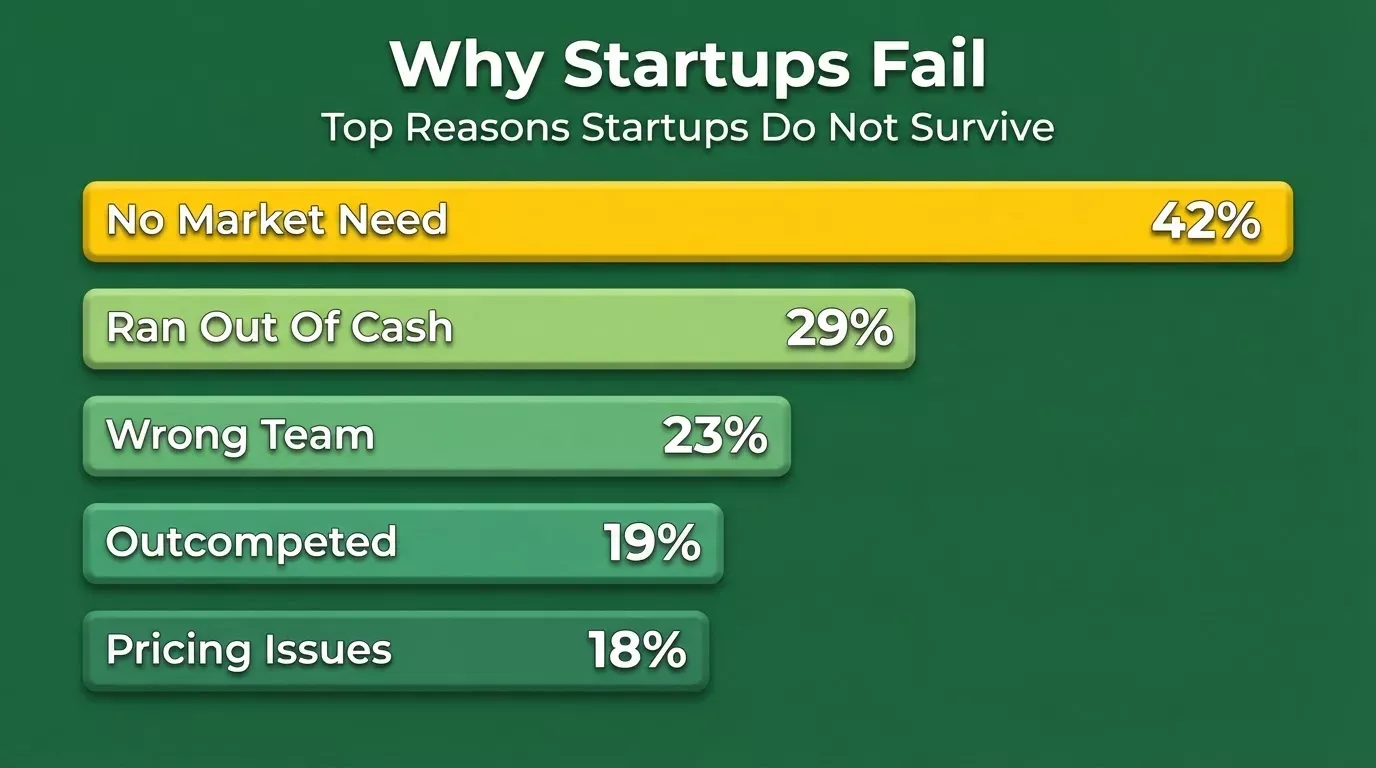
42% of startups fail because they skip the market homework, not because of bad code or a weak team.
Confusing TAM for Your Target Market
TAM is the ceiling, not the plan. Stating "we're going after the $500B global software market" tells investors nothing about who you will actually serve first. Your pitch needs SOM, not just TAM.
Relying Only on Top-Down Market Data
Pulling numbers from industry reports without also building a bottom-up calculation feels like guesswork. Using both approaches together gives you the most accurate, defensible market data.
Skipping SOM Entirely
Many founders present TAM and SAM but skip SOM, the one number that actually says "here is what we will realistically capture." That is the number investors use to stress-test your plan.
No Connection to Your Go-To-Market Strategy
SOM without a go-to-market strategy is just a percentage. Investors want to see the logic: how many potential customers, at what price, through which sales strategies, and why right now.
Using Outdated Market Research
Market conditions shift fast. Using industry data from 2021 in a 2026 pitch does not reflect current market dynamics, especially in fast-moving tech sectors.
Why TAM SAM SOM Matters for Business Strategy
TAM SAM SOM is not just a pitch deck exercise. It is one of the most practical tools in a founder's planning toolkit.
Allocate resources: Knowing your SOM helps determine how many people you need, how much budget to put toward marketing efforts, and where to focus sales efforts in the first 12-18 months.
Attract investors: A well-constructed TAM, SAM, and SOM shows you understand market trends, competitive factors, and where you fit. It builds investor confidence faster than any list of product features.
Set realistic revenue targets: SOM gives you a grounded number to plan around, instead of reverse-engineering from a wish. SOM is typically 1-5% of SAM for early-stage startups in years one through three.
Develop targeted marketing: SAM tells you exactly who your target market segment is. That informs your messaging, pricing, and distribution channels.
Compare market opportunity across segments: Running separate calculations for different geographies or customer segments helps you see which new markets are worth pursuing first.
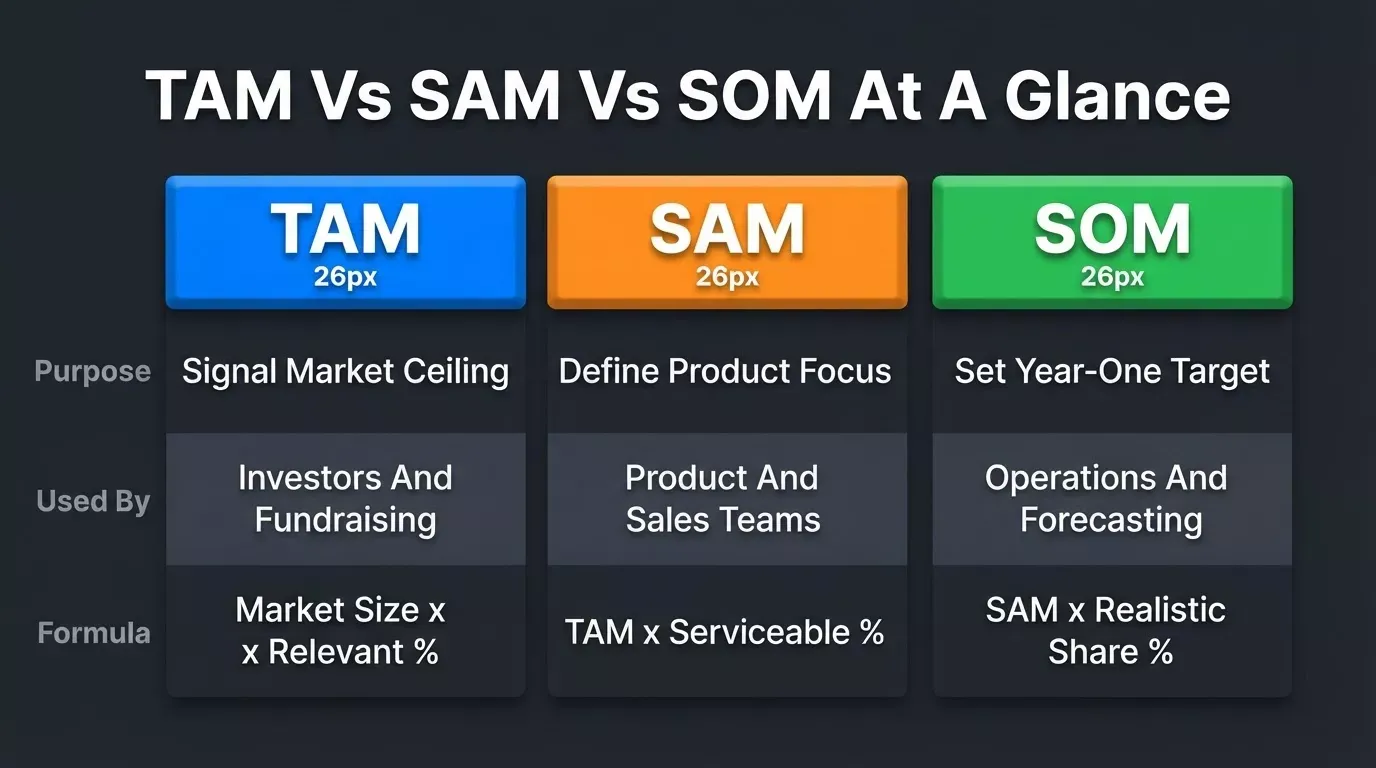
A quick-reference breakdown of each layer's purpose, primary user, and formula.
| Layer | Primary Purpose | Who Uses It Most | Key Formula |
|---|---|---|---|
| TAM | Signal market size to investors | Fundraising, investor decks | Market size x relevant % |
| SAM | Define product-market fit scope | Product and sales strategy | TAM x serviceable % |
| SOM | Set realistic year-one targets | Operations, forecasting, hiring | SAM x realistic share % |
TAM SAM SOM and the 2026 Founder Validation Stack
Market sizing does not happen in a vacuum. In 2026, the founders who get this right pair their TAM, SAM, and SOM with real market research: competitive analysis, customer surveys, and thorough research on pricing and demand.
The validation stack looks like this:
- Idea: What problem are you solving?
- Market research: Who has this problem, how many of them are there, and what do they currently pay?
- TAM SAM SOM calculation: how big is the opportunity, really?
- MVP / prototype: does your solution actually solve it?
- Customer feedback: Do potential customers want to pay for it?
- Go-to-market strategy: how do you reach your SOM in year one?
Most founders skip steps 2 and 3, then wonder why the product does not grow. TAM SAM SOM is the validation layer that saves you from building the wrong thing for the wrong market. You can use a TAM SAM SOM calculator to speed up the number-crunching once you have your market defined.
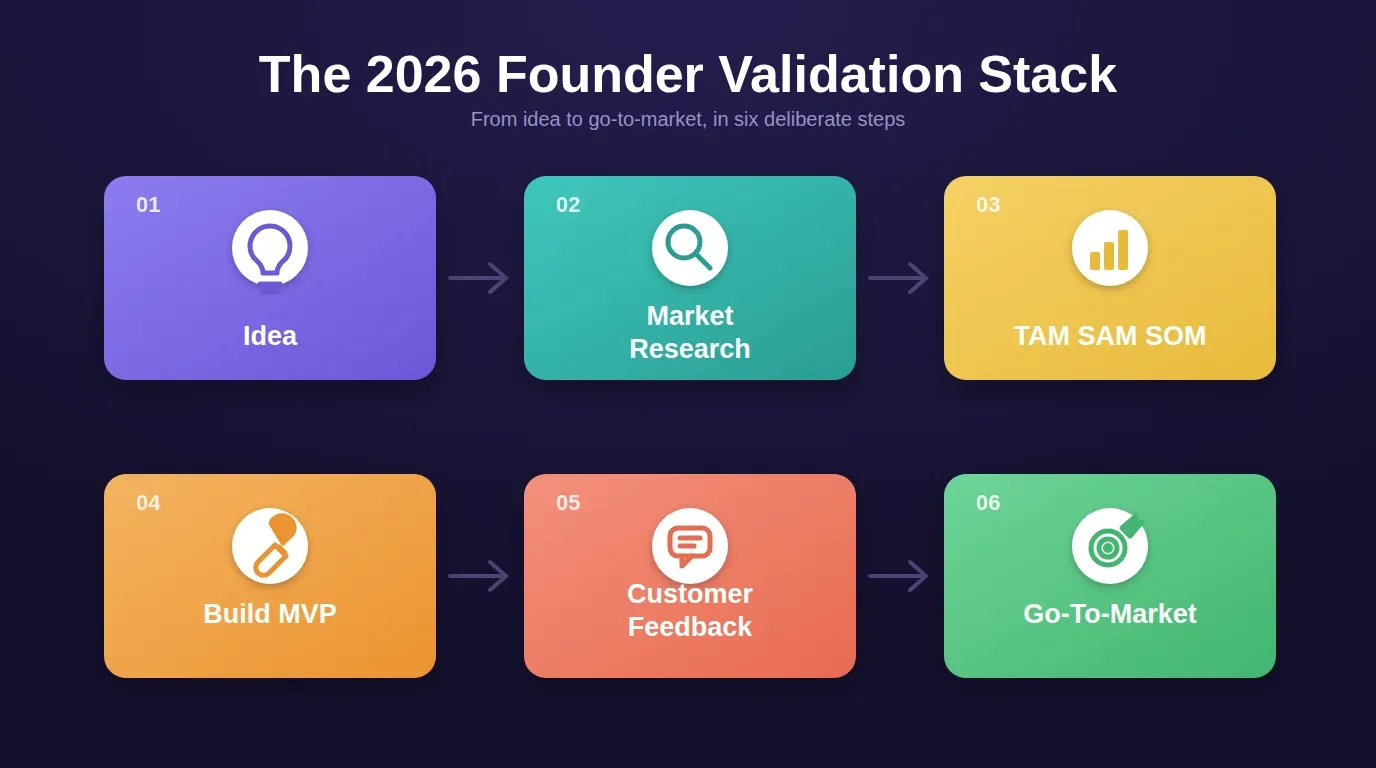
The complete 2026 validation stack: every step before you build is as important as the build itself.
Rocket.new: Where Market Research Meets Building
Here is where it gets interesting for 2026 founders.
Doing a real TAM SAM SOM analysis requires gathering market research data, running competitive intelligence, synthesizing financial reports and industry reports, and then building something quickly to test your assumptions. Historically, that meant hiring consultants, spending weeks on research, then handing off to a dev team.
Rocket.new changes that equation.
Rocket is the world's first Vibe Solutioning platform: a single workspace where founders research what to build, build it, and monitor what matters. The platform covers the full arc from strategic intelligence to execution inside one place, with a shared context architecture so the thinking before the build and the build itself happen together, nothing re-explained, everything compounding.
Most AI builders on the market, including Lovable, Bolt, and v0, start at execution. You arrive with an idea and get a product back. There is no thinking layer: no market research, no competitive intelligence, no validation. As Rocket puts it: "They build what you tell them to build. Rocket figures out what's worth building, then builds it."
Solve: Market Research Built-In
Rocket's Solve module takes any business question and delivers a complete, structured, evidence-backed answer. Run a TAM SAM SOM analysis, get competitive context, and understand market demand before writing a single line of code. The output is a structured analytical deliverable, not a chatbot answer, covering market sizing, competitive landscape, risk matrix, and execution path.
Intelligence: Competitive Analysis That Feeds Your SAM
Rocket's Intelligence pillar monitors every public platform a competitor operates on and interprets what signals mean for your business. Real-time competitive analysis feeds directly into your SAM calculation because the serviceable addressable market depends on what competitors already serve and which gaps remain open.
Build: From Validated Idea to Production App in Minutes
Once you have validated your market and defined your SOM, Rocket's Build generates production-grade web apps in Next.js and mobile apps in Flutter. Most apps generate in 1-3 minutes from a plain-language description. That speed means you can build, test with actual potential customers, and iterate before your SOM assumptions go stale.
All three pillars run on Rocket's shared context architecture: the market research from Solve carries directly into Build, the competitive signals from Intelligence inform product decisions, and nothing needs to be re-explained. The entire validation stack becomes one continuous flow inside a single workspace. For a deeper look at how this works in practice, see how Rocket takes you from market validation to a deployed product.
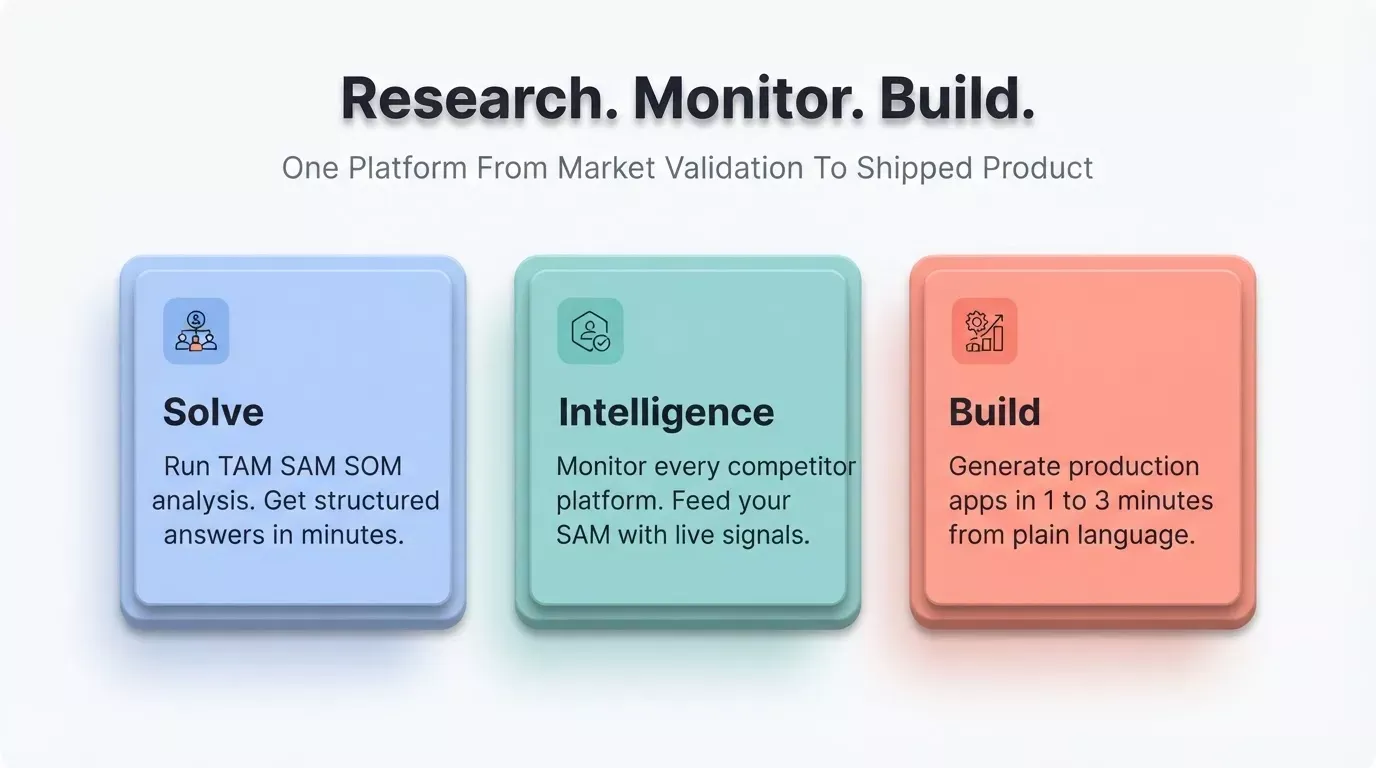
Solve researches your market, Intelligence tracks competitors, Build ships your product, all in one workspace.
| Stage | Traditional Approach | With Rocket |
|---|---|---|
| Market research | Hire analysts, wait weeks | Run in Solve in minutes |
| Competitive intelligence | Manual scanning | Automated Intelligence monitoring |
| Prototype / MVP | Hire developers, wait months | Generate in Build in 1-3 minutes |
| Iteration | Expensive, slow | Chat, Visual Edit, or Code, no limit |
| Launch | Deployment setup required | One-click launch with custom domain |
With 1.5 million users across 180 countries and backing from Salesforce Ventures and Accel, Rocket is purpose-built for the kind of founder who wants to validate first and build second. Explore what you can build with Rocket's AI app builder to see the full range of products founders are shipping.
TAM SAM SOM: Your Market, Your Plan, Your Proof
TAM SAM SOM example calculations are only as useful as the market research they are built on. The framework is not about impressing investors with large numbers. It is about forcing yourself to think clearly about who your potential customers are, how many of them exist, and what portion you can realistically capture with your current resources and go-to-market strategy.
Skipping this work costs founders months and money. 42% of startups fail because they build products nobody actually wants or needs, not because of bad code or a weak team, but because they skipped the homework on their actual market. TAM SAM SOM is one of the most straightforward tools that push back against that pattern.
In 2026, the best founders use it as a living document, updated as market conditions shift, as fresh market research data comes in, and as the business grows from its first serviceable obtainable market SOM into the next segment.
Ready to validate your market and build your product in the same workspace? Start building on Rocket.new: research your TAM, SAM, and SOM with Solve, track competitors with Intelligence, and generate your MVP in minutes with Build.
Table of contents
- -What Is TAM, SAM, SOM, and Why Does It Matter?
- -What Is Total Addressable Market (TAM)?
- -How to Calculate TAM
- -What is Serviceable Addressable Market (SAM)?
- -How to Calculate SAM
- -What is the Serviceable Obtainable Market (SOM)?
- -How to Calculate SOM
- -A Real TAM SAM SOM Example: AI App Builder for Founders
- -How the Calculation Flows: From TAM to SOM
- -How Founders Get TAM, SAM, and SOM Wrong
- -Confusing TAM for Your Target Market
- -Relying Only on Top-Down Market Data
- -Skipping SOM Entirely
- -No Connection to Your Go-To-Market Strategy
- -Using Outdated Market Research
- -Why TAM SAM SOM Matters for Business Strategy
- -TAM SAM SOM and the 2026 Founder Validation Stack
- -Rocket.new: Where Market Research Meets Building
- -Solve: Market Research Built-In
- -Intelligence: Competitive Analysis That Feeds Your SAM
- -Build: From Validated Idea to Production App in Minutes
- -TAM SAM SOM: Your Market, Your Plan, Your Proof