
AI app builders let anyone generate production-ready Next.js and Flutter apps from plain language in minutes. Platforms like Rocket combine research, building, and competitive monitoring in one place, making app development faster for all skill levels.
The fastest way to build apps with AI is now within reach for solo builders, startup teams, and non-technical creators. AI-powered vibe solutioning platforms generate production-ready Next.js web apps and Flutter mobile apps from plain-language descriptions, with no coding required, turning ideas into working products in minutes, not months.
What Is a Vibe Solutioning Platform?
Rocket is the world's first vibe solutioning platform, where teams research what to build, build it, and monitor what matters, all in one place. Unlike standalone AI app builders that start at execution and stop there, Rocket combines three connected pillars:
- Solve: decision intelligence that answers any business question with a structured, evidence-backed report before a single line of code is written
- Build: production-grade generation of Next.js web apps, Flutter mobile apps, landing pages, internal tools, and more from natural language descriptions
- Intelligence: continuous competitive monitoring across every public platform a competitor operates on, so teams always know what is changing in their market
All three pillars share a single context architecture. The Solve research that validated the direction becomes the foundation of the Build. The Intelligence signal from last week informs this week's product decision. Nothing is re-explained. Everything compounds.
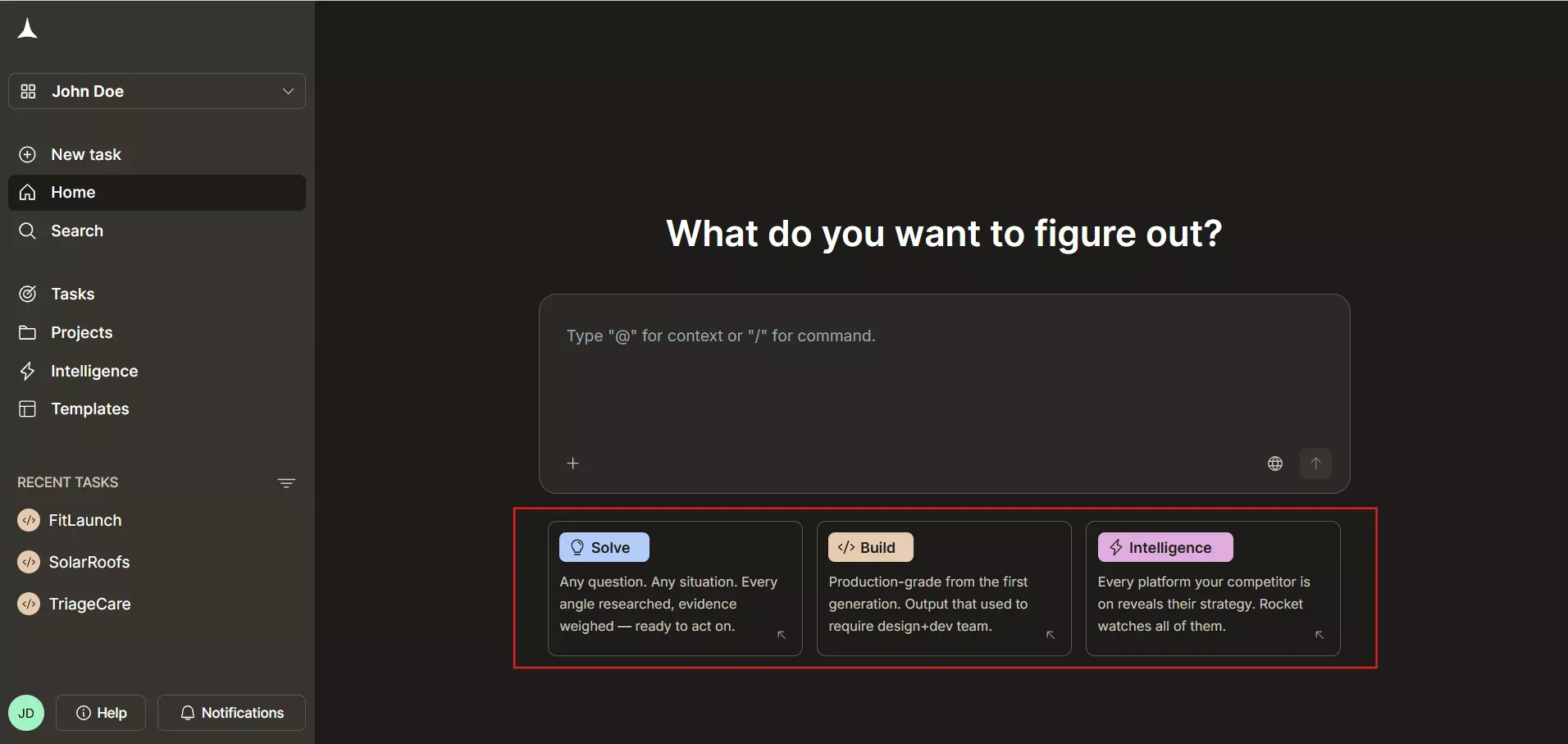
Rocket combines Solve, Build, and Intelligence into one connected platform, with no context lost between steps.
Who Is This For?
- Solo founders and indie builders: go from idea to deployed product without a development team
- Startup teams: validate, build, and iterate faster than hiring allows
- Internal tools teams: ship dashboards, portals, and admin panels without engineering backlogs
- Non-technical creators: describe what you need in plain language and get a working app back
The Changing Nature of App Building
When someone suggests an idea, the whole process starts moving. One person mentions a client portal. Another asks for a tool to track form submission data. A simple spark, then suddenly the conversation becomes a plan. With AI app builders in the mix, that early moment turns into progress far sooner.
Instead of sketching everything manually, users now guide layouts, backend logic, and data models through natural language prompts. The shift feels almost casual. A sentence becomes structured. A question becomes logic. This rhythm supports both complex apps and simple internal tools because it mirrors how people think.
Why AI App Builders Are Becoming Standard
The need for shorter cycles keeps growing. People want working versions sooner. Teams want to review changes earlier.
With AI app builders, much of that early heavy lifting disappears. These platforms respond to natural language, which allows users to shape user interface layouts or backend logic as if they were having a conversation with a teammate.
And with that shift, attention moves from technical setup to thinking through what users genuinely need. Instead of writing code for every part of the system, teams can focus on what the app should actually do. That balance helps both seasoned engineers and non-technical users move in sync.
This is why so many teams rely on no-code AI app builder tools for internal tools, web apps, and even more complex apps that used to require longer timelines.
AI Is Reshaping How Apps Get Built
The shift to AI-assisted development is backed by real numbers. Generative AI tools can increase developer productivity by up to 45%, and the majority of professional developers now use AI coding tools in their daily workflows. Most apps on modern AI builders generate in one to three minutes, a timeline that was unimaginable just a few years ago.
1.5 million people have tried Rocket across 180 countries, from solopreneurs validating their first idea to enterprise teams running strategy and execution on the same platform.
A Quick Look at the App Building Process Today
Even with AI, a familiar structure helps keep everything flowing. The process below mirrors how most modern app builders guide users from idea to working result. As the early shape appears, the rest becomes easier. AI quietly carries the repetitive setup so teams can stay focused on intent.
AI App Builder vs Traditional Development
| Dimension | Traditional Development | AI App Builder |
|---|---|---|
| Time to first working app | Weeks to months | Minutes to hours |
| Team size required | Large dev team | Solo or small team |
| Backend setup | Manual configuration | Auto-generated with Supabase |
| Framework decisions | Developer chooses | Next.js or Flutter auto-assigned |
| Starting cost | High upfront investment | Free to start |
| Iteration speed | Slow release cycles | Iterate through the conversation |
| Pre-build research | Separate tools required | Built into the platform via Solve |
| Competitive monitoring | Manual tracking | Continuous and automated via Intelligence |
How Natural Language Shapes AI App Building
Natural language is shaping the present, not just the future. People phrase thoughts casually, and the system translates those phrases into screens, logic, or connections. This makes the process feel accessible without lowering the ceiling for advanced teams.
Platforms that support vibe coding workflows are gaining traction precisely because they remove the translation layer between intent and output. Developers and non-developers alike benefit from this shift.
Where AI App Builders Fit in Real Teams
Across the board, teams use AI app builders in different ways. Small teams rely on them for working on app drafts. Larger groups use them to experiment or support internal tools. And many hybrid workflows combine AI guidance with manual coding for complex parts.
The presence of an AI agent within these tools helps automate logic, manage repetitive tasks, and respond to natural language prompts with clear adjustments. This gives teams freedom to rethink how they build apps without replacing deeper engineering work. Teams exploring full-stack AI app building find this hybrid model especially effective.
AI App Builder Integration Model
The flow from a plain-language prompt to a deployed, integrated app follows a clear loop:
From a plain-language prompt to a deployed, integrated app, the core loop of AI-powered app building.
Six Ways to Start Building
The fastest way to build apps with AI is not limited to typing a prompt. Rocket supports six starting points, so you always begin from where you already are:
- Plain language description: describe what you want, and Rocket generates it immediately
- Screenshot or wireframe upload: upload a PNG or JPG, and Rocket builds from the visual
- Figma import: import a completed Figma design and Rocket converts it to production code, preserving typography, spacing, and color system
- GitHub repository: connect an existing Next.js TypeScript codebase, and Rocket picks up exactly where it left off
- Pre-built template: start from a template (zero credits consumed) and customize from there
- URL redesign: provide any live website URL, and Rocket reimagines it using eight slash commands
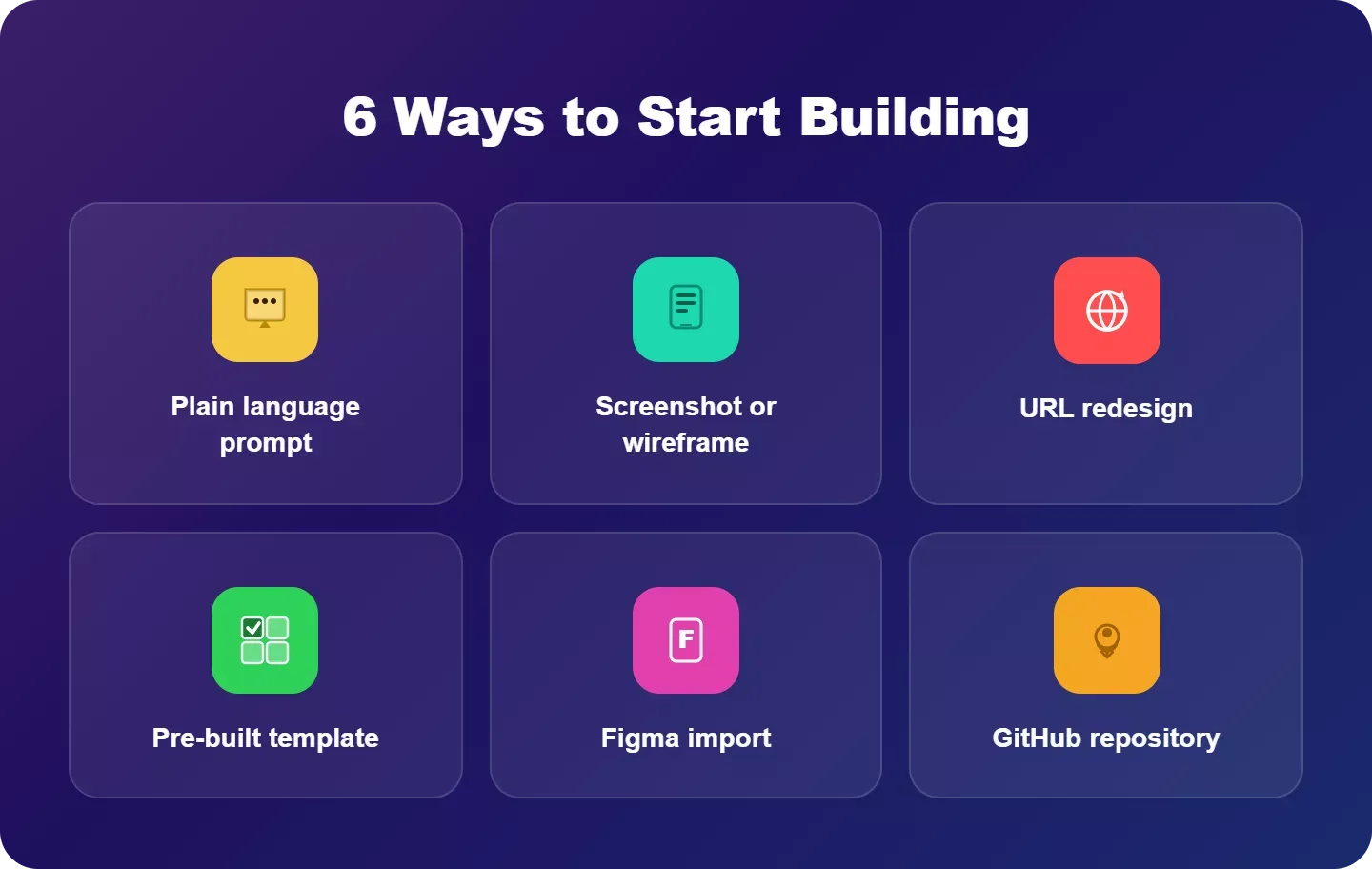
Every starting point is a valid entry into the build, with no single path required.
Real Gains for Working App Delivery
Teams build apps faster when the early scaffolding comes together automatically. Most apps take one to three minutes to generate. This changes the way teams brainstorm because ideas do not just stay theoretical; they turn into apps quickly enough to evaluate.
Developers can generate production-ready Next.js TypeScript components with Supabase auth and Tailwind CSS styling, adjust logic, or fine-tune flows without repeating setup tasks. When AI-powered features highlight issues or produce improved versions, teams feel the benefit immediately.
This makes app building less about starting from zero and more about refining something real. AI-assisted development is now mainstream, with the majority of professional developers using AI coding tools in their daily workflows.
Rocket: The Fastest Way to Build Apps With AI
Rocket is a vibe solutioning platform that offers a conversational approach to app development. It generates production-ready Next.js web apps and Flutter mobile apps from user descriptions in everyday language, with SEO-ready structure, WCAG accessibility compliance, and GDPR coverage built in by default.
Many teams like how adaptable it feels. The platform listens closely, reacts quickly, and supports connections to Stripe, Supabase, Google Analytics, Notion, Linear, Airtable, Mailchimp, Mixpanel, Typeform, Calendly, and 25+ other integrations, all authenticating once and flowing into every build.
Rocket also makes it straightforward to build internal tools without a developer, making it a strong choice for operations and product teams that need quick turnarounds.
Rocket Build Features
| Feature | What It Does |
|---|---|
| Next.js web apps | Production-grade, SEO-ready, WCAG-compliant from first generation |
| Flutter mobile apps | iOS and Android from a single codebase, dark and light theming included |
| AI-powered iteration | Adjust layout, logic, or data model through conversation |
| 25+ integrations | Stripe, Supabase, Notion, Linear, Mixpanel, Typeform, Calendly and more |
| Version history and rollback | Full version history with one-click rollback |
| Built-in analytics | Visitors, conversions, and Core Web Vitals tracked from day one |
| Plan transparency | Free plan includes generation and live preview. Source code download and private apps require a paid plan. |
The Role of Generative AI in App Production
Generative AI now supports nearly every step. It writes production-ready Next.js TypeScript components, drafts Flutter mobile layouts, creates initial data models, and configures integrations automatically. Many teams rely on these capabilities to keep momentum across projects.
Natural language prompts keep the process smooth. When something needs adjustment, users phrase it, and the system reacts. This keeps teams moving forward, even when the app becomes more complex. Teams looking to build a full-stack app from a single prompt find this approach dramatically reduces the gap between idea and shipped product.
When to Use AI App Builders vs. Manual Coding
Some apps require deep customization. Others need to be built quickly. AI app builders support both paths. Many teams prefer a blend: AI lays the foundation with production-ready Next.js or Flutter code, and developers apply their expertise where logic needs greater precision.
This hybrid approach tends to feel balanced. It keeps speed without ignoring the importance of high-quality engineering. Understanding how AI generates code from natural language helps teams decide exactly where to hand off to manual work.
Getting From Idea to Functional App Faster
Everything begins with an idea. With AI app builders, converting that idea into a functional app no longer feels like a long journey. The structure forms quickly, and teams can iterate using natural language rather than building everything manually.
This makes app building approachable for mixed teams with different levels of coding knowledge. Everyone can contribute, because everyone can phrase ideas naturally. AI tool adoption continues to climb year over year, confirming that the shift to AI-first development is not a trend but a structural change in how software gets built.
Start Building Today
Ready to stop waiting and start building? Rocket is the fastest way to turn a plain-language description into a production-ready Next.js or Flutter app, with Solve for pre-build research and Intelligence for ongoing competitive monitoring, all in one platform.
Start building for free on Rocket.new and go from idea to working app today.
Table of contents
- -What Is a Vibe Solutioning Platform?
- -Who Is This For?
- -The Changing Nature of App Building
- -Why AI App Builders Are Becoming Standard
- -AI Is Reshaping How Apps Get Built
- -A Quick Look at the App Building Process Today
- -AI App Builder vs Traditional Development
- -How Natural Language Shapes AI App Building
- -Where AI App Builders Fit in Real Teams
- -AI App Builder Integration Model
- -Six Ways to Start Building
- -Real Gains for Working App Delivery
- -Rocket: The Fastest Way to Build Apps With AI
- -Rocket Build Features
- -The Role of Generative AI in App Production
- -When to Use AI App Builders vs. Manual Coding
- -Getting From Idea to Functional App Faster
- -Start Building Today