Curious how the future of vibe programming is changing software development? This blog shows that a shift is happening across software teams, enabling developers to generate functional code from plain language in minutes. It highlights how developers can focus on designing experiences rather than wrestling with syntax.
Software development is changing faster than ever.
Tasks that once took weeks of careful planning and manual coding can now be described in plain language and generated in minutes.
This shift is not just for beginners. It is reshaping how senior engineers and system architects approach their work.
Can developers focus more on designing experiences and less on typing syntax?
The future of vibe programming is pointing exactly in that direction. Instead of wrestling with boilerplate and syntax, developers are orchestrating AI-driven systems.
In this blog, we will look at how this approach is reshaping workflows and what it means for modern software teams.
What is Vibe Programming Really About?
Traditional software development has always centered on manually writing logic, structuring modules, debugging, and refining every piece.
But in vibe coding, the workflow flips.
You do not generate code line by line; you describe outcomes in natural language and let AI tools generate working prototypes.
Think of it as guiding an intelligent composer. You say, “I need a responsive dashboard with dynamic charts that update in real time.” The AI writes the scaffolding, builds routes, injects data logic, and you test and refine.
It is still software engineering, but it is driven by AI-assisted coding rather than constant manual labor. The vibe code concept shifts your job from typing syntax to directing an orchestra of AI agents that generate code and iterate rapidly.
The primary goal of vibe coding is not to eliminate developers. It is to make the developer’s thought process the interface.
Why It Matters for Digital Experience Design?
Experienced developers and architects pay attention to vibe programming because it changes how digital experiences are created.
Vibe code changes where attention is spent. It takes away mechanical repetition and gives time back to refine the feel, flow, and intent of digital products.
- Speed: You can generate code for complex UI and backend logic within minutes. That is rapid prototyping that used to take days.
- Creative focus: Instead of manually writing code, your effort shifts to architecture, security, and overall design logic.
- Iteration: Generated drafts evolve faster, letting you test new features and UX flows early.
- Democratization: Non-coders and designers can participate earlier in app development through natural language prompts.
When software engineers focus on orchestration rather than syntax, app development becomes more about the human experience than the logic flow.
Inside the Vibe Programming Workflow
Vibe coding involves several moving parts, each designed to translate thought into executable software.
Step 1: Prompting with Precision
In vibe programming, the coding approach revolves around natural language prompts. You type, “Build a chat app with message encryption and real-time updates,” into a text box. The AI tool parses your intent, understands additional context, and begins to generate code.
Your job is to provide the right context, constraints, and structure. The system acts like a pair programmer, taking cues and returning a working skeleton.
Step 2: Generation Loop
Once you hit press enter, vibe code comes alive. Within seconds, it builds boilerplate, configurations, endpoints, and UI components. You run and test. When error messages appear, you tweak your prompt and press Enter again.
This loop generates, tests, and refines the pulse of vibe coding.
Step 3: Manual and AI Collaboration
Even with AI, you still do manual coding. You handle critical logic, security vulnerabilities, data optimization, and fine-tuned UX. Software engineers supervise generated code and inject expertise where AI lacks context.
Step 4: Governance Layer
Without governance, random changes or hallucinated patterns from AI tools can cause instability. Teams implement code quality checks, static analysis, and code completion reviews to maintain production readiness.
Here is a visualization of the workflow:
This diagram highlights that the cycle never really ends. Generated code evolves just like existing code. As code grows, so does understanding, testing, and refinement.
The Technical Shift for Teams
For large teams doing software engineering, vibe coding is not just about generating faster it is about redefining collaboration.
- Architectural depth: Teams can experiment with entire applications and swap modules before hard commits.
- Pair intelligence: AI becomes your pair programmer, predicting needs and anticipating missing logic.
- Continuous learning: Each prompt adds additional context to the system, refining its understanding of your stack.
- Human oversight: Engineers review generated code and validate that the code works under real world conditions.
These practices bring AI-assisted collaboration into every sprint cycle. Building software now feels like conducting software.
Here is another diagram illustrating the team flow:
This loop enables faster feedback, lower friction, and dynamic real-world applications where generated code becomes smarter over time.
Real World Use Cases of Vibe Coding
Vibe programming is no longer theoretical. Teams are already applying it in production workflows and throwaway weekend projects.
- Internal tooling: Enterprises use Vibe Code to generate code for admin dashboards and automation systems.
- MVP builds: Founders convert a business idea into a working prototype using natural language prompts.
- Rapid iteration: Teams build software faster, test UX variants, and push updates instantly.
- Maintenance: AI identifies outdated modules in existing code and suggests replacements automatically.
- Code comprehension: Teams run stuff directly from prompts without browsing docs or copy paste stuff.
It is not just about replacing typing. It is about enabling the fastest path from intent to reality without losing craftsmanship.
Practical Example with Rocket.new
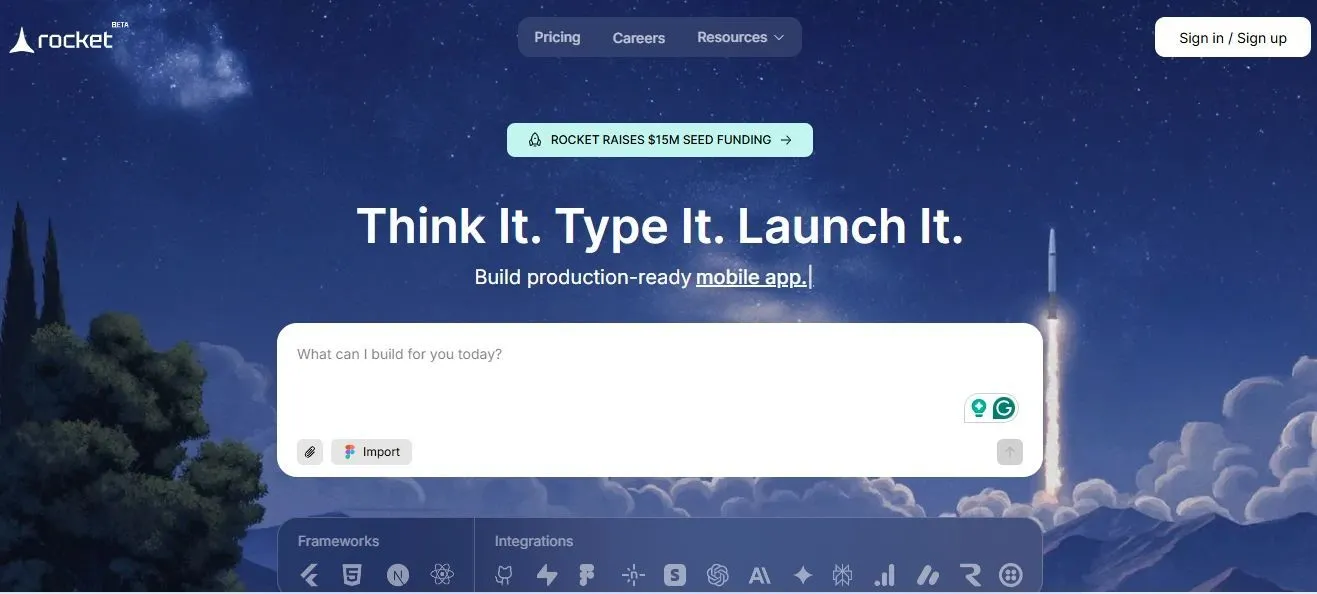
Rocket.new apply this concept to real app development. You can build software, create a new app, add features, and deploy it instantly using prompts.
Here is how it works step by step:
- Define your vision: Describe your app in a text box using natural language prompts.
- Generate the base: The AI tool starts generating code for the front end, back end, and logic.
- Refine experience: Adjust visuals, logic, or prompts until the code works exactly as intended.
- Test integrations: Connect databases or APIs, simulate real world applications.
- Deploy instantly: Use one click deployment to take your app directly to users.
- Iterate: Review generated code, add features, fix error messages, repeat the loop.
Rocket.new lets developers build software with both vibe coding and control. You can create a working prototype faster than traditional workflows allow.
Build any app with simple prompts no copy paste, no diffs anymore. Use prompts to create your entire app and deploy in minutes. Shape your next digital experience with vibe code.
Best Practices for Experienced Developers
When experts adopt vibe coding, mastery comes from controlling its unpredictability.
- Version your prompts: Treat prompts like code they define architecture and logic.
- Review generated code: Always check for performance flaws or security vulnerabilities.
- Mix approaches: Balance manual coding and AI assisted coding for high code quality.
- Test rigorously: Generated code can work fine while still hiding bugs. Verify every new feature.
- Use metrics: Measure how vibe code scales before pushing to production.
The secret is to keep humans in charge while letting AI tools do the heavy lifting.
Traditional vs Vibe Programming
| Factor | Traditional Development | Vibe Programming |
|---|---|---|
| Workflow Control | High manual control | AI guided via natural language prompts |
| Speed | Slower | Much faster code generation |
| Maintenance | Predictable | Dependent on prompt quality |
| Scalability | Manual scaling | AI agents adapt quickly |
| Quality Checks | Human driven | Human AI collaborative |
| Cost | High labor | Lower prototyping cost |
Community Insights
One of the most insightful discussions of vibe programming comes from a LinkedIn article, which explores Andrej Karpathy’s perspective on AI-assisted development.
“AI assisted development is not about replacing developers, but about letting them focus on intent and architecture while AI handles repetitive tasks. Vibe coding represents a new workflow where natural language prompts drive the creation of functional software.” — Read more on LinkedIn
Looking Ahead
The future of vibe programming will change how we build software. Software engineers will evolve into creative directors who guide AI-assisted ecosystems. The new wave of AI tools will merge programming languages with natural language.
We will still value clarity, logic, and architectural discipline, but the process will feel different. Professional developers will start by describing systems, testing generated code, refining prompts, and maintaining code quality through cycles.
The developer of the future will not just build apps; they will create workflows where code exists only as an expression of thought. This is not about copy-paste stuff anymore. It is about expressing intention through conversation.
Table of contents
- -What is Vibe Programming Really About?
- -Why It Matters for Digital Experience Design?
- -Inside the Vibe Programming Workflow
- -Step 1: Prompting with Precision
- -Step 2: Generation Loop
- -Step 3: Manual and AI Collaboration
- -Step 4: Governance Layer
- -The Technical Shift for Teams
- -Real World Use Cases of Vibe Coding
- -Practical Example with Rocket.new
- -Best Practices for Experienced Developers
- -Traditional vs Vibe Programming
- -Community Insights
- -Looking Ahead